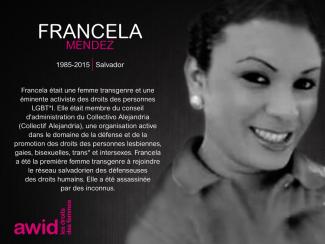
Francela Mendez
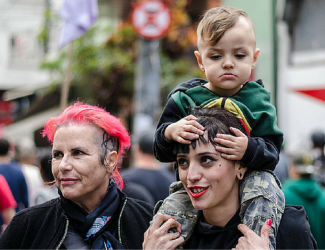
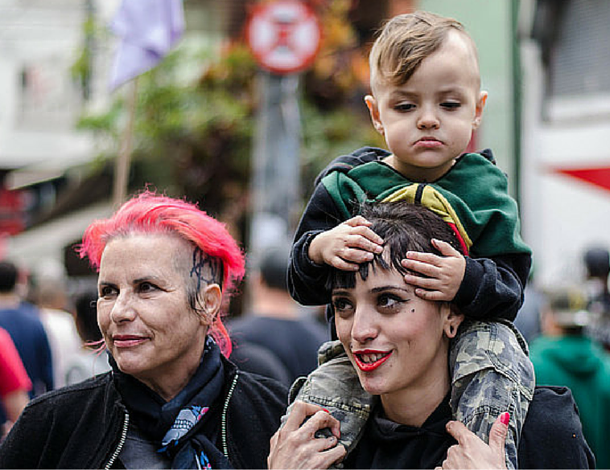
Over the past few years, a troubling new trend at the international human rights level is being observed, where discourses on ‘protecting the family’ are being employed to defend violations committed against family members, to bolster and justify impunity, and to restrict equal rights within and to family life.
The campaign to "Protect the Family" is driven by ultra-conservative efforts to impose "traditional" and patriarchal interpretations of the family, and to move rights out of the hands of family members and into the institution of ‘the family’.
Since 2014, a group of states have been operating as a bloc in human rights spaces under the name “Group of Friends of the Family”, and resolutions on “Protection of the Family” have been successfully passed every year since 2014.
This agenda has spread beyond the Human Rights Council. We have seen regressive language on “the family” being introduced at the Commission on the Status of Women, and attempts made to introduce it in negotiations on the Sustainable Development Goals.
AWID works with partners and allies to jointly resist “Protection of the Family” and other regressive agendas, and to uphold the universality of human rights.
In response to the increased influence of regressive actors in human rights spaces, AWID joined allies to form the Observatory on the Universality of Rights (OURs). OURs is a collaborative project that monitors, analyzes, and shares information on anti-rights initiatives like “Protection of the Family”.
Rights at Risk, the first OURs report, charts a map of the actors making up the global anti-rights lobby, identifies their key discourses and strategies, and the effect they are having on our human rights.
The report outlines “Protection of the Family” as an agenda that has fostered collaboration across a broad range of regressive actors at the UN. It describes it as: “a strategic framework that houses “multiple patriarchal and anti-rights positions, where the framework, in turn, aims to justify and institutionalize these positions.”
This project is built in collaboration with:


We would also like to thank the following people for their valuable contribution:
Listen to the story here:

We ramped up preparations for the 13th AWID international Forum, focused a lot of energy on the Post 2015 Development Agenda and Financing for Development processes, and continued the core work of our priority areas:
In response, we are moving out of our silos.
Increasingly, women’s rights and other movements worldwide are articulating the systemic and intersectional nature of these and other problems. We are making better connections with the agendas of other social and environmental movements for solidarity, alliance building and collective responses. We are also seeing greater visibility of these movements fighting for justice on the ground.

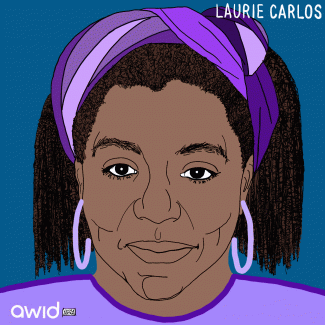
Laurie Carlos was an actor, director, dancer, playwright, and poet in the United States. An extraordinary artist and visionary with powerful ways of bringing the art out in others.
“Laurie walked in the room (any room/every room) with swirling clairvoyance, artistic genius, embodied rigor, fierce realness—and a determination to be free...and to free others. A Magic Maker. A Seer. A Shape Shifter. Laurie told me once that she went inside people’s bodies to find what they needed.” - Sharon Bridgforth
She combined performance styles such as rhythmic gestures and text. Laurie mentored new actors, performers, writers and helped amplify their work through Naked Stages, a fellowship for emerging artists. She was an artistic fellow at Penumbra Theater and supported with identifying scripts to produce, with a goal of “bringing more feminine voices into the theater”. Laurie was also a member of Urban Bush Women, a renowned contemporary dance company telling stories of women of the African diaspora.
In 1976, as Lady in Blue, she made her Broadway debut in Ntozake Shange’s original and award-winning production of the poetic drama For colored girls who have considered suicide / when the rainbow is enuf. Laurie’s own works include White Chocolate, The Cooking Show, and Organdy Falsetto.
“I tell the stories in the movement—the inside dances that occur spontaneously, as in life—the music and the text. If I write a line, it doesn’t necessarily have to be a line that is spoken; it can be a line that’s moved. A line from which music is created. The gesture becomes the sentence. So much of who we are as women, as people, has to do with how we gesture to one another all the time, and particularly through emotional moments. Gesture becomes a sentence or a state of fact. If I put on a script ‘four gestures,’ that doesn’t mean I’m not saying anything; that means I have opened it up for something to be said physically.” Laurie Carlos
Laurie was born and grew up in New York City, worked and lived in Twin Cities. She passed away on 29 December 2016, at the age of 67, after a battle with colon cancer.
“I believe that that was exactly Laurie’s intention. To save us. From mediocrity. From ego. From laziness. From half-realized art making. From being paralyzed by fear.
Laurie wanted to help us Shine fully.
In our artistry.
In our Lives.” - Sharon Bridgforth for Pillsbury House Theatre
“There’s no one that knew Laurie that wouldn’t call her a singular individual. She was her own person. She was her own person, her own artist; she put the world as she knew it on stage with real style and understanding, and she lived her art.” - Lou Bellamy, Founder of Penumbra Theater Company, for Star Tribune
Nous constatons une implication sans précédent des acteurs anti-droits dans les espaces internationaux consacrés aux droits humains. Pour être plus efficaces et plus audibles, les acteurs anti-droits œuvrent à la constitution d’alliances tactiques qui regroupent différents secteurs et confessions et franchissent les frontières régionales et nationales.
Cette « alliance impie » entre des acteurs traditionalistes issus de milieux catholiques, évangéliques, mormons, orthodoxes russes et musulmans s’est construite autour d’une cause commune qui se concrétise dans un certain nombre de thèmes de discussion et d’efforts communs de plaidoyer visant à réduire à néant les progrès obtenus par les féministes en matière de droits sexuels au niveau international.
Activités clés : en tant que gouvernement de l’Église catholique romaine, le « Saint-Siège » utilise son statut unique d’État observateur permanent auprès de l’ONU pour faire pression en faveur de visions conservatrices, patriarcales et hétéronormatives de la féminité, de l’identité de genre et de la « famille ». Il promeut des politiques anti-avortement et anti-contraception.
Basé à : la Cité du Vatican, Rome, Italie.
Affiliation religieuse : catholique.
Connexions avec d’autres acteurs anti-droits : groupes chrétiens américains ; alliances interreligieuses orthodoxes ; OSC catholiques.
Activités clés : l’OCI se définit comme la « voix collective du monde musulman » et agit comme un bloc d’États au sein des Nations Unies. Elle tente d’ouvrir des brèches dans le système de protection des droits humains en s’appuyant sur des références à la religion, à la culture ou à la souveraineté nationale. Elle promeut le concept de « famille traditionnelle » et contribue à la mise en place d’un régime parallèle de droits humains doté d’un caractère plus restrictif (voir par exemple la Déclaration du Caire de 1990 sur les droits humains dans l’Islam).
Basé à : Djeddah, Arabie Saoudite.
Affiliation religieuse : musulmane.
Connexions à d’autres acteurs anti-droits : missions des États ultraconservateurs auprès de l’ONU, par exemple la Russie.
Activités clés : conférences internationales et régionales ; production et diffusion de recherches et de connaissances ; lobbying auprès des Nations Unies pour « défendre la vie, la foi et la famille ».
Basé à : Rockford, Illinois, États-Unis.
Affiliation religieuse : prédominance catholique et chrétienne évangélique.
Connexions à d’autres acteurs anti-droits : le Sutherland Institute, un groupe de réflexion conservateur ; l’Église des Saints des Derniers Jours ; le département de la famille et de la vie de l’Église orthodoxe russe ; les prêtres catholiques anti-avortement et pro-vie ; la Fondation pour la culture et le patrimoine africains ; la Fédération polonaise des mouvements pro-vie ; la Fédération européenne des associations de familles catholiques ; le Comité des ONG de l’ONU sur la famille ; le Réseau politique pour les valeurs ; la Société démographique géorgienne ; des parlementaires polonais, moldaves, etc. ; FamilyPolicy ; l’Institut russe d’études stratégiques ; HatzeOir ; C-fam ; et d’autres encore.
Activités clés : lobbying auprès des Nations Unies, en particulier auprès la Commission de la condition de la femme, pour la « défense de la vie et de la famille » ; diffusion d’informations diverses (par ex. les bulletins faxés du vendredi) ; travail de construction du mouvement ; formations à l’intention des militants conservateurs.
Basé à : New York et Washington D.C., États-Unis.
Affiliation religieuse : catholique.
Connexions avec d’autres acteurs anti-droits : l’International Youth Coalition (Coalition internationale de la jeunesse) ; l’Alliance mondiale pour la jeunesse ; Human Life International ; le Saint-Siège ; coordination de la Civil Society for the Family ; le Family Research Council (États-Unis) et d’autres OSC anti-droits chrétiennes/catholiques ; délégation des États-Unis auprès de la CSW.
Activités clés : lobbying dans les espaces internationaux consacrés aux droits humains pour des politiques pro-famille, anti-LGBT*Q et anti-ESC (éducation sexuelle complète) ; formations à l’intention des acteurs de la société civile et des délégués d’États membres (par exemple « Le Guide des ressources sur la langue consensuelle des Nations Unies sur les questions familiales ») ; diffusion d’informations ; production de savoirs et d’analyses ; campagnes en ligne.
Basé à : Gilbert, Arizona, États-Unis.
Affiliation religieuse : Mormone.
Connexions avec d’autres acteurs anti-droits : en charge du Caucus sur les droits de la famille à l’ONU ; C-fam ; JONAH (Juifs offrant de nouvelles alternatives à l’homosexualité)[Béné1] ; NARTH, l’Association nationale pour la recherche et la thérapie de l’homosexualité (USA) ; le Congrès mondial des familles ; CitizenGo ; l’Institut Magdalen ; l’Associación La Familia Importa ; le Groupe des amis de la famille (bloc de 25 États).
Activités clés : plaidoyer pour « la famille » et contre les droits sexuels et reproductifs dans les espaces politiques internationaux, y compris les Nations Unies, l’Union européenne et l’Organisation des États américains ; formation des jeunes membres à l’art de la diplomatie et de la négociation, aux relations internationales, aux activités de terrain et au développement d’une communication efficace ; programme de stage pour encourager la participation des jeunes aux activités de l’alliance ; conférences régulière des leaders émergents ; production et diffusion de savoirs.
Basé à : New York (États-Unis) avec des bureaux régionaux à Nairobi (Kenya), Quezon (Philippines), Bruxelles (Belgique), Mexico (Mexique) et Beyrouth (Liban).
Affiliation religieuse : principalement catholique, mais vise l’affiliation interreligieuse.
Connexions avec d’autres acteurs anti-droits : C-Fam ; Human Life International ; le Saint-Siège ; la campagne Life Coalition.
Activités clés : l’Église orthodoxe russe, en capitalisant sur ses liens étroits avec l’État russe, fonctionne comme un « entrepreneur de normes » dans le cadre des débats sur les droits humains. La Russie et l’Église orthodoxe russe ont coopté le langage des droits humains pour souligner l’importance de la « moralité » et des « valeurs traditionnelles » définies comme des fondements prétendument essentiels des droits humains. La Russie a mené une série d’actions pour que le Conseil de l’Europe adopte des résolutions fondées sur les « valeurs traditionnelles » et a été en première ligne du travail visant à proposer des amendements hostiles aux résolutions progressistes dans des domaines tels que la mortalité maternelle, la protection du champ d’action de la société civile et le droit de manifester pacifiquement.

Filter for funders that support initiatives in your geographical area.
La pandemia de COVID-19 le mostró al mundo la importancia de lxs trabajadorxs esenciales. Estamos hablando de limpiadorxs, enfermerxs, paramédicxs, trabajadorxs del hogar, transportistxs, las personas que trabajan en los supermercados, entre muchísimas otras. Su trabajo es atender y garantizar el bienestar de lxs demás y hacer funcionar nuestras economías.
Pero mientras ellxs nos cuidan…
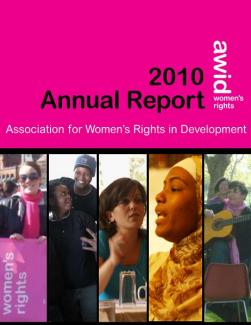
Our 2010 Annual Report highlights the major accomplishments of each of our strategic initiatives during the year.
Along with activity highlights, we include a brief analysis of the impact of our initiatives as well as reflections from our members and partners that further illustrate the relevance of AWID’s work and its connection to broader women’s rights movements.
This interactive document is complete with links to our websites and recent publications with in-depth information on the issues we address in the report.
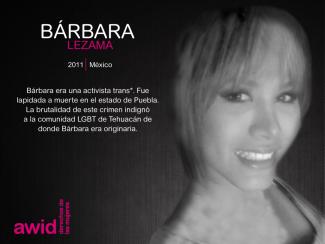
Fadila M. fue una activista tribal soulaliyate de Azrú, en la región Ifrane de Marruecos. Luchó contra una forma específica de discriminación territorial dirigida a las mujeres tribales.
Como parte del Movimiento de Mujeres Soulaliyate por el Derecho a la Tierra, trabajó para reformar el marco legislativo relacionado con la administración de la propiedad comunitaria, a través de la adopción, en 2019, de tres proyectos de ley que garantizan la igualdad de mujeres y varones.
Según las leyes consuetudinarias vigentes, las mujeres no tenían derecho a beneficiarse de la tierra, en especial aquellas que eran solteras, viudas o divorciadas. En Marruecos, los derechos a las tierras colectivas eran transmitidos tradicionalmente entre los varones de la familia mayores de 16 años. Desde 2007, Fadila M. ha sido parte del movimiento de mujeres, la primera movilización nacional de base por los derechos a la tierra. Una de sus conquistas ha sido que, en 2012, las mujeres soulaliyate pudieron registrarse por primera vez en las listas de beneficiarixs, y recibir compensaciones relacionadas con la cesión de tierras. El movimiento también logró la enmienda del dahir (decreto del Rey de Marruecos) de 1919, para garantizar el derecho a la igualdad de las mujeres.
Fadila M. falleció el 27 de septiembre de 2018. Las circunstancias de su muerte no son claras. Participó en una marcha de protesta relacionada con el tema de las tierras colectivas y, si bien las autoridades informaron que su muerte fue accidental y que tuvo un paro cardíaco camino al hospital, la sección local de la Asociación de Derechos Humanos de Marruecos (AMDH) señaló que Fadila fue sofocada por un miembro de la fuerza policial utilizando una bandera marroquí. Su familia solicitó una investigación, pero los resultados de la autopsia no fueron dados a conocer.
Más información sobre el Movimiento de Mujeres Soulaliyate por el Derecho a la Tierra (en inglés)
Nota: Como no ninguna fotografía/imagen de Fadila M. disponible, la obra de arte (en lugar de un retrato) pretende representar por lo que luchó y trabajó: la tierra y los derechos a vivir y tener acceso a esa tierra y lo que crece en ella.
"Where is the money for feminist organizing?"
How much do you know about feminist resourcing? 📊 Take AWID's "Where is the Money for Feminist Organizing?" quiz to test your knowledge:
Take the quiz onlineDownload and print it
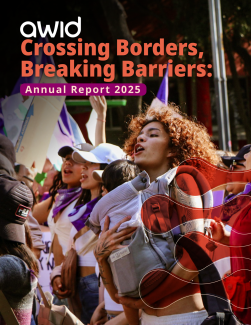
2025 was the year many of the storms we had long anticipated arrived all at once. From an avalanche of funding cuts, to intensified militarization and authoritarianism; from growing border violence to climate crises.
We asked what feminist movements will need not only to survive this moment, but to grow our collective strength and to shape our future. Our answer focused our work around three pillars: infrastructure, leadership and sustainability.
This is also the work of reinventing what it means for us at AWID to be global, to build solidarity and belonging across borders, to support movement and to mobilize action. There is no doubt that this is a time for courage, experimentation and collective imagination.
Rosa Candida Mayorga Muñoz était une travailleuse sociale, leader syndicale et défenseure des droits humains du Guatemala. On la surnommait affectueusement Rosita.
Dans les années 1980, Rosa devient la première femme à siéger au comité exécutif du syndicat de l’Institut d’électrification nationale (STINDE), syndicat qu’elle avait rejoint en premier lieu pour défendre les droits des femmes au travail. Cela signifiait, à ses yeux, de lutter pour l’égalité des chances dans une entreprise où de nombreuses femmes affrontaient un système discriminatoire et violent mis en place par la direction de l’entreprise. Rosa avait également subi du harcèlement sexuel sur son lieu de travail, tant de la part de collègues que de responsables. Elle n’entendait cependant pas rester silencieuse.
Rosa a continué à se battre et fait partie des efforts pour façonner la lutte afin qu’elle prenne la forme du « Pacte collectif pour les conditions de travail du INDE-STINDE ». Ce pacte était le premier du genre et le premier au Guatemala à caractériser le concept de harcèlement (sexuel). Il fait désormais référence dans la loi guatémaltèque pour les questions de travail, et sert d’encouragement aux autres syndicats.
« Elle n’avait d’autres outils pour se battre que ses propres idéaux... Elle a été intimidée à plusieurs reprises, harcelée pour abandonner la lutte, mais son courage a fait naître l’espoir chez les syndicalistes de la base. Rosita a créé une image de respect non seulement au sein de son syndicat mais également face aux autorités de l’institution et au sein du mouvement des femmes. Elle a été reconnue comme une pionnière du mouvement des femmes du syndicat, dans un espace qui avait davantage été dominé par les hommes. » - Maritza Velasquez, ATRAHDOM
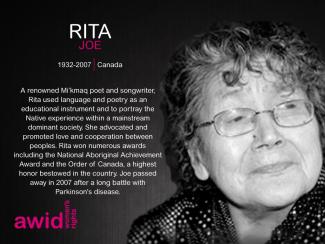
Rosa est décédée le 4 avril 2018, elle avait 77 ans.
Lors de ce 14e Forum, nous célébrerons et amplifierons les réalités féministes autour de nous, à tous les stades de déveoppement !
Nous voulons faire de ce Forum une réalité féministe : un lieu où vous pouvez habiter un monde différent, où vous pouvez rapporter vos victoires et les solutions que vous avez élaborées ; ce qui vous rend plus fortes, pleines d’espoir et prêtes à continuer. Ce rassemblement sera différent de tous ceux auxquels vous avez pu assister par le passé.
Nous vous encourageons fortement à vous joindre à nous pour co-créer ce monde. Cela en vaut la peine !
Chaque Forum a un thème qui reflète les besoins de nos membres et de nos mouvements, et répond à notre analyse du contexte actuel.
Actuellement, les fascismes, les fondamentalismes, les autoritarismes et le pouvoir illimité des entreprises prennent de l’ampleur au niveau mondial. Nous voyons ces menaces converger avec l’État pour façonner les normes publiques, les récits et les politiques, ancrant une culture de la peur, de la haine et de l’incitation à la violence dans les discours publics. Les États, qui étaient autrefois une cible de plaidoyer et de réclamation de droits, n’éprouvent plus de sentiment de responsabilité dans la plupart des cas, et peuvent parfois même être dans l’incapacité de faire respecter les droits.
Le Forum de l'AWID de 2016 s’était focalisé sur les horizons féministes et les conditions prérequises à leur établissement. Il était devenu clair, et reste évident aujourd’hui, que le défi majeur de nombreux mouvements de justice sociale est de réfléchir en dehors du système actuel sur des solutions structurelles. L’imaginaire peut ainsi devenir restreint en raison de longues expériences d’inégalités et d’oppression. Mais ce que nous avions aussi entendu, et que nous observons autour de nous, c’est que les mouvements féministes sont bel et bien en train de vivre et de promouvoir des réalités orientées sur les droits et la justice, ainsi que des solutions à petite et grande échelles.
En l’occurrence, nous voyons l’urgence de mobiliser à partir d’un lieu d’espoir, plutôt qu’à partir d’un plus petit dénominateur commun – un espoir qui se fonde sur la certitude qu’à travers le monde, même imparfaites, existent des expériences et des pratiques qui recouvrent des façons d’être plus justes, et qu’en partageant, renforçant et consolidant ces expériences, nous pouvons contribuer à augmenter leur influence.
Il ne s’agit pas de rêves impossibles, mais de réalités vécues. Ce sens des possibilités déclenche le réexamen et l’appréciation nouvelle des dimensions transformatives de notre travail.
À l’AWID, nous concevons ces réalités féministes comme les exemples vivants des mondes que nous savons possibles. Nous concevons ces diverses réalités féministes comme des revendications et des incarnations d’espoir et de pouvoir. Elles sont ancrées dans les multiples manières de vivre, de penser et de faire autrement, que ce soit au niveau des expressions quotidiennes de nos modes de vie ou nos manières d'être en relations les un.e.s avec les autres ou au niveau de systèmes alternatifs de gouvernance et de justice. Les réalités féministes combattent les systèmes de pouvoir dominants tels que le patriarcat, le capitalisme et la suprématie blanche.
Il s’agit là de propositions puissantes qui nous orientent vers une vision établie de possibilités, et qui nous montrent comment les organisations féministes ouvrent la voie à la justice dans les mouvements et les communautés à travers le monde.
Dans une communauté noire extrêmement marginalisée de Jackson, dans l'État du Mississippi, se tient une expérimentation d’économie solidaire et coopérative via la Cooperation Jackson (Coopération de Jackson). Il s’agit d’un plan ambitieux qui vise à construire une propriété communautaire en dehors des modes de production capitalistes. (en anglais)
En Afrique de l’Ouest, les agricultrices résistent à l’accaparement des terres et refusent les projets d’industrialisation agricole. Elles affirment audacieusement « Nous sommes la solution » à travers une campagne de renforcement des solutions agro-écologiques qui se centre sur les agricultrices et leurs savoirs comme solutions pour nourrir les communautés et atténuer le changement climatique.
Parallèlement en Inde, 5 000 femmes se sont rassemblées pour développer des systèmes communautaires de souveraineté alimentaire basés sur les savoirs locaux, comprenant des banques de céréales et de semences
Les femmes au Mexique ont créé un projet d’économie non monétaire, par et pour les femmes, ainsi que pour toute personne qu’elles connaissent. A El Cambalache, la valeur est équivalente pour tout : les gens échangent des choses dont ils n’ont plus besoin contre d’autres choses désirées comme les savoirs, les compétences et l’entraide que les personnes veulent partager. El Cambalache a été créé sur des valeurs anti-systémiques et anticapitalistes des mouvements sociaux locaux (en anglais et en espagnol)
À Rojava, les Kurdes construisent une démocratie sans État et les femmes kurdes offrent la jinéologie comme cadre de remise en question du patriarcat, du capitalisme et de l’État, et créent des systèmes et des institutions permettant de mettre ce cadre en pratique
Au Royaume-Uni, Arnacho Agony Aunts (Tantes anarcho-agonie) est une émission de conseil sur le sexe et les rencontres, réalisée à partir d’une perspective féministe, antifasciste et anarchiste. Les animatrices Rowan et Marijam récupèrent un espace de l’ultra droite en donnant aux gens (principalement des hommes) un espace pour poser des questions délicates dans un cadre sans jugement (en anglais)
Le projet African Feminist Judgement (Jugement féministe africain) élabore et diffuse des jugements alternatifs pour des cas importants de jurisprudence en Afrique sur une variété de cas juridiques. Le cœur du projet consiste à s’appuyer sur une pratique judiciaire féministe et des jugements féministes alternatifs pour contribuer à la jurisprudence africaine, aux pratiques légales et aux décisions judiciaires (en anglais)
La coopérative Usha en Inde a été fondée à un moment où les banques conventionnelles refusaient de fournir des services aux travailleurs·ses du sexe à Sonagachi. Les travailleurs·ses du sexe se sont organisé·e·s pour prioriser leurs préoccupations économiques et mettre en place leur propre institution financière. La coopérative Usha est une banque coopérative qui réunit plus de 20 000 travailleurs·ses du sexe et a fourni plus de 4,7 millions d’USD de prêts à 7 231 travailleurs·ses du sexe sur une année. Les membres sont tou·te·s des travailleurs·ses du sexe et la banque procure une réelle possession et influence sur la gouvernance et la gestion de la coopérative, innovant en matière de moyens offerts aux individus et communautés marginalisés pour renforcer leur pouvoir économique, selon leurs propres conditions.
À Porto Rico, une fiducie foncière communautaire aide à transformer une installation informelle située à proximité d’un canal pollué et propice aux inondations, en une communauté durable. Cela fournit un nouveau modèle d’amélioration des installations informelles dans les villes, sans pour autant les rendre hors d’atteinte pour les résident·e·s d’origine.
Dans de nombreux pays d’Amérique latine, les activistes fournissent des conseils et de l’accompagnement entre pairs sur l’avortement médical, réclamant le droit des femmes à disposer de leur corps et des savoirs médicaux. (pour des raisons de sécurité, aucun lien n’est fourni)
En savoir plus sur ces point d'ancrage thématiques
Nous attendons du Forum 2020 qu’il :
Construise le pouvoir des réalités féministes en nommant, célébrant, amplifiant et contribuant à créer un élan autour des expériences et des propositions qui mettent en lumière ce qui est possible tout en nourrissant nos imaginaires collectifs.
Réapprovisionne les sources d’espoir et d’énergie en tant que carburants nécessaires à l’activisme pour les droits et la justice, et à la résilience.
Renforce la connectivité, la réciprocité et la solidarité entre une diversité de mouvements féministes ainsi qu’avec d’autres mouvements orientés vers les droits et la justice.
Le Forum se veut bien plus qu’un événement de quatre jours. C’est un arrêt de plus dans un parcours de renforcement de mouvement autour des réalités féministes, lequel a déjà commencé et continuera bien au-delà des dates du Forum.