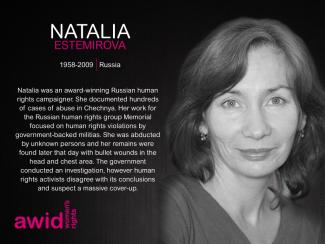
Natalia Estemirova

Over the past few years, a troubling new trend at the international human rights level is being observed, where discourses on ‘protecting the family’ are being employed to defend violations committed against family members, to bolster and justify impunity, and to restrict equal rights within and to family life.
The campaign to "Protect the Family" is driven by ultra-conservative efforts to impose "traditional" and patriarchal interpretations of the family, and to move rights out of the hands of family members and into the institution of ‘the family’.
Since 2014, a group of states have been operating as a bloc in human rights spaces under the name “Group of Friends of the Family”, and resolutions on “Protection of the Family” have been successfully passed every year since 2014.
This agenda has spread beyond the Human Rights Council. We have seen regressive language on “the family” being introduced at the Commission on the Status of Women, and attempts made to introduce it in negotiations on the Sustainable Development Goals.
AWID works with partners and allies to jointly resist “Protection of the Family” and other regressive agendas, and to uphold the universality of human rights.
In response to the increased influence of regressive actors in human rights spaces, AWID joined allies to form the Observatory on the Universality of Rights (OURs). OURs is a collaborative project that monitors, analyzes, and shares information on anti-rights initiatives like “Protection of the Family”.
Rights at Risk, the first OURs report, charts a map of the actors making up the global anti-rights lobby, identifies their key discourses and strategies, and the effect they are having on our human rights.
The report outlines “Protection of the Family” as an agenda that has fostered collaboration across a broad range of regressive actors at the UN. It describes it as: “a strategic framework that houses “multiple patriarchal and anti-rights positions, where the framework, in turn, aims to justify and institutionalize these positions.”

Yes, the survey can be accessed using a smartphone.

Listen to the story here:
Before starting the WITM research methodology, it is important you prepare the background and know what to expect.
With AWID’s WITM research methodology, we recommend that you first review the entire toolkit.
While this toolkit is designed to democratize WITM research, there are capacity constraints related to resources and research experience that may affect your organization’s ability use this methodology.
Use the “Ready to Go?” Worksheet to assess your readiness to begin your own WITM research. The more questions you can answer on this worksheet, the more prepared you are to undertake your research.
Before beginning any research, we recommend that you assess your organization’s connections and trust within your community.
In many contexts, organizations may be hesitant to openly share financial data with others for reasons ranging from concerns about how the information will be used, to fear of funding competition and anxiety over increasing government restrictions on civil society organizations.
As you build relationships and conduct soft outreach in the lead-up to launching your research, ensuring that your objectives are clear will be useful in creating trust. Transparency will allow participants to understand why you are collecting the data and how it will benefit the entire community.
We highly recommend that you ensure data is collected confidentially and shared anonymously. By doing so, participants will be more comfortable sharing sensitive information with you.
We also recommend referring to our “Ready to Go?” Worksheet to assess your own progress.
Sí, invitamos a compartir más impresiones acerca de alguna cuestión que sea de importancia para ti respondiendo a las preguntas abiertas al término de la encuesta.
.

Una identidad de género latinoamericana
El término travesti se trata de una identidad de género latinoamericana sin equivalente en otros idiomas, y exclusivamente femenina. Es una persona designada varón al nacer que se identifica como mujer, y siempre deben abordarse con el pronombre “ella”.
Travesti no es solo una identidad de género ubicada fuera del binarismo de género, también es una identidad cultural arraigada en los movimientos latinoamericanos. El término inicialmente fue peyorativo, pero luego fue re-apropiado como símbolo de resistencia y dignidad. Toda travesti es trans porque no se identifica con el género asignado al nacer, sin embargo no toda travesti se considera mujer trans, ya que travesti ya es una identidad de género en sí misma.
Referencia: Berkins, Lohana. (2006). Travestis: una Identidad Política . Trabajo presentado en el Panel Sexualidades contemporáneas en las VIII Jornadas Nacionales de Historia de las Mujeres/ III Congreso Iberoamericano de Estudios de Género Diferencia Desigualdad. Construirnos en la diversidad, Villa Giardino, Córdoba, 25 al 28 de octubre de 2006.
This section will guide you on how to ensure your research findings are representative and reliable.
In this section:
- Collect your data
1. Before launch
2. Launch
3. During launch- Prepare your data for analysis
1. Clean your data
2. Code open-ended responses
3. Remove unecessary data
4. Make it safe- Create your topline report
- Analyze your data
1. Statistical programs
2. Suggested points for analysis
If you also plan to collect data from applications sent to grant-making institutions, this is a good time to reach out them.
When collecting this data, consider what type of applications you would like to review. Your research framing will guide you in determining this.
Also, it may be unnecessary to see every application sent to the organization – instead, it will be more useful and efficient to review only eligible applications (regardless of whether they were funded).
You can also ask grant-making institutions to share their data with you.
Your survey has closed and now you have all this information! Now you need to ensure your data is as accurate as possible.
Depending on your sample size and amount of completed surveys, this step can be lengthy. Tapping into a strong pool of detail-oriented staff will speed up the process and ensure greater accuracy at this stage.
Also, along with your surveys, you may have collected data from applications sent to grant-making institutions. Use these same steps to sort that data as well. Do not get discouraged if you cannot compare the two data sets! Funders collect different information from what you collected in the surveys. In your final research report and products, you can analyze and present the datasets (survey versus grant-making institution data) separately.
There are two styles of open-ended responses that require coding.
Questions with open-ended responses
For these questions, you will need to code responses in order to track trends.
Some challenges you will face with this is:
If using more than one staff member to review and code, you will need to ensure consistency of coding. Thus, this is why we recommend limiting your open-ended questions and as specific as possible for open-ended questions you do ask.
For example, if you had the open-ended question “What specific challenges did you face in fundraising this year?” and some common responses cite “lack of staff,” or “economic recession,” you will need to code each of those responses so you can analyze how many participants are responding in a similar way.
For closed-end questions
If you provided the participant with the option of elaborating on their response, you will also need to “up-code” these responses.
For several questions in the survey, you may have offered the option of selecting the category “Other” With “Other” options, it is common to offer a field in which the participant can elaborate.
You will need to “up-code” such responses by either:
Analyze the frequency of the results
For each quantitative question, you can decide whether you should remove the top or bottom 5% or 1% to prevent outliers* from skewing your results. You can also address the skewing effect of outliers by using median average rather than the mean average. Calculate the median by sorting responses in order, and selecting the number in the middle. However, keep in mind that you may still find outlier data useful. It will give you an idea of the range and diversity of your survey participants and you may want to do case studies on the outliers.
* An outlier is a data point that is much bigger or much smaller than the majority of data points. For example, imagine you live in a middle-class neighborhood with one billionaire. You decide that you want to learn what the range of income is for middle-class families in your neighborhood. In order to do so, you must remove the billionaire income from your dataset, as it is an outlier. Otherwise, your mean middle-class income will seem much higher than it really is.
Remove the entire survey for participants who do not fit your target population. Generally you can recognize this by the organizations’ names or through their responses to qualitative questions.
To ensure confidentiality of the information shared by respondents, at this stage you can replace organization names with a new set of ID numbers and save the coding, matching names with IDs in a separate file.
With your team, determine how the coding file and data should be stored and protected.
For example, will all data be stored on a password-protected computer or server that only the research team can access?
A topline report will list every question that was asked in your survey, with the response percentages listed under each question. This presents the collective results of all individual responses.
Tips:
- Consistency is important: the same rules should be applied to every outlier when determining if it should stay or be removed from the dataset.
- For all open (“other”) responses that are up-coded, ensure the coding matches. Appoint a dedicated point person to randomly check codes for consistency and reliability and recode if necessary.
- If possible, try to ensure that you can work at least in a team of two, so that there is always someone to check your work.
Now that your data is clean and sorted, what does it all mean? This is the fun part where you begin to analyze for trends.
Are there prominent types of funders (government versus corporate)? Are there regions that receive more funding? Your data will reveal some interesting information.
Smaller samples (under 150 responses) may be done in-house using an Excel spreadsheet.
Larger samples (above 150 responses) may be done in-house using Excel if your analysis will be limited to tallying overall responses, simple averages or other simple analysis.
If you plan to do more advanced analysis, such as multivariate analysis, then we recommend using statistical software such as SPSS, Stata or R.
NOTE: SPSS and Stata are expensive whereas R is free.
All three types of software require staff knowledge and are not easy to learn quickly.
Try searching for interns or temporary staff from local universities. Many students must learn statistical analysis as part of their coursework and may have free access to SPSS or Stata software through their university. They may also be knowledgeable in R, which is free to download and use.

• 2 - 3 months
• 1 or more research person(s)
• Translator(s), if offering survey in multiple languages
• 1 or more person(s) to assist with publicizing survey to target population
• 1 or more data analysis person(s)
• List of desired advisors: organizations, donors, and activists
• Optional: an incentive prize to persuade people to complete your survey
• Optional: an incentive for your advisors
Survey platforms:
• Survey Monkey
• Survey Gizmo (Converts to SPSS for analysis very easily)
Examples:
• 2011 WITM Global Survey
• Sample of WITM Global Survey
• Sample letter to grantmakers requesting access to databases
Visualising Information for Advocacy:
• Cleaning Data Tools
• Tools to present your data in compelling ways
• Tutorial: Gentle Introduction to Cleaning Data

Les données seront traitées à des fins statistiques, pour mettre en lumière l’état du financement de l’organisation des mouvements féministes dans le monde entier, et ne seront présentées que sous forme agrégée. L’AWID ne publiera pas d’informations relatives à une organisation donnée ni ne divulguera d’informations qui permettraient d’identifier une organisation par le biais de son emplacement ou de caractéristiques qui lui sont propres, sans son accord explicite.
Contenu lié
TV5Monde: Kate Millett, décès d'une féministe qui combattait avec caresses et plaisir

L'une des dirigeantes fondatrices de la coopérative était Lohana Berkins, une militante, défenseuse et promotrice de l'identité trans. Lohana a joué un rôle crucial dans la lutte pour les droits des personnes trans et travestis.
Grâce à sa lutte, entre autres choses, l'approbation de la loi sur l'identité de genre a été obtenue. C'est l'une des lois les plus progressistes au monde, garantissant les droits fondamentaux des personnes trans et des travestis. Désormais, les personnes peuvent changer de nom et de sexe avec un affidavit et ont accès à des soins de santé complets sans intervention/approbation judiciaire ou médicale (Outright International, 2012).
Los resultados de la investigación también influirán sobre tu trabajo de incidencia ya que, por ejemplo, te habrán revelado qué sectores otorgan más financiamiento y cuáles consideras que necesitan mayor formación para ejercer su rol de donantes.
En esta sección
- Desarrolla la estrategia de incidencia
- Ponte en contacto con tus redes
- Adapta la estrategia a cada sector
1. Organizaciones por los derechos de las mujeres
2. Entidades bilaterales y multilaterales
3. Fundaciones privadas
4. Fondos de mujeres
5. Sector privado y nuevos donantes
En la sección de este Manual dedicada a «Prepara el marco para la investigación», te recomendamos que pensaras en las metas que esperabas alcanzar con la investigación. Esas metas te permitirán desarrollar una estrategia de incidencia una vez que hayas completado la investigación.
Una estrategia de incidencia es un plan para difundir los resultados de la investigación de una forma tal que te permita cumplir las metas, dentro del objetivo más amplio que es hacer incidencia con sectores clave para introducir cambios positivos en cuanto a los recursos disponibles para los procesos organizativos por los derechos de las mujeres.
Cómo utilizar las metas definidas en el marco para la investigación:
De esa lista — que será lo más exhaustiva posible — elige los medios más eficientes para alcanzar tus metas. (Más abajo encontrarás ejemplos específicos de audiencias y métodos de incidencia)
Una vez que hayas desarrollado la estrategia, podrás comenzar con la difusión.
Para difundir los resultados, primero ponte en contacto con las personas/organizaciones a través de las cuales distribuiste la encuesta, y también con todas las que respondieron la encuesta y fueron entrevistadas.
No te olvides de pedirles que identifiquen quién será tu contacto en cada organización y pídeles que te confirmen una vez que hayan realizado cualquier publicación referida a tus materiales.
Esto te permitirá tener un registro de quiénes difundieron el informe pero también construir vínculos más sólidos con las organizaciones y personas con las que trabajas.
A modo de ejemplo te presentamos una lista de sectores sobre los que AWID realiza incidencia.
Para esto te resultará útil la lista de organizaciones y personas que te asesoraron durante la investigación (consultorxs). Ellxs te ayudarán a difundir el informe en distintos espacios y también podrán presentarte a nuevas organizaciones o llevarte a nuevos espacios para hacer incidencia.
Objetivos propuestos: Que las organizaciones por los derechos de las mujeres actualicen sus conocimientos acerca de las tendencias en el financiamiento; pensar colectivamente iniciativas conjuntas para la movilización de recursos utilizando los resultados de la investigación; influir sobre cómo abordan la movilización de recursos
Ejemplos de posibles métodos de incidencia:
Objetivo propuesto: Crear conciencia acerca de cómo el sector del financiamiento no está cumpliendo con sus compromisos establecidos y cómo necesita mejorar los mecanismos de apoyo para financiar los procesos organizativos por los derechos de las mujeres.
Identifica qué entidades bilaterales y multilaterales son las más influyentes en cuanto al financiamiento; esto podría incluir a las sedes locales de las embajadas.
Ejemplos de posibles métodos de incidencia:
Objetivo propuesto: Expandir la calidad y cantidad del apoyo a las organizaciones por los derechos de las mujeres.
Ejemplos de posibles métodos de incidencia:
Objetivo propuesto: Alentarlas a continuar y expandir su trabajo.
Ejemplos de posibles métodos de incidencia:
Objetivos propuestos: Incrementar su conocimiento del campo y alentar a la coherencia entre sus intereses filantrópicos y sus prácticas comerciales.
Ejemplos de posibles métodos de incidencia:
Asegúrate de adaptar las presentaciones, propuestas y aplicaciones a cada uno de los grupos a los que quieres llegar.
Insistimos en recomendarte que consultes nuestra Planilla ¿Estoy listx? para evaluar cómo has ido avanzando.

1-2 años, dependiendo de los objetivos de incidencia
• 1 persona (o más) de comunicación
• Lista de espacios para hacer publicidad de la investigación
• Lista de los blogs y revistas en línea donde se pueden publicar artículos acerca de su hallazgo de la investigación
• Lista de asesores
• Sus productos de información WITM
• Ejemplo de plan para incidencia

Our aim is to reach a total of 2,000 responses, almost double the number from the last WITM survey in 2011.