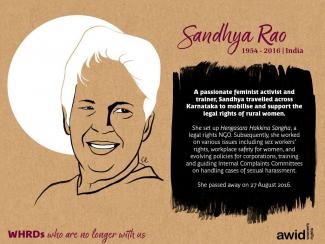
Sandhya Rao
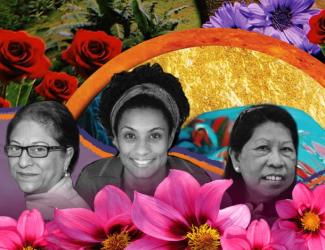
AWID’s Tribute is an art exhibition honouring feminists, women’s rights and social justice activists from around the world who are no longer with us.
This year’s tribute tells stories and shares narratives about those who co-created feminist realities, have offered visions of alternatives to systems and actors that oppress us, and have proposed new ways of organising, mobilising, fighting, working, living, and learning.
49 new portraits of feminists and Women Human Rights Defenders (WHRDs) are added to the gallery. While many of those we honour have passed away due to old age or illness, too many have been killed as a result of their work and who they are.
This increasing violence (by states, corporations, organized crime, unknown gunmen...) is not only aimed at individual activists but at our joint work and feminist realities.
The portraits of the 2020 edition are designed by award winning illustrator and animator, Louisa Bertman.
AWID would like to thank the families and organizations who shared their personal stories and contributed to this memorial. We join them in continuing the remarkable work of these activists and WHRDs and forging efforts to ensure justice is achieved in cases that remain in impunity.
“They tried to bury us. They didn’t know we were seeds.” - Mexican Proverb
It took shape with a physical exhibit of portraits and biographies of feminists and activists who passed away at AWID’s 12th International Forum, in Turkey. It now lives as an online gallery, updated every year.
To date, 467 feminists and WHRDs are featured.
AWID works towards the realization of gender justice and women’s human rights worldwide. We work to strengthen the voices and impact of women’s rights advocates, organizations and movements. Our main Priority Areas relate to themes that are closely linked to dominant global trends.
These themes reflect growing challenges that negatively impact women’s rights worldwide.
The survey is for groups, organizations and movements working specifically or primarily for the rights of women, LBTQI+ people and on gender justice in all contexts, at all levels, and in all regions. If this is one of the core pillars of your group, collective, network or any other type of organization - whether registered or not, newly formed or long-standing, we invite you to take this survey.

*At this time, we are not asking for responses from individuals or funders.
Learn more about the survey:
Consult the F.A.Q.
Cette édition du journal, en partenariat avec Kohl : a Journal for Body and Gender Research (Kohl : une revue pour la recherche sur le corps et le genre) explorera les solutions, propositions et réalités féministes afin de transformer notre monde actuel, nos corps et nos sexualités.

Todos nuestros informes anuales estan disponibles en línea.

To claim your power as an expert on the state of resourcing for feminist movements
La Convocatoria de Actividades enumera una lista de sugerencias para formatos y metodologías. Sé creativx y asegúrate de leer la sección «Lo que debes saber».

النمرة.



Dans le monde entier, les mouvements féministes, de défense des droits des femmes, pour la justice de genre, pour la défense des personnes LBTQI+ et les mouvements alliés vivent un moment critique, face à de puissantes remises en question de droits et libertés pourtant acquis.
Ces dernières années ont vu la rapide montée de l’autoritarisme, de la violente répression de la société civile et de la criminalisation des défenseur·ses des droits humains des femmes et des personnes de genre divers, l’escalade de guerres et de conflits dans plusieurs régions du monde, la perpétuation des injustices économiques et de crises conjuguant la santé, l’écologie et les changements climatiques.
يومَ دعتني أنجليكا وفابي لأكون القَيِّمة على تشكيلة نصوص شبقية من تحرير نسوة سود لم أكن أعرف ما يعنيه عملُ القيِّم. الشبق ومشتقاته، هذه فهمتها جيداً، لكن عمل القَيِّم...

Second High-level Dialogue on Financing for Development
1 |
Fournir aux membres de l’AWID, partenaires du mouvement et financeurs une analyse actualisée, robuste, éprouvée et orientée sur l’action des réalités du financement des mouvements féministes et de l’état actuel de l’écosystème du financement féministe. |
2 |
Identifier et expliquer les occasions d’orienter davantage de financement de meilleure qualité vers l’organisation des mouvements féministes, mettre en lumière les fausses solutions et mettre un frein aux tendances à cause desquelles les financements ne parviennent pas et/ou vont à l’encontre des programmes de justice de genre et féministes intersectionnels. |
3 |
Formuler les visions, propositions et programmes féministes en faveur de la justice du financement. |