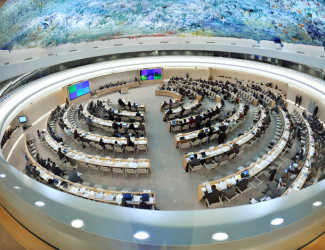
The Human Rights Council (HRC) is the key intergovernmental body within the United Nations system responsible for the promotion and protection of all human rights around the globe. It holds three regular sessions a year: in March, June and September. The Office of the UN High Commissioner for Human Rights (OHCHR) is the secretariat for the HRC.
The HRC works by:
Debating and passing resolutions on global human rights issues and human rights situations in particular countries
Examining complaints from victims of human rights violations or activist organizations on behalf of victims of human rights violations
Appointing independent experts (known as “Special Procedures”) to review human rights violations in specific countries and examine and further global human rights issues
Engaging in discussions with experts and governments on human rights issues
Assessing the human rights records of all UN Member States every four and a half years through the Universal Periodic Review
AWID works with feminist, progressive and human rights partners to share key knowledge, convene civil society dialogues and events, and influence negotiations and outcomes of the session.
With our partners, our work will:
◾️ Monitor, track and analyze anti-rights actors, discourses and strategies and their impact on resolutions
Nuestras/os afiliadas/os tanto individuales como institucionales provienen de todas las regiones del mundo y de 163 países; las/os más recientes se nos han unido desde Zimbabue, Turquía y los Estados Unidos. ¡Todas/os nuestras/os afiliadas/os aportan una rica y diversa gama de perspectivas, experiencias, conocimiento, energía e inspiración!
¿Sabías que cada semana publicamos perfiles de afiliadas/os?
Uno de los beneficios de ser afiliada/o de AWID es que tu historia sea destacada en nuestro boletín informativo, el cual llega a 35,000 suscriptoras/es, y a través de nuestros canales en las redes sociales que tienen más de 60,000 seguidores.
Publicaciones recientes:
Conoce a Angila Ashitua, una joven afiliada a AWID que vive en el condado de Vihiga, Kenia Occidental.
Aprendiendo más acerca del trabajo que hace AWID y de temas relativos a los derechos de las mujeres y la justicia social por medio de nuestras publicaciones y recursos, incluyendo el último video "Cambiando sistemas, cambiando vidas". [disponible solo en inglés]
Participando en nuestras sesiones de aprendizaje electrónico. ¡Mira lo más destacado de nuestro seminario en línea sobre justicia fiscal! [disponible solo en inglés]
¡Y mucho más!
Puedes renovar tu membresía por uno, dos o tres años; también ofrecemos membresías individuales e institucionales gratis a quienes tengan bajos ingresos o presupuestos.
Si tienes alguna dificultad y necesitas apoyo con el proceso de inscripción, por favor no dudes en comunicarte conmigo a través de membership@awid.org
Testemonios de nuestras/os afiliadas/os
"AWID nos ha resultado una red muy interesante y estamos participando en muchas de sus plataformas". - Engabu Za Tooro (afiliada/o institucional AWID)
"Espero una colaboración fructífera con el equipo. Me siento excelente. Gracias por aceptarme como afiliada". - R. Chakraborty (afiliada individual AWID)
"Muchas gracias, AWID, pues el trabajo que hacen es formidable. Aprecio realmente sus esfuerzos". - E. Khan (afiliada individual AWID)
Je suis activiste à titre individuel, je ne travaille avec aucun groupe, organisation et/ou mouvement à l’heure actuelle, est-ce que je devrais participer à cette enquête?
Non, nous reconnaissons l’importance de votre travail, mais nous ne collectons pas les réponses fournies à titre individuel à l’heure actuelle.
Nous Sommes la Solution is a rural women 's movement for food sovereignty in West Africa. Founded originally as a campaign against hyper-industrialized agriculture, Nous Sommes la Solution has grown into a movement of more than 500 rural women’s associations from Burkina Faso, Senegal, Ghana, Gambia, Guinea Bissau, Mali and Guinea.
Together, this women-led movement is building and strengthening food and seed sovereignty across West Africa. They feed communities, strengthen local economies, amplify the knowledge of women farmers and mitigate the devastating effects of climate change through agroecological practices. They also organize workshops, forums and community radio broadcasts to share their messages, their traditional knowledges and agroecological practices across rural communities.
In collaboration with universities and public research centers, Nous Sommes la Solution works towards restoring traditional Indigenous varieties of rice (a staple food in West Africa) and promoting local food economies based on agroecological principles, influencing national policy-making, all the while supporting women in creating farming associations and collectively owning and managing farmland.
Une fois que vous aurez analysé l’ensemble des données issues du sondage, des interviews, de la recherche documentaire et possiblement d’autres sources, vous pourrez créer votre produit final.
Votre produit final sera le document qui synthétisera, analysera et posera un regard critique sur vos données. Ce sera la composante que vous partagerez avec votre communauté afin de présenter et d’expliquer votre recherche à votre auditoire.
À l’AWID, nous rédigeons fréquemment un rapport complet qui analyse chaque ensemble de données et qui synthétise tous nos résultats pour ensuite créer des produits plus concis comme des infographies et des sommaires (expliqué plus loin dans la section « Finalisez et mettez en forme »).
1. Écrivez clairement
Organisez vos données comme si vous vouliez raconter une histoire. Vous pouvez suivre l’ordre de votre sondage. Vous pouvez également regrouper certaines questions qui mènent à votre conclusion de façon cohérente et progressive.
Adaptez votre langage à votre public. Employez un langage universel et évitez le jargon ou les termes trop techniques.
L’importance de la révision
La personne chargée de la révision relira votre document, s’assurera qu’il est rédigé de manière concise, procédera à la vérification des faits, soulèvera les incohérences qui doivent être résolues, assurera la fluidité du texte et suggérera éventuellement des titres.
Il est préférable que cette personne connaisse et comprenne votre travail WITM, sans être engagée dans la recherche. Ainsi, elle apportera au document une nouvelle perspective.
2. Rendez-le attrayant
Créez des tableaux et des graphiques à l’aide des données recueillies. Ce type de documents visuels est très utile pour faire ressortir les principaux résultats de votre recherche et pour valider votre analyse.
Utilisez des images pertinentes qui illustrent vos propos.
Mettez en évidence les principaux chiffres et/ou les témoignages percutants.
Rappel : Plus votre produit est accessible, plus les gens auront envie de le lire…et de le partager!
À cette étape, vous avez recueilli toutes vos données, vous les avez analysées et vous avez transformé ces renseignements en produit final, probablement en un long rapport.
1. Peaufinez vos résultats
Avant de passer à la prochaine étape, vous devriez partager votre produit final avec les organisations, les activistes et les donateurs qui vous conseillent.
C’est le moment idéal pour vérifier les aspects suivants :
Est-ce qu’il manque des points clés à votre analyse des tendances et du panorama actuels du financement ?
Est-ce qu’il manque des points clés à vos conclusions ?
Y a-t-il des données inexactes qui doivent être corrigées ?
Y a-t-il des suggestions de nature générale sur la manière de renforcer le rapport afin d’atteindre les objectifs fixés dans le cadre de référence de la recherche.
Lorsque vous aurez intégré toutes les réactions de vos conseillers et conseillères, assurez-vous de présenter le document à la personne chargée des révisions.
Vous aurez ainsi en main la version finale et complète de votre rapport. Si vous prévoyez de publier votre rapport final en d’autres langues, il est temps de le faire traduire.
2. Encouragez les réactions
Les personnes qui vous conseillent seront probablement très occupées. Assurez-vous de leur accorder un délai raisonnable lorsque vous leur demandez de commenter le texte.
Soyez brefs et spécifiques lorsque vous sollicitez des commentaires, de sorte qu’il leur soit facile d’y répondre. Si vous le souhaitez, vous pouvez simplement copier et coller la liste des points que nous vous avons fournie.
Si vous publiez en plusieurs langues, assurez-vous que vos conseillers et conseillères vérifient la ou les versions finales traduites de vos produits.
Il s’agit d’une contribution considérable de la part de vos conseillers et conseillères. Pensez à leur offrir une forme de reconnaissance.
• 1 personne (ou plus) chargée de la recherche
• 1 éditeur-trice (spécialisé-e web si vous créez des prduits en ligne)
• Traducteur(s)-trice(s), si vous réalisez votre recherche en différentes langues
Ressources requises :
• Liste d’organisations, de donateurs et d’activistes agissant à titre consultatif
• Note conceptuelle (définie par votre cadre de référence)
• Résultats préliminaires de votre sondage
• Questions d'interview
• Résultats de vos interview
• Données de votre recherche documentaire
• Toutes les données utilsées dans le rapport
Can I fill the survey outside KOBO and share my responses with you via email?
Unless there are accessibility issues and/or you are filling the survey in other languages, we strongly encourage you to use KOBO for WITM standardized data collection and analysis.
As feminists struggling for gender, peace, economic, social and environmental justice, we know there is no single recipe for success but an array of possibilities that can and are making change happen. The menu of options is as diverse as our movements and the communities in which we live and struggle.
Before we dare to present some of the feminist imaginations for another world, here are the principles around which we base our propositions:
1. Self-determined development from the local to the global
We believe there is no one model for all and that everyone has a right to claim and contribute to building another world that is possible, as the World Social Forum motto puts it.
This includes the right to participate in democratic governance and to influence one’s future – politically, economically, socially and culturally.
Economic self-determination gives peoples the ability to take control over their natural resources and use those resources for their own ends or collective use. Furthermore, women’s economic agency is fundamental to mitigating the often cyclical nature of poverty, denial of education, safety, and security.
2. Rights, substantive equality and justice are at the core of the economy
The principle of substantive equality is laid out in the Convention on the Elimination of All Forms of Discrimination against Women (CEDAW) and other international human rights instruments. This principle is fundamental for development and achieving a just economy as it affirms that all human beings are born free and equal.
Non-discrimination is an integral part of the principle of equality that ensures that no one is denied their rights because of factors such as race, gender, language, religion, sexual orientation, gender identity, political or other opinion, national or social origin, property or birth.
The inherent dignity of all persons without distinction must be upheld and respected. While States are responsible for ensuring the use of maximum available resources for the fulfilment of human rights, reclaiming rights and dignity is fundamentally a key space for civil society struggle and popular mobilization.
3. Just distribution for all, without monopolization (the anti-greed principle)
This principle, exercised through organized efforts to transform unjust institutions, guides the restoration of balance between "participation" (input) and "distribution" (output) when either principle is violated.
It puts limits on monopolistic accumulations of capital and other abuses of property. This concept is founded on an economy model that is based on fairness, and justice.
4. Feminist and cross-movement solidarity is key
In order to make change happen, we need strong and diverse feminist networks. We need movements building solidarity from the personal to the political, from the local to the global and back.
Building collective power through movements helps convert the struggle for human rights, equality and justice into a political force for change that cannot be ignored.
“Only movements can create sustained change at the levels that policy and legislation alone cannot achieve.”
La encuesta contiene 47 preguntas en total, de las cuales 27 son de respuesta obligatoria* y las 20 restantes son opcionales. La mayoría de las preguntas de la encuesta son de opción múltiple. Invitamos a responder la totalidad de las preguntas.