Human Rights Council (HRC)
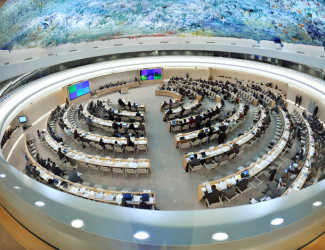
The Human Rights Council (HRC) is the key intergovernmental body within the United Nations system responsible for the promotion and protection of all human rights around the globe. It holds three regular sessions a year: in March, June and September. The Office of the UN High Commissioner for Human Rights (OHCHR) is the secretariat for the HRC.
The HRC works by:
-
Debating and passing resolutions on global human rights issues and human rights situations in particular countries
-
Examining complaints from victims of human rights violations or activist organizations on behalf of victims of human rights violations
-
Appointing independent experts (known as “Special Procedures”) to review human rights violations in specific countries and examine and further global human rights issues
-
Engaging in discussions with experts and governments on human rights issues
-
Assessing the human rights records of all UN Member States every four and a half years through the Universal Periodic Review
AWID works with feminist, progressive and human rights partners to share key knowledge, convene civil society dialogues and events, and influence negotiations and outcomes of the session.
With our partners, our work will:
◾️ Raise awareness of the findings of the 2017 and 2021 OURs Trends Reports.
◾️Support the work of feminist UN experts in the face of backlash and pressure
◾️Advocate for state accountability
◾️ Work with feminist movements and civil society organizations to advance rights related to gender and sexuality.
Related Content
S'inscrire à la liste de diffusion
Michelle D'Cruz
Michelle est une féministe d'Asie du Sud-Est qui aime concerterer pour rassembler des gens et susciter des conversations en faveur du changement social et du partage des connaissances féministes, à travers l'art, la poésie, la musique et les jeux. Forte d'une expérience en plaidoyer digital et en développement de stratégies de communication, elle a contribué à des initiatives en matière de droits digitaux, de recherche sur les droits humains et de création de coalitions de la société civile dans toute l'Asie du Sud-Est. Elle est titulaire d'une licence de droit de l'Université nationale de Singapour, aime se balader dans des rues au hasard de la ville et apprécie un peu trop le café.
Snippet Watch Stories (EN)
Learn more about the impact of the forum through these stories
FRMag - Resistance Series
Serie Resistencia Feminista
Snippet - WCFM Airtable iFrame - EN
Explore the Database now!
Don't know where to start? Let's try understanding the filters.
Maritza Quiroz Leiva
Maritza Quiroz Leiva was an Afro Colombian social activist, a community leader and women human rights defender. Among the 7.7 million Colombians internally displaced by 50 years of armed conflict, Maritza dedicated her advocacy work to supporting the rights of others, particularly in the Afro Colombian community who suffered similar violations and displacement.
Maritza was the deputy leader of the Santa Marta Victim's Committee, and an important voice for those seeking justice in her community, demanding reparations for the torture, kidnapping, displacement, and sexual violence that victims experienced during the armed conflict. She was also active in movement for land redistribution and land justice in the country.
On 5 January 2019, Maritza was killed by two armed individuals who broke into her home. She was 60 years old.
Maritza joined five other Colombian social activists and leaders who had been murdered just in the first week of 2019. A total of 107 human rights defenders were killed that year in the country.
A Joy to the World: Six Questions with Naike Ledan
Interviewed by Chinelo Onwualu

![]() |
Naike Ledan is a social justice defendant, a committed feminist that brings forward 20 years of experience in human rights and health justice advocacy, women’s empowerment, the fight for universal access to basic services and social inclusion, as well as civil society capacity building. She has built extensive work in Canada, West and southern Africa, as well as in Haiti, in civil rights advocacy, capacity building for CSOs, while emphasising the social determinants of structural exclusion. She values the principles of shared leadership, anticolonial, anti-oppressive, and anti-patriarchal spaces. |

Chinelo You’re billed as a trans rights activist; I’m curious about how you made that journey.
Naike So, I grew up in Haiti until I was 18, then I lived in Montreal for 19 years. Coming back to Haiti in 2016, I thought I would be coming back home, but the place had changed and I had to readjust. I did not necessarily reconnect in the way that I’d expected to with childhood family and friends. I came back as an expat with a comfortable work situation, and I felt very much like a foreigner for a very long time. And at the same time, I felt very much at home because of the language, the understood silence, the not having to explain when we start singing a commercial – you know, that thing we share, that energy, that space, that spirit.

What helped me was, I loved the work of going into the country and documenting people’s knowledge. So I left the comfort. I became a country director of a regional organisation that was queer as fuck! Most of my work was to find resources and build the capacity of civil society. My strategy was to go into the countryside, look for all these little organizations, help build their capacity, and fund them. I was not interested in politicians and shaking hands and taking pictures
Chinelo Tell me about the workshop you conducted with AWID for the festival. What was it about and what was the context?

Naike International media doesn’t really talk about Haiti, but with a political environment that is as bad as ours, the economic environment is even more catastrophic. Being a more middle class Haitian, speaking different languages, having different passports, I was initially hesitant to take the space. But I often see myself as a bridge more than someone that would talk about themself. That is how I came to invite Semi, who is a brilliant young trans woman from outside Port-au-Prince, to take the space to talk for herself and walk us through the ecosystem of the realities for trans women in Haiti. We ended up building a session about uninclusive feminism – or, I would say, formal feminist spaces – and how trans girls in Haiti do not have spaces where they can contribute to women’s knowledge and sharing of women’s realities. So the AWID festival was the opportunity for me to give the space to the women who should have it. We had a wonderful time; we had wine online while hosting the conversation. My co-facilitator, Semi, shared what it is like to be a trans child/girl/woman at different stages of her life. She also shared the dangers of the street, of poverty, of exclusion, of “not passing,” and her victories as well.
Chinelo What is the relationship of trans women to feminist organizations in Haiti? What has been your experience with that?
Naike It’s been really hard – heartbreaking, actually – the experience of trans women in Haiti. From not existing at all to just being extremely sexualized. The other thing that’s been happening is how they’re being killed, and how those killings have gone unreported in the media. This is how non-existent, how erased trans women are. They’re everywhere but not in job settings, not in feminist settings, not in organizational settings. Not even in LGBT organizations. It’s only recently, and because of a lot of advocacy push, that some of these organization are kind of readjusting, but in feminist spaces, this is still out of the question. We are still having to deal with the old exclusionary discourse of “They’re not women. Of course, if they can pass…” The culture of passing, it’s a risk management conversation – how much you pass and how much you don’t pass and what it means for your body and the violence it inflicts. In the trans-exclusionary realities we live in, which are reproduced in a lot of feminist spaces, those that pass completely may be considered girls, but only to a certain extent. But how about falling in love, how about having a conversation, how about being in the closet, how about wanting a certain aesthetic, or a career? So really, the conversation about hormone therapy becomes about risk reduction, as Semi herself shared at the workshop. But we don’t have the option of hormone therapy, we don’t have the medical framework nor the system to support those who would like to pursue that option.
Chinelo When you talk about the way that trans people and queer people are thought of in society, it sounds like it might be similar to Nigeria, which can be a deeply homophobic environment.
Naike Haiti is a very complex country in a very beautiful way. Nothing is simple, you know, nothing is ever one way. Haitians are very tolerant – and they’re also very homophobic. You’re going to find regions in the countryside where people aren’t that homophobic at all because all the Vodou temples there, and this is a religion that respects life. One basic principle of the Vodou religion is that all children are children. So, there is no right or wrong in the religion. For the longest time, people thought of Haiti as a haven, a place where people are tolerant – we’re talking 70s, 80s, pre-HIV, 90s even. Then you had the earthquake [in 2010] where around 300,000 people died. And then all this money came from the south of the US through the Evangelicals to rebuild the country and find Jesus. So, the homophobia in Haiti is very recent. In the depth, in the heart of the soul of the culture, I cannot really say that it is homophobic. But in the everyday life, it surely lands on the skin of queer people, that violence. And that of women, of poor women, of dark women as well, because colorism runs deep in the Caribbean.
Chinelo How have you managed this? What’s been your strategy for survival?

Naike I’m really in love with my work. I love working. When I first arrived, I was working with this horrible NGO but I was doing amazing work. I was always in the countryside, conversing and learning from people, from women. And that filled my heart for so long because I’m very much in love with my culture, with black people, with black women – old black women, black babies. It just fills me up in a spiritual way. When we were in Canada my kids were in these all-white schools and tokenized. They did not speak Creole nor French. And now, they’re running free in the yard and starting to fight in Creole. I also found hubs of survival with the people I met. I created bonds with the queers and others who were weirdos like me and it’s been really wonderful. But now I’m struggling because I don’t feel safe in Haiti anymore. We have about 40 kidnappings per week in Port-Au-Prince – and it’s been like that since 2018. I’ve developed anxiety and panic attacks. So It’s time to go, and I’ve been asking myself, “where is home?” I spent 19 years in Montreal but I never felt at home there. When I left, I never missed it so I don’t want to go back. I’ve been crying a lot lately because it feels like entering a second exile.
Chinelo What’s your relationship to pleasure, leisure, and rest?
Naike My relationship with pleasure, leisure, and rest are for me one and the same. It is the lived moment when I indulge in the heat of the sun on my face for example. It is pleasure, leisure, and rest at the same time.
Pleasure: My go-to space, most solely a haven of celebration of myself. I reserve myself the power and the right to be loud or quiet in the enjoyment of the pleasure I experience. All the pleasure I viciously and abundantly indulge in, including and not limited to the pleasure of solitude and silence.
Leisure: biking, music festivals, eating, wine discoveries, dancing in Haitian traditional Vodou dances are amongst many that occur at the moment.
Rest: is what I live for. As an overachiever and a person that is literally in love with work, it is a paradox how lazy I am. No one knows that because all of what the world sees is this: an accomplished overworker. They do not know how I can just, uncompromisingly and profoundly indulge in idleness.

Explore Transnational Embodiments
This journal edition in partnership with Kohl: a Journal for Body and Gender Research, will explore feminist solutions, proposals and realities for transforming our current world, our bodies and our sexualities.

التجسيدات العابرة للحدود
نصدر النسخة هذه من المجلة بالشراكة مع «كحل: مجلة لأبحاث الجسد والجندر»، وسنستكشف عبرها الحلول والاقتراحات وأنواع الواقع النسوية لتغيير عالمنا الحالي وكذلك أجسادنا وجنسانياتنا.
Debbie Stothard
During her 38-year career, Debbie Stothard, has worked with diverse communities and activists to engage states, IGOs and other stakeholders throughout Asia, Africa, Europe, and the Americas on human rights and justice. Her work is focused on the thematic priorities of business and human rights, atrocity prevention, and women’s leadership. Accordingly, she has either facilitated or been a resource person at nearly 300 training events in the past 15 years. Most of these were grassroots-oriented workshops delivered in the field, focused on human rights advocacy, economic literacy and business and human rights, and transitional justice and atrocity prevention. Her work in transitional justice and atrocity prevention has mainly focused on Burma/Myanmar, however she has provided advice on responses to other country situations around the world.
During 1981 – 1996, Debbie worked as a crime reporter, student organizer, policy analyst, academic, government advisor and food caterer in Malaysia and Australia while volunteering for human rights causes. In 1996, she founded ALTSEAN-Burma which spearheaded a range of innovative and empowering human rights programs. This includes ALTSEAN’s ongoing intensive leadership program for diverse young women from Burma, which in the past 22 years, has helped strengthen and expand women’s leadership in conflict-affected zones. She served as a member of the Board of the International Federation for Human Rights (FIDH) for 9 years as Deputy Secretary-General (2010-2013) and Secretary-General (2013 – 2019) during which she promoted the mission and profile of FIDH at approximately 100 meetings and conferences per year.
Snippet Forum Quoate Nicky Mcintyre (ES)
Todos nuestros procesos de cambio se basan en las relaciones que construimos en espacios como los Foros de AWID donde se baila juntxs, tu humor se trasluce, tu yo real, cuentas historias... eso es lo que hace la diferencia.
- Nicky Mcintyre, Estados Unidos
Maria Elizabeth Macias Castro
Film club - Finding Sally
Finding Sally (2020) Amharic | Anglais avec sous-titres anglais
Une enquête personnelle sur la vie mystérieuse de la tante de la réalisatrice Sally, une aristocrate éthiopienne devenue rebelle communiste qui a disparu après la révolution conduisant au renversement de l'empereur Haile Selassie.
Discussion en direct avec Tamara Dawit, réalisatrice de « Finding Sally »
23 juin à 12 h 30 EST sur IG en direct
Snippet - WCFM Contact us- En
If your funding institution is already a part of the Database and you would like to contact us to update your record, or if you would like to leave some feedback for us, please use the form above.
Roxana Reyes Rivas
Roxana Reyes Rivas, filósofa, feminista, lesbiana, poeta, política y activista por los derechos humanos de las mujeres y las personas LGBTI en Costa Rica. Dueña de una pluma afilada y un humor agudo, con la risa a flor de piel. Nació en 1960 y creció en San Ramón de Alajuela, cuando era una zona rural, y su vida entera rompería con los mandatos de lo que significaba ser mujer.
Desde El Reguero (grupo de lesbianas en Costa Rica) organizó festivales lésbicos por más de 10 años, espacios lúdico-formativos de encuentro en momentos donde el gobierno y la sociedad costarricense perseguía y criminalizaba la existencia lésbica. Para cientos de mujeres los festivales lésbicos eran el único lugar donde podían ser ellas mismas y encontrarse con otras como ellas.
Roxana decía que fundar partidos políticos era uno de sus pasatiempos. “Es importante que en Costa Rica la gente entienda que hay otras formas de hacer política, que muchos temas es necesario resolverlos colectivamente”. Fue una de lxs fundadores de los partidos Nueva Liga Feminista y VAMOS, un partido centrado en los derechos humanos.
“El oficio de la filosofía es meter la puya, ayudar a que la gente empiece a preguntarse cosas. La filósofa que no irrita a nadie, no está haciendo bien su trabajo”. Durante 30 años, Roxana fue profesora de filosofía en universidades públicas costarricenses. De su mano generaciones enteras de estudiantes reflexionaron sobre los dilemas éticos en la ciencia y la tecnología.
La herramienta favorita de Roxana era el humor, ella creó el premio del Chiverre Incandescente, un reconocimiento a la estupidez que otorgaba vía redes sociales a diferentes figuras públicas, ridiculizando sus exabruptos y afirmaciones anti-derechos.
Un cáncer agresivo se llevó a Roxana a fines del 2019, antes de que alcanzara a publicar la compilación de sus poemas, un último regalo de la mente creativa de una feminista que siempre levantó la voz para denunciar la injusticia.
Où et quand se déroulera le Forum ?
Du 2 au 5 décembre 2024, à Bangkok, en Thaïlande ! Nous nous rassemblerons au Centre national de convention de la Reine Sirikit (QSNCC) et aussi virtuellement en ligne.
Barbara Lezama
Snippet example from training video
Big banner heading
some text some text some text some text some text some text some text some text some text some text some text some text
Snippet - WITM INFOGRAPHIC_1_EN_2 Annual budget size
In 2023, feminist and
women's rights organizations
had a median annual budget of
In contrast, over $1 billion went
to three anti-rights groups in 2021-2022,
with funding for anti-gender networks still rising.
Rosa Candida Mayorga Muñoz
Rosa Candida Mayorga Muñoz était une travailleuse sociale, leader syndicale et défenseure des droits humains du Guatemala. On la surnommait affectueusement Rosita.
Dans les années 1980, Rosa devient la première femme à siéger au comité exécutif du syndicat de l’Institut d’électrification nationale (STINDE), syndicat qu’elle avait rejoint en premier lieu pour défendre les droits des femmes au travail. Cela signifiait, à ses yeux, de lutter pour l’égalité des chances dans une entreprise où de nombreuses femmes affrontaient un système discriminatoire et violent mis en place par la direction de l’entreprise. Rosa avait également subi du harcèlement sexuel sur son lieu de travail, tant de la part de collègues que de responsables. Elle n’entendait cependant pas rester silencieuse.
Rosa a continué à se battre et fait partie des efforts pour façonner la lutte afin qu’elle prenne la forme du « Pacte collectif pour les conditions de travail du INDE-STINDE ». Ce pacte était le premier du genre et le premier au Guatemala à caractériser le concept de harcèlement (sexuel). Il fait désormais référence dans la loi guatémaltèque pour les questions de travail, et sert d’encouragement aux autres syndicats.
« Elle n’avait d’autres outils pour se battre que ses propres idéaux... Elle a été intimidée à plusieurs reprises, harcelée pour abandonner la lutte, mais son courage a fait naître l’espoir chez les syndicalistes de la base. Rosita a créé une image de respect non seulement au sein de son syndicat mais également face aux autorités de l’institution et au sein du mouvement des femmes. Elle a été reconnue comme une pionnière du mouvement des femmes du syndicat, dans un espace qui avait davantage été dominé par les hommes. » - Maritza Velasquez, ATRAHDOM
Rosa est décédée le 4 avril 2018, elle avait 77 ans.
From the heart of the comuna
Our women ancestors form a circle
Sacred, alive, powerful
We are in the middle
Feeling their strength.
The drum beats a sound of earth
Our skin dresses in colours
We are green, red, orange, blue, violet, black
The drum beats a sound of earth
A voice vibrates, a scream emanates, a song rings out, lulling to sleep, awakening consciousness.
The drum beats a sound of earth
A gaze of complicity, friendship profound.
The drum beats a sound of earth
Ours is but one heart, beating a rhythm of the soul, inviting us to move, inspiring desire, and showing us a path.
One of communal togetherness, power of the people, self-government, a women’s revolution of subversive communal care.
The drum beats a sound of earth
And I invite you to join, to be voice, skin, gaze, seed, fire, song, communion.
The drum beats a sound of earth
And I invite you to discover it, to love it, to know it, and to defend it from the heart of the community
For 25 years they have lived along the same dusty streets, at the top of a hill named after a lion. They come from different places, many from traditional farming communities. Their skin is the colour of rebellion, the colour of a cardon cactus, because in them lives the spirit of the semi-arid Lara State, which is where their love for life comes from, their appreciation, care and protection of water and land. They are heiresses of the Gayon and Ayaman lineages, Indigenous communities that lived and live in the northern part of Lara State.
From the time they were very young they learned that maternity is a role from which it is not easy to escape. Caring for children, home and husband, washing, ironing, cooking, cleaning—everything had to be impeccable, people insisted.
And that was life—that and violence, insults, abuse, hitting, scheming, complaints were to be expected. It seemed almost natural, and that is how they spent their days. Everyday life on those dirt streets living in little houses of tin sheet metal without any electricity or running water. That was poverty, the precarity of when a man would arrive, yes, a man, a project. And then, an unusual revolution because it came about without war.
Then they were invited to go out, they were invited to take to the streets and occupy public space. In the process, the women tore down doors and windows, broke chains, let their hair down and they felt free, free like runaway slaves, Caribbean rebels, freedom fighters.
And those concepts of independence and sovereignty are something that those who had the chance to study had read about, but feeling it, feeling like the protagonists of a process of social transformation—that is an important victory that we have to mention and we cannot forget.
At the top of that hill one can feel the complicity, the shared fire, the years of struggle. They tell of how one of them would go around with her parasol in the afternoons from house to house having coffee and conversing with the people she would invite, convincing them
We are going to make a community council!
Let’s move forward together as a community!
Let’s make plans for education, sports, health, nutrition, a women and gender equality committee, the economy.
We can form our own People’s Government so our Neighbourhood can Be Beautiful!
And that is how the houses came, the doctor’s office, daycare, electricity, potable water. These are some of the community’s achievements, some of our common dreams come true.
And you might ask how a cuentera, a storyteller, made her way to a hill with the name of a lion
And I will tell you: it’s that I was born rowdy, always fighting, I was born a wanderer my grandmother would say, born ready Comandante Chavez would add, from so much walking, grumbling, fighting, and doubting that military man, that I would end up becoming convinced by the community project, by the idea of self-government, of the people managing their own resources, of all the power going to the communities, and so I was convinced.
But I knew something was missing because the women, the women of the community kept building up the people’s power and putting our hearts in the anti-imperialist and anti-capitalist fight, but there is something that hurts and continues to affect us. There are wounds from a patriarchy still present.
So one day, I found myself crying and the drum of the earth beat and our women ancestors spoke.
I found myself surrounded by a group of women who held me up, who contained me as I spilled over in front of them, as it both hurt and liberated me at the same time. That is how I discovered that love among women heals you, saves you, and that our friendship is profoundly political and that sisterhood is a way of being, of living life. From that moment on I never felt alone again, I never felt like an island again, because I know there is a group of women who carry me, bring me, love me, care for me and me for them. I know that this way of becoming a feminist with the mysticism of women loving life is an experience of feeling connected and loved by women, even if you never see them again. How not to want this that happened to me, to happen also to other women, this new beginning, this birth of a new heart is a gift from the goddesses that must be shared.
So I decided to join the women and I began walking from community to community to learn about others’ experiences. We began debating health, education, nutrition, we began preaching the anti-patriarchal word and calling for communities free of machismo. We insisted on recovering ancestral knowledge, intuition, we decided to defend life by talking about abortion and we found ourselves laughing, crying, debating, reflecting. I find myself with Macu, with the China, Yenni, Carolina, Maria, Ramona, Irma, and even with our sister Yenifer who left us not long ago.
This is my homage to them, the women of the hill, the lioness women, the ones who without a doubt have sown a seed in me with so much force it now beats with my heart.
Without a doubt they blaze a path, they are the ones who make caring for a family possible, collective care. They are also a force, a force in a territory that fights to overcome the embargo, the patriarchal violence, the political treason, to overcome the bureaucracy and the corruption.
Without a doubt they blaze a path
Without a doubt they are a compass
Without a doubt they are the heart of the community
Thank you.