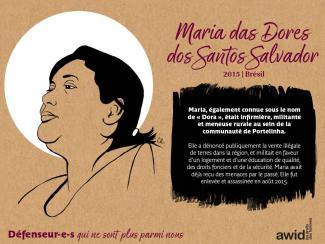
Maria das Dores dos Santos Salvador
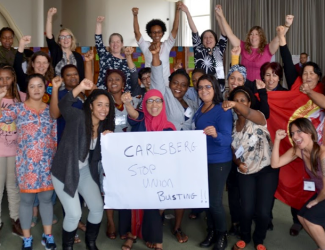
Women human rights defenders (WHRDs) worldwide defend their lands, livelihoods and communities from extractive industries and corporate power. They stand against powerful economic and political interests driving land theft, displacement of communities, loss of livelihoods, and environmental degradation.
Extractivism is an economic and political model of development that commodifies nature and prioritizes profit over human rights and the environment. Rooted in colonial history, it reinforces social and economic inequalities locally and globally. Often, Black, rural and Indigenous women are the most affected by extractivism, and are largely excluded from decision-making. Defying these patriarchal and neo-colonial forces, women rise in defense of rights, lands, people and nature.
WHRDs confronting extractive industries experience a range of risks, threats and violations, including criminalization, stigmatization, violence and intimidation. Their stories reveal a strong aspect of gendered and sexualized violence. Perpetrators include state and local authorities, corporations, police, military, paramilitary and private security forces, and at times their own communities.
AWID and the Women Human Rights Defenders International Coalition (WHRD-IC) are pleased to announce “Women Human Rights Defenders Confronting Extractivism and Corporate Power”; a cross-regional research project documenting the lived experiences of WHRDs from Asia, Africa and Latin America.
"Women Human Rights Defenders confronting extractive industries: an overview of critical risks and Human Rights obligations" is a policy report with a gender perspective. It analyses forms of violations and types of perpetrators, quotes relevant human rights obligations and includes policy recommendations to states, corporations, civil society and donors.
"Weaving resistance through action: Strategies of Women Human Rights Defenders confronting extractive industries" is a practical guide outlining creative and deliberate forms of action, successful tactics and inspiring stories of resistance.
The video “Defending people and planet: Women confronting extractive industries” puts courageous WHRDs from Africa, Asia, and Latin America in the spotlight. They share their struggles for land and life, and speak to the risks and challenges they face in their activism.
Challenging corporate power: Struggles for women’s rights, economic and gender justice is a research paper outlining the impacts of corporate power and offering insights into strategies of resistance.
AWID acknowledges with gratitude the invaluable input of every Woman Human Rights Defender who participated in this project. This project was made possible thanks to your willingness to generously and openly share your experiences and learnings. Your courage, creativity and resilience is an inspiration for us all. Thank you!
Conferencia Internacional de Seguimiento sobre la Financiación para el Desarrollo, Doha, Qatar
📅 Mardi 12 mars
🕒 de 9 h à 17 h HNE
🏢 Armenian Cultural Center, 630 2e avenue, coin de la 35e rue
Lancement du processus préparatoire intergouvernemental de la troisième Conférence sur le financement du développement, octobre 2014
The survey is for groups, organizations and movements working specifically or primarily for the rights of women, LBTQI+ people and on gender justice in all contexts, at all levels, and in all regions. If this is one of the core pillars of your group, collective, network or any other type of organization - whether registered or not, newly formed or long-standing, we invite you to take this survey.

*At this time, we are not asking for responses from individuals or funders.
Learn more about the survey:
Consult the F.A.Q.
Contenido relacionado
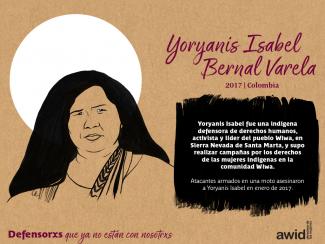
El Heraldo: Mujer asesinada en Valledupar era líder wiwa, defensora de derechos humanos
Survival: Colombia: lideresa indígena de Sierra Nevada asesinada
Further drafting sessions on the Addis Ababa outcome document
Learn more from the CSO Hitchhiker’s Guide
She was born in Bahia, the Northeastern part of Brazil. She is an immigrant, a social activist and a mother of 8 children.
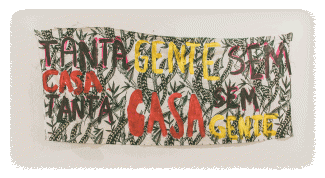
Carmen experienced homelessness at the age of 35, after migrating to Sao Paulo on her own. This led her to become a fierce advocate for vulnerable, marginalized and invisibilized communities most affected by the housing crisis. She eventually became one of the founders of MSTC in 2000.
As a visionary political organizer and the current leader of the MSTC, Carmen’s work has laid bare the city's housing crisis and provided inspiration to others on different ways to organize and manage occupations. She stood strong on the forefront of several occupations. One of them is the 9 de Julho Occupation, which now serves as a stage for direct democracy, and a space where everyone can be heard, seen, appreciated and work together.
Carmen has been long celebrated for her boldness in giving life back to abandoned buildings in the heart of São Paulo.
To know more about her life, you can follow her on Instagram!

To share your lived experience with mobilizing funding for your organizing