Special Focus

AWID is an international, feminist, membership organisation committed to achieving gender equality, sustainable development and women’s human rights

AWID Forum: Co-creating Feminist Futures

In September 2016, the 13th AWID international Forum brought together in Brazil over 1800 feminists and women’s rights advocates in a spirit of resistance and resilience.

This section highlights the gains, learnings and resources that came out of our rich conversations. We invite you to explore, share and comment!


What has happened since 2016?

One of the key takeaways from the 2016 Forum was the need to broaden and deepen our cross-movement work to address rising fascisms, fundamentalisms, corporate greed and climate change.

With this in mind, we have been working with multiple allies to grow these seeds of resistance:

And through our next strategic plan and Forum process, we are committed to keep developing ideas and deepen the learnings ignited at the 2016 Forum.

What happens now?

The world is a much different place than it was a year ago, and it will continue to change.

The next AWID Forum will take place in the Asia Pacific region (exact location and dates to be announced in 2018).

We look forward to you joining us!

About the AWID Forum

AWID Forums started in 1983, in Washington DC. Since then, the event has grown to become many things to many peoples: an iterative process of sharpening our analyses, vision and actions; a watershed moment that reinvigorates participants’ feminisms and energizes their organizing; and a political home for women human rights defenders to find sanctuary and solidarity.

Learn more about previous Forums

Related Content

Film club - intro

Dans le cadre de l’aventure de l’AWID sur les Réalités féministes, nous vous invitons à explorer notre tout nouveau Club de cinéma féministe : une collection de courts et longs métrages sélectionnés par des programmateurs·rices et narrateurs·rices féministes du monde entier, dont Jess X. Snow (Asie/Pacifique), Gabrielle Tesfaye (Afrique/diaspora africaine) et Esra Ozban (Asie du Sud-Ouest, Afrique du Nord). Alejandra Laprea est responsable du programme Amérique latine et centrale, que nous lancerons en septembre dans le cadre de Crear, Résister, Transformer : un festival pour les mouvements féministes porté par l’AWID. En attendant, surveillez les annonces sur les projections de films spéciaux et les discussions avec les réalisateurs·rices!

WITM - Refreshed DATA SNAPSHOTS - ES

Un vistazo a los datos

Nuestro poder colectivo, nuestra sabiduría y nuestro compromiso no tienen límites. Pero nuestras cuentas bancarias sí.

Las instantáneas de datos están basadas en las respuestas de 1.174 organizaciones feministas, por los derechos de las mujeres,  LGBTQI+ y aliadas (en adelante «organizaciones feministas y por los derechos de las mujeres») de 128 países a ¿Dónde está el dinero para las organizaciones feministas? la encuesta de AWID.  

Descarga aquí

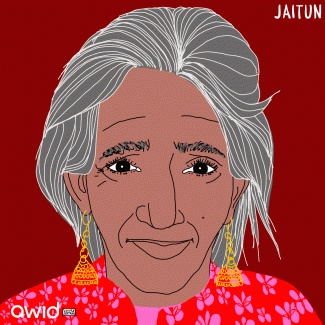
Jaitun

Jaitun, commonly referred to as ‘Amma’, was committed to ensuring the reproductive rights of women and girls in India. She was particularly dedicated to advocating for those living in poverty and who are most marginalized, including Dalit and Muslim women and girls.

Jaitun was the vital force behind the case Jaitun v Janpura Maternity Home & Ors. Her perseverance for justice led to a ground-breaking judgment issued by the High Court of Delhi, holding the Indian government accountable for failing to deliver a number of its legally-binding obligations such as reproductive health care and the right to food.

Her daughter Fatema who was living under the poverty line was denied reproductive services and had to deliver her child in public, under a tree. At the time, both Jaitun and Fatema were homeless as a result of their home being demolished by the government as part of redevelopment and gentrification in New Delhi.

“The judgment has since been used by countless lawyers and activists globally, including the Former United Nations Special Rapporteur on the Right to Health, not only as a source of inspiration but as a solid springboard to further justice.” - Jameen Kaur

Jaitun has inspired many other women living in poverty to claim their rights. She passed away in 2017.

“In Jaitun’s death, we have now lost an inimitable warrior for justice, but her spirit of defiance lives on.” - Jameen Kaur

“In my 18 years as a human rights advocate, I have not met a woman that has inspired and moved my spirit in the same way Amma did. Her roaring courage; her imitable humour - we used to compare her to the Bollywood actress Hema Melini - as she would be upset we had spent so much time away from her - she would say, with a twinkle in her eye, ‘You have forgotten Amma, Amma is not speaking to you’ and then with great dramatics turn her back, only to turn around laughing and stretching her arms out for a hug. Her kindness and ultimately her love and joy for love and the right for all of us to live with dignity. I miss her terribly.” - Jameen Kaur
 

Do I have to be an AWID member to participate in the Forum?

No, you don't have to be an AWID member to participate but AWID members receive a discounted registration fee as well as a number of other benefits.

Learn more on how to become an AWID member

Allez-vous ouvrir un appel à propositions ?

Oui ! Veuillez lire notre Appel à activités et vous inscrire ici. La date limite est fixée au 1er février 2024.

Cookies

We’re committed to protecting your privacy, so here we explain how we use cookies on our website.

If you have any questions, please get in touch via the form on our contact page.

What are cookies?

A cookie is a small data file downloaded by your web browser (for example Chrome or Internet Explorer) and stored on your computer. They are downloaded automatically when you visit websites. Cookies are used to perform essential tasks on a website, to record how people use a website and to gather data for marketing.

How we use cookies

We provide essential information on our website to millions of people every year. To do this, we have to manage our website effectively and to reach out to more people who need our support and information. Cookies are a small, but essential way to make all this happen. We use cookies to:

  1. To measure how people use our website. This helps us understand how well different sections of our website are performing. It also helps us track numbers of visitors and helps us ensure our website is robust and works well for every single one of the millions of people who use it.
  2. To record actions so that the website will work well for you. For example, our online shop uses cookies to record items that you place in your shopping basket. We also use cookies in our online donations process and in other tools such as our online breath test.
  3. We also record actions so we can reach people more effectively. This works by using a cookie to remember what pages you have visited so we can tailor our marketing messages based on your interests.

Change your cookie settings

You can update your cookie preferences by clicking on the button below.

Cookie Settings

In addition, most browsers allow you to manage cookies saved on your device – just go to the help section of your browser. To learn more about cookies and how to manage them, visit the ICO website.

Your rights

Cookies never record your credit card details or easily identifiable personal data such as your name and address. You have every right to refuse to accept cookies from our website.

If you disable cookies you will still be able to access nearly all the information on our website. But please remember that this may affect some functionality.

How to disable cookies

You can disable cookies by changing your settings in your web browser or you can use the incognito option on Google Chrome. To find out more about your browser settings, visit the relevant support page below:

Cookies used by this site

OURS 2021 - Chapter 1 es

Capítulo 1

Promover agendas feministas: progresos clave en género y sexualidad

La montée en puissance des antidroits a préparé son terrain. Nous devons comprendre la montée de l’ultranationalisme, du pouvoir incontrôlé des entreprises, de la répression croissante et de l’amenuisement de l’espace civique pour contextualiser les menaces actuelles contre nos droits.

Leer más

Snippet - COP30 - 6th International Rights of Nature Tribunal - ES

6to Tribunal International por los Derechos de la Naturaleza: Un nuevo compromiso con la Madre Naturaleza

Donde les organizadores de la primera línea de defensa conducen y las corporaciones rinden cuentas.

📅 Martes 11 de noviembre de 2025
📍 En línea y en la Universidade Federal do Pará, Belém

Más información aquí

Isabel Cabanillas de la Torre

Isabel Cabanillas de la Torre fue una activista joven y una artista feminista muy querida de Ciudad Juárez, México, conocida por sus hermosos diseños evocadores de indumentaria pintada a manoen los que los ojos eran una característica emblemática de su trabajo. Sus murales transformaron los edificios abandonados y vacíos del centro de Ciudad Juárez, al sumarles vida y crítica política a sus paredes.

A través de su arte y de su activismo político, Isabel buscó llamar la atención sobre la violencia de género que se extendía por su ciudad natal. Colaboró como voluntaria con la red Mesa de Mujeres en el proyecto «Observatorio Ciudadano de Género», que monitoreaba la actuación de jueces, fiscales y defensorxs públicxs en casos de femicidios y otras violaciones a los derechos basadas en el género. Integró también «Hijas De Su Maquilera Madre», una colectiva feminista cuyo nombre alude a las hijas de madres que son trabajadoras de la maquila. Algunas de estas madres fueron las primeras víctimas de femicidio en Ciudad Juárez.

El último proyecto de Isabel (todavía en curso) fue una instalación artística para protestar contra una compañía canadiense que quería extraer cobre de los Médanos de Samalayuca.

El 18 de enero de 2020 Isabel fue atacada a balazos mientras volvía a su casa del centro de Ciudad Juárez en bicicleta, víctima, aparentemente, de un asesinato selectivo. Su cuerpo fue encontrado junto a su bicicleta.

El asesinato de Isabel desató una nueva ola de indignación contra los femicidios de la región: cientos de personas marcharon hacia el puente de la frontera entre EEUU y México, y lo bloquearon durante horas mientras cantaban «Ni una más», que es la protesta continua de las colectivas feministas contra los asesinatos de las mujeres en todo México. Solamente en 2019, 3.142 mujeres y niñas fueron asesinadas en el país; muchas de ellas fueron atacadas específicamente por su género.

Amaba andar en bicicleta.

«La bicicleta era un símbolo de libertad para ella. Simbolizaba ser libre en las calles.» - Marisol, amiga de Isabel

My question isn’t answered here

For additional questions, please use our contact form, and select “14th AWID Forum" from the dropdown menu.

Contact us

How can I fund my participation in the AWID Forum?

If your group or organization receives funding, you might want to discuss with your funder already now if they are able to support your travel and participation to the Forum. Many institutions plan their budgets for next year early in 2023, so better not delay this conversation for next year.

Privacy and cookies - before 25 Apr 2023

AWID Privacy Policy, Your rights to privacy and cookies

This policy governs all pages hosted at www.awid.org, and any other websites under the control of the AWID (the “Website”) and registrations for these sites. It does not apply to pages hosted by organisations other than AWID, to which we may link and whose privacy policies may differ. Please read the following policy to understand our privacy policy regarding nature, purpose, using and sharing of your personal identifiable information that is collected via this website.

1. Types of information collected on this site

Generally, you can browse this website without submitting your personal information to us. However, in some circumstances, we will ask for your personal information.

1.1 Information you provide to us

When you are on the website and are asked for personal information, you are sharing that information only with AWID.

1.1.1 The information you provide to get updates from AWID:

When you register to use the website – for example, subscribe to receive emails from us or apply to become a member - you provide us with the mandatory information about you like Name, country, language to receive email updates and email address. This information is provided by you through secure forms and is stored on secure servers.

1.1.2 The payment information you provide to become member or registering for a paid event:

Also, while becoming a member or registering for events, you may need to provide payment information. AWID doesn’t store any credit card information on its servers and uses payment gateway to process the payment information.

1.1.3 The optional information you chose to give us as AWID member (with consent)

When you communicate with AWID, provide optional information through forms on the website or use the site to communicate with other members, we collect information about your communication and any information you choose to provide.

1.1.4 Information you provide us through contact forms or when you directly communicate with us

When you communicate with us, we collect your communication and any other information you choose to provide us.

1.2 Information that is automatically collected (third party cookies)

In addition, when you interact with the Website, our servers may keep an activity log that does not identify you individually (“Non-Personal Information”). Generally, we collect the following categories of Non-Personal Information:

  • We may collect certain demographic data such as age and gender as part of collecting personal information;
  • We collect and store certain device information about your computer, mobile device, or other device that you use to access the Website. This information may include IP address, geolocation information, unique device identifiers, browser type, browser language, and other transactional information;
  • We automatically log certain usage information about your use of the Website. This information includes a reading history of the pages you view. We use this information to provide you with a more customized experience on the Website;
  • We collect and store additional “traffic data” such as time of access, date of access, software crash reports, session identification number, access times, and referring website addresses; and
  • We collect and store your search terms and search results.
  • We also collect and store certain other information regarding our users’ use of the Website so that third parties may provide us with reports and analysis regarding usage and browsing patterns of the Website.

For more information about cookies, please see www.allaboutcookies.org.

If you do not wish to receive cookies you can easily modify your web browser to refuse cookies, or to notify you when you receive a new cookie, see how here.

2. Use of information collected on this website

AWID uses the information we collect about you to:

  • Better understand how you are using our website and what we could do to improve your experience.
  • Communicate with you via email to share resources and analysis in the field of women's rights, connect with you and provide opportunities to engage with our work, keep you updated about developments at AWID and with our partners.
  • Comply with our legal obligations to:
    • Detect and prevent fraud, spam, abuse, security incidents, and other harmful activity.
    • Conduct security investigations and risk assessments.
    • Verify or authenticate information provided by you (such as to verify your authorization to act as an agent on behalf of a nonprofit organization).
    • Conduct checks against databases and other information sources, to the extent permitted by applicable laws.
    • Resolve any disputes with any of our users or customers and enforce our agreements with third parties.
    • Enforce our Terms of Use and other policies.

3. Distribution of information

If you have subscribed to AWID´s e-newsletters or email updates or you have become a member, we will send you regular communications as specified in the relevant area of the website. You are able to unsubscribe from any of the e-newsletters or email updates at any time by using the unsubscribe information provided in our emails.

4. Accessing, changing and removing information

The accuracy of your individual identifying information is important to AWID. We are always looking for ways to make it easier for you to review and correct the information that AWID maintains about you through our website. If you change your email address, or if any of the other information we hold is inaccurate or out of date, please write to us here.

  • Where you have provided AWID with consent to use your personal data, you can withdraw it any time by sending us a communication and specifying which consent you are withdrawing. Please note that the withdrawal of your consent does not affect the lawfulness of any processing activities based on such consent before its withdrawal.
  • Where applicable, you may also have a right to receive a machine-readable copy of your personal data. If you would like to have a copy of the personal data we hold on you or if you think that we hold incorrect personal data about you, please write to us.
  • You also have the right to ask us to delete your personal data or restrict how it is used. There may be exceptions to the right to erasure for specific legal reasons which, if applicable, we will set out for you in response to your request.
  • At any time, regardless of applicable law, you may object to us processing your personal information for direct marketing purposes. You may, at any time, ask AWID to cease processing your data for these direct marketing purposes by Contacting Us.


5. Sharing information

Except as explained below, AWID will not disclose any of your personally identifiable information, and will not sell or rent lists containing your information to third parties. AWID may disclose information when it has your permission to do so or under special circumstances, such as when it believes in good faith that the law requires it.

6. Information security

We are continuously implementing and updating administrative, technical, and physical security measures to help protect your information against unauthorized access, loss, destruction, or alteration. Some of the safeguards we use to protect your information are firewalls and data encryption, and information access controls. If you know or have reason to believe that your AWID membership credentials have been lost, stolen, misappropriated, or otherwise compromised or in case of any actual or suspected unauthorized use of your AWID membership account, please contact us through on Contact Us.

7. Changes to this policy & Contacting us

This policy may change from time to time. The changed policy will be posted on this website and Last updated date at the end of the policy will be updated. There will be an email update sent to you for the revised policy and if you do not agree with the revised policy, you will have the option to cancel you registration(s) with us. You can also write to us here. We welcome your feedback!

Last updated: May 2019

Bibliothèque de ressources « Nos droits en danger »

Bibliothèque de ressources « Nos droits en danger »

Collection évolutive de ressources en soutien aux mouvements féministes, aux décideur·euse·s et aux allié·e·s pour contrer les fascismes, les fondamentalismes et résister aux tendances antidroits.

agent in action

Snippet - COP30 - Resistance Hubs Section Column 1 - FR

Alors que les dirigeant·es du monde se réunissent au Brésil, il est vital que les mouvements féministes, en particulier les pays de la Majorité globale, aient des espaces indépendants pour se rassembler, mettre au point des stratégies et bouleverser le cours des choses.

Ces pôles remettent en cause l’élitisme des discussions climat, se concentrent sur les expériences vécues et entendent construire le pouvoir collectif au-delà des frontières. Ils constituent un contrepoids critique aux négociations internationales verticales et souvent excluantes. Les pôles visent à encourager des solutions pilotées par la communauté, amplifier les revendications féministes et veiller à ce que les principes féministes de soin et de solidarité façonnent l’agenda climat. Il ne s’agit pas seulement d’être présentes à la COP30, il faut redéfinir la conversation sur la justice climatique, dans des termes féministes.

Aïssata Kane

Aïssata Kane, surnommée affectueusement “Yaye Kadia” (Mère Kadia), a de tout temps été une féministe engagée dans la défense des droits des femmes africaines, et particulièrement mauritaniennes.

Au cours de sa carrière politique, en 1975, elle fut nommée ministre de la protection de la famille et des affaires sociales et travailla avec ardeur à l’amélioration du statut des femmes dans son pays; c’était la première fois qu'une femme occupait un tel poste.   

Ce travail consista notamment à promouvoir l’éducation des filles et des femmes, à lutter contre la pratique du gavage sur les jeunes femmes, à faire pression pour l’inclusion d’une disposition sur les droits maritaux et à plaider en faveur de la création d’un quota de représentation féminine au Parlement.  

“[Aïssata] a réalisé toutes ses passions avec humilité, courage et détermination. Elle ne voulait déranger personne avec ce combat qu’elle menait sur tous les fronts à la fois.” Ball Halimata Dem, la nièce d’Aïssata

Ayant fondé l'Union nationale des femmes de Mauritanie (UNFM), elle avait cocréé et publié pour elles le magazine Marienou, dédié à l’émancipation des femmes mauritaniennes. Aïssata dirigea également plusieurs organisations sous-régionales et locales, notamment en tant que présidente de l'Association internationale des femmes francophones (AIFF) et, en écologiste résolue, fut présidente de l'Association pour la protection de l'environnement en Mauritanie (APEM). 

En 2018, on lui décerna le Prix de la Femme africaine pionnière. Ce prix honore son engagement à faire progresser le statut de la femme en Mauritanie et reconnaît son grand leadership et son sens de l'innovation.

Aïssata est décédée le 10 août 2019. 

Why did AWID choose Taipei as the location for the Forum?

We see Taipei as the location in the Asia Pacific region that will best allow us to build that safe and rebelious space for our global feminist community.

Taipei offers a moderate degree of stability and safety for the diversity of Forum participants we will convene. It also has strong logistical capacities, and is accessible for many travellers (with a facilitated e-visa process for international conferences).

The local feminist movement is welcoming of the Forum and keen to engage with feminists from across the globe.

Read more about our considerations when choosing Taipei

¿Cómo se conecta el Foro de AWID con espacios regionales y otros?

Estamos en comunicación con reuniones regionales, temáticas y de donantes planificadas para 2023-2024, para garantizar el flujo de conversaciones y conexiones. Si estás organizando un evento y deseas establecer una conexión con el Foro de AWID, ¡por favor contáctanos!