15 Resources for Activism for Safe and Legal Abortion
Today, we come together to declare that our bodies, health, and choices are our own, and cannot be held back by oppressive fundamentalisms and discourses that seek to lay claim to us.
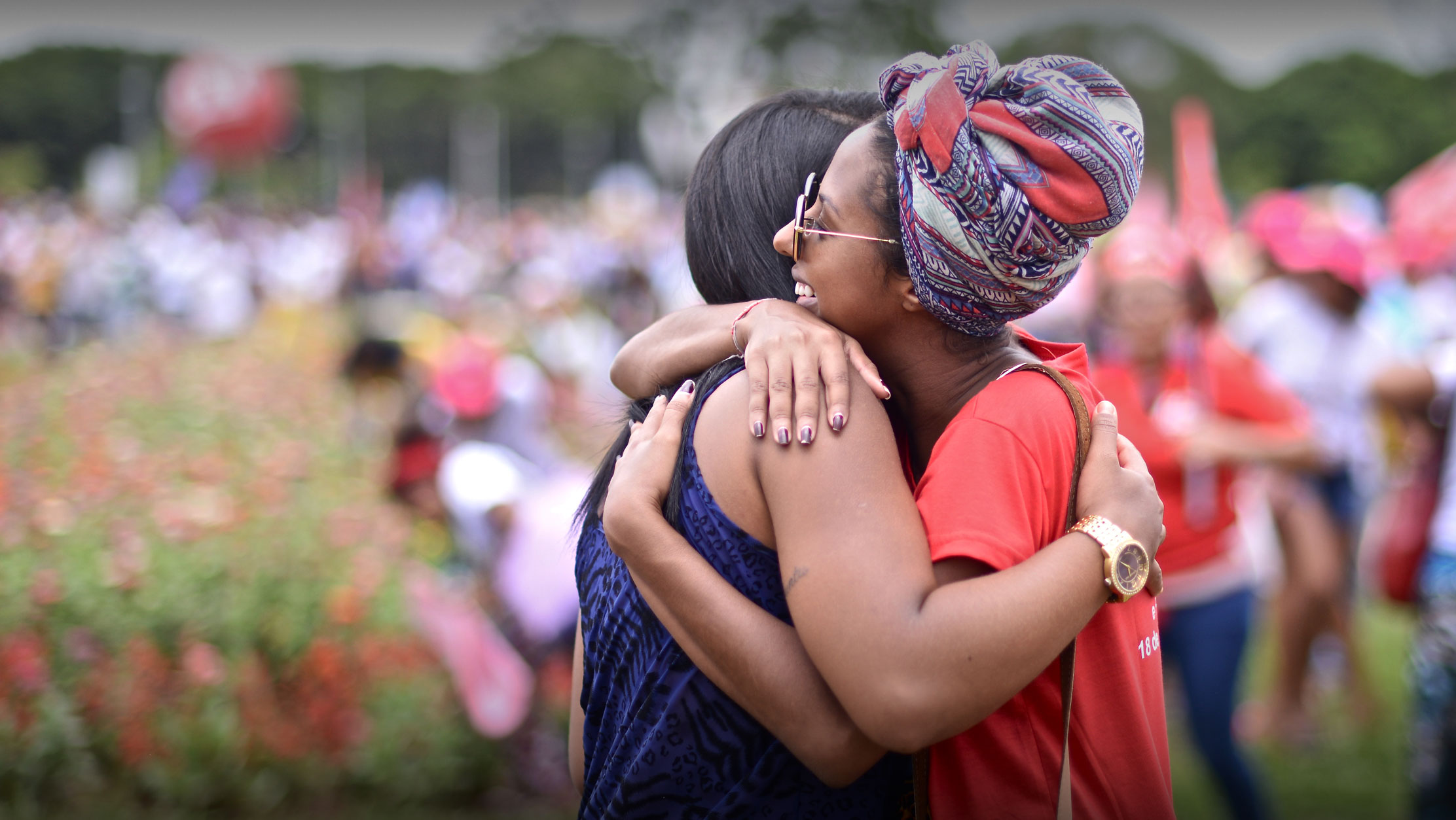
Today, we come together to declare that our bodies, health, and choices are our own, and cannot be held back by oppressive fundamentalisms and discourses that seek to lay claim to us.
Recently, we introduced five of AWID’s incredible members in the first part of our series “Member Musings ahead of the AWID Forum”. They shared what gets them excited about the Forum, how they or their movement will contribute to building collective power for rights and justice, and how being in Bahia, Brazil with thousands of other activists help strengthen the diverse work they do.
We thought now will be a great time to do a throwback to some highlights from the past three AWID Forums (2005 in Thailand, 2008 in South Africa, 2012 in Turkey) and for those who have not been to an AWID Forum, we hope this will give you some insight into why thousands of activists attend AWID Forums.
FINAL NGO MG intervention to the official meeting 7/18/2016.
Civil society and women human rights defender organizations worldwide strongly condemn the proposal of the ARENA party to reform the Penal Code in El Salvador.
Close your eyes and imagine the global economic systems of your dreams. One in which feminist theory and practice are integrated and concepts like market, growth, and profit are replaced with solidarity, sharing of resources and collective well being.
At the 31stSession of the Council, the report that was mandated by the protection of family resolution in the 29th Session was tabled. The report was the outcome of a controversial resolution in the 29th Session of the Council which was sponsored by a cross-regional group of states including Egypt, Cote d’Ivoire, El Salvador, Mauritania, Morocco, Russian Federation, Tunisia, Uganda, Qatar, Belarus, China and Bangladesh.
To the development community on International Day of Action for Women’s Health: don’t curtail our rights by legitimising conservative religious ideologies.
Solidarity with the struggle and resistance of feminists and diverse social movements in Brazil.
Religious fundamentalisms are gaining ground within communities, political systems, international arenas with devastating effects for ordinary people, and for women in particular. There is an urgent need to resist religious fundamentalist advances, and development actors are in a position to take a strong role in this.