Young Feminist Activism
Organizing creatively, facing an increasing threat
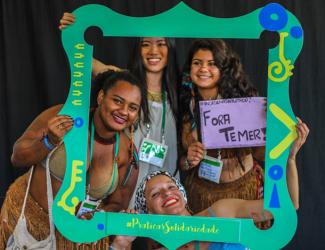
Young feminist activists play a critical role in women’s rights organizations and movements worldwide by bringing up new issues that feminists face today. Their strength, creativity and adaptability are vital to the sustainability of feminist organizing.
At the same time, they face specific impediments to their activism such as limited access to funding and support, lack of capacity-building opportunities, and a significant increase of attacks on young women human rights defenders. This creates a lack of visibility that makes more difficult their inclusion and effective participation within women’s rights movements.
A multigenerational approach
AWID’s young feminist activism program was created to make sure the voices of young women are heard and reflected in feminist discourse. We want to ensure that young feminists have better access to funding, capacity-building opportunities and international processes. In addition to supporting young feminists directly, we are also working with women’s rights activists of all ages on practical models and strategies for effective multigenerational organizing.
Our Actions
We want young feminist activists to play a role in decision-making affecting their rights by:
-
Fostering community and sharing information through the Young Feminist Wire. Recognizing the importance of online media for the work of young feminists, our team launched the Young Feminist Wire in May 2010 to share information, build capacity through online webinars and e-discussions, and encourage community building.
-
Researching and building knowledge on young feminist activism, to increase the visibility and impact of young feminist activism within and across women’s rights movements and other key actors such as donors.
-
Promoting more effective multigenerational organizing, exploring better ways to work together.
-
Supporting young feminists to engage in global development processes such as those within the United Nations
-
Collaboration across all of AWID’s priority areas, including the Forum, to ensure young feminists’ key contributions, perspectives, needs and activism are reflected in debates, policies and programs affecting them.
Related Content
Umyra Ahmad
Umyra Ahmad is a Malaysian feminist with a background in international and regional advocacy, and human rights education. In AWID, she works on advancing rights related to gender and sexuality at the UN. Prior to joining, she was a programme officer at IWRAW Asia Pacific, where she supported regional, national and grassroots organizations in using UN treaty body mechanisms as a tool for state accountability and access to justice. In Malaysia, she works with queer and refugee collectives and supports coordination of various mutual aid initiatives.
Puis-je vous contacter si j’ai des questions ou des inquiétudes?
Si vous avez des questions ou des inquiétudes, merci de nous contacter par le biais de ce formulaire, en indiquant « Enquête WITM » dans l’objet de votre message. Vous pouvez également nous écrire à witm@awid.org.
A Collective Love Print | Small Snippet EN
A Collective Love Print
“If we can inherit trauma, can we inherit an imprint related to love?”
Teresa Scalzo, Esq.
Joanne Kobuthi-Kuria
Joanne es una feminista africana que siente pasión por la lucha contra las desigualdades de género en el continente africano. Ha trabajado con varias organizaciones, medios de comunicación y grupos de reflexión globales, incluidos Amnistía Internacional, Wrthy, el Instituto de Investigación en Desarrollo Local, la BBC, la Comunidad de África Oriental (CAO), entre otros. Integra la junta de Freely in hope, una ONG radicada en Kenia y Zambia, que busca capacitar a lxs sobrevivientes y defensorxs para convertirse en líderes de la lucha para poner fin a la violencia sexual, y de Msingi Trust, un movimiento de activistas que trabajan en la confluencia de la fe y los derechos humanos. Posee una maestría en Administración de Empresas, maestrías en Política Pública y una licenciatura en Derecho. Tiene adicción por los libros, en especial, por la literatura de ficción.
Denis Ramirez Meza
Snippet - WITM To build - AR

لبناء وقائع نسوية ترتكز على الأدلة عن كيف يتحرك المال ولمن يصل
Crear | Résister | Transform: A Walkthrough of the Festival - smaller snippet AR
“ابدعي، قاومي، غيّري”: جولة في المهرجان
مع استمرار الرأسمالية الأبوية الغيريّة في دَفعِنا نحو الاستهلاكية والرضوخ، نجد نضالاتنا تُعزَل وتُفصَل عن بعضها الآخر من خلال الحدود المادّية والحدود الافتراضية على حدٍّ سواء.
Guadalupe Campanur Tapia
Guadalupe was an environmental activist involved in the fight against crime in Cherán, Mexico.
Guadalupe helped to overthrow the local government in April 2011 and participated in local security patrols including those in municipal forests. She was among the Indigenous leaders of Cherán, who called on people to defend their forests against illegal and merciless logging. Her work for seniors, children, and workers made her an icon in her community.
She was killed in Chilchota, Mexico about 30 kilometers north of her hometown of Cherá.
Maria Olivo
Maria est graphiste et communicatrice visuelle. Elle a travaillé dans le secteur des Organisations Non-Gouvernementales et des droits humains, avec par exemple Profamilia et OXFAM. En tant que femme du Sud Global, elle se sent particulièrement appelée à utiliser ses compétences pour travailler avec des organisations qui contribuent à protéger le bien-être ainsi que les droits de millions de filles et de femmes en Amérique latine.
Emilia Quan
Snippet - WITM Why now_col 1 - AR
لماذا الآن؟

تتواجد الحركات النسوية، حركات حقوق النساء، حركات العدالة الجندرية، حركات مجتمع الميم - عين وحلفاءها/ يفاتها في مفترق شديد الأهمية وتواجه هجمات عصيبة على حقوق وحريات حصلت عليها. فتصاعد الاستبداد في الأعوام الأخيرة، وكذلك القمع العنيف للمجتمع المدني وتجريم النساء والأشخاص المتنوعين/ات جندرياً المدافعين عن حقوق الإنسان، تصاعد الحروب والأزمات في الكثير من أنحاء العالم، استمرار الظلم الاقتصادي والتقاطع بين الصحة، البيئة والأزمة المناخية.
Winnie Madikizela- Mandela
A Winnie la han descripto como una «militante agitadora» que luchó contra el régimen del apartheid en Sudáfrica.
Fue encarcelada numerosas veces y en varias ocasiones fue encerrada en celdas de aislamiento. Ma’Winnie, como la recuerdan afectuosamente, era conocida por hablar abiertamente sobre los desafíos que las mujeres negras enfrentaron durante y después del apartheid, habiendo sido ella misma sometida a esas brutalidades como madre, esposa y activista durante la lucha. Fue más allá del concepto erróneo que sostiene que el liderazgo está basado en el género, la clase o la raza. A pesar de haber sido una figura controvertida, es recordada por muchxs por su nombre en xhosa, «Nomzamo», que significa «la que soporta las pruebas».
Ma’Winnie sigue siendo una inspiración para muchxs, especialmente las jóvenes sudafricanas.
Su muerte incentivó un creciente movimiento bajo el lema: «Ella no murió, se multiplicó».
Christine Hayhurst
With over 30 years of finance experience, Christine has devoted her career to furthering nonprofit missions on a global scale. Her contributions extend to serving as Treasurer on the Board of an NGO. Christine joined AWID in 2007 as Controller and in 2023 took on the role as Director of Finance. During her spare time she enjoys traveling, gardening and hiking.
Fany Puyesky
Snippet - WITM RESOURCES - AR
المصادر
(متوفرة باللغة الإنجليزية)
Promenade Artistique Féministe
Annonce de programme par Rula Khoury
Dans le cadre de notre engagement à nouer des liens plus profonds avec des artistes via nos pratiques de co-création de Réalités Féministes, AWID a collaboré avec un Groupe de Travail Artistique visant à faire progresser et à renforcer les programmes et réalités féministes, dans les communautés et mouvements via l’expression créative. Notre intention ici est de rassembler des féministes créatifs·ves dans un espace puissant et audacieux pour grandir et vivre librement, et briser les récits toxiques en les remplaçant par des alternatives transformatrices.
Cette exposition rassemblera le travail d’artistes et de collectifs du monde entier, de celle.ux qui créent activement la différence que nous voulons voir dans ce monde. Ces féministes créatifs·ves comprennent Upasana Agarwal, Nicole Barakat, Siphumeze Khundayi, Katia Herrera, Ali Chavez Leeds, Colectivo Morivivi, Ika Vantian, ainsi que les organisateurs·rices de l’exposition #MeToo en Chine. Leurs voix résonnent avec force dans leur refus d'accepter les limites imposées par le patriarcat, et amplifient leurs engagements envers les communautés dans lesquelles, et avec lesquelles, i.elles travaillent. Chaque œuvre représente, à sa façon, des actes de résistance quotidienne, des histoires et des identités inédites, des liens avec la terre et nos ancêtres et, plus important encore, la solidarité qui existe au sein et entre les mouvements et luttes féministes. Ces artistes inspirent et sont inspiré·e·s par des stratégies créatives de résistance et d'initiatives féministes qui nous montrent comment nous pouvons vivre ensemble dans un monde plus juste - un monde qui place au centre le soin et la guérison.
Barin Kobane
Barin était membre de l’unité de combat exclusivement féminine des Unités de protection du peuple kurde (YPG).
Elle a été tuée alors qu’elle était en service actif.
La journaliste libanaise Hifaa Zuaiter a écrit : « Barin représente tout ce que nous avons entendu à propos du courage des femmes kurdes et sa mort représente bien plus que le meurtre d’un-e rival-e ou une perte résultant d’une lutte politique ou ethnique. L’exhibition monstrueuse de sa dépouille par un groupe de rebelles syriens provient du fait qu’en tant que femme combattant sur un champ de bataille réservé aux hommes, elle a osé menacer l’hégémonie masculine ».