Young Feminist Activism
Organizing creatively, facing an increasing threat
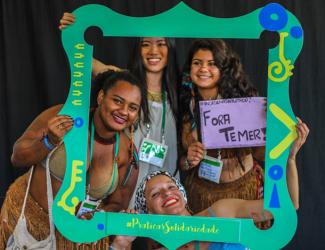
Young feminist activists play a critical role in women’s rights organizations and movements worldwide by bringing up new issues that feminists face today. Their strength, creativity and adaptability are vital to the sustainability of feminist organizing.
At the same time, they face specific impediments to their activism such as limited access to funding and support, lack of capacity-building opportunities, and a significant increase of attacks on young women human rights defenders. This creates a lack of visibility that makes more difficult their inclusion and effective participation within women’s rights movements.
A multigenerational approach
AWID’s young feminist activism program was created to make sure the voices of young women are heard and reflected in feminist discourse. We want to ensure that young feminists have better access to funding, capacity-building opportunities and international processes. In addition to supporting young feminists directly, we are also working with women’s rights activists of all ages on practical models and strategies for effective multigenerational organizing.
Our Actions
We want young feminist activists to play a role in decision-making affecting their rights by:
-
Fostering community and sharing information through the Young Feminist Wire. Recognizing the importance of online media for the work of young feminists, our team launched the Young Feminist Wire in May 2010 to share information, build capacity through online webinars and e-discussions, and encourage community building.
-
Researching and building knowledge on young feminist activism, to increase the visibility and impact of young feminist activism within and across women’s rights movements and other key actors such as donors.
-
Promoting more effective multigenerational organizing, exploring better ways to work together.
-
Supporting young feminists to engage in global development processes such as those within the United Nations
-
Collaboration across all of AWID’s priority areas, including the Forum, to ensure young feminists’ key contributions, perspectives, needs and activism are reflected in debates, policies and programs affecting them.
Related Content
Snippet FEA Principles of Work (EN)
Principles
OF WORK
Questions (Forum page)
Questions?
Do you have questions regarding the AWID Forum or related activities? We have answers!
Ika Vantiani

Bunga ou fleur en francais est un symbole qui est souvent associé aux femmes en Indonésie. Ce qui signifie qu'une fleur peut également être associée aux femmes transgenres. Parce que les femmes transgenres sont des femmes. Aussi belles, aussi fortes, l’une comme l’autre a vécu sans attendre d'être "cueillie", mais en grandissant, en s'épanouissant et en mourant à sa guise. Cette œuvre est un hommage à mes ami·e·s transgenres à l'occasion de la Journée Internationale de la Visibilité des Personnes Transgenres.
À propos d’Ika Vantiani

Est-ce que plusieurs personnes d’un même groupe peuvent répondre séparément aux questions de l’enquête WITM?
Non, nous souhaitons recevoir une seule participation par groupe.
Orouba Barakat
Snippet FEA Principles of work Education and Learning (ES)

EDUCACIÓN Y APRENDIZAJE CONSTANTE
FRMag - Editors Note (ES)
Nota de la editora
Las Realidades Feministas son una invitación cálida y afectuosa, una suerte de acto de cuidado y preservación colectivo (en oposición al autocuidado), una invitación a atesorar, a hacer inventario de toda la labor realizada para que no desaparezca. (...)
Natalia Estemirova
Understanding the Context of Anti-Rights Threats
Chapter 2
While fundamentalisms, fascisms and other systems of oppression shapeshift and find new tactics and strategies to consolidate power and influence, feminist movements continue to persevere and celebrate gains nationally and The rising power of anti-rights actors is not happening in a vacuum. Understanding the rise of ultra-nationalism, unchecked corporate power, growing repression, and diminishing civic space is key to contextualize the anti-rights threats we face today.

Danger - Trump and the Far Right.
Today, considerably more than half of the world’s population is governed by far-right leaders. Against this backdrop, human rights defenders and feminists are working hard to “hold the line” and protect multilateralism and the international human rights system. They also face the risk that their engagement may bring with it violent reprisals. At the same time, these institutions are increasingly subject to private sector interests. Large businesses, particularly transnational corporations, are occupying seats at the negotiating table and leadership positions in a number of multilateral institutions, including the UN. This nexus of ultra-nationalism, closing civic space, and corporate capture is having a tremendous impact on whether human rights for all can ever be achieved.
Table of Contents
- Nationalism and Ultra-nationalism
- Corporate Capture: Untamed Corporate Power is Putting Rights at Risk
- Reprisals and Closing Civic Spaces for Feminist Activists, and LGBTIQ+ and Women Human Rights Defenders
- Movement Resistance Story: CEDAW’s Article 16: A Pathway for Reformation of Discriminatory Family Laws in Muslim Contexts
Can I access and fill the survey from my phone?
Yes, the survey can be accessed using a smartphone.
Leyla Yıldızhan (Deniz Fırat)
Snippet FEA Story 1 Maps Economies of Care (FR)

FRMag - My queer Ramadan
Mon Ramadan queer
par Amal Amer
Je prie en famille pour la première fois en six ans, recouvert.e d’un keffieh que j’ai déniché dans une poubelle. (...)
illustration : « Les anges aussi sortent la nuit », par Chloé Luu >
Nuala Fennell
Promover agendas feministas: progresos clave en género y sexualidad
Capítulo 1
Mientras los fundamentalismos, los fascismos y otros sistemas de opresión cambian de forma y encuentran nuevas tácticas y estrategias para consolidar su poder e influencia, los movimientos feministas siguen perseverando y celebrando logros a nivel nacional y en espacios regionales e internacionales.

Un grupo de mujeres recrea la marcha de mujeres de 1956 a Pretoria para protestar contra las leyes de pases.
Por ejemplo, en 2019, se dio un paso significativo en el Consejo de Derechos Humanos, cuando la ONU reconoció por primera vez el derecho a la integridad y autonomía corporal. Varias resoluciones del Consejo sobre la discriminación contra mujeres y niñas también reconocen que la reacción está vinculada con grupos de presión regresivos, con perspectivas ideológicas o con el uso inapropiado de la cultura o la religión para oponerse a los derechos igualitarios de mujeres y niñas. También hemos visto progresos feministas en el trabajo de Procedimientos Especiales de la ONU (funcionarixs independientes), tales como enfatizar la obligación de los Estados de oponerse a las narrativas de ideología de género, denunciar el uso inapropiado por parte de los actores antiderechos de referencias a la «cultura», y enfatizar que las creencias religiosas no pueden ser utilizadas como justificación de la violencia o la discriminación.
Índice de contenidos
- Nivel nacional
- Espacios internacionales
- Ejercicio: ¡Esquematicemos y celebremos nuestras victorias!
¿Tendré oportunidad de compartir mi opinión sobre cuestiones que no se hayan incluido en la encuesta?
Sí, invitamos a compartir más impresiones acerca de alguna cuestión que sea de importancia para ti respondiendo a las preguntas abiertas al término de la encuesta.