Organizing creatively, facing an increasing threat
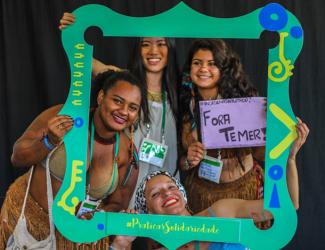
Young feminist activists play a critical role in women’s rights organizations and movements worldwide by bringing up new issues that feminists face today. Their strength, creativity and adaptability are vital to the sustainability of feminist organizing.
At the same time, they face specific impediments to their activism such as limited access to funding and support, lack of capacity-building opportunities, and a significant increase of attacks on young women human rights defenders. This creates a lack of visibility that makes more difficult their inclusion and effective participation within women’s rights movements.
A multigenerational approach
AWID’s young feminist activism program was created to make sure the voices of young women are heard and reflected in feminist discourse. We want to ensure that young feminists have better access to funding, capacity-building opportunities and international processes. In addition to supporting young feminists directly, we are also working with women’s rights activists of all ages on practical models and strategies for effective multigenerational organizing.
Our Actions
We want young feminist activists to play a role in decision-making affecting their rights by:
Fostering community and sharing information through the Young Feminist Wire. Recognizing the importance of online media for the work of young feminists, our team launched the Young Feminist Wire in May 2010 to share information, build capacity through online webinars and e-discussions, and encourage community building.
Researching and building knowledge on young feminist activism, to increase the visibility and impact of young feminist activism within and across women’s rights movements and other key actors such as donors.
Promoting more effective multigenerational organizing, exploring better ways to work together.
Supporting young feminists to engage in global development processes such as those within the United Nations
Collaboration across all of AWID’s priority areas, including the Forum, to ensure young feminists’ key contributions, perspectives, needs and activism are reflected in debates, policies and programs affecting them.
Priscilla has nearly two decades of experience working in the non-profit sector with social justice organizations that worked on women and youth rights, conservation, peacebuilding and development. Her interests are in setting up progressive processes and systems that will help an organization live to their values and principles and thrive, and finding ways to support organizations and fundraisers to locate and secure the resourcing they need to do good work. . Priscilla joined AWID in 2018 as Resource Mobilization Manager and in July 2023, took on the role of Director of Operations and Funding Partnerships.
Priscilla holds an MSc in International Politics from the School of Oriental and African Studies (SOAS), a growing pile of books she is still trying to find time to read, and sits on the Board of Hodan Somali Community, a London-based charity.
“I’m no adherent to the concept of the ‘Third World’. I make films so that people - no matter what race or color they are - can understand them. For me there are only exploiters and the exploited, that’s all. To make a film means to take a position.” - Sarah Maldoror
Sarah Maldoror, a French filmmaker of West Indies descent, was a pioneer of Pan-African cinema. At the core of her work, she placed political concerns along with her longstanding involvement in decolonization movements.
Her groundbreaking film and “revolutionary picture” Sambizanga (1972) follows Angolan militants’ anti-colonial liberation struggle, as well as captures a woman’s perspective in a historical moment she finds herself in.
“For many African filmmakers, cinema is a revolutionary tool, a political education to raise consciousness. It is inscribed in the evolution of a Third Cinema striving to decolonize thought and advocate radical changes in society.” - Sarah Maldoror
Throughout her career, Sarah - together with a number of African and Caribbean artists - co-founded (1956) the first Black theatre troupe in France. She made around 40 films, comprising important documentaries that amplify the lives and work of black artists, including her friend and poet Aimé Césaire who wrote to her:
“To Sarah Maldo
who, a camera in hand,
fights oppression, alienation
and flies in the face
of human bullshit.”
Sarah was also committed to giving African women more ownership of the filmmaking process. In an interview, she pointed out:
"African women must be everywhere. They must be in the images, behind the camera, in the editing room and involved in every stage of the making of a film. They must be the ones to talk about their problems."
Sarah left an incredibly powerful legacy to be carried forward.
Born 19 July 1929, Sarah passed away on 13 April 2020 from complications of the coronavirus.
Creemos que para que los movimientos feministas sean transformadores y sólidos debemos seguir trabajando en nuestras similitudes y diferencias. También debemos cuestionar el poder y los privilegios, tanto dentro como fuera de nuestros movimientos.
Clone of Snippet - Intro WITM - FR
Where is the Money for Feminist Organizing? Survey Results
Thanks to our global feminist community! From May to August 2024, nearly 1,200 organizations working for Women's rights, gender justice, and LBTQI+ equality shared their experiences in the WITM survey. The results offer a unique picture of how feminist movements are resourced and where gaps remain.
Stay tuned for the upcoming report for more analysis!
Marta es une investigadore y activista queer transfeministe no binarie de la antigua Yugoslavia que, actualmente, reside en Barcelona. Trabaja como organizdore de movimientos transnacionales, economista feminista y constructore de sistemas alternativos. Es confundadore y une de les coordinadores de Global Tapestry of Alternatives, un proceso global que busca identificar, documentar y poner en contacto alternativas de tapicería en los ámbitos local, regional y mundial. En el plano local, participa en organizaciones transfeministas, queer, de personas migrantes y contra el racismo. Además, posee un doctorado en Ciencias Ambientales y Tecnología de la Universidad Autónoma de Barcelona, centrado en las perspectivas feministas decoloniales de un pluriverso de alternativas sistémicas y la creación de sistemas alternativos feministas, basados en el cuidado y la sostenibilidad de la vida. En sus ratos libres, disfruta del boxeo, tocar la guitarra y la batería como integrante de una banda de samba, también se recrea en la fotografía, el senderismo, en cocinar para sus afectos y malcriar a sus dos gatos.
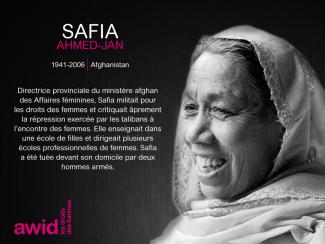
María Digna Montero fue una garífuna (afrodescendiente e indígena) defensora de la tierra e integrante de la Organización Fraternal Negra Hondureña (OFRANEH), una organización de base que trabaja para proteger a las comunidades garífunas, sus derechos ancestrales, su cultura, sus recursos y su territorio.
María también enseñaba en la escuela local, e integraba el grupo de trabajo de Educación Bilingüe Intercultural de OFRANEH.
El 12 de octubre (Día de la Resistencia Indígena) de 2019, sujetos desconocidos le dispararon a María varias veces en el patio de su casa.
Fue una de las seis defensoras garífunas asesinadas entre septiembre y octubre de 2019 y, según OFRANEH, no hubo ninguna investigación de estos crímenes por parte de las autoridades. En un comunicado oficial, la organización también subrayó la conexión entre la violencia contra líderes garífunas y el incremento de las industrias extractivas que explotan los recursos naturales en sus comunidades, y definieron esta violencia como «parte de una estrategia de intimidación y de expulsión sistemática por parte del Estado de Honduras.»
«El recrudecimiento de la tensión y de los riesgos crecientes para la seguridad y derechos humanos de las lideresas en las comunidades y territorios ancestrales es producto del despojo, desplazamiento y criminalización hacia las comunidades, y de los mega proyectos extractivos que impulsa el Estado junto con las corporaciones nacionales e internacionales.» - Pronunciamiento de OFRANEH, 13 de octubre de 2019
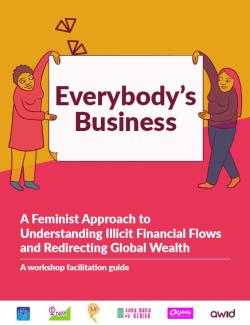
Download your faciliation guide:
"A Feminist Approach to Understanding Illicit Financial Flows and Redirecting Global Wealth"
Remplissez votre formulaire d'adhésion et indiquez votre contribution à au moins un type d'action proposé.
Consultez vos courriels et vérifiez que vous avez bien reçu votre dossier de bienvenue numérique confirmant votre inscription.
Effectuez les actions pour lesquelles vous vous êtes engagé·e lors de votre inscription.
Snippet - COP30 Intro
Join the feminist movement reclaiming climate action from corporate capture
With 1,773 fossil fuel lobbyists at last year's COP29, we're heading alongside other feminists to Belém, Brazil for COP30, from 10 November – 21 November 2025, where we will continue to denounce false solutions, call out corporate capture, demand that States uphold their commitments under the Common but Differentiated Responsibilities and Respective Capabilities and push for feminist economic alternatives.
$2.7 trillion for the military. $300 billion for climate justice. We're here to flip the script.
Elina est une jeune avocate des droits humains afro-dominicaine et féministe intersectionnelle, engagée à utiliser sa voix et ses compétences pour construire un monde plus juste, empathique et inclusif. Elle a commencé la faculté de droit à 16 ans, convaincue que cela lui donnerait les outils nécessaires pour comprendre et promouvoir la justice sociale. Après un JD (doctorat en droit) en République dominicaine, elle a poursuivi un LL.M. (maîtrise en droit) en droit international public et droits humains au Royaume-Uni en tant que boursière Chevening. Seule femme latino-caribéenne de sa classe, elle a obtenu son diplôme avec distinction.
Elina a travaillé à l'intersection des droits humains, du genre, de la migration et de la politique et ceci à plusieurs niveaux : des instances étatiques aux collectifs de base aux organisations internationales. Elle a aidé à plaider des cas de violence sexiste devant la Cour interaméricaine des droits de l'homme. En tant que membre du Groupe consultatif des jeunes du FNUAP, elle a contribué au renforcement des droits sexuels et reproductifs en République dominicaine. Elle a codirigé la première campagne d'Amnesty International sur les droits des travailleur.euse.s du sexe dans les Amériques, développant des partenariats solides avec des organisations dirigées par des travailleur.euse.s du sexe et utilisant la position d'Amnesty pour amplifier la voix des femmes défenseurs des droits humains et des travailleur.euse.s du sexe. Elina fait partie de Foro Feminista Magaly Pineda et de la Global Shapers Community. Elle parle espagnol, français et anglais.
Grâce à la richesse de son expérience, Elina apporte à l’AWID de solides compétences de gouvernance et de planification stratégique et un savoir-faire éprouvé en matière de mécanismes des Nations Unies et des droits humains régionaux. Elle affirme également très clairement sa détermination à continuer de faire de l’AWID une organisation inclusive pour toutes les femmes, et particulièrement les jeunes féministes et celles des Caraïbes. C’est avec la diversité de ces apports qu’Elina rejoint une sororité de féministes internationales qui ont du mordant. Elle pourra continuer à y développer son leadership féministe, pour ne plus jamais se sentir seule dans cette voie.
Nilcéa Freire était une activiste, politicienne et universitaire brésilienne. Ardente défenseuse des droits des femmes et des minorités sous-représentées dans le pays, sa vie et son travail ont été marqués par une longue histoire de luttes et de victoires.
"Nous devons, tout en résistant, continuer à chercher à progresser, et ce que nous pouvons accomplir actuellement, je pense que nous le devons à la fantastique organisation des jeunes femmes blanches, et surtout des femmes noires, dans toutes les capitales d’États et les grandes villes brésiliennes.” - Nilcéa Freire
En 1999, elle est devenue la première femme à occuper le poste de doyenne de l'université d'État de Rio de Janeiro. Elle y a dirigé la mise en œuvre de la première politique d'action positive pour les étudiant·e·s des écoles publiques, demandant au sein d’une école publique que des places soient spécifiquement réservées aux étudiant·e·s noir·e·s à faible revenu. Ce système a été adopté dans des dizaines d'autres universités publiques.
Quelques années plus tard, Nilcéa dirigea le Secrétariat spécial des politiques pour les femmes sous le gouvernement de l'ancien président Luiz Inácio Lula da Silva. C’est à ce titre qu’elle conduisit la première Conférence nationale des femmes. Plus de 12 000 femmes de tout le pays y participèrent et le résultat de ce travail collectif fut incorporé dans le Plan national des politiques pour les femmes.
Son engagement envers les femmes, les Afro-Brésilien·ne·s et les populations autochtones se reflète aussi fortement dans son travail de défense de leurs droits, qu’elle a mené dans le cadre des initiatives du bureau de la Fondation Ford du Brésil, dont elle était la directrice régionale.
L’activiste féministe Manoela Miklos a dit de Nilcéa qu'elle était "une femme sans égal·e".
Nilcéa s’est éteinte à Rio de Janeiro à l'âge de 66 ans, le 29 décembre 2019, des suites d’un cancer.
"Je n’ai pas de mots face à l’annonce de la mort de notre chère Nilcéa Freire. Il m’est trop triste de savoir qu’elle est partie si tôt. Elle s’est toujours rangée du côté de celleux qui ne tolèrent pas les injustices de ce monde. Elle était la ministre des femmes, sans cesse engagée dans la cause féministe. Elle nous manquera beaucoup!” - Jandira Feghali, Federal Deputy
A Film Series on Feminist Realities from Africa and the African Diaspora
by Gabrielle Tesfaye
When I created my short animation film, The Water Will Carry Us Home, my mind was plugged into a magical world of fearless resilience and ancestral mermaids who transformed their deepest scars into a new generation of life. Set during the time of the transatlantic slave trade, I was pulled to show this history of African enslavement in a different way than it has ever been told on screen. I wanted to give my ancestors the commemoration they never received. I was motivated to reclaim the history that continues to paint us as helpless victims. Essentially, I wanted to tell the truth. To reclaim and reimagine our history and perspective, means to simultaneously heal our generational traumas that exist today. It is this important work that so many women through the African continent and the African diaspora are doing today, igniting our collective Feminist Realities.
In the making of the film I researched religiously, and in what was written, I saw what was not. There were many times I felt I was hitting a wall trying to find something that was not there, and it was in those voided places that I realized the storytellers of today are filling the voids. I found the most useful stories in contemporary art, film, and African diaspora folklore.
“... a truly unique, raw and representation of feminist power in action.”
The Water Will Carry Us Home carried itself around the world into the hearts of the Diaspora. It also led me here, as the curator of the African and Diaspora film screenings of AWID’s Co-Creating Feminist Realities initiative. Whilst curating this collection of films, I looked for stories that were completely unique, raw and representational of feminist power in action. Consisting of three shorts and one feature, they reveal stories through many communities in Africa and the diaspora, including Ethiopia, Uganda, The Democratic Republic of Congo, South Africa and Kenya. These films reposition African women as what they truly are- self governing and empowered through the unfiltered lens of their work.
“An incredibly beautiful, attentive, finely observed telling of the connection between Africa and its Diaspora formed form the trans Altantic slave trade. The visual universe it creates is just gorgeous… an echo of the fusion of spiritual traditions and non-linear time that speak to how we are still experiencing the moments of the past that formed 'new' worlds of diaspora blackness.”
- Jessica Horn, PanAfrican feminst strategist, writer and co-creator of the temple of her skin
Our short documentary film, Women Hold Up the Sky, created by the WoMin African Alliance, tells the story of women activists in Uganda and the Democractic Republic of Congo who are actively reclaiming their land rights, threatened by mining and other extractives in their homes. The film not only exposes the corruption of extractivism, but finally shares what we have been missing on screen - how grassroots African women are actively organizing, strategizing, and analyzing within their communities to create women-centred and community-driven alternatives. Margaret Mapondera of WoMin explains it beautifully, that they are the “custodians of lands, forests, waters, rivers and territories; the ways in which women hold and transmit the stories / herstories of our past and our futures; the powerful and transformative ways of being that women embody in their relationships to each other, to the environment and in themselves.”
“A refreshing and much-needed piece of cinema highlighting the many ways African women are coming together to create women-led and community-driven alternatives… The fight is on and
women hold the key.”
Pumzi, created by critically acclaimed director Wanuri Kahiu, bridges Africa and science fiction around climate and environmentalism. Pumzi imagines a futuristic world where humankind has been forced to settle on another planet. While Pumzi seems afro-futuristic and new for Africa on the surface, Kahiu reveals the truth that science fiction and fantasy is something that has always existed in African storytelling, but never recognized. Kahiu creates a world where women are truth seekers and heroes who pioneer us into a new world, the opposite of images that position Africans as victims of war and destruction. Instead, Pumzi writes the narrative of African women being their own saviors and problem solvers, who stop at no cost to follow the cryptic visions they channel in their dreams.
“A pioneering African sci-fi film, situating women as scribes of the future and opening up our visions about other worlds, other universes we might occupy as Africans - always an important exercise as we imagine our way out of present crises.”
- Jessica Horn, PanAfrican feminst strategist, writer and co-creator of the temple of her skin
Our feature film of the program, Finding Sally is set in 1970’s Ethiopia during the time of The Red Terror war, documenting the striking history of director Tamara Mariam Dawit’s activist aunt, Sally Dawit. Throughout the film we learn of Sally’s incredible journey as a young and courageous woman activist navigating one of the most violent times of Ethiopian history. Sally’s story not only reveals the gravity of this time, but the reflection of her own personal evolution as a young woman. Dawit was intentional to tell the film through the lens of women, untouched by male voices. Due to so much Ethiopian history being told by men, the making of this powerful story preserved its reality of honoring the feminist perspective. Dawit explains, “Women in revolution and war are often only included as someone's spouse or someone who did cooking or typing work. I wanted to look at the activism around the revolution only through the memories and voices of women.” Finding Sally demonstrates the reclamation of history sought by current filmmakers today. It is an igniting of feminist power and our connected realities throughout time.
“The responsibility falls on us, to remember these women that came before us and their brilliant work so they are not forgotten like the thousands of women already forgotten while fighting the good fight. Sally is such a woman and may she never be forgotten.”
These films have became a part of my own psyche, empowering me to continue building powerful alternatives towards justice from within. They affirm that I am a woman among a world of women, holding up the skies and actively building indestructible Feminist Realities. These films are more than stories of African women - they are globally relatable, inspiring and set the example of Feminist Realities for all of us around the world.
Gabrielle Tesfaye:
Gabrielle Tesfaye is an interdisciplinary artist versed in painting, animation, film, puppetry and interactive installation. Her work is rooted in the African diaspora, Afro-futurism, ancient art practices and cultural storytelling.
Follow us on Social Media to receive news about upcoming events and screenings:
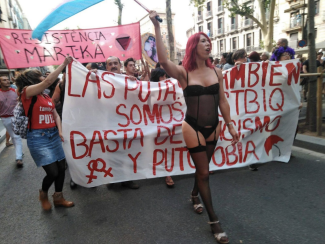
Linda Porn is yet another heroine of feminist union organizing and sex worker activism nationally (in Spain) and transnationally.
Originally from Mexico, she has been living in Spain since the 2000s. She is a sex worker, an activist, a single mother and a multidisciplinary artist. Drawing from these different identities, she uses performance, video art and theater to vizibilize struggles at the intersections of transfeminism, sex work, migration, colonialism and motherhood.
She combines art and sex work while caring for her daughter as a single mother.
Linda also belongs to sex workers collectives that fight for their rights, such as the OTRAS union and CATS Murcia. She also co-founded the group 'Madrecitas' - that visibilises and denounces racist institutional violence against migrant families. Violence to which she and her daughter were subjected as a sex worker and migrant single mother.