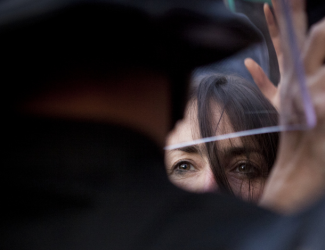
Philippe Leroyer | Flickr (CC BY-NC-ND 2.0)

Special Focus

AWID is an international, feminist, membership organisation committed to achieving gender equality, sustainable development and women’s human rights

Women Human Rights Defenders

WHRDs are self-identified women and lesbian, bisexual, transgender, queer and intersex (LBTQI) people and others who defend rights and are subject to gender-specific risks and threats due to their human rights work and/or as a direct consequence of their gender identity or sexual orientation.

WHRDs are subject to systematic violence and discrimination due to their identities and unyielding struggles for rights, equality and justice.

The WHRD Program collaborates with international and regional partners as well as the AWID membership to raise awareness about these risks and threats, advocate for feminist and holistic measures of protection and safety, and actively promote a culture of self-care and collective well being in our movements.


Risks and threats targeting WHRDs  

WHRDs are exposed to the same types of risks that all other defenders who defend human rights, communities, and the environment face. However, they are also exposed to gender-based violence and gender-specific risks because they challenge existing gender norms within their communities and societies.

By defending rights, WHRDs are at risk of:

  • Physical assault and death
  • Intimidation and harassment, including in online spaces
  • Judicial harassment and criminalization
  • Burnout

A collaborative, holistic approach to safety

We work collaboratively with international and regional networks and our membership

  • to raise awareness about human rights abuses and violations against WHRDs and the systemic violence and discrimination they experience
  • to strengthen protection mechanisms and ensure more effective and timely responses to WHRDs at risk

We work to promote a holistic approach to protection which includes:

  • emphasizing the importance of self-care and collective well being, and recognizing that what care and wellbeing mean may differ across cultures
  • documenting the violations targeting WHRDs using a feminist intersectional perspective;
  • promoting the social recognition and celebration of the work and resilience of WHRDs ; and
  • building civic spaces that are conducive to dismantling structural inequalities without restrictions or obstacles

Our Actions

We aim to contribute to a safer world for WHRDs, their families and communities. We believe that action for rights and justice should not put WHRDs at risk; it should be appreciated and celebrated.

  • Promoting collaboration and coordination among human rights and women’s rights organizations at the international level to  strengthen  responses concerning safety and wellbeing of WHRDs.

  • Supporting regional networks of WHRDs and their organizations, such as the Mesoamerican Initiative for WHRDs and the WHRD Middle East and North Africa  Coalition, in promoting and strengthening collective action for protection - emphasizing the establishment of solidarity and protection networks, the promotion of self-care, and advocacy and mobilization for the safety of WHRDs;

  • Increasing the visibility and recognition of  WHRDs and their struggles, as well as the risks that they encounter by documenting the attacks that they face, and researching, producing, and disseminating information on their struggles, strategies, and challenges:

  • Mobilizing urgent responses of international solidarity for WHRDs at risk through our international and regional networks, and our active membership.

Related Content

My Queer Ramadan 

by Amal Amer, California, US

I pray with my family for the first time in six years while wrapped in a keffiyah I scavenged from a dumpster.

Since coming into myself, I have refused to pray in jamaat with my family. Joining in the ranks of hierarchy, “women” behind “men” irks me. It grates my skin and teeth to the degree where I can’t focus, and the standing, bowing, and kneeling feels like a battle against my true being. Each second listening, a betrayal of my nature. Instead, I pray by myself in my own way. 

Yet this Ramadan, I feel different. Back in my childhood home after many years, I am choosing to fast. I choose suhoor with my family, and praying together feels like a natural extension of eating together. After eating, my mother, father, brother and I line up for fajr. 

I pray behind Baba, but my prayer is my own. I close my eyes, staying with my breath and my body. 

My eyes closed, I open my inner sight to a wide open window on a vista of mountains, bright sun spreading over a light mist of clouds. This was the view I had while praying in jamaat at a queer Muslim wedding I attended in the mountains of the South of France last September. 

I lined up with the wedding guests, queer and trans folks of North and West African, Arab, and European descent. Folks of all faiths joined while some chose to stand in respect at the sides or behind. The groups did not fall along fault lines of “Muslim” or “non-Muslim,”  “religious” or “non religious.” The two lovers marrying each led us in prayer, and so did the Muslim woman officiating the nikkah. Each of the three led us in two rounds of prayers, two raqat.

I showed up as I was, my body uncovered. I had not washed. I only passed my camera to a friend who chose to stand at the side. 

In the first sujood, I broke down crying. I wore a jean dress that loves my body, one found at a thrift store my ex-girlfriend pointed me to.

The sobs come through my whole body during the prayer, and I put my head to the earth with my community like a homecoming. A return to the embrace of love both intensely personal and communal, and I am held.

It feels like swimming in the sea with multiple people:  joyful togetherness. But when you go beneath the water, it’s just you and the current. 

Like a dozen people buried in the same graveyard. Separate, but sharing the same soil. Becoming one with the growing earth. 

That was how it felt to pray in communion at a queer Muslim wedding.

I welcomed the light of acceptance while showing up as myself that day, with a group of people who had also chosen to claim all the parts of themselves in love. That light made a home in me, and it illuminates my heart in the dark living room at fajr this Ramadan morning. Though I pray with my birth family who do not accept all of me, I see myself praying in jamaat at that glorious wedding with all of my queer Muslim ancestors, my queer angels, my lineage, my soul family, my queer Muslim family, all standing in prayer. Bowing as one. 

My family’s home does not always feel like my own, though I am here now. I take the bukhoor from room to room, barefoot. Smolder from the censer, an incense that says, “Here I am.” Baraka, blessings from the source of all, Allah and the Goddess to each room in the house, bidding good and dispersing the unbidden. 

As I write this the sky turns the same royal blue I am familiar with from exiting the club and pulling all-nighters. It is the gradient of morning I step into as I go to sleep. 

Word meanings:

  • Ramadan: the Muslim holy month, traditionally observed with 29 days of fasting without food or water during daylight hours

  • Keffiyah: a patterned scarf common in the SWANA region. The black and white version referred to here is associated with the Palestinian liberation movement 

  • Pray in jamaat: Islamic ritual prayer in a group. Participants follow one person, traditionally male, who calls the prayer aloud.

  • Suhoor: the meal before the fast starts at dawn

  • Fajr: the dawn prayer

  • Baba: father

  • Raqat: one round of prayer consisting of standing, bowing, kneeling, and pressing the head to the ground

  • Sujood:the prayer position when one presses one’s head to the earth

  • Nikkah: the religious marriage ceremony 

  • Bukhoor: an Arabic incense, woodchips soaked in resin

  • Baraka: blessing


“Angels go out at night too”

by Chloé Luu (@Electrichildren), France

Pictures of angels in my life, just some women and non-binary people of color hanging out, taking care of themselves and expressing love to each other. It's these simplest moments that are the most empowering.

Chloé Luu (@Electrichildren)


< Freeing the Church, Decolonizing the Bible for West Papuan Women

Kunyit Asam: The Roots of Love and Resilience >

Snippet FEA Union Otras Photo 5 (EN)

Photo of people sitting on red chairs in a hall

14th AWID international Forum is cancelled (forum page)

The 14th AWID International Forum is cancelled

Given the current world situation, our Board of Directors has taken the difficult decision to cancel Forum scheduled in 2021 in Taipei. 

Read the full announcement

Florence Adong-Ewoo

Florence fue una activista por los derechos de las personas con discapacidad que trabajó con varias organizaciones de mujeres con discapacidad en Uganda.

También ocupó la Dirección del Distrito de Lira de la Asociación de Mujeres con Discapacidad, así como del foro de Consejeras Mujeres del Distrito de Lira. Formada como consejera para personas con discapacidad y para madres y padres de niñxs con discapacidad, apoyó muchos proyectos que reclamaban mayor representación de las personas con discapacidad.

Murió en un accidente de motocicleta.


Florence Adong-Ewoo, Uganda
Main image
AWID-CSW_header.png
Body

Snippet - WITM Languages - EN

Principes d'engagement

Bienvenue à Crear | Résister | Transform : un festival dédié aux mouvements féministes !

Principes d'engagement

L'AWID s'engage à créer un espace en ligne qui nous invite et nous pousse tou·te·s à faire preuve de courage, de curiosité, de générosité et de responsabilité partagée. 

Nous vous invitons à créer à nos côtés des espaces sans harcèlement ni violence, où chacun·e est respecté·e dans son identité et son expression de genre, sa race, ses capacités, sa classe, sa religion, sa langue, son ethnicité, son âge, sa profession, son type d'éducation, sa sexualité, sa taille et son apparence physique. Des espaces où nous reconnaissons les inégalités de notre monde et où nous nous efforçons de les transformer au gré de nos propres interactions avec les autres.


Nous voulons créer un espace qui permette à tout·te·s :

  • d’être présent·e·s:

Soyez là les un·e·s pour les autres en étant activement à l’écoute. Essayons de nous sentir proches, même si tout est virtuel. Pour cela, vous aurez accès à l’interprétation de la discussion et à des moyens de communications ouverts (comme la boîte de dialogue et autres outils) pour réagir et échanger. Nous vous recommandons de porter des écouteurs ou un casque pendant la séance pour mieux entendre les autres et vous faire entendre. Dans la mesure du possible, essayez de fermer votre messagerie électronique ou toute autre distraction pendant que vous prenez part à la discussion.

  • de valoriser toutes les formes de savoirs:

Célébrons les multiples façons dont le savoir se manifeste dans nos vies. Nous vous invitons à aborder la conversation avec curiosité et ouverture d’esprit pour apprendre des autres, en se permettant de désapprendre et de réapprendre à travers ces  échanges, comme une manièrede commencer à construire collectivement des connaissances.

  • de se sentir accueillie·s: 

Nous nous engageons à adopter une approche holistique de l'accessibilité en tenant compte des différents besoins physiques, linguistiques, mentaux et de sécurité. Nous voulons un espace qui accueille des personnes d'origines, de croyances, de capacités et d'expériences différentes. Nous anticiperons au mieux mais vous demanderons également de nous communiquer vos besoins, et nous ferons de notre mieux pour y répondre.

  • de se sentir en sécurité et respecté·e·s :

Nous nous engageons tou·te·s individuellement et collectivement à respecter la vie privée de chacun·e· et à demander le consentement des autres avant de partager des images ou du contenu qui les concerne,  générés au cours de la conversation.


Créer un environnement sécurisé, respectueux et agréable durant ces conversations est la responsabilité de  tou·te·s .


Signalement

Si vous remarquez qu'une personne a un comportement discriminatoire ou offensant, veuillez contacter la personne de référence qui vous sera indiquée en début de session. 

Tout·e participant·e qui utilisera un langage ou des images abusives sera exclu·e de la conversation et ne sera pas réadmis·e. Nous n’aurons plus de relations avec cette personne de quelque manière que ce soit. 

Snippet FEA Principles of Work S4 (ES)

Cuatro manos sosteniéndose por las muñecas, formando un cuadrado.

HORIZONTALIDAD

“Where is the Money for Women’s Rights?" AWID’s WITM Toolkit (landing page intro) ES

Una nueva edición de la investigación "¿Dónde está el dinero?" está actualmente en marcha.

Obtén más información

Manual «¿Dónde está el dinero?» (WITM)

Una metodología de investigación que puedes aplicar tú mismx

Women leaders
© UN Women/Ashutosh Negi (CC BY-NC-ND 2.0) [https://creativecommons.org/licenses/by-nc-nd/2.0/]

AWID presenta este Manual WITM para apoyar a personas y organizaciones que quieran investigar por su cuenta las tendencias en el financiamiento para una región, temática o población en particular, adaptando las metodologías de investigación de AWID.


El Manual WITM de AWID es producto de diez años de experiencia. Las investigaciones de WITM y este Manual son una demostración política y práctica de los recursos y pasos necesarios para realizar investigaciones en acción de buena calidad.

Más información sobre el contexto de la metodología de la investigación WITM

El equipo WITM también ofrece apoyo técnico y político antes y durante el proceso de investigación. Te invitamos a leer el Manual y a ponerte en contacto con nosotras en fundher@awid.org si necesitas más información.

Nadine Ramaroson

Son soutien aux femmes et aux personnes les plus vulnérables de sa communauté a fait que Nadine était un modèle pour beaucoup. Elle était déterminée à aider les pauvres et les sans-abri en particulier.

Bien que sa mort ait été déclarée comme étant accidentelle, la famille Ramaroson, sur l’initiative de son père André Ramaroson, a mené une enquête qui a mis en évidence des preuves de son assassinat. Elle serait décédée dans un accident mortel survenu entre Soanierano - Ivongo et Ste Marie - une histoire qui a été réfutée par sa famille. Elle avait reçu de nombreuses menaces de mort pour ses positions politiques résolues. L’affaire est toujours en cours auprès des tribunaux à Antananarivo (la capitale de Madagascar).


Nadine Ramaroson, Madagascar

What Our Members Say - En

What Our Members Say

Colectivo Morivivi

Colectivo Moriviví is an all women artistic collective. Our artistic production consists of muralism, community-led muralism, and protest performance/actions. Our work is about democratizing art and bringing the narratives of Puerto Rican communities to the public sphere to create spaces in which they are validated. We believe that through artivism we can promote consciousness on social issues and strengthen our collective memory.  

“Cacibajagua” 2017, Mural Project. Jiangxi, China
“Paz para la Mujer” 2015, collaboration with Coordinadora Paz para la Mujer Organization. Santurce,
“Paz para la Mujer” 2015, collaboration with Coordinadora Paz para la Mujer Organization. Santurce, Puerto Rico


“Paz para la Mujer” 2015, collaboration with Coordinadora Paz para la Mujer Organization. Santurce, Puerto Rico
“Paz para la Mujer” 2015, collaboration with Coordinadora Paz para la Mujer Organization. Santurce, Puerto Rico
Collectivo Moriri Artwork


As part of their participation in AWID’s Artist Working Group, Colectivo Morivivi gathered a diverse group of members, partners and staff to facilitate a collaborative process of dreaming into, informing, and deciding on the content for a community mural through a multi-stage co-creation process. The project began with a remote conceptualization with feminists from different parts of the planet brought together by AWID, and then it evolved to its re-contextualization and realization in Puerto Rico. We were honored to have the input of local artists Las Nietas de Nonó(@lasnietasdenono), the participation of local women in the Community Painting Session, the logistics support from the Municipality of Caguas, and FRIDA Young Feminist Fund’s additional support to the collective.
 
The mural explores the transcendence of borders by presenting bodies like a map, in an embrace that highlights the intersection of the different feminist manifestations, practices and realities. 
 
We also thank Kelvin Rodríguez, who documented and captured the different stages of this project in Puerto Rico:

Collectivo Moriri Artwork

About Colectivo Morivivi 

Colectivo Morivivi portrait

Moriviví is a collective of young female artists, working on public art since April 2013. Based in Puerto Rico, we’ve gained recognition for the creation of murals and community led arts.

The group started out in local Urban Art Festivals. As our work became more popular, organizations and community leadership started to reach out to us. We began as eight high schoolers who wanted to paint a mural together. However, in eight years of hard work, we’ve faced many challenges.  Now we are in a period of transition. During this following year, we aim to restructure the collective internally. Our goal is to open new opportunities for collaborators and back-up our decision making process with a new evaluation system.  In the long run, we aspire to become an alternative school of art practice for those interested in immersing themselves in community art production.

Snippet FEA No feminist economies without feminist unions (FR)

Pas d’économies féministes sans syndicats féministes!

Par le biais de l'organisation syndicale, Sopo, Sabrina et Linda se battent non seulement pour les droits des femmes, des travailleur·euses essentiel·les, des travailleur·euses migrant·e·s et des travailleur·euses du sexe, mais pour les droits de tous·tes les travailleur·euses .

La lutte pour mettre fin à l'exploitation des travailleur·euses est une lutte féministe. C’est pourquoi il n’y a pas d’économies féministes sans syndicats féministes.

FRMag - The Triple (FR)

Les invalides en triple : parlons sexe, chéri !

par Nandini Tanya Lallmon 

Olajumoke « Jay » Abdullahi et Kym Oliver sont des féministes révolutionnaires à plus d'un titre. (...)

Lire

illustration : « Éclose » de Titash Sen >

Sainimili Naivalu

« J’ai constaté la discrimination dans la rue, que ce soit par des taquineries ou des agressions verbales qui y ont lieu. Je me suis aussi faite plein d’ami·e·s et j’y ai rencontré plusieurs personnes. Il se peut que ce soit dangereux là-bas, mais je suis une survivante, et pour le moment, c’est là où je suis. » -  Sainimili Naival

Sainimili Naivalu était une activiste féministe des droits des personnes handicapées issue du village de Dakuibeqa, sur l’île de Beqa aux Fidji.

Elle a demandé aux responsables et acteurs politiques de fournir des politiques et des services adaptés au handicap, comme la construction de rampes dans les villes et les villages afin d'accroître leur accessibilité. Les barrières physiques n’étaient pas les seules qu’elle aspirait à modifier. Sur la base de sa propre expérience, elle savait que des changements plus difficiles devaient être menés dans les sphères économiques et sociales. Bon nombre des défis avec lesquels sont aux prises les personnes handicapées trouvent leurs racines dans les attitudes discriminantes et stigmatisantes. 

Survivante et combattante, Sainimili a contribué à co-créer des réalités féministes qui renforcent l’inclusion et font évoluer les attitudes par rapport à l’égalité des personnes handicapées. Elle a été membre de la Spinal Injury Association of Fiji (SIA) ainsi que participé à la formation « Démarrez votre entreprise » de l’Organisation internationale du Travail à Suva via le projet « Pacific Enable » (le Pacifique rend possible) du Forum Asie-Pacifique sur le handicap. Elle a ainsi pu transformer ses idées en une entreprise qui lui était propre. Elle était commerçante sur l’étal de marché 7 de Suva, offrant des services de manucure, tout en gérant un stand au marché des femmes SIA pour y vendre de l’artisanat, des suls et des objets historiques. Sainimili planifiait d’élargir son commerce et de devenir une employeuse majeure de personnes handicapées. 

Outre son activisme, elle était également médaillée de tennis de table et une récente championne.

Avec sa personnalité vive, Sainimili était unique. On savait toujours lorsqu’elle était dans la pièce car ses rires et ses histoires étaient la première chose qu’on pouvait remarquer. -  Michelle  Reddy

Sainmili est décédée en 2019.
 

Snippet - CSW69 Image - ES