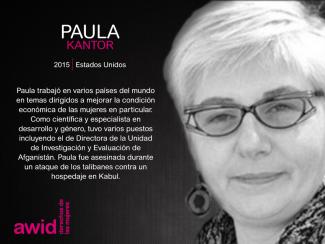
Paula Kantor

WHRDs are self-identified women and lesbian, bisexual, transgender, queer and intersex (LBTQI) people and others who defend rights and are subject to gender-specific risks and threats due to their human rights work and/or as a direct consequence of their gender identity or sexual orientation.
WHRDs are subject to systematic violence and discrimination due to their identities and unyielding struggles for rights, equality and justice.
The WHRD Program collaborates with international and regional partners as well as the AWID membership to raise awareness about these risks and threats, advocate for feminist and holistic measures of protection and safety, and actively promote a culture of self-care and collective well being in our movements.
WHRDs are exposed to the same types of risks that all other defenders who defend human rights, communities, and the environment face. However, they are also exposed to gender-based violence and gender-specific risks because they challenge existing gender norms within their communities and societies.
We work collaboratively with international and regional networks and our membership
We aim to contribute to a safer world for WHRDs, their families and communities. We believe that action for rights and justice should not put WHRDs at risk; it should be appreciated and celebrated.
Promoting collaboration and coordination among human rights and women’s rights organizations at the international level to strengthen responses concerning safety and wellbeing of WHRDs.
Supporting regional networks of WHRDs and their organizations, such as the Mesoamerican Initiative for WHRDs and the WHRD Middle East and North Africa Coalition, in promoting and strengthening collective action for protection - emphasizing the establishment of solidarity and protection networks, the promotion of self-care, and advocacy and mobilization for the safety of WHRDs;
Increasing the visibility and recognition of WHRDs and their struggles, as well as the risks that they encounter by documenting the attacks that they face, and researching, producing, and disseminating information on their struggles, strategies, and challenges:
Mobilizing urgent responses of international solidarity for WHRDs at risk through our international and regional networks, and our active membership.
Como lo demuestran estos tuits, resulta que sextear como feminista es sexy, divertido – y caliente – todo eso sin perder de vista el compromiso con la equidad y la justicia.
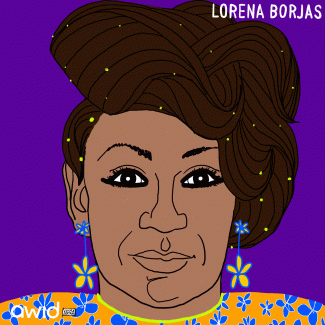
Lorena Borjas, a trans Latina woman and activist, lived and worked in the Jackson Heights neighborhood of Queens, New York City. In those streets, she looked after her community for years, advocating for trans and immigrant rights, supporting survivors of human trafficking and abuse, campaigning for sex workers’ rights and those of people living with HIV and AIDS.
Lorena was strong and tireless in her fight to support, defend, and have the back of those most marginalized and discriminated by transphobia, misogyny and racism.
“She pushed us to shine authentically, to become a scream of subversion that says, ‘I am here, and I deserve happiness, too.’” - Cecilia Gentili, a trans activist and Lorena’s friend
Having faced numerous traumas and hardships herself, as a trans immigrant woman and victim of human trafficking, Lorena pulled knowledge and emotional memory from the well of her experiences in order to help build and strengthen the community she was part of and which was part of her. Some of the ways she did this was to organize and mobilize support ranging from providing condoms and connecting trans women to different services, to setting up an HIV testing clinic in her own home.
"She was such a beautiful soul who helped others when her journey was difficult and painful as an immigrant, as a trans immigrant. She believed the trans community needed love, acceptance, and compassion, and she gave it all.” - Luchia Dragosh, QPTV Supervising producer of a documentary about Lorena
In more than 25 years of activism, she also founded the Lorena Borjas Community Fund together with Chase Strangio (lawyer and trans rights activist). The Fund helps the many different members of her community (and especially trans persons) dealing with immigration challenges to avoid the cycle of arrest-jail-deportation.
Lorena passed away in March 2020 of complications from COVID-19.
Her enormous and beautiful legacy will be taken forward through the streets of Queens by the network and community she co-created.
“We will pick up her work where she left it, work that is essential to the well-being of “mis pajaras” as she called the trans girls of Queens under her wing.” - Cecilia Gentili
"Lorena brought light to us when we were living through a very dark time here in New York. She brought us light when we were dealing with the crack epidemic, when we were dealing with the AIDS crisis, dealing with changes in immigration policies." - Cristina Herrera, founder and CEO of Translatina Network and Lorena’s friend
"Lorena has done more than anyone else I know to shine a light on the epidemic of trafficking in transgender communities and to help other trans women escape exploitation." - Lynly Egyes (represented Borjas on behalf of the Transgender Law Center)
Watch a documentary about Lorena Borjas
Read a postscript in The New Yorker about Lorena Borjas
Read an opinion piece in the New York Times by Cecilia Gentilin
Isabel est une féministe du Royaume-Uni avec plus d'une décennie d'expérience de réponses féministes aux fascismes, aux fondamentalismes et aux tendances antidroits. À l'AWID, son travail se concentre sur le renforcement des connaissances. Elle a notamment dirigé la production de la série Droits en danger en collaboration avec l'Observatoire sur l'universalité des droits (OUR). Elle est titulaire d’un master en études sur le genre de l’École d’études orientales et africaines (SOAS) et a précédemment travaillé avec Women Living Under Muslim Laws (WLUML). Elle est passionnée par le travail intermouvements, la construction de connaissances centrées sur les mouvements et l’utilisation de l’expression créative pour perturber les systèmes d’oppression. En dehors du travail, Isabel est active dans divers espaces de justice liée au handicap, aux soins collectifs, à l’apprentissage et au plaidoyer.
لأول مرة، يعرض منتدى جمعية حقوق المرأة في التنمية ثلاثة طرق للمشاركة
سيجتمع المشاركون/ات في بانكوك، تايلاند. ننتظر بفارغ الصبر!
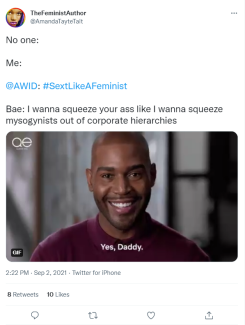
Personne :
Moi :
@AWID : #SextLikeAFeminist
Bae : Je veux te presser le cul aussi fort que je voudrais éjecter les misogynes hors des hiérarchies des entreprises.
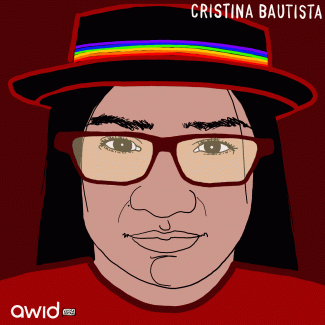
“Si nos mantenemos en silencio, nos matan. Si hablamos (nos matan) también. Así que, hablemos” Cristina Bautista, 2019.
Incansable defensora de los derechos del pueblo Nasa, Cristina habló alto y claro sobre la violencia dirigida contra su comunidad. En un discurso ante las Naciones Unidas, Cristina reclamó la protección de las vidas de las mujeres indígenas, y su participación en las diferentes esferas de la vida. En 2017, Cristina entró en el programa de Becas Indígenas de la Oficina de Derechos Humanos de la ONU y en 2019 recibió una subvención del Fondo de Contribuciones Voluntarias de la ONU para los Pueblos Indígenas.
"Me gustaría sacar a la luz la situación actual de los pueblos indígenas en Colombia, el asesinato de líderes indígenas, la represión de las protestas sociales. El acuerdo de paz, en lugar de ayudar, lo que ha hecho es reforzar el conflicto y la explotación de territorios sagrados en Colombia... En la situación actual, en casi todas las naciones indígenas, como mujeres, estamos trabajando para encontrar un futuro mejor para nuestras familias. No quiero que más mujeres del campo vivan en estas circunstancias. Las mujeres indígenas necesitamos oportunidades para participar en la vida política, económica, en la sociedad y en la cultura. Hoy me da fuerzas ver a todas estas mujeres aquí y ver que no estoy sola". - Cristina Bautista, 2019
El 29 de octubre de 2019, Cristina fue asesinada junto a cuatro guardias indígenas desarmados en un ataque que, supuestamente, fue llevado a cabo por miembros armados del grupo disidente de las FARC "Dagoberto Ramos".
Según Global Witness, "en los últimos años el asesinato de líderes comunitarios y sociales ha aumentado dramáticamente en Colombia".
"La comunidad Nasa ha alertado repetidamente a las autoridades sobre las amenazas que reciben y que ponen en peligro su seguridad. Sin embargo, a pesar de los esfuerzos que ponen los sucesivos gobiernos colombianos, los pueblos indígenas siguen corriendo grandes riesgos, especialmente, las figuras clave religiosas o comunitarias como Cristina Bautista". - Reunión informativa de la ONU para la prensa (en inglés), 1 de noviembre de 2019.
Margo Okazawa-Rey is an activist-educator and transnational feminist working on issues of militarism for nearly 30 years. She is a founder member of the International Women’s Network against Militarism and Women for Genuine Security, the US group of the Network. She has long-standing activist commitments with Du Re Bang/My Sisters Place in South Korea and Women’s Centre for Legal Aid and Counselling in Palestine. She also serves on the International Board of PeaceWomen Across the Globe in Bern, Switzerland and is President of the Board of Directors of Association for Women’s Rights in Development (AWID). Her foundational activist/life principle is that love is a radical act. She is also known as DJ MOR Love and Joy.

Manal Tamimi is a Palestinian activist and human rights defender. She is a mother of four who holds a master’s degree in international humanitarian law. Due to her activism, she was arrested three times and got wounded more than once, including with live explosive bullets which are banned internationally. Her family is also a target: her children have been arrested and wounded with live ammunition more than once. The last incident was an assassination attempt of her son Muhammad who was shot in the chest, near the heart, a few weeks after his liberation from the occupation prisons where he had spent two years. Her philosophy on life: if I have to pay the price for being a Palestinian and not for a crime I have committed, I refuse to die in silence.
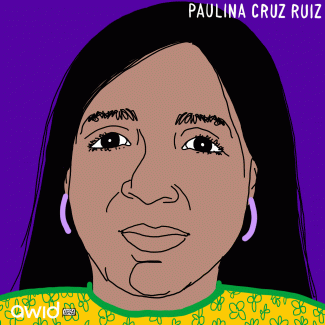
Paulina Cruz Ruiz, originaire de Rabinal dans la région de Baja Verapaz au Guatemala, était une défenseuse des droits humains au pouvoir ancestral Maya Achí (autochtone). Elle participait activement à la mobilisation et à la résistance communautaires, notamment via des mesures juridiques contre des projets miniers sur des territoires autochtones, aux effets sévères et néfastes pour leur tissu socioenvironnemental.
« Le modèle d’industrie extractive promu par le gouvernement guatémaltèque et la construction de projets de développement à grande échelle sur des terres autochtones, sans le consentement des communautés, est source de litiges constants avec les mouvements de résistance. » - Minority Rights Group International (groupe international pour les droits des minorités)
Paulina a également participé à la Marche pour la dignité, la vie et la justice, durant laquelle des milliers de guatémaltèques ont initié, le 1er mai 2019, une marche de huit jours contre la corruption et l’impunité face aux poursuites et aux assassinats de défenseur·e·s des droits humains, des terres ainsi que de leaders paysan·ne·s et autochtones.
Paulina a été assassinée le 14 septembre 2019 près de chez elle, dans le village de Xococ.
D’après Minority Rights Group International, « l’une des problématiques constantes qui affecte le plus les communautés mayas tient dans l’accroissement des activités de l’industrie minière. »
En savoir plus sur les mayas au Guatemala (en anglais)
En savoir plus sur la Marche pour la dignité, la vie et la justice (en anglais)
Claudia es Maestra en Igualdad y Equidad para el Desarrollo, psicóloga feminista, activista por la defensa de los derechos humanos desde hace 30 años y por los derechos de las mujeres desde hace 24 años.
Trabajando en El Salvador, Claudia está cofundadora y directora Ejecutiva de la Asociación Mujeres Transformando, desde hace 16 años es defensora de derechos laborales de las trabajadoras del sector maquila textil y confecciones. Ha colaborado en la formulación de iniciativas de Ley, propuestas de políticas públicas e investigaciones tendientes a mejorar la calidad del empleo para las trabajadoras de este sector, además de trabajar incansablemente en el fortalecimiento organizativo y empoderamiento de las obreras de la maquila textil y bordadoras a domicilio.
Participa activamente en acciones de incidencia a nivel nacional, regional e internacional por la defensa y reivindicación de los derechos laborales de la clase trabajadora del Sur Global desde una perspectiva, feminista, anticapitalista, antipatriarcal y desde la toma de conciencia de clase y de género. Es parte del Consejo Directivo de la Iniciativa Spootlithg y del Grupo Nacional de Referencia de la minsma. Tambien es parte del Grupo Asesor de la Sociedad Civil de ONUMujeres.
منال التميمي، ناشطة فلسطينية ومدافعة عن حقوق الإنسان. أم لأربعة أطفال كما أنها حائزة على ماجستير في القانون الدولي الإنساني. اعتقلت منال ثلاث مرات على إثر نشاطها السياسي وأصيبت أكثر من مرة بالرصاص الانشطاري الحي المحظور دوليا. عائلتها مستهدفة أيضًا: اعتقل وأصيب أطفالها بالذخيرة الحية أكثر من مرة. وكانت الحادثة الأخيرة محاولة اغتيال نجلها محمد الذي أصيب برصاصة في صدره قرب القلب بعد أسابيع قليلة من تحريره من سجون الاحتلال حيث أمضى عامين. فلسفتها في الحياة: إذا كان عليّ أن أدفع ثمن كوني فلسطينيّة، فأنا أرفض أن أموت في صمت.
Tandis que les dirigeant·es du monde entier se réunissent au Brésil, les mouvements féministes manifestent, se rassemblent et bouleversent le statu quo à la COP30 et partout ailleurs ! Nous voilà en route vers Belém au Brésil, aux côtés d’autres féministes, pour assister à la COP30 du 10 au 21 novembre 2025. Nous continuerons d’y dénoncer les fausses solutions.