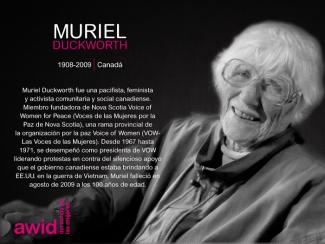
Muriel Duckworth
WHRDs are self-identified women and lesbian, bisexual, transgender, queer and intersex (LBTQI) people and others who defend rights and are subject to gender-specific risks and threats due to their human rights work and/or as a direct consequence of their gender identity or sexual orientation.
WHRDs are subject to systematic violence and discrimination due to their identities and unyielding struggles for rights, equality and justice.
The WHRD Program collaborates with international and regional partners as well as the AWID membership to raise awareness about these risks and threats, advocate for feminist and holistic measures of protection and safety, and actively promote a culture of self-care and collective well being in our movements.
WHRDs are exposed to the same types of risks that all other defenders who defend human rights, communities, and the environment face. However, they are also exposed to gender-based violence and gender-specific risks because they challenge existing gender norms within their communities and societies.
We work collaboratively with international and regional networks and our membership
We aim to contribute to a safer world for WHRDs, their families and communities. We believe that action for rights and justice should not put WHRDs at risk; it should be appreciated and celebrated.
Promoting collaboration and coordination among human rights and women’s rights organizations at the international level to strengthen responses concerning safety and wellbeing of WHRDs.
Supporting regional networks of WHRDs and their organizations, such as the Mesoamerican Initiative for WHRDs and the WHRD Middle East and North Africa Coalition, in promoting and strengthening collective action for protection - emphasizing the establishment of solidarity and protection networks, the promotion of self-care, and advocacy and mobilization for the safety of WHRDs;
Increasing the visibility and recognition of WHRDs and their struggles, as well as the risks that they encounter by documenting the attacks that they face, and researching, producing, and disseminating information on their struggles, strategies, and challenges:
Mobilizing urgent responses of international solidarity for WHRDs at risk through our international and regional networks, and our active membership.
AWID стремится к языковой справедливости, и мы сожалеем, что на данный момент проведение опроса на большем количестве языков не представляется возможным. Если вам нужна помощь в переводе или вы хотите заполнить анкету на любом другом языке, пожалуйста, свяжитесь с нами по адресу witm@awid.org
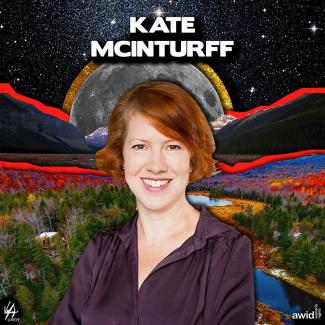
Desde su paso por Peacebuild hasta la Canadian Feminist Alliance for International Action [alianza feminista canadiense para la acción internacional], Amnistía Internacional y el Canadian Centre for Policy Alternatives (CCPA, centro canadiense para las alternativas políticas), Kate tuvo durante toda su vida una pasión por los derechos de las mujeres y la igualdad de género y dedicó su carrera a luchar contra la desigualdad y a hacer del mundo un lugar más compasivo.
Fue integrante del Comité Coordinador de Social Watch [observatorio social] y colaboró con los informes del Observatorio Social Nacional canadiense. Como investigadora senior en el CCPA, Kate fue aclamada a nivel nacional por hacer la investigación, escribir y producir el informe anual «Los mejores y los peores lugares para ser mujer en Canadá».
Murió tranquilamente, rodeada de su familia, luego de una batalla de tres años con el cáncer de colon. Sus seres queridos la describen como «una feminista divertida, valiente y sin remordimientos».
Lutter contre vents et marées : le récit de la victoire sans précédent du Réseau Solidarité.
En janvier 2022, le Réseau Solidarité a organisé une grève avec 400 travailleur·euses. Sa principale demande ? L’augmentation des salaires. La grève a été déclenchée après des mois de discussions sans résultats avec le ministère géorgien des Affaires Sociales.
Après avoir manifesté, négocié, parlé à la presse, résisté aux représailles et enduré le froid de l’hiver géorgien pendant des semaines, les travailleur·euses ont obtenu des concessions sans précédent de la part du gouvernement: augmentation des salaires, congés payés de maternité, couverture des frais de transport, arrêt des licenciement, indemnisation des jours de grève, et plus.
La grève a non seulement abouti à des gains matériels, mais a également permis aux travailleur·euses de se sentir uni·e·s et habilité·e·s à se défendre et à lutter pour des conditions de travail décentes, dans le présent et à l'avenir. Iels sont devenu·es une source d'inspiration pour tous·tes les travailleur·euses du pays.
Pour en savoir plus sur leur victoire, cliquez ici.
Building on initial desk research and consultations with allies that led us to rule out many other options in the region, we organized a thorough round of site visits to Nepal, Malaysia, Sri Lanka, Thailand, Indonesia and (later) Taiwan.
Each site visit included not just scoping the logistical infrastructure but meeting with local feminist groups and activists to better understand the context, and their sense of potential opportunities and risks of an AWID forum in their context.
They often expressed conflicted feelings about the opportunities and risk that the visibility of an event like the Forum could bring to them. In one, during the first 30 minutes of our meeting we heard unanimously from the activists gathered that an AWID Forum would be subject to huge backlash, that LGBTQ rights were a particular political hot-button and that fundamentalist groups would turn out in full force to interrupt the event. When our response was “ok, then you don’t feel it’s a good idea”, again the unanimous response was “of course it is, we want to change the narrative!”.
It was difficult to hear and see in some of these places how many feminist activists wanted to leverage the opportunity of a visible big event and were prepared to face the local risks; but our considerations as hosts of close to 2,000 people from around the world impose a different calculation of risk and feasibility.
We also grappled with questions of what it means to organize a feminist forum that is aligned to principles around inclusion, reciprocity and self-determination, when state policy and practice is usually directly counter to that (although officials in the ministries of Tourism work very hard to smooth that over).
In many of these places, monitoring the context felt like an exercise on a pendulum that could swing from open and safe for feminist debates in one moment to stark repression and xenophobia the next, sacrificing feminist priorities as political bargaining chips to pacify right wing, anti-rights forces.
Our challenges in Asia Pacific led us to consider: would it be easier if we moved the Forum to a different region? Yet today, we would not be able to organize an AWID Forum in Istanbul as we did in 2012; nor would we be able to do one in Brazil as we did in 2016.
With all of this complexity, AWID selected Taipei as the Forum location because:
In organizing the AWID Forum, we are trying to build and hold space as best we can for the diverse expressions of solidarity, outrage, hope and inspiration that are at the core of feminist movements.
At this moment, we see Taipei as the location in the Asia Pacific region that will best allow us to build that safe and rebelious space for our global feminist community.
The fact is, there is no ideal location in today’s world for a Forum that centers Feminist Realities. Wherever we go, we must build that space together!
Etendez vos frontières. Les membres de l'AWID représentent de plus en plus une section transversale dynamique et variée de féministes travaillant, entre autres, sur les questions foncières, les droits des travailleures, les droits sexuels et l'autonomie corporelle. En devenant membre, vous pouvez relier vos luttes entre mouvements.
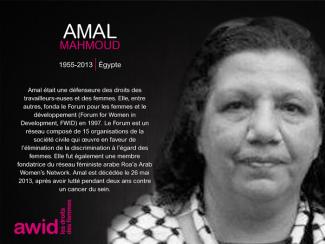
Sim, ainda queremos a sua resposta, independentemente de terem recebido financiamento em três, dois, um, ou qualquer um dos anos entre 2021 e 2023.
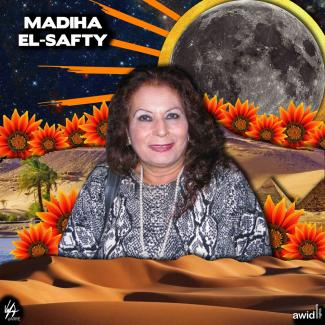
Madiha était une éminente professeure de sociologie qui s’est activement engagée auprès de la société civile en tant que défenseure des droits des femmes dans les pays arabes.
Elle a présidé l'Alliance pour les femmes arabes et a été membre du Comité sur la société civile et du Comité sur le développement du gouvernorat de Minia auprès du Conseil national pour les femmes. Elle a publié de nombreux articles qui ont éclairé et analysé les inégalités de genre et la discrimination à l'égard des femmes.
Ses collègues, étudiant-e-s et ami-e-s se souviennent d'elle avec tendresse.
Ассоциация «Права женщин в развитии» и Фонд «Красный зонт» приглашают Вас принять участие в диспуте-семинаре на тему феминизма и секс-работы.

10 ноября 2020г. в 14:00 по UTC (сверьтесь с вашим местным временем)
В рамках данной сессии, сотрудницы (-ки) Ассоциации «Права женщин в развитии» будут делиться своими знаниями и опытом работы в условиях виртуального общения. Мы поговорим об основных сложностях и интерсекциональности в работе секс-работниц (-ков) и феминисток (-ов).
Подумайте над своими вопросами!
Для участниц (-ков) будет предоставлен перевод на испанский, французский и русский языки.
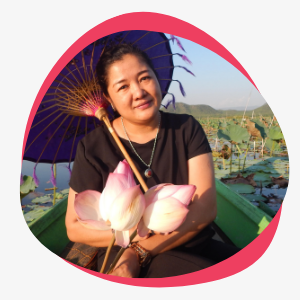
Кей Тхи является секс-работницей и с 2007 года лоббирует вопросы здоровья и прав секс-работниц (-ков). За последние девять лет она участвовала в программе по предупреждению ВИЧ среди женщин, работающих в секс-индустрии, и мужчин, имеющих половые связи с мужчинами, в Мьянме. В настоящее время Кей Тхи является региональной координаторкой Азиатско-Тихоокеанской сети секс-работниц (-ков) (АТССР) и работает с партнерами по всему Азиатско-Тихоокеанскому региону.
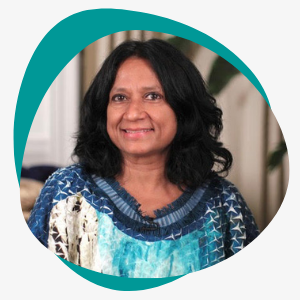
Гитанджали является соосновательницей и исполнительной директоркой организации CREA (Нью-Дели). Она феминистка и любительница кино, работала по вопросам сексуальности, репродуктивного здоровья, гендера, прав человека и насилия в отношении женщин на различных уровнях - в качестве активистки, грантодательницы и на директивном уровне.
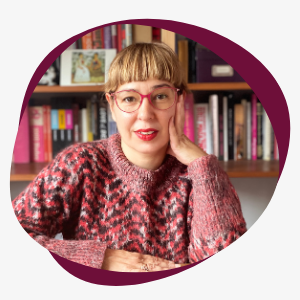
Вера присоединилась к фонду «Красный зонт» в августе 2017 года в качестве сотрудницы по программам. Вера родилась в Испании, где окончила факультет журналистики Университета Сан Пабло в Валенсии. Последние 7 лет она является активной участницей организации «X-talk», очень вовлечена в работу Коллектива Стриптизерш (-ров) Восточного Лондона, а также является участницей съемочной группы «Опера секс-работниц (-ков)».
Заинтересованы в том, чтобы вскоре стать частью этого диспут-семинарa и других обучения?!
We strive for transparency, responsible use of our resources, fairness in our collaborations and accountability and integrity with our members, partners, funders and the movements with(in) which we work. We are committed to reflecting on our experiences, sharing our learnings openly, and striving to change our practices accordingly.
نسأل عن هذه المعلومات كي نسهّل عملية المعالجة وكي نستطيع أن نتواصل مع مجموعتكم/ن في حالة لم تستطيعون تكملة الاستطلاع و\ أو في حالة كانت لديكم/ن شكوك أو أسئلة إضافية. يمكنكم/ن قراءة المزيد عن كيف نستعمل المعلومات التي نجمعها خلال عملنا هنا.
Mridula was a strong advocate for the advancement for women’s health at a time when the topic of women’s sexual and reproductive health were considered taboo in Fiji.
The initial works of the Fiji Women’s Rights Movement about sexual and reproductive rights were under her guidance, and in September 1999, the United Nations Population Fund presented her with a regional award for Reproductive Health and Rights. Mridula was a strong, dedicated and tireless campaigner who was passionate about women’s health and empowerment.
She was a valued member of the women’s and feminist movement in Fiji and her contributions will always be remembered. Mridula passed away due to natural causes in 2017.


Par Alejandra Laprea
Qu’il est difficile de condenser la puissance et la diversité des voix qui s'élèvent en Amérique latine afin de vous présenter les autres réalités qui émergent dans ce vaste territoire, ces réalités féministes que nous construisons à partir du mouvement et des organisations populaires….
Pendant longtemps, j’ai tenté de paramétrer ma recherche et la sélection des films qui vous permettraient d’avoir un aperçu de tous ces rêves et projets qui se matérialisent peu à peu sur les territoires ‘notre-américains’, comme nous aimons à les appeler. La tâche a été ardue : il a fallu tenter d'établir des paramètres tels que la présence géographique, la justice linguistique et la représentation de la diversité des populations : indiennes, afro-descendantes, migrantes, et la multiplicité des drapeaux et des luttes qui découlent de toutes ces voix. Je suis arrivée à la conclusion que la création de cette compilation était un travail qui prendrait plusieurs années, un de ces projets en perpétuelle construction.
Pour ce salon, je suis partie à la recherche d'œuvres liées à la mobilisation et à la militance, ainsi que de documents qui donneront peut-être lieu à de grands débats que nous n'avons pas encore eus.
Dans cette sélection de films, vous découvrirez les voix de réalisatrices qui ne se contentent pas de restituer les réalités féministes palpitant dans chaque recoin de ce territoire vaste et divers, mais explorerez aussi des oeuvres qui, dans leur conception même, s'interrogent sur le pourquoi, le qui et le comment du cinéma ou de l'audiovisuel. Ces femmes comprennent le cinéma comme un outil de lutte, comme quelque chose de plus que de simples images à apprécier sur un écran. Pour ces réalisatrices ou collectifs de cinéastes, le cinéma et l'audiovisuel constituent un outil capable de promouvoir la discussion, d'ouvrir un débat, bref, une ressource pour la pédagogie populaire et féministe.
Ainsi, cette petite présentation est un voyage à travers les réalités féministes à deux niveaux : d’un côté, il y a ces histoires que vous découvrirez, et de l’autre, le travail de ces cinéastes qui cherchent à expérimenter, à créer d’autres réalités féministes dans leur façon de faire de l’audiovisuel et de raconter des histoires.
Bon voyage au gré de ces films de résistance, créatifs et transformateurs !
Direction: Giovana García Soto
Docu-fiction
Spanish with English subtitles
In Lima is Burning our work plays with documentary and fiction to take us into the life of Gía, a non-binary person, who uses performance art as a tool to denounce and transgress, as a vital manifesto against transfobia in every space, including gays spaces. With Gía we also take a look at transfeminism as a safe community in which Gía feels embraced, where she shares feelings and affections.
Giovana Garcia Sojo is a young peruvian audiovisual producer, specialized in low-budget production, creation for children and adolescents in cinema and cinematographic script by the International School of Cinema and Television - EICTV in San Antonio de Baños - Cuba. Giovana has developed her path as a director towards women and feminized identities, Lima is Burning is one of her first works.
Réalisé par Patricia Ortega
Fiction
Sous-titres en anglais
Patricia Ortega, directrice de “Yo Imposible” explore à travers Ariel, une jeune dont l’intersexualité a été violentée chirurgicalement dans son enfance, les multiples façons dont on tente de normaliser la diversité sexuelle et de genre.
Le film nous raconte comment Ariel a découvert qu’elle était née intersexe et qu’elle avait subi plusieurs chirurgies visant à normaliser ses organes génitaux. Cette découverte confronte le personnage à la redécouverte de son corps, à la reconstruction de son identité et nous confronte, nous qui regardons le film, à la remise en question d’une société dominée par l’hétéronormativité qui invisibilise les autres et les condamne au malheur.
Patricia Ortega, cinéaste vénézuélienne vivant en Argentine, a étudié à l’Ecole internationale de Cinéma et Télévision de Cuba et s’est spécialisée dans la réalisation de films. À travers la fiction, elle traite les situations extrêmes que les femmes ou les corps féminisés traversent et leurs façons de les surmonter.
“Yo Imposible” est une prise de position face à la conception d’un monde qui n’est conçu qu’en termes de masculin/féminin et qui invisibilise les autres. «Ces personnes ne sont pas malades, simplement génétiquement différentes. On intervient sur leurs organes génitaux et leur corps au moyen d'hormones sans leur autorisation, ce qui constitue une violation de leurs droits humains et de leur identité, et on cherche à les faire entrer dans les canons établis.» - Patricia Ortega
Réalisé par Maria Torrellas Liebana
Documentaire
Sous-titres en anglais
María Torrellas nous raconte la révolution cubaine à travers les femmes qui l’ont fait vivre, dont Vilma Espín, Celia Sánchez et Haydee Santamaría, entre autres.
Mais on ne peut pas se limiter à raconter l'histoire de la révolution cubaine par les femmes au passé, et c'est une lutte quotidienne que Torrellas dévoile en donnant la voix aux paysannes cubaines, professionnelles, étudiantes et ouvrières d’aujourd’hui. Dans «Cubanas, mujeres en revolución», nous découvrons les défis actuels des femmes cubaines face aux préjugés persistants, aux nouvelles formes de violence et au défi constant de créer de nouvelles réalités féministes pour celles et celleux qui viendront après elles dans un territoire assiégé depuis plus de soixante-dix ans par l'impérialisme américain.
María Torrellas est une communicante et documentariste. Elle a une longue carrière cinématographique et a obtenu, entre autres, le prix Santiago Alvarez in Memoriam pour son documentaire : Memoria de una Hija de Oshun (Mémoire d’une fille d’Oshún).
«Dans ce documentaire, j’ai souhaité mêler les luttes des héroïnes d’hier à celles des femmes d’aujourd’hui. Il s’agit d’histoires racontées par les femmes elles-mêmes où elles évoquent également les combattantes qu’elles admirent le plus. J’ai été impressionnée d’entendre “la révolution nous a tout donné” ou “que serait devenue ma famille sans la révolution?” de la bouche de camarades aux origines humbles, paysannes ou noires.» - María Torrellas
Réalisé par Gabriela Arnal et Marzel Ávila pour Fondo de Acción Urgente - LAC
Équateur 2019
Sous-titres en anglais
CUIDANDERAS, qui fusionne les mots ‘cuidar’ (prendre soin) et ‘curanderas’ (guérisseuses), est la synthèse d’une série portant sur les femmes en Amérique latine sur leurs territoires, des femmes qui mettent leur corps et toute leur énergie à protéger leurs communes, à protéger ce que nous offre la pachamama en nous engageant à en faire usage avec autant de sagesse que le reste des êtres vivants. Cette mini-série de documentaires nous présente les histoires de trois collectifs de femmes latinoaméricaines qui se dédient à prendre soin de leurs territoires, guérir leurs corps et affronter les modèles extractivistes et racistes en Équateur, en Colombie et en Bolivie.
Province d’Orellana, Équateur. Depuis plusieurs siècles, les femmes Waorani se battent pour leur territoire amazonien et la préservation de leur culture autochtone. Aujourd’hui, elles sont confrontées aux menaces de l’industrie pétrolière et son modèle de production mortifère. Depuis la jungle, des leaders appartenant à l’Association des femmes Waorani de l’Amazonie équatorienne (AMWAE, d’après son sigle en espagnol) exposent les raisons de leur résistance et nous montrent cette joie inépuisable qui symbolise leur plus grande force.
Buenaventura, Colombie. Dans le port le plus grand et le plus violent de Colombie, ravagé par des décennies de conflit armé, de racisme et de machisme, un groupe de femmes refuse de sombrer dans la peur et résiste dans l’adversité. La Red Mariposas de Alas Nuevas (Réseau papillons aux ailes nouvelles) réunit des femmes noires de la côte pacifique colombienne qui travaillent de concert pour protéger leur territoire, récupérer leurs traditions ancestrales et guérir les blessures de cette violence systématique et structurelle.
Protéger et prendre soin du corps-terre-territoire est la vocation des femmes autochtones, paysannes et irrigantes (chargées des irrigations) en Bolivie face à un modèle extractiviste qui menace leurs vies, leur santé, leur intégrité physique et sexuelle et la survie de leurs communautés et de leurs territoires. Le Réseau de défenseuses de la Terre Mère a réuni des femmes de plus de 12 communautés autochtones afin de défendre leur droit à l’eau et dénoncer les violations des droits humains et des droits de la nature perpétrées par les industries extractives, tout en récupérant leurs savoirs et pratiques ancestrales de soin collectif.
«CUIDANDERAS, un mot qui combine ‘cuidadoras’ (celles qui prennent soin) et ‘curanderas’ (guérisseuses), présente les histoires de femmes défenseuses latinoaméricaines qui se consacrent à prendre soin de leurs territoires comme de leurs corps. La force collective de ces femmes a changé l’histoire de leurs communautés en Équateur, en Colombie et en Bolivie face à l’extractivisme et au racisme.»
Réalisé par Carlina Reynso
Argentine 2013
Espagnol
Si quelque chose a marqué les luttes féministes en Amérique latine, c'est assurément le cri lancé à l'échelle continentale en faveur d’un avortement libre, sûr et gratuit. Du nord au sud, les mouvements féministes se lèvent et descendent dans la rue pour lutter en faveur de la libération de notre premier territoire : notre corps. Ce documentaire sur l'avortement au sein de ce salon s’avère ainsi indispensable à l’heure de comprendre le pouvoir de nos femmes latino-américaines.
“Yo aborto, Tu Abortas Todxs Callamos” raconte l’histoire de sept femmes, dont la réalisatrice du documentaire, issues de classes socioculturelles différentes, qui se penchent sur une problématique dont chacune a, un jour ou l’autre, fait l’expérience dans son propre corps : l’avortement clandestin.
À travers leurs témoignages, la réalisatrice tente de démonter les mythes liés à l’interruption volontaire de grossesse, de déstigmatiser la question et de renouveler notre regard sur l’une des formes de violence les plus courantes dans les Amériques.
Réalisatrice, chercheuse et productrice de cinéma féministe, c’est aussi une activiste féministe qui anime des ateliers de création de scénarios d’un point de vue du genre afin de multiplier les films illustrant des réalités différentes et des histoires contre-hégémoniques. Carolina Reynoso conjugue de manière équilibrée activisme et création dans chacune de ses œuvres.
«Nous sommes un groupe de réalisateurs·rices audiovisuel·le·s qui avons réalisé ce documentaire pour continuer à lutter en faveur d’un avortement libre, sûr et gratuit en Argentine. Le film présente les témoignages de sept femmes, dont la réalisatrice du documentaire, issues de différentes classes socioculturelles qui se penchent sur une problématique dont chacune a, un jour ou l’autre, fait l’expérience dans son propre corps: l’avortement clandestin.» -L’équipe de tournage
Nosotras Audiovisuales, collectif de réalisatrices chiliennes
Chili 2020
Lien vers le micro documentaire:
Espagnol
"Historias Urgentes" est une série créée par des femmes afin de visibiliser les besoins et les expériences revêtant une importance pour la population des territoires qui composent le Chili d'aujourd'hui. Cette série audiovisuelle est née pour entretenir la flamme ayant attisé la révolte sociale en octobre 2019 dans un Chili diversifié qui s'était réveillé et avait alors déclaré : «ça suffit».
"Resistencia en ollas comunes", la première de ces "Historias urgentes", nous montre, par la voix de quatre femmes d'Iquique, de Valparaíso, de Chillán et de Santiago, comment les soins se trouvent en première ligne de la résistance, créant d'autres réalités féministes pour elles-mêmes et pour les communautés où vivent les femmes d'Amérique latine.
Nosotras audiovisuales
Cette organisation, qui réunit des femmes ayant un lien avec l’audiovisuel chilien, est née en 2017 du besoin de connecter les femmes qui travaillent dans l’audiovisuel. Elle encourage ainsi le réseautagel, la collaboration et l’information entre femmes du secteur audiovisuel, ainsi que leurs travaux et leurs points de vue sur le monde du travail.
Nosotras Audiovisuales participe à la révolte chilienne en enregistrant et créant des contenus de création collective.
Micol Metzner
Argentine 2019
Castillan
À partir de son expérience personnelle, la réalisatrice Micol Metzner présente une œuvre qui mêle documentaire et fiction, sa voix de cinéaste engagée à celle de milliers de femmes victimes de la traite sur le continent et démontre enfin que la solidarité entre femmes constitue la meilleure protection.
Réalisatrice audiovisuelle et formée à l’Institut d’arts cinématographiques d’Avellaneda, cette directrice artistique et monteuse fait partie du Cluster audiovisual de la Ciudad de Buenos Aires (Cluster audiovisuel de la ville de Buenos Aires), un espace communautaire et coopératif multisectoriel qui réalise des projets indépendants.
Elle anime des ateliers de cinéma dans certains quartiers et dans des contextes carcéraux (institutions pour mineur·e·s et prisons pour femmes). Elle fait partie de la société de production audiovisuelle MVM.
«La société de production MVM est née de la nécessité de pouvoir exprimer beaucoup de choses que nous exprimons habituellement dans la rue et de pouvoir le faire de manière créative à travers le dessin, l'audiovisuel et la photographie.
La société de production MVM est un lieu de recherche sur le langage, le graphisme et l'audiovisuel d’un point de vue féministe. C'est aussi un lieu qui permet de se libérer de tout ce que nous vivons et de générer des productions artistiques, parfois pour guérir, parfois pour créer des espaces de débat, comme c’est le cas de ce court métrage... Je n'imaginais pas que ce serait le cas, mais à chaque fois que le court métrage est diffusé, beaucoup de choses sortent, il engendre des discussions qui sont beaucoup plus enrichissantes que le court métrage en soi. Et le fait que ce soit notre travail qui déclenche ça, c’est formidable...».
Facebook: @AWIDWomensRights
Instagram: @awidwomensrights
Twitter ENG: @awid
Twitter ES: @awid_es
Twitter FR: @awid_fr
LinkedIn: Association for Women's Rights in Development (AWID)
Dada la situación global, nuestra Junta Directiva tomó la difícil decisión de cancelar el Foro que estaba programado en 2021, enTaipei.
Мы проанализируем ответы, чтобы получить представление о тенденциях, и представим результаты на 15-м Международном форуме AWID в Бангкоке, а также в режиме онлайн, в декабре 2024 года. Зарегистрируйтесь для участия в Форуме здесь!