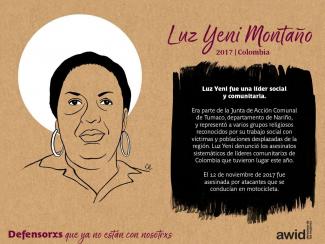
Maria Auxiliadora Escalante Diaz
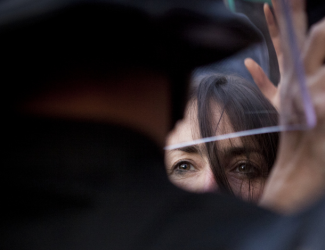
WHRDs are self-identified women and lesbian, bisexual, transgender, queer and intersex (LBTQI) people and others who defend rights and are subject to gender-specific risks and threats due to their human rights work and/or as a direct consequence of their gender identity or sexual orientation.
WHRDs are subject to systematic violence and discrimination due to their identities and unyielding struggles for rights, equality and justice.
The WHRD Program collaborates with international and regional partners as well as the AWID membership to raise awareness about these risks and threats, advocate for feminist and holistic measures of protection and safety, and actively promote a culture of self-care and collective well being in our movements.
WHRDs are exposed to the same types of risks that all other defenders who defend human rights, communities, and the environment face. However, they are also exposed to gender-based violence and gender-specific risks because they challenge existing gender norms within their communities and societies.
We work collaboratively with international and regional networks and our membership
We aim to contribute to a safer world for WHRDs, their families and communities. We believe that action for rights and justice should not put WHRDs at risk; it should be appreciated and celebrated.
Promoting collaboration and coordination among human rights and women’s rights organizations at the international level to strengthen responses concerning safety and wellbeing of WHRDs.
Supporting regional networks of WHRDs and their organizations, such as the Mesoamerican Initiative for WHRDs and the WHRD Middle East and North Africa Coalition, in promoting and strengthening collective action for protection - emphasizing the establishment of solidarity and protection networks, the promotion of self-care, and advocacy and mobilization for the safety of WHRDs;
Increasing the visibility and recognition of WHRDs and their struggles, as well as the risks that they encounter by documenting the attacks that they face, and researching, producing, and disseminating information on their struggles, strategies, and challenges:
Mobilizing urgent responses of international solidarity for WHRDs at risk through our international and regional networks, and our active membership.
L’enquête est disponible sur KOBO, une plateforme en source libre de collecte, gestion et visualisation de données. Pour y participer, il vous suffit de cliquer ici sur le lien de l’enquête et de suivre les indications pour répondre aux questions.
Maria is a graphic designer and visual communicator. Maria has worked with NGOs and Human Rights like Profamilia and OXFAM. As a woman of the Global South, she feels especially called to use her skills to work with organizations that help protect the wellbeing, as well the rights of millions of girls and women in Latin America.
Escucha esta historia aquí:
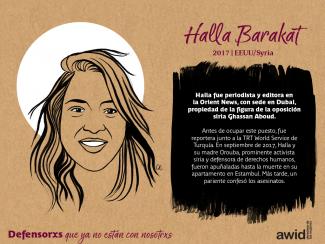
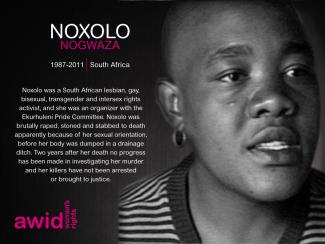
There are 47 questions in total, of which 27 are mandatory* and the remaining 20 are optional. The majority of questions are multiple-choice. We invite you to respond to all the questions.
Leila es una líder, defensora y consultora feminista transnacional, con más de veinticinco años de experiencia en la promoción de los derechos humanos, la igualdad de género y la justicia sexual y reproductiva en salud, derechos y justicia a nivel local y global. Leila nació en Argelia y se educó en Estados Unidos, Francia y Marruecos; a lo largo de su carrera profesional, ha vivido y trabajado en África, Europa y Estados Unidos.
Durante más de cinco años fue Vicepresidenta de Programas en el Fondo Global de Mujeres (GFW), supervisando el otorgamiento estratégico de subvenciones, el fortalecimiento de los movimientos, la incidencia global y las colaboraciones filantrópicas. En GFW duplicó las subvenciones otorgadas a más de 17 millones USD, inauguró el trabajo sobre movimientos feministas y de género en las crisis, creó un programa para niñas adolescentes liderado por un consejo asesor de niñas, y dirigió su trabajo de incidencia filantrópica. Antes de eso, entre 2002 y 2016 se desempeñó en el equipo de dirección de Ipas, donde publicó extensamente sobre derecho al aborto y justicia, lideró tareas de incidencia globales, y se asoció con grupos feministas que trabajan sobre gestión autónoma, movilización comunitaria y reducción de estigmas respecto de la integridad corporal y de los derechos sexuales y reproductivos. Mientras vivió en África del Norte, cofundó una empresa consultora feminista interseccional, Strategic Analysis for Gender Equality (SAGE), que trabajaba en las intersecciones de los derechos económicos, de género y sexuales y reproductivos, y dirigió el trabajo nacional, regional y mundial sobre género de la oficina de El Cairo de la Fundación Ford durante cinco años.
Leila tiene una vasta experiencia en educación popular, incidencia, organizaciones sin fines de lucro, juntas de desarrollo, filantropía, y monitoreo y evaluación. Es una hábil comunicadora comprometida con la utilización del enfoque interseccional para priorizar y difundir las voces y las experiencias de las personas más marginadas. Ha recibido la beca «Op-ed Public Voices» de la Fundación Ford, y fue becaria Fulbright en Marruecos. Sus publicaciones cubren una amplia gama de tópicos, incluyendo enfoques feministas y decoloniales a la filantropía, la promoción de los derechos humanos de las mujeres en contextos mayoritariamente musulmanes, estrategias feministas para impulsar la justicia reproductiva, el fomento de los abortos autogestionados, y la lucha contra los estigmas y la discriminación.
Actualmente Leila se desempeña como Copresidenta de la Junta Directiva del Centro por los Derechos Constitucionales (CCR), e integra la Junta Directiva del Highlander Research and Education Center. Es también funcionaria del consejo de rendición de cuentas del Numun Feminist Technology Fund y del comité asesor de la African Women’s Human Rights Defenders Platform. Anteriormente ha integrado las Juntas de la SisterSong Women of Color Reproductive Justice Collective, de la Red Mundial de Mujeres por los Derechos Reproductivos (WGNRR), del Fondo Global de Mujeres (GFW), del Fondo de Acción para el Aborto Seguro (SAAF), y del Proyecto de Tecnologías para la Salud Reproductiva (RHTP). Fue elegida Tesorera e integrante del Comité Ejecutivo de la Junta Directiva de Prospera, y del Comité de Dirección de Fenomenal Funds por cuatro años. Leila tiene una Maestría en Salud Pública, y una Maestría en Estudios de Medio Oriente y Norte de África; ha estudiado derecho islámico en Marruecos, y cursó estudios doctorales en sociología en Francia. Ha estudiado árabe y alemán, habla francés e inglés en forma fluida.
Si deseas guardar las respuestas y retomar la encuesta más tarde, puedes hacerlo todas las veces que lo necesites. KOBO guardará tus respuestas en la esquina superior izquierda de la página de la encuesta y recargará tu registro cuando regreses a la encuesta. Solo asegúrate de continuar desde la misma computadora y navegador.
Alexandra is an anglo-colombian feminist with over 20 years of experience in local, national and international HIV and sexual and reproductive health and rights programming. She has extensive experience in resource mobilization and donor relations with private philanthropic foundations and multilateral agencies on behalf of international, national and local NGOs, predominantly in Latin America and the Caribbean. Prior to AWID, Alexandra worked at Fundación Si Mujer, a feminist abortion provider and educator in Colombia, RedTraSex and the International HIV/AIDS Alliance.
Alexandra has a BA in International Relations and Development Studies from Sussex University and a MSc in Public Health from the London School of Hygiene and Tropical Medicine. In rare moments when she is not working or parenting, she loves to swim, eat and has recently begun to play Zelda: Breath of the Wild with her son.
Listen to the story here:
Si, quelle qu’en soit la raison, vous souhaitez que votre participation soit annulée et vos réponses supprimées, vous en avez le droit. Merci de nous contacter par le biais de ce formulaire, en indiquant « Enquête WITM (Où est l’argent?) » dans l’objet de votre message. Nous annulerons votre participation et supprimerons vos réponses.
Jemutai is a passionate plant lover who finds inspiration in the natural world and its intricate web of interconnections. This fascination with the universe's interrelatedness is mirrored in their approach to work, community building, care and support.
She believes in the vibrant presence of their ancestors within them and lives to experience, remember, uphold, appreciate and celebrate their struggles, triumphs and values.
As an intersectional queer feminist and human rights activist, Jemutai has dedicated their career to advocating for equity and inclusivity. They are passionate about Organizational Development, with a background in Grants Making and Administration, and now pursuing a path in creating impactful experiences for convenings and providing operational leadership and support, ensuring that spaces are inclusive, safe and curated with precision and care.
Jemutai is also a strong believer in the philosophy of Ubuntu – the idea that "I am because we are." This belief in our shared humanity and mutual interdependence informs their collaborative approach and commitment to fostering a supportive, inclusive environment for all, especially structurally silenced and marginalized people.
Una identidad de género latinoamericana
El término travesti se trata de una identidad de género latinoamericana sin equivalente en otros idiomas, y exclusivamente femenina. Es una persona designada varón al nacer que se identifica como mujer, y siempre deben abordarse con el pronombre “ella”.
Travesti no es solo una identidad de género ubicada fuera del binarismo de género, también es una identidad cultural arraigada en los movimientos latinoamericanos. El término inicialmente fue peyorativo, pero luego fue re-apropiado como símbolo de resistencia y dignidad. Toda travesti es trans porque no se identifica con el género asignado al nacer, sin embargo no toda travesti se considera mujer trans, ya que travesti ya es una identidad de género en sí misma.
Referencia: Berkins, Lohana. (2006). Travestis: una Identidad Política . Trabajo presentado en el Panel Sexualidades contemporáneas en las VIII Jornadas Nacionales de Historia de las Mujeres/ III Congreso Iberoamericano de Estudios de Género Diferencia Desigualdad. Construirnos en la diversidad, Villa Giardino, Córdoba, 25 al 28 de octubre de 2006.