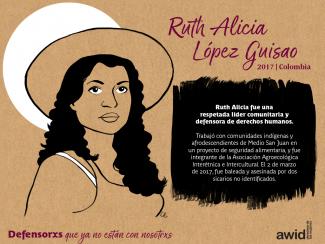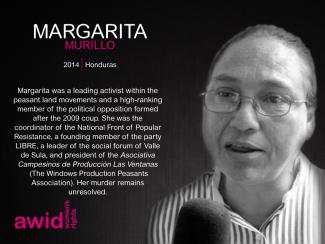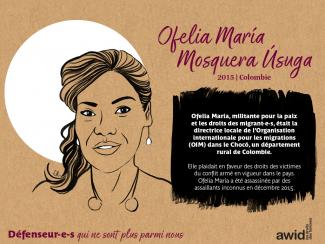
Philippe Leroyer | Flickr (CC BY-NC-ND 2.0)

Special Focus

AWID is an international, feminist, membership organisation committed to achieving gender equality, sustainable development and women’s human rights

Women Human Rights Defenders

WHRDs are self-identified women and lesbian, bisexual, transgender, queer and intersex (LBTQI) people and others who defend rights and are subject to gender-specific risks and threats due to their human rights work and/or as a direct consequence of their gender identity or sexual orientation.

WHRDs are subject to systematic violence and discrimination due to their identities and unyielding struggles for rights, equality and justice.

The WHRD Program collaborates with international and regional partners as well as the AWID membership to raise awareness about these risks and threats, advocate for feminist and holistic measures of protection and safety, and actively promote a culture of self-care and collective well being in our movements.


Risks and threats targeting WHRDs  

WHRDs are exposed to the same types of risks that all other defenders who defend human rights, communities, and the environment face. However, they are also exposed to gender-based violence and gender-specific risks because they challenge existing gender norms within their communities and societies.

By defending rights, WHRDs are at risk of:

  • Physical assault and death
  • Intimidation and harassment, including in online spaces
  • Judicial harassment and criminalization
  • Burnout

A collaborative, holistic approach to safety

We work collaboratively with international and regional networks and our membership

  • to raise awareness about human rights abuses and violations against WHRDs and the systemic violence and discrimination they experience
  • to strengthen protection mechanisms and ensure more effective and timely responses to WHRDs at risk

We work to promote a holistic approach to protection which includes:

  • emphasizing the importance of self-care and collective well being, and recognizing that what care and wellbeing mean may differ across cultures
  • documenting the violations targeting WHRDs using a feminist intersectional perspective;
  • promoting the social recognition and celebration of the work and resilience of WHRDs ; and
  • building civic spaces that are conducive to dismantling structural inequalities without restrictions or obstacles

Our Actions

We aim to contribute to a safer world for WHRDs, their families and communities. We believe that action for rights and justice should not put WHRDs at risk; it should be appreciated and celebrated.

  • Promoting collaboration and coordination among human rights and women’s rights organizations at the international level to  strengthen  responses concerning safety and wellbeing of WHRDs.

  • Supporting regional networks of WHRDs and their organizations, such as the Mesoamerican Initiative for WHRDs and the WHRD Middle East and North Africa  Coalition, in promoting and strengthening collective action for protection - emphasizing the establishment of solidarity and protection networks, the promotion of self-care, and advocacy and mobilization for the safety of WHRDs;

  • Increasing the visibility and recognition of  WHRDs and their struggles, as well as the risks that they encounter by documenting the attacks that they face, and researching, producing, and disseminating information on their struggles, strategies, and challenges:

  • Mobilizing urgent responses of international solidarity for WHRDs at risk through our international and regional networks, and our active membership.

Related Content

Snippet FEA Get Involved 1 (FR)

ENGAGEZ-VOUS!

Vous pouvez suivre le travail de ces collectifs sur les réseaux sociaux et sites internet suivant:

Je suis une jeune féministe. Comment m’impliquer au sein de l’AWID ?

Les jeunes féministes sont au cœur de l’action de l’AWID.

De fait, 38 % de nos membres sont ont moins de 30 ans.

Nous estimons que les jeunes féministes représentent le présent et l’avenir de la lutte pour les droits des femmes. Nous encourageons les jeunes femmes à devenir des leaders du mouvement et notre programme « Activisme des jeunes féministes » est transversal à tous les autres aspects de notre travail.

Dans le même temps, en définissant les jeunes féministes comme l'un de nos domaines prioritaires, nous apportons de nouvelles perspectives aux débats actuels et veillons à ce que les jeunes activistes puissent exprimer clairement leurs priorités et leurs inquiétudes.

En savoir plus sur le programme Activisme des jeunes féministes

English title

This is a French article

- created from the French site

How can I access the survey?

The survey is available on KOBO, an open-source platform for collecting, managing, and visualizing data. To participate, simply click on the survey link here and follow the instructions to complete the survey. 

Snippet FEA EoS The Cover (FR)

Illustration of a pink human in white underwear doing a power pose

La puissante
Autoprotection et renforcement

I am experiencing violence in one or more of my relationships. Can AWID advocate on my behalf?

Unfortunately, no. AWID is not a direct service or individual advocacy organization.

It would be better for you to seek legal advice and contact a women’s shelter or referral centre in your area.

The HotPeachPages is an online resource that offers links to women’s shelters around the world. AWID cannot vouch for the accuracy or quality of its listings, but it may be a good place to start if you don’t know of organizations in your area.

L’activisme au Moyen-Orient et en Afrique du Nord

Notre hommage en ligne met à l’honneur cinq défenseuses des droits humains assassinées au Moyen-Orient ou en Afrique du Nord. Ces défenseuses étaient avocates ou militantes et ont œuvré pour les droits des femmes ou pour les droits civils. Leur mort met en évidence les conditions de travail souvent difficiles et dangereuses dans leurs pays respectifs. Nous vous invitons à vous joindre à nous pour commémorer la vie, le travail et l’activisme de ces femmes. Faites circuler ces mèmes auprès de vos collègues et amis ainsi que dans vos réseaux et twittez en utilisant les hashtags #WHRDTribute et #16Jours.


S'il vous plaît cliquez sur chaque image ci-dessous pour voir une version plus grande et pour télécharger comme un fichier 

[scald=2457:sdl_editor_representation]


¿La encuesta ¿Dónde está el dinero? es accesible para personas con discapacidades?

Sí, es accesible para personas con diverso grado de discapacidades auditivas, visuales, cognitivas y de movilidad.

Snippet FEA Ecofeminism (EN)

WEST AFRICA

NOUS SOMMES LA SOLUTION
We are the Solution

ECOFEMINISM:

Respect for all we have around us

2007: se intensifica la participación de la sociedad civil con la creación del WWG sobre FpD

En octubre de 2007 se creó el Women’s Working Group on Financing for Development [Grupo de Trabajo de Mujeres sobre Financiación para el Desarrollo, WWG on FfD en inglés], una alianza entre organizaciones y redes por los derechos de las mujeres cuyo objetivo es defender y promover avances en cuanto a igualdad de género, empoderamiento de las mujeres y derechos humanos en los procesos de la ONU relacionados con la FpD.

Tercer Diálogo de Alto Nivel sobre la Financiación para el Desarrollo, 23 al 25 de octubre de 2007

  • En el tercer panel de alto nivel, la participación de la sociedad civil se incrementó exponencialmente. Además de las seis mesas redondas, hubo audiencias para la sociedad civil y el sector empresarial.
  • AWID leyó en plenaria la declaración de la sociedad civil que pedía a los gobiernos prestar una mayor atención a la importancia de las organizaciones por los derechos de las mujeres como agentes del desarrollo y a la necesidad de promover nuevos mecanismos de financiación para las mujeres en los países en desarrollo y los menos desarrollados. Esta declaración exhortó a los gobiernos a brindar un mayor apoyo a la arquitectura de género de la ONU para que el sistema en su conjunto pudiera avanzar en sus compromisos en materia de igualdad de género, empoderamiento de las mujeres y derechos humanos, incluyendo los derechos económicos, sociales, culturales y ambientales de todas las personas.

WHRDs from Sub-Saharan Africa

In our 2015 Online Tribute to Women Human Rights Defenders No Longer With Us we are commemorating four women from Sub-Saharan Africa, three of whom were murdered due to their work and/or who they were in their gender identity and sexual orientation. Their deaths highlight the violence LGBT persons often face in the region and across the globe. Please join AWID in honoring these women, their activism and legacy by sharing the memes below with your colleagues, networks and friends and by using the hashtags #WHRDTribute and #16Days. 


Please click on each image below to see a larger version and download as a file


María Verónica Reina

María was recognized globally for her extraordinary leadership in the disability community.

She represented the International Disability and Development Consortium during the negotiation of the United Nations Convention on the Rights of Persons with Disabilities (2001-2006).

Her work was devoted to the implementation of the goal of the Convention - realization of universal human rights by, for and with persons with disabilities for an inclusive, accessible and sustainable world.

In her words, her leadership was about “...serving the disability community, starting with small tasks that others may not wish to do”.

She passed away on October 27, 2017 in her hometown of Rosario, Argentina.

Read more about María Verónica Reina in her own words 


María Verónica Reina, Argentina

Combien de temps faut-il pour répondre aux questions de l’enquête?

La durée est estimée à 30 minutes.

Snippet FEA Mariama Sonko (EN)

This is Mariama Sonko, an inspiring small-scale rural farmer, eco-feminist and a woman human rights defender.

She lives in Niaguiss, a town in the southwest of Senegal. Growing up in a family and community of rural farmers, she witnessed the essential role of women in food production and seed preservation from a very early age, while also being immersed in the rhythms and working of the land. Mariama has been defending local agricultural knowledge and peasant practices since the 1990s. As a mother of five children, the food she grows herself is the main source of sustenance for her family.

She is currently the president of “Nous Sommes la Solution'' and is involved in promoting agroecological practices and family farming, encouraging food sovereignty, biodiversity and farmer seed preservation, and demanding equitable access to resources and land for women across West Africa.

Source: AWID’s Feminist Realities Festival Crear | Résister | Transform - Day 2/ 2ème jour/ 2º día

2013: le sixième Dialogue de haut niveau examine les progrès des OMD