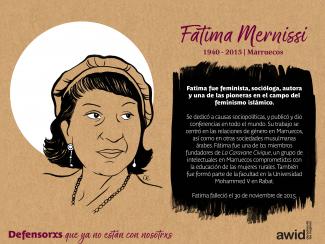
Fatima Mernissi
Over the past few years, a troubling new trend at the international human rights level is being observed, where discourses on ‘protecting the family’ are being employed to defend violations committed against family members, to bolster and justify impunity, and to restrict equal rights within and to family life.
The campaign to "Protect the Family" is driven by ultra-conservative efforts to impose "traditional" and patriarchal interpretations of the family, and to move rights out of the hands of family members and into the institution of ‘the family’.
Since 2014, a group of states have been operating as a bloc in human rights spaces under the name “Group of Friends of the Family”, and resolutions on “Protection of the Family” have been successfully passed every year since 2014.
This agenda has spread beyond the Human Rights Council. We have seen regressive language on “the family” being introduced at the Commission on the Status of Women, and attempts made to introduce it in negotiations on the Sustainable Development Goals.
AWID works with partners and allies to jointly resist “Protection of the Family” and other regressive agendas, and to uphold the universality of human rights.
In response to the increased influence of regressive actors in human rights spaces, AWID joined allies to form the Observatory on the Universality of Rights (OURs). OURs is a collaborative project that monitors, analyzes, and shares information on anti-rights initiatives like “Protection of the Family”.
Rights at Risk, the first OURs report, charts a map of the actors making up the global anti-rights lobby, identifies their key discourses and strategies, and the effect they are having on our human rights.
The report outlines “Protection of the Family” as an agenda that has fostered collaboration across a broad range of regressive actors at the UN. It describes it as: “a strategic framework that houses “multiple patriarchal and anti-rights positions, where the framework, in turn, aims to justify and institutionalize these positions.”
Para fortalecer nuestra voz y poder colectivos para obtener más y mejor financiamiento para las organizaciones feministas, por los derechos de las mujeres y de las personas LBTQI+ y demás organizaciones aliadas de todo el mundo.
Lutter contre vents et marées : le récit de la victoire sans précédent du Réseau Solidarité.
En janvier 2022, le Réseau Solidarité a organisé une grève avec 400 travailleur·euses. Sa principale demande ? L’augmentation des salaires. La grève a été déclenchée après des mois de discussions sans résultats avec le ministère géorgien des Affaires Sociales.
Après avoir manifesté, négocié, parlé à la presse, résisté aux représailles et enduré le froid de l’hiver géorgien pendant des semaines, les travailleur·euses ont obtenu des concessions sans précédent de la part du gouvernement: augmentation des salaires, congés payés de maternité, couverture des frais de transport, arrêt des licenciement, indemnisation des jours de grève, et plus.
La grève a non seulement abouti à des gains matériels, mais a également permis aux travailleur·euses de se sentir uni·e·s et habilité·e·s à se défendre et à lutter pour des conditions de travail décentes, dans le présent et à l'avenir. Iels sont devenu·es une source d'inspiration pour tous·tes les travailleur·euses du pays.
Pour en savoir plus sur leur victoire, cliquez ici.
Etendez vos frontières. Les membres de l'AWID représentent de plus en plus une section transversale dynamique et variée de féministes travaillant, entre autres, sur les questions foncières, les droits des travailleures, les droits sexuels et l'autonomie corporelle. En devenant membre, vous pouvez relier vos luttes entre mouvements.

Le 11 juillet 2024, nous avons eu une conversation étonnante avec de grandes féministes sur l'état de l'écosystème du financement et le pouvoir du recherche « Où est l'argent ? ».
Un merci spécial à Cindy Clark (Thousand Currents), Sachini Perera (RESURJ), Vanessa Thomas (Black Feminist Fund), Lisa Mossberg (SIDA) et Althea Anderson (Fondation Hewlett).
N'oubliez pas que l'enquête restera ouverte jusqu'au 31 août 2024 !

Cuando planifiquen la actividad que les gustaría presentar en el Foro, por favor también tengan en cuenta cómo podrían financiar su participación. Los costos a tener en cuenta son: alojamiento, viaje, visa, inscripción al Foro, y otros.
Es importante señalar que este Foro tendrá muchos ‘espacios abiertos’ y momentos para que los distintos movimientos puedan intercambiar entre sí y aprender, pero menos sesiones formales. (Consulten la sección sobre “Cómo describir el Foro para movilizar recursos” debajo).
Antes que nada, hablen con sus donantes actuales.
Asegúrense de hacerlo con anticipación. (Les recomendamos contactarlxs como máximo durante los primeros meses de 2020). Muchxs donantes que apoyan a organizaciones feministas han asignado recursos para que sus copartes puedan viajar al Foro. Otrxs podrían asignarles esos recursos cuando les renueven su apoyo o como parte de un fondo para viajes.
Si su organización/grupo tiene donantes, podrían contarles que quieren asistir al Foro AWID para aprender, vivenciar, compartir y contactarse con otrxs, aun si su actividad no resulta seleccionada para el programa final. Para poder apoyar su participación, lxs donantes tendrán que saber que ustedes quieren asistir al Foro cuanto antes (ya deben estar decidiendo cómo van a repartir sus fondos en 2020).
Buscar nuevos donantes:
Si no tienen donantes que les apoyen o lxs que tienen no pueden asignarles fondos para viajar al Foro, tal vez podrían buscar nuevos donantes.
Los plazos y requisitos varían de un donante a otro, y los procesos para aprobar una donación pueden llevar meses. Si piensan solicitar fondos a un donante nuevo, por favor háganlo cuanto antes.
Desde siempre los movimientos feministas hemos desplegado nuestra creatividad para financiar nuestro activismo. A continuación encontrarán algunas ideas que podrían inspirarlxs para pensar formas alternativas de movilizar recursos:
Podrán encontrar más ideas en la serie de publicaciones de AWID sobre feministas que se autofinancian, que incluye ideas específicas para movilizar fondos y participar en eventos.
AWID intenta hacer del Foro un evento verdaderamente global con participación de una variedad de movimientos, regiones y generaciones. Con este fin, movilizamos recursos para un Fondo Acceso (FA) limitado que asistirá a lxs participantes a cubrir los costos que implica asistir al Foro.
El Fondo Acceso de AWID podrá apoyar a un número limitado de participantes del Foro y personas que faciliten sesiones/actividades. Este apoyo no está garantizado y lxs alentamos a buscar formas alternativas de financiar su participación en el Foro, incluyendo sus gastos de viaje.
En su formulario de aplicación pueden indicar que les gustaría ser tenidxs en cuenta para el Fondo Acceso de AWID. Por favor tengan presente que estos recursos son muy limitados y que no vamos a poder apoyar a todxs. Aun si indican que les gustaría ser tenidxs en cuenta para el Fondo Acceso, les alentamos a continuar explorando otras opciones para financiar su participación en el Foro. A fines de junio de 2020 confirmaremos las decisiones acerca del Fondo Acceso.
A continuación encontrarán algunos mensajes simples que pueden utilizar cuando hablen con sus donantes o con personas de su comunidad. Por favor no duden en adaptarlos como les pueda resultar más útil.
El Foro AWID es un espacio que los movimientos feministas crean juntos y que permite a lxs participantes renovar energía para su activismo, fortaleciendo sus vínculos con muchos movimientos por los derechos y la justicia. Lxs participantes pueden encontrar allí esperanza, energía e imaginación radical, al mismo tiempo que profundizan análisis compartidos, aprenden y desarrollan la solidaridad entre movimientos que permite agendas más integradas y estrategias conjuntas.
Nuestra organización está buscando fondos para asistir al Foro y poder vincularnos con otrxs activistas y movimientos de todo el mundo, fortalecer nuestras estrategias y compartir el trabajo que hacemos. Nos inspira la experiencia de otrxs que han participado en el Foro y que describieron la fuerza de esta convocatoria feminista global:
“Durante cuatro días … las voces se entretejieron para articular una perspectiva global sobre el estado de la igualdad de género. Y cuando digo ‘global’ quiero decir por ejemplo que había traducción simultánea en siete idiomas…”
“Nos recordó que no estamos solas. El Foro nos permitió traducir lo colectivo a nuestros movimientos. Con diferencias en cuanto a ideologías, identidades o fronteras, nuestra fortaleza yace en nuestra visión y en cómo nos apoyamos unas a otras”.
Es importante señalar que este Foro tendrá muchos ‘espacios abiertos’ y momentos para que los movimientos puedan aprender e intercambiar entre sí, pero menos sesiones formales. Si bien muchxs participantes no podrán facilitar sesiones formales, para ellxs también será un espacio valioso en el que aprender, pensar estrategias y vivenciar el poder colectivo de los movimientos feministas en acción.
Para calcular los costos y saber cuánto dinero necesitarán recaudar, es importante que tengan en cuenta que su participación podrá requerir todos o algunos de los siguientes gastos:
El 14o Foro de AWID tendrá lugar del 11 al 14 de enero de 2021 en Taipéi, Taiwán.
El Foro es más que una reunión de cuatro días. Es una estación en un recorrido más largo para fortalecer nuestros movimientos en torno a la noción de Realidades Feministas que ya ha comenzado y que continuará más allá de las fechas del Foro.
We strive for transparency, responsible use of our resources, fairness in our collaborations and accountability and integrity with our members, partners, funders and the movements with(in) which we work. We are committed to reflecting on our experiences, sharing our learnings openly, and striving to change our practices accordingly.


Nous avons ensuite organisé une série complète de visites au Népal, en Malaisie, au Sri Lanka, en Thaïlande, en Indonésie et (plus tard) à Taïwan. Sur place, chaque visite comprenait non seulement un examen de l’infrastructure logistique, mais aussi des réunions avec des activistes et des groupes féministes locales·aux afin de mieux comprendre la situation et leur analyse des risques et opportunités potentielles quant à un Forum de l’AWID dans leur contexte.
Ils ont souvent exprimé des sentiments partagés entre risques et opportunités liées à la visibilité apportée par un événement comme le Forum. Durant l’une des réunions, les activistes présent·e·s soulignèrent à l'unanimité, au cours des 30 premières minutes, que le Forum de l’AWID pouvait entraîner de nombreux contrecoups, que les droits LGBTQ étaient un sujet politique particulièrement sensible et que les groupes fondamentalistes chercheraient de toutes leurs forces à interrompre l’événement. Lorsque nous répliquâmes « ok, donc vous ne pensez pas que ce soit une bonne idée », leur réponse également unanime fut « bien sûr que si, nous voulons changer les récits !».
Il était difficile d’entendre et de voir dans certains endroits le nombre d’activistes féministes qui voulaient utiliser l’opportunité de visibilité d’un tel événement comme levier, prêt·e·s à faire face aux risques locaux ; mais l’accueil de près de 2000 personnes venues du monde entier nécessitait de prendre en compte d’autres calculs de risque et de faisabilité.
Nous avons également débattu de questions sur ce qu’implique l’organisation d’un forum féministe en cohérence avec les principes d’inclusion, de réciprocité et d’autodétermination, là où les politiques et les pratiques étatiques vont généralement à leur encontre (même si les représentant·e·s des Ministères du Tourisme ont tenté ardemment de concilier ce point).
Dans beaucoup d’endroits, suivre le contexte donnait des impressions de balancier pouvant pencher vers l’ouverture et la sécurité des débats féministes à un moment donné, et vers la répression totale et la xénophobie l’instant d’après, sacrifiant les priorités féministes dans les négociations politiques cherchant à apaiser l’extrême droite ou les forces anti-droits.
Ce processus a donné lieu à des réflexions sur le contexte extrêmement difficile pour l’activisme des droits des femmes et de la justice de genre au niveau mondial.
Pour autant, nous ne pourrions aujourd’hui organiser un Forum de l’AWID à Istanbul comme nous l’avions fait en 2012, ou au Brésil comme en 2016.
L’organisation du Forum de l’AWID implique pour nous la création et la disposition d’un espace qui s’ajuste au mieux à une diversité de formes d’expression de solidarité, d’indignation, d’espoir et d’inspiration. Celles-ci sont au cœur de nos mouvements féministes.
Actuellement, Taipei nous semble donc être l’emplacement de la région Asie-Pacifique qui nous permet au mieux de bâtir un espace sécurisé et désobéissant pour notre communauté féministe mondiale.
Le fait est qu’il n’existe pas d’emplacement idéal dans le monde actuel pour tenir un Forum qui se concentre sur les Réalités féministes. Peu importe où nous irons, nous devrons construire cet espace ensemble !
Dada la situación global, nuestra Junta Directiva tomó la difícil decisión de cancelar el Foro que estaba programado en 2021, enTaipei.