Protection of the Family
The Issue
Over the past few years, a troubling new trend at the international human rights level is being observed, where discourses on ‘protecting the family’ are being employed to defend violations committed against family members, to bolster and justify impunity, and to restrict equal rights within and to family life.
The campaign to "Protect the Family" is driven by ultra-conservative efforts to impose "traditional" and patriarchal interpretations of the family, and to move rights out of the hands of family members and into the institution of ‘the family’.
“Protection of the Family” efforts stem from:
- rising traditionalism,
- rising cultural, social and religious conservatism and
- sentiment hostile to women’s human rights, sexual rights, child rights and the rights of persons with non-normative gender identities and sexual orientations.
Since 2014, a group of states have been operating as a bloc in human rights spaces under the name “Group of Friends of the Family”, and resolutions on “Protection of the Family” have been successfully passed every year since 2014.
This agenda has spread beyond the Human Rights Council. We have seen regressive language on “the family” being introduced at the Commission on the Status of Women, and attempts made to introduce it in negotiations on the Sustainable Development Goals.
Our Approach
AWID works with partners and allies to jointly resist “Protection of the Family” and other regressive agendas, and to uphold the universality of human rights.
In response to the increased influence of regressive actors in human rights spaces, AWID joined allies to form the Observatory on the Universality of Rights (OURs). OURs is a collaborative project that monitors, analyzes, and shares information on anti-rights initiatives like “Protection of the Family”.
Rights at Risk, the first OURs report, charts a map of the actors making up the global anti-rights lobby, identifies their key discourses and strategies, and the effect they are having on our human rights.
The report outlines “Protection of the Family” as an agenda that has fostered collaboration across a broad range of regressive actors at the UN. It describes it as: “a strategic framework that houses “multiple patriarchal and anti-rights positions, where the framework, in turn, aims to justify and institutionalize these positions.”
Related Content
2024: Fortaleciendo movimientos, sosteniendo el cambio
Desde el auge de la derecha en muchos países y la oleada de recortes al financiamiento que afectan seriamente a la sociedad civil de la mayoría global, hasta el genocidio en curso en Gaza, la intensificación de los violentos conflictos en Sudán y la crisis climática en muchas áreas de nuestro planeta, estamos frente a las fuerzas reales del fascismo y a un orden mundial de impunidad.
Descargar el informe anual 2024

De cara al futuro, nos basamos en los poderosos llamados a la acción realizados por les feministas en el Foro de AWID. Juntes podemos construir un mundo en el que la justicia, la liberación y los cuidados no sean aspiraciones, sino realidades.
Snippet - WITM why - AR
لماذا عليّ تعبئة الاستطلاع؟
Clone of Crear | Résister | Transform: A Walkthrough of the Festival! - smaller snippet

Crear | Résister | Transform :
visite guidée du Festival
Alors que le capitalisme hétéropatriarcal s’acharne à nous contraindre au consumérisme et à la conformité, nous constatons que nos luttes sont cloisonnées et séparées par des frontières aussi bien physiques que virtuelles.
Shireen Lateef
Shireen fue una inspiración para muchas feministas en Fiyi y una aliada poderosa del movimiento de mujeres.
Abogó incansablemente por la igualdad de género tanto a nivel local como regional. Comenzó su carrera como especialista junior en género en el Banco de Desarrollo Asiático e introdujo profundos cambios en las políticas de género de la institución. Su investigación «Gobernar mediante lxs danda: violencia doméstica entre lxs indo-fiyianxs» fue uno de los primeros trabajos de investigación sobre violencia doméstica, matrimonio y mujeres en Fiyi. Este trabajo fundacional ha sido un catalizador para el trabajo feminista en esta área.
El legado de Shireen sigue vivo porque son muchxs lxs que recuerdan su influencia, su compromiso y su apoyo al movimiento de mujeres de Fiyi y del Pacífico.
Inna Michaeli
Inna es una activista y socióloga feminista queer. Posee muchos años de profundo compromiso con las luchas feministas y LGBTQI+, la educación en política y en procesos de organización de y para las mujeres migrantes, así como por la liberación de y la solidaridad con Palestina. Se incorporó a AWID en 2016 y cumplió diferentes funciones, la más reciente como Directora de Programas. Reside en Berlín (Alemania), creció en Haifa (Palestina/Israel), nació en San Petersburgo (Rusia), y ha puesto todo ese recorrido geográfico político y de resistencia a los colonialismos pasados y presentes al servicio del activismo feminista y la solidaridad transnacional.
Inna es autora de Women's Economic Empowerment: Feminism, Neoliberalism, and the State (Empoderamiento económico de las mujeres: Feminismo, neoliberalismo y Estado. Palgrave Macmillan, 2022), basado en la tesis que le valió un doctorado de la Universidad Humboldt de Berlín. Como académica, impartió cursos sobre globalización, producción de conocimientos, identidad y pertenencia. Inna posee una maestría en Estudios Culturales de la Universidad Hebrea de Jerusalén. Integra la Junta de Jewish Voice for a Just Peace in the Middle East (Voces Judías por una Paz Justa en Medio Oriente, Alemania) y, con anterioridad, fue miembro de la Junta de +972 Advancement of Citizen Journalism (+972 Avance del Periodismo Ciudadano). Antes, Inna trabajó con la Coalición de Mujeres por la Paz y es una apasionada de la movilización de recursos para el activismo de base.
Elena Gastaldo
Snippet - WITM To Strengthen - AR

لتقوية صوتنا وقوتنا الجماعية لنصل لتمويل أكبر وأفضل للتنظيمات النسائية والنسوية وحركات الميم - عين وحلفائها/يفاتها عالمياً
Clone of #6 - Sexting like a feminist Tweets Snippet FR
Mariam Uy Acob
Mariam était assistante juridique à l'Alliance des droits humains Kawagib Moro.
Mariam était une fervente critique de la militarisation imposée aux communautés moro et a constamment dénoncé les bombardements aériens et les cantonnements de troupes. Elle a dû fuir et chercher refuge après avoir révélé et dénoncé des injustices commises à l'encontre des communautés musulmanes aux Philippines.
Il semble que Mariam ait été assassinée par de présumés agents de l'armée à cause de son action en tant que défenseure. Les assaillants qui l‘ont tuée l’ont épiée, ont rattrapé le véhicule dans lequel elle se trouvait et ont fait feu sur elle à sept reprises.
Margo Okazawa-Rey
Dre. Margo Okazawa-Rey est titulaire de la Chaire Barbara Lee pour le leadership des femmes et professeure invitée en études sur les femmes, le genre et la sexualité et en politique publique au Mills College à Oakland, en Californie. Elle est également professeure émérite à la San Francisco State University.
Ses principaux domaines de recherche et d’activisme au cours des 25 dernières années sont le militarisme, les conflits armés et la violence à l’égard des femmes, analysés de manière intersectionelle. Professeure Okazawa-Rey siège au conseil consultatif international de Du Re Bang à Uijongbu en Corée du Sud, au Conseil international de PeaceWomen Across the Globe à Berne, en Suisse, et est co-présidente du conseil du Highlander Research and Education Centre à New Market, Tennessee aux États-Unis.
Ses publications récentes incluent « Nation-izing » Coalition and Solidarity Politics for US Anti-militarist Feminists (en presse) ; « No Freedom without Connections: Envisioning Sustainable Feminist Solidarities » (2018) dans Feminist Freedom Warriors : Genealogies, Justice, Politics, and Hope, Chandra Talpade Mohanty et Linda Carty (ed.) ; Between a Rock and Hard Place: Southeast Asian Women Confront Extractivism, Militarism, and Religious Fundamentalisms (2018) ; à « Liberal Arts Colleges Partnering with Highlander Research and Education Center : Intergenerational Learning for Student Campus Activism and Personal Transformation, » numéro spéciale de Feminist Formations (Feminist Social Justice Pedagogy, (2018).
Sunila Abeyseke
Snippet - WITM about research - PT
Sobre o inquérito WITM
O inquérito global do WITM é um pilar fundamental da terceira edição da nossa investigação orientada para a ação: "Onde está o dinheiro para a organização feminista" (abreviado, "Onde está o dinheiro" ou WITM). Os resultados do inquérito serão aprofundados e explorados através de conversas profundas com ativistas e financiadores, e comparados com outras análises e investigações existentes sobre o estado do financiamento para feministas e para a igualdade de género globalmente
O relatório completo "Onde está o dinheiro para a organização feminista" será publicado em 2026.
Para mais informações sobre como a AWID tem chamado a atenção para o dinheiro a favor de e contra os movimentos feministas, consulte a nossa história do WITM e os nossos relatórios anteriores aqui.
Colectivo Morivivi Snippet ES
Colectivo Morivivi
Moriviví es un colectivo de jóvenes artistas mujeres que trabajan en arte público desde abril de 2013. Con sede en Puerto Rico, hemos obtenido reconocimiento por la creación de murales y de arte comunitario.
Ana M. Tallada Iglesia
Ana was a strong advocate of women’s rights and worked with a broad cross-section of women, from those in grassroots networks to those in the private sector.
She believed in building bridges across sectors. Ana was a member of the National Network for the Promotion of Women (RNPM), and was active in developing many social programs that address issues such as sexual and reproductive health and rights.
Salome Chagelishvili
Salome is a feminist activist from Tbilisi, Georgia, devoted to social and gender justice. She holds a Master's degree in gender studies, and has been engaged in feminist, queer and green movements for over twelve years, working amongst others on issues of gender based violence, domestic violence, sexual and reproductive health and rights, LGBTIQ rights, [women’s] Labor Rights, Healing Justice and holistic and digital security and rights.
Since 2014 she has been actively working on safety and security issues of activists and Women Human Rights Defenders, providing integrated security and digital security workshops specifically for activists from under-privileged groups (queer persons, ethnic and religious minorities, rural women and girls, etc) as well as bigger feminist organisations. Salome is a member of the Independent Group of Feminists - a non-formal, non-hierarchical and non-registered initiative that unites feminists with diverse backgrounds in Georgia. Currently, she is the Executive Director of the Women's Fund in Georgia, fully engaged in women's/feminist movement building, providing feminist funding, and encouraging local feminist philanthropy.
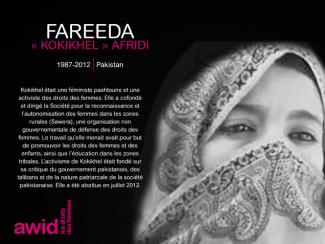
Farida Afridi
ما هو الهدف من استطلاع "أين المال"؟
الهدف الأساسي من وراء استطلاع "أين المال" هو تسليط الضوء على على وقائع التمويل المتنوّعة والمركّبة للحركات النسوية، حركات النساء، حركات العدالة الجندرية وحركات مجتمع الميم - عين والحركات الحليفة لها على المستوى العالمي. بناءاً على هذا، وبناءً على ذلك - تعزيز قضية تحويل أموال أكثر وأفضل وتحويل السلطة باتجاه الحركات النسوية.
40 ans de la fondation de AWID: L'album | FR Snippet Home
40 ans de la fondation de AWID: L'album
En collaboration avec l'artiste Naadira Patel, nous avons créé un album qui met en lumière une sélection de moments marquants, représentatifs des quatre décennies de soutien de AWID aux mouvements féministes.
Marceline Loridan-Ivens
Nacida en 1928, Marceline trabajó como actriz, guionista y directora.
Dirigió The Birch-Tree Meadow en 2003, protagonizada por Anouk Aimee, así como varios otros documentales. También fue una sobreviviente del Holocausto. Tenía solo quince años cuando ella y su padre fueron arrestadxs y enviadxs a campos de concentración nazis. Los tres kilómetros entre su padre en Auschwitz y ella en Birkenau eran una distancia infranqueable, sobre la cual escribió en una de sus novelas más influyentes: Pero no regresaste.
Al hablar sobre su trabajo, una vez afirmó: «Todo lo que puedo decir es que todo lo que pueda escribir, todo lo que pueda develar, es mi tarea hacerlo».