Left
Half
Left

Special Focus

AWID is an international, feminist, membership organisation committed to achieving gender equality, sustainable development and women’s human rights

Memory as Resistance: A Tribute to WHRDs no longer with us

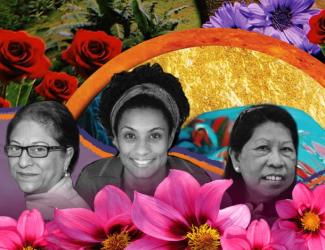
AWID’s Tribute is an art exhibition honouring feminists, women’s rights and social justice activists from around the world who are no longer with us. 


In 2020, we are taking a turn

This year’s tribute tells stories and shares narratives about those who co-created feminist realities, have offered visions of alternatives to systems and actors that oppress us, and have proposed new ways of organising, mobilising, fighting, working, living, and learning.

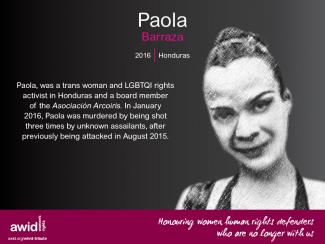
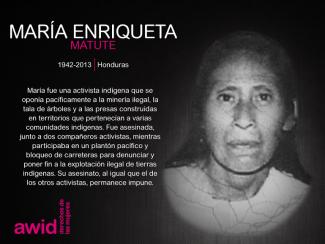
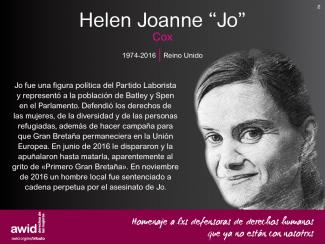
49 new portraits of feminists and Women Human Rights Defenders (WHRDs) are added to the gallery. While many of those we honour have passed away due to old age or illness, too many have been killed as a result of their work and who they are.

This increasing violence (by states, corporations, organized crime, unknown gunmen...) is not only aimed at individual activists but at our joint work and feminist realities.

The stories of activists we honour keep their legacy alive and carry their inspiration forward into our movements’ future work.

Visit the online exhibit

The portraits of the 2020 edition are designed by award winning illustrator and animator, Louisa Bertman

AWID would like to thank the families and organizations who shared their personal stories and contributed to this memorial. We join them in continuing the remarkable work of these activists and WHRDs and forging efforts to ensure justice is achieved in cases that remain in impunity.

“They tried to bury us. They didn’t know we were seeds.” - Mexican Proverb 


The Tribute was first launched in 2012

It took shape with a physical exhibit of portraits and biographies of feminists and activists who passed away at AWID’s 12th International Forum, in Turkey. It now lives as an online gallery, updated every year.

To date, 467 feminists and WHRDs are featured.

Visit the online exhibit

Related Content

CREDITS | Content Snippet EN

Credits

Co-editeurices
Chinelo Onwualu
Ghiwa Sayegh (Kohl)

Création graphique et illustration
Sophia Andreazza

Stratège des communications
Zuhour Mahmoud (Kohl)

Editrice de la langue arabe
Sabah Ayoub (Kohl)

Responsable de la traduction
Maya Zebdawi (Kohl)


L’équipe de AWID
Nana Darkoa Sekyiamah
Lola Silva
Kamee Abrahamian
Tanya Lallmon    
Maria Olivo
Marianne Asfaw
Ana Abelenda


Version française
Traduction
Camille Dufour
Morgane Boëdec

Relecture
Nathalie Thériault
 

Traduction arabe
Lina Yahya
Marina Samir
Maya Zebdawi
Nidal Majeed
Rania El-Ghazal
Rola Alaeddine
Viviane Akiki


Version espagnole
Traduction
Verónica Torrecillas
Gabriela Adelstein
Maria Luisa Peralta
Alejandra Sarda
Gabby De Cicco

Relecture
Alejandra Sarda
Gabby De Cicco
María Eugenia Martí


Portuguais vers anglais
Traduction
Luiza Martello

Relecture
Shaina Greiff
 

Fahmida Riaz

« Après
Après l’amour la première fois,
Nos corps et nos esprits nus
Une galerie des glaces,
Complètement désarmés, absolument fragiles,
Nous nous couchons dans les bras de l’autre
Respirant attentivement,
Avec la crainte de briser
Ces figurines en cristal. » - Fahmida Riaz

Fahmida Riaz a brisé les tabous sociaux en écrivant sur le désir des femmes dans ses poèmes, créant des récits alternatifs à propos du corps des femmes et de leur sexualité, et établissant de nouveaux standards dans la littérature urdu.

Son travail s’est confronté à de sévères critiques de la part des conservateurs, qui l’ont accusée d’utiliser des expressions érotiques et « pornographiques » dans son langage poétique.  

Fahmida a finalement été mise sur liste noire et accusée de sédition en vertu de l’article 124A du Code pénal pakistanais sous la dictature de Zia-ul-Haq. Forcée à l’exil en 1981, elle a passé presque sept ans en Inde avant de retourner au Pakistan. 

Dans la préface de « Badan Dareeda » (Un corps ravagé), un recueil de poèmes publié en 1974, elle écrit :

Si, en effet, je suis forcée à me tenir aujourd’hui devant ce maqtal et me confronte à la potence, je dois y faire face, la tête haute. Mes poèmes sont la trace d’une tête mutilée : des sons émanant même lorsque suspendue par des cordes… Un corps ravagé a pris la forme de razmia, ou  d’un son de rupture. Et si cette rupture est effectivement choquante pour les gens, c’est que la poète a atteint son intention : elle a réussi à la perturber. (traduction de l’urdu vers l’anglais par Asad Alvi) 

La splendeur de Fahmida résidait dans sa défiance de toute logique ou toute catégorie particulière de genre, nation, religion ou culture. Elle refusait d’être mise dans le rôle d’une « femme poète », brisant les définitions traditionnelles de la poésie féminine, des concepts et des thématiques (variant entre conscience politique, corps, culture, désir, religion, foyer), et renversant les inhibitions assignées à son genre.   

« Il faut que vous compreniez que la culture ne peut avoir d’essence. Les cultures changent, circulent entre elles, formant de nouvelles cultures. La culture est née de cette façon. Il n’y a pas de conflits de cultures. »

Fahmida a écrit plus de 15 livres de poésie et de fiction, dont son poème ‘Taaziyati Qaraardaaden’ («Résolutions de condoléances» en anglais) qui pourrait servir d'hommage approprié à sa vie et à son héritage et de collection de poèmes (Apna Jurm To Saabit He «Mon crime est prouvé») publié en 1988 durant son exil.

Fahmida Riaz est née à Meerut, en Inde, le 28 juillet 1946 et est décédée le 21 novembre 2018 à Lahore, au Pakistan. 

Jessica Whitbread

Biography

Jessica is a queer artist- activist from Toronto, Canada, but is currently based in Bulgaria. Jessica has over 15 years experience in the HIV response working at the intersections of gender and HIV with key populations (sex workers, women who use drugs, LGBTQI communities, incarcerated people and of course people living with HIV). Jessica loves movement building and thinking/taking/strategizing about arts-based interventions. One fun project she started in 2013 was LOVE POSITIVE WOMEN that engages over 125 community groups and organizations globally every February 1-14th to celebrate women living with HIV in their communities.

Position
Membership and Constituency Engagement Lead
Add to stories
Off

Sexting Like a Feminist: Humor in the Digital Feminist Revolution | Title Snippet AR

الصياغات النسوية للرسائل النصّية ذات المحتوى الجنسي: الدُّعابة الجنسانيّة في فضاء الثورة النسوية الرقمية

تشينيلو أونوالو


ترجمة مايا زبداوي

Sylvia Rivera

Sylvia Rivera was a civil rights activist, a transvestite and sex worker.

Known as the New York Drag queen of color, Silvia was fierce and tireless in her advocacy, in defense of those who  were marginalized and excluded as the “gay rights” movement mainstreamed in the United States in the early 1970’s.

In a well-known speech on Christopher Street Day in 1973, Sylvia, shouted through a crowd of LGBT community members: 

“You all tell me, go and hide my tail between my legs.
I will no longer put up with this shit.
I have been beaten.
I have had my nose broken.
I have been thrown in jail.
I have lost my job.
I have lost my apartment.
For gay liberation, and you all treat me this way?
What the fuck’s wrong with you all?
Think about that!” 

In 1969, at age 17, Silvia took part in the iconic Stonewall Riots by allegedly throwing the second Molotov cocktail to protest the police raid of the gay bar in Manhattan. She continued to be a central figure in the uprisings that followed, organizing rallies and fighting back police brutality.

In 1970, Sylvia worked together with Marsha P. Johnson to establish Street Transvestite Action Revolutionaries (S.T.A.R.), a political collective and organisation that would set up projects of mutual support for trans people living on the streets, those struggling with drug addiction and in prisons and in particular for trans people of color and those living in poverty. 

Defiant of labels, Silvia lived life in a way that challenged people in the gay liberation movement to think differently. She said: 

“I left home at age 10 in 1961. I hustled on 42nd Street. The early 60s was not a good time for drag queens, effeminate boys or boys that wore makeup like we did. Back then we were beat up by the police, by everybody. I didn't really come out as a drag queen until the late 60s. when drag queens were arrested, what degradation there was. I remember the first time I got arrested, I wasn't even in full drag. I was walking down the street and the cops just snatched me. People now want to call me a lesbian because I'm with Julia, and I say, "No. I'm just me. I'm not a lesbian." I'm tired of being labeled. I don't even like the label transgender. I'm tired of living with labels. I just want to be who I am. I am Sylvia Rivera. 

Through her activism and courage, Sylvia offered a mirror that reflected all that was wrong within society, but also the possibility of transformation. Sylvia was born in 1951 and passed away in 2002. 

Ȃurea Mouzinho

Biography

Ȃurea Mouzinho es una activista feminista por la justicia económica de Luanda, Angola, que tiene una carrera de diez años en investigación, otorgamiento de subvenciones, incidencia y construcción de movimientos por los derechos de las mujeres y la justicia económica en toda África y en el Sur global. Actualmente es Directora de Programa para África en Thousand Currents, y es parte del consejo editorial de Feminist Africa. También integra Ondjango Feminista, una colectiva feminista que cofundó en 2016. Recientemente ha sido madre de un niño de Géminis, y disfruta los días tranquilos con su joven familia y los largos paseos por la playa. Ocasionalmente publica tweets con el nombre de usuarie @kitondowe.

Add to stories
Off

#3 - Sexting like a feminist Tweets Snippet AR

بصراحة…

Image of a tweet with a gif of a man saying "Yes daddy". Text says: No one: (blank). Me: Bae I wanna squeeze your ass like I wanna squeeze misogynists out of corporate hierarchies.

رغبتي في الانقضاض على جسدك تعادل رغبتي بالانقضاض على كراهية النساء المتجذرة في التسلسلات الهرمية للشركات

Cynthia Cockburn

Cynthia Cockburn fue una socióloga feminista, escritora, académica, fotógrafa y activista por la paz.

Estudió los aspectos relacionados con el género en la violencia y el conflicto e hizo importantes contribuciones al movimiento por la paz gracias a sus investigaciones sobre masculinidad y violencia, así como gracias a su activismo local e internacional.

Cynthia aportó un análisis feminista potente sobre la militarización y la guerra, y fue una de las académicas cuyos escritos y estudios demostraron claramente cómo la violencia de género desempeñaba un papel clave en la perpetuación de la guerra. Al trabajar en estrecha colaboración con activistas por la paz en distintos países en conflicto, sus conclusiones abarcaron diversos contextos, entre ellos: Irlanda del Norte, Bosnia y Herzegovina, Israel/Palestina, Corea del Sur, Japón, España y el Reino Unido. También logró incluir en sus investigaciones y escritos académicos una interpretación sobre cómo la violencia se experimenta como un continuo de tiempo y escala y cómo se percibe de forma muy diferente cuando se analiza desde la perspectiva de género.

En sus propias palabras: "El género nos ayuda a ver la continuidad, la conexión entre los casos de violencia".

Cynthia conectó su trabajo de investigación con el activismo que sostuvo a nivel local e internacional con los movimientos por la desmilitarización, el desarme y la paz. Ayudó a iniciar el campamento de paz de las mujeres de Greenham Common, que defendía el desarme nuclear universal en Gran Bretaña, y formó parte también de la creación del capítulo londinense de Women in Black [Mujeres de Negro]. A lo largo de las décadas, Cynthia organizó y participó en vigilias semanales locales y en el coro político Raised Voices [Elevar las Voces], para el que, además de cantar, escribió varias letras de canciones que forman parte de su repertorio.

Su activismo la llevó a apoyar también el trabajo de la Women’s International League for Peace and Freedom [Liga Internacional de Mujeres por la Paz y la Libertad] (WILPF, por su siglas en inglés), el European Forum of Socialist Feminists [Foro Europeo de Feministas Socialistas] y Women Against Fundamentalism [Mujeres contra el Fundamentalismo].

"Cynthia arrojó claridad feminista, tejió comunidades feministas, cantó canciones de paz, escuchó, escuchó, escuchó, observó los pájaros - y detuvo el tráfico. Siempre estaré agradecida y en deuda con ella, la otra 'Cynthia'" - Cynthia Enloe.

Cynthia nació en julio de 1934 y falleció en septiembre de 2019, a la edad de 85 años.

Fatima Qureshi

Biography

A nomad of cultures, born in Hong Kong, rooted in Turkish-Pakistani heritage, Fatima’s love for narratives - both in reading and co-creating them - fueled her passion for communications activism. Supported by her education in journalism, Fatima has worked for 7 years in digital and media communications fields with NGOs that provide education opportunities and legal aid to refugee and asylum seekers, as well as with the Muslim feminist movement which applies feminist and rights-based lenses in understanding and searching for equality and justice within Muslim legal tradition. She is a regular op-ed writer on feminist issues in the Global South.

Through storytelling in this hyper-digital age of social media, Fatima continues to collaborate with community organizers and grassroots activists to create audiovisual content with the aim to cultivate bridges of understanding towards collective liberation and decolonization. On days when she’s not working, she intently watches independent feminist films coming from Iran, Morocco and Pakistan and on other days, she performs spoken word poetry with her comrades in Kuala Lumpur.

Position
ICM Digital Communications and Partnerships Lead
Add to stories
Off

Upasana Agarwal

Upasana Agarwal

Upasana es unx ilustradorx y artista no binarie de Calcuta, India. Su obra explora narrativas identitarias y personales, que empean restos o evidencias visuales de los contextos con los que trabaja. Le atraen especialmente los diseños en patrones que, para ellx, comunican verdades complejas sobre el pasado, el presente y el futuro. Cuando Upasana no está ilustrando, organiza y dirige un centro de arte comunitario queer y trans de la ciudad. 

Visitar la exposición

Hevrin Khalaf

Hevrin Khalaf était une grande dirigeante politique kurde de Syrie dans la région autonome du Rojava, où les femmes kurdes risquent leur vie pour résister aux offensives turques et pour bâtir un système féministe.

Elle a travaillé en tant que secrétaire-générale du Parti du Futur de la Syrie, un groupe qui souhaitait construire des ponts, réconcilier les différents groupes ethniques et mettre sur pied une « Syrie démocratique, pluraliste et décentralisée ».

Véritable symbole de cet effort de réconciliation, elle a également oeuvré à la promotion de l’égalité entre les femmes et les hommes et fut représentante auprès des journalistes en visite, des humanitaires et des diplomates.

Hevrin a de plus été diplômée en tant qu’ingénieure civile, à la ville de Derik, ainsi que l’une des fondatrices de la Fondation pour la Science et la Libre pensée en 2012.

Elle a été torturée et assassinée le 12 octobre 2019 par la milice Ahrar al-Sharqiya, soutenue par la Turquie, lors d’une opération militaire contre les Forces démocratiques syriennes dans le Rojava.

 « L’assassinat de Khalaf est un tournant majeur dans l’histoire moderne de la Syrie, celui-ci ayant une fois de plus confirmé la validité du vieux proverbe kurde qui dit : « Il n’y a de véritable ami·e que la montagne ». Je serai toujours ami avec Khalaf et sa vision d’un monde meilleur. » – Ahed Al Hendi

Nana Abuelsoud

Biography

Nana es una organizadora feminista e investigadora en derechos reproductivos y políticas demográficas que reside en Egipto. Es miembro de RESURJ (organización feminista por la justicia sexual y reproductiva), del Órgano Asesor del Proyecto A del Líbano y de la Comisión de la Comunidad de Mama Cash. Nana tiene una maestría en Salud Pública del Instituto KIT y la Universidad Vrije de Ámsterdam. En su trabajo, da seguimiento y contextualiza las políticas demográficas nacionales, al tiempo que reúne información para abordar la eugenesia moderna, las ayudas internacionales de carácter regresivo y el autoritarismo. Anteriormente, formó parte de la Fundación de Ginebra para la Educación y la Investigación Médica, la Iniciativa Egipcia para los Derechos Personales y el Colectivo Feminista Ikhtyar de El Cairo.

Add to stories
Off

Beijing sans Entraves: le Pouvoir des Jeunes Mouvements Féministes

En partenariat avec de jeunes activistes féministes et des organisations dirigées par des jeunes, l'AWID co-organise Beijing sans Entraves en parallèle et indépendamment de Beijing + 25. 

Lire plus

Laurie Carlos

Laurie Carlos was an actor, director, dancer, playwright, and poet in the United States. An extraordinary artist and visionary with powerful ways of bringing the art out in others. 

“Laurie walked in the room (any room/every room) with swirling clairvoyance, artistic genius, embodied rigor, fierce realness—and a determination to be free...and to free others. A Magic Maker. A Seer. A Shape Shifter. Laurie told me once that she went inside people’s bodies to find what they needed.” - Sharon Bridgforth 

She combined performance styles such as rhythmic gestures and text. Laurie mentored new actors, performers, writers and helped amplify their work through Naked Stages, a fellowship for emerging artists. She was an artistic fellow at Penumbra Theater and supported with identifying scripts to produce, with a goal of “bringing more feminine voices into the theater”. Laurie was also a member of Urban Bush Women, a renowned contemporary dance company telling stories of women of the African diaspora.

In 1976, as Lady in Blue, she made her Broadway debut in Ntozake Shange’s original and award-winning production of the poetic drama For colored girls who have considered suicide / when the rainbow is enuf. Laurie’s own works include White Chocolate, The Cooking Show, and Organdy Falsetto

“I tell the stories in the movement—the inside dances that occur spontaneously, as in life—the music and the text. If I write a line, it doesn’t necessarily have to be a line that is spoken; it can be a line that’s moved. A line from which music is created. The gesture becomes the sentence. So much of who we are as women, as people, has to do with how we gesture to one another all the time, and particularly through emotional moments. Gesture becomes a sentence or a state of fact. If I put on a script ‘four gestures,’ that doesn’t mean I’m not saying anything; that means I have opened it up for something to be said physically.” Laurie Carlos

Laurie was born and grew up in New York City, worked and lived in Twin Cities. She passed away on 29 December 2016, at the age of 67, after a battle with colon cancer.


Tributes:  

“I believe that that was exactly Laurie’s intention. To save us. From mediocrity. From ego. From laziness. From half-realized art making. From being paralyzed by fear.
Laurie wanted to help us Shine fully.
In our artistry.
In our Lives.” - Sharon Bridgforth for Pillsbury House Theatre

“There’s no one that knew Laurie that wouldn’t call her a singular individual. She was her own person. She was her own person, her own artist; she put the world as she knew it on stage with real style and understanding, and she lived her art.” - Lou Bellamy, Founder of Penumbra Theater Company, for Star Tribune 

Read a full Tribute by Sharon Bridgforth