Special Focus

AWID is an international, feminist, membership organisation committed to achieving gender equality, sustainable development and women’s human rights

Confronting Extractivism & Corporate Power

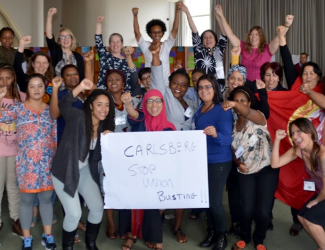
Women human rights defenders (WHRDs) worldwide defend their lands, livelihoods and communities from extractive industries and corporate power. They stand against powerful economic and political interests driving land theft, displacement of communities, loss of livelihoods, and environmental degradation.


Why resist extractive industries?

Extractivism is an economic and political model of development that commodifies nature and prioritizes profit over human rights and the environment. Rooted in colonial history, it reinforces social and economic inequalities locally and globally. Often, Black, rural and Indigenous women are the most affected by extractivism, and are largely excluded from decision-making. Defying these patriarchal and neo-colonial forces, women rise in defense of rights, lands, people and nature.

Critical risks and gender-specific violence

WHRDs confronting extractive industries experience a range of risks, threats and violations, including criminalization, stigmatization, violence and intimidation.  Their stories reveal a strong aspect of gendered and sexualized violence. Perpetrators include state and local authorities, corporations, police, military, paramilitary and private security forces, and at times their own communities.

Acting together

AWID and the Women Human Rights Defenders International Coalition (WHRD-IC) are pleased to announce “Women Human Rights Defenders Confronting Extractivism and Corporate Power”; a cross-regional research project documenting the lived experiences of WHRDs from Asia, Africa and Latin America.

We encourage activists, members of social movements, organized civil society, donors and policy makers to read and use these products for advocacy, education and inspiration.

Share your experience and questions!

Tell us how you are using the resources on WHRDs Confronting extractivism and corporate power.

◾️ How can these resources support your activism and advocacy?

◾️ What additional information or knowledge do you need to make the best use of these resources?

Share your feedback


Thank you!

AWID acknowledges with gratitude the invaluable input of every Woman Human Rights Defender who participated in this project. This project was made possible thanks to your willingness to generously and openly share your experiences and learnings. Your courage, creativity and resilience is an inspiration for us all. Thank you!

Related Content

Nadine Ramaroson

Son soutien aux femmes et aux personnes les plus vulnérables de sa communauté a fait que Nadine était un modèle pour beaucoup. Elle était déterminée à aider les pauvres et les sans-abri en particulier.

Bien que sa mort ait été déclarée comme étant accidentelle, la famille Ramaroson, sur l’initiative de son père André Ramaroson, a mené une enquête qui a mis en évidence des preuves de son assassinat. Elle serait décédée dans un accident mortel survenu entre Soanierano - Ivongo et Ste Marie - une histoire qui a été réfutée par sa famille. Elle avait reçu de nombreuses menaces de mort pour ses positions politiques résolues. L’affaire est toujours en cours auprès des tribunaux à Antananarivo (la capitale de Madagascar).


Nadine Ramaroson, Madagascar

Snippet FEA NSS uplifts and grows (EN)

Nous Sommes la Solution uplifts and grows the leadership of rural women working towards African solutions for food sovereignty.

How do you define external funding?

External funding includes grants and other forms of funding from philanthropic foundations, governments, bilateral, multilateral or corporate funders and individual donors – from both within your country or abroad. It excludes resources that groups, organizations and/or movements generate autonomously such as, for example, membership fees, the voluntary contributions of staff, members and/or supporters, community fundraisers, venue hires or sale of services. For ease and clarity, definitions of the different types of funding as well as short descriptions of different donors are included in the survey.

Research methology

Over eight years, we did four global surveys and built a research methodology.

In 2013, we published three global reports. These reports confirm that women’s rights organizations are doing the heavy lifting to advance women’s rights and gender equality by using diverse, creative and long-term strategies, all while being underfunded.

Our 2010 global survey showed that the collective income of 740 women’s organizations around the world totaled only USD 104 million. Compare this with Greenpeace International, one organization with a 2010 budget of USD 310 million1. Imagine the impact these groups could have if they were able to access all the financial resources they need and more?

AWID’s WITM research has catalyzed increased funding for women’s rights organizing. WITM research was a driving force behind the Catapult crowdfunding platform, which has raised USD 6.5 million for women’s rights. The Dutch Government cited WITM research as a reason for its unprecedented MDG 3 Fund of EU 82 million. WITM research has also led to the creation of several new funds: FRIDA – The Young Feminist Fund, the Indigenous Women’s Fund, Fundo Elas, the Mediterranean Women’s Fund and the Rita Fund.

Funding trends analyses

While the WITM research has shed important light on the global funding landscape, AWID and partners have identified the need to dig deeper, to analyze funding trends by region, population and issue. In response, organizations are now using AWID’s WITM research methodology to do their own funding trends analyses. For example, in November 2013, Kosova Women’s Network and Alter Habitus – Institute for Studies in Society and Culture published Where is the Money for Women’s Rights? A Kosovo Case Study.

At the same time, AWID continues to collaborate with partners in Where is the Money for Indigenous Women’s Rights (with International Indigenous Women’s Forum and International Funders for Indigenous Peoples) and our upcoming Where is the Money for Women’s Rights in Brazil? (with Fundo Elas).

Several organizations have also conducted their own independent funding trends research, deepening their understanding of the funding landscape and politics behind it. For example, the South Asian Women’s Fund was inspired by AWID’s WITM research to conduct funding trends reports for each country in South Asia, as well as a regional overview. Other examples of research outside of AWID include the collaboration between Open Society Foundations, Mama Cash, and the Red Umbrella Fund to produce the report Funding for Sex Workers Rights, and the first-ever survey on trans* and intersex funding by Global Action for Trans* Equality and American Jewish World Service.


Sainimili Naivalu

« J’ai constaté la discrimination dans la rue, que ce soit par des taquineries ou des agressions verbales qui y ont lieu. Je me suis aussi faite plein d’ami·e·s et j’y ai rencontré plusieurs personnes. Il se peut que ce soit dangereux là-bas, mais je suis une survivante, et pour le moment, c’est là où je suis. » -  Sainimili Naival

Sainimili Naivalu était une activiste féministe des droits des personnes handicapées issue du village de Dakuibeqa, sur l’île de Beqa aux Fidji.

Elle a demandé aux responsables et acteurs politiques de fournir des politiques et des services adaptés au handicap, comme la construction de rampes dans les villes et les villages afin d'accroître leur accessibilité. Les barrières physiques n’étaient pas les seules qu’elle aspirait à modifier. Sur la base de sa propre expérience, elle savait que des changements plus difficiles devaient être menés dans les sphères économiques et sociales. Bon nombre des défis avec lesquels sont aux prises les personnes handicapées trouvent leurs racines dans les attitudes discriminantes et stigmatisantes. 

Survivante et combattante, Sainimili a contribué à co-créer des réalités féministes qui renforcent l’inclusion et font évoluer les attitudes par rapport à l’égalité des personnes handicapées. Elle a été membre de la Spinal Injury Association of Fiji (SIA) ainsi que participé à la formation « Démarrez votre entreprise » de l’Organisation internationale du Travail à Suva via le projet « Pacific Enable » (le Pacifique rend possible) du Forum Asie-Pacifique sur le handicap. Elle a ainsi pu transformer ses idées en une entreprise qui lui était propre. Elle était commerçante sur l’étal de marché 7 de Suva, offrant des services de manucure, tout en gérant un stand au marché des femmes SIA pour y vendre de l’artisanat, des suls et des objets historiques. Sainimili planifiait d’élargir son commerce et de devenir une employeuse majeure de personnes handicapées. 

Outre son activisme, elle était également médaillée de tennis de table et une récente championne.

Avec sa personnalité vive, Sainimili était unique. On savait toujours lorsqu’elle était dans la pièce car ses rires et ses histoires étaient la première chose qu’on pouvait remarquer. -  Michelle  Reddy

Sainmili est décédée en 2019.
 

Snippet FEA Avellaneda, Gran Buenos Aires (ES)

Avellaneda, Gran Buenos Aires, Argentina

Cooperativa Textil Nadia Echazú

Tejiendo

VIDAS

El mío no es ninguno de los idiomas oficiales de la encuesta y me cuesta mucho responderla, ¿qué puedo hacer?

AWID tiene un compromiso con la justicia lingüística y, en este punto, lamentamos no poder contar con más idiomas para la encuesta ¿Dónde está el dinero? Sin embargo, en caso de que necesites asistencia con la traducción o desees responder la encuesta en otro idioma, te pedimos que nos contactes al email witm@awid.org.

7. Synthesize your research findings

Now that you have analyzed all your data – from your survey, interviews, desk research and potentially other sources – you can create your final product.

In this section:

Create your final product

Your final product will be the document that will summarize, analyze and criticize your data. That will be the piece that you will share with your community to present and explain your research to your audience.

At AWID, we often write a comprehensive written report that analyzes each set of data and synthesizes all of our findings, then later create smaller products, such as infographics and summaries (explained in the subsequent section “Finalize and format”).

1. Write clearly

  • Organize your data as you would like to tell a story. You can follow the order of your survey. Or you can regroup some questions to lead to your conclusion in a smooth and progressive way.
  • Adapt your language to your audience. Use universal language and avoid jargon or too technical terms.

Importance of the editor

An editor will proofread, ensure concise writing, conduct fact-checking, point out inconsistencies that need to be resolved, arrange the flow of the document and possibly suggest titles.

Your editor should preferably be someone who understands and knows your WITM work but who was not directly involved in the research. This will bring in a fresh perspective.

2. Make it pretty

  • Use the data collected to create graphs and tables. These type of visuals are a compelling way to highlight the main findings of your research and validate your analysis.

  • Source relevant images that can illustrate your report.

  • Highlight key-numbers and/or powerful testimonials.

Remember: The more accessible your product is, the more people will want to read (and share!) it.

Back to top


Gather review & inputs

At this point, you have collected all your data, analyzed it and transformed it into your final product, likely in a long report.

1. Polish your results

Before moving on to the next steps – you should share your final research product with your advisor organizations, activists, and donors.

This is a great moment to check the following points:

  • Are there any key points missing in your analysis of the present funding landscape and trends?
  • Are there any key points missing in your conclusions?
  • Are there any inaccuracies in the data that need to be corrected?
  • General suggestions on strengthening the report to achieve your goals as listed in your research framing.

Once you have inputted all feedback from your advisors, be sure to run it by your editor once more.

This will now be the final, completed version of your report.  If you intend to publish the final report in other languages, now is the time to send it for translation.

2. Facilitate the feedback

  • Your advisors are likely busy with their regular responsibilities. Be sure to request feedback within a reasonable deadline.
  • Keep your request for feedback brief and specific, so it is easy for them to respond. If you like, you can simply copy and paste the bullet points we have provided.
  • If you are publishing in multiple languages, ensure you have advisors who can also review the final translated versions of your product(s).

This is a significant contribution from your advisors. Consider offering them some form of recognition.

Back to top


Previous step

6. Conduct desk research

Next step

8. Finalize and format


Estimated time:

• 2 - 5 months

People needed:

• 1 or more research person(s)
• 1 Editor (or web-editor if you create an online product)
• Translator(s), if done in more than one language

Resource needed:

• List of advisor organizations, activists, and donors.
• Concept note (from “Frame your research” section)
• Survey topline results
• Prepared interview questions
• Interview results
• Desk research data
• All other data used in report


Previous step

6. Conduct desk research

Next step

8. Finalize and format


Ready to Go? Worksheet

Download the toolkit in PDF