Confronting Extractivism & Corporate Power
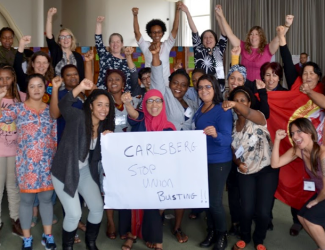
Women human rights defenders (WHRDs) worldwide defend their lands, livelihoods and communities from extractive industries and corporate power. They stand against powerful economic and political interests driving land theft, displacement of communities, loss of livelihoods, and environmental degradation.
Why resist extractive industries?
Extractivism is an economic and political model of development that commodifies nature and prioritizes profit over human rights and the environment. Rooted in colonial history, it reinforces social and economic inequalities locally and globally. Often, Black, rural and Indigenous women are the most affected by extractivism, and are largely excluded from decision-making. Defying these patriarchal and neo-colonial forces, women rise in defense of rights, lands, people and nature.
Critical risks and gender-specific violence
WHRDs confronting extractive industries experience a range of risks, threats and violations, including criminalization, stigmatization, violence and intimidation. Their stories reveal a strong aspect of gendered and sexualized violence. Perpetrators include state and local authorities, corporations, police, military, paramilitary and private security forces, and at times their own communities.
Acting together
AWID and the Women Human Rights Defenders International Coalition (WHRD-IC) are pleased to announce “Women Human Rights Defenders Confronting Extractivism and Corporate Power”; a cross-regional research project documenting the lived experiences of WHRDs from Asia, Africa and Latin America.
We encourage activists, members of social movements, organized civil society, donors and policy makers to read and use these products for advocacy, education and inspiration.
-
"Women Human Rights Defenders confronting extractive industries: an overview of critical risks and Human Rights obligations" is a policy report with a gender perspective. It analyses forms of violations and types of perpetrators, quotes relevant human rights obligations and includes policy recommendations to states, corporations, civil society and donors.
-
"Weaving resistance through action: Strategies of Women Human Rights Defenders confronting extractive industries" is a practical guide outlining creative and deliberate forms of action, successful tactics and inspiring stories of resistance.
-
The video “Defending people and planet: Women confronting extractive industries” puts courageous WHRDs from Africa, Asia, and Latin America in the spotlight. They share their struggles for land and life, and speak to the risks and challenges they face in their activism.
-
Challenging corporate power: Struggles for women’s rights, economic and gender justice is a research paper outlining the impacts of corporate power and offering insights into strategies of resistance.
Share your experience and questions!
◾️ How can these resources support your activism and advocacy?
◾️ What additional information or knowledge do you need to make the best use of these resources?
Thank you!
AWID acknowledges with gratitude the invaluable input of every Woman Human Rights Defender who participated in this project. This project was made possible thanks to your willingness to generously and openly share your experiences and learnings. Your courage, creativity and resilience is an inspiration for us all. Thank you!
Related Content
Snippet - Intro WITM - AR
نكمل مشوار بناء الحشد الذي بدأناه قبل 20 عاماً لموارد أفضل وأكبر لحركات التغيير الاجتماعي بقيادة نسوية، تدعوكم/ن جمعية حقوق المرأة في التنمية لاستكمال استطلاعنا
" "أين التمويل للتنظيمات النسوية" (WITM)
الرجاء اختيار اللغة المفضلة للإجابة على الاستطلاع في أقصى يمين الصفحة
Kate Millett
Contenido relacionado
Huffington Post: Muere Kate Millett, activista y referente feminista
TeleSUR: Muere la autora feminista Kate Millett a los 82 años
5. Conduct interviews
Interviews produce in-depth information that you cannot easily obtain from surveys. While surveys focuses mainly on quantifiable data and closed questions, interviews allow for expert opinions from activists and donors, and open-ended questions which can provide context to survey data results.
In this section
- General tips
1. Before conducting your interviews
2. During the interviews- Specialized interviews
1. Donor interviews
2. Women’s rights organizations and activists interviews- Preliminary findings
General tips
1. Before conducting your interviews
Send the interviewees a concept note with your objectives for the interview and for your overall research, as well as a list of questions.
This allows them to prepare answers for more complicated questions and look up information that they may not have immediately on hand.
2. During the interviews
- You can conduct interviews while your survey is running, in order to save time.
- Try to keep your interviews as consistent as possible in order to facilitate systematic analysis of results. This means asking the same questions. Coding identical responses to each question will allow you to uncover hidden trends.
- The interviews can also be used to flesh out some of the survey findings
Do not base your questions on assumptions about your interviewees’ knowledge.
Instead, first clarify what they know – this will reveal information as well.
- DON’T: “Given the current funding trends in Switzerland, do you know of any opportunities for collaboration? This question assumes that the interviewee knows current funding trends and that their understanding of funding trends matches yours.
- DO: First ask “What is your understanding of current funding trends in Switzerland?”, followed by “Do you know of any opportunities for collaboration?” This will reveal what their understanding is, giving you even more information than the first question.
Specialized interviews
1. Donor interviews
Interviews with donors will allow you to build deeper relationships with them, which will be useful when you conduct post-research advocacy. They will also provide you with deeper insight into funders’ decision-making processes.
Suggested topics of focus for donor interviews:
- What are their funding priorities? Why and how did they select those priorities? For example, why do they choose project-funding over core support or vice versa?
- What are annual amounts allocated to the advancement of women’s human rights? This will strengthen overall reliability of data collected.
- Have they noticed any funding trends, and what do they believe are the origins and politics behind these trends?
- What is their theory of social change and how does that impact their relationships with women’s rights organizations?
View samples of donor interviews
2. Women’s rights organizations and activists interviews
Interviews with women’s rights organizations and activists will provide you with insight into their on-the-ground realities. Again, these interviews will allow you to build deeper relationships that can be incorporated into your advocacy, particularly to encourage collaboration between donors and activists.
Suggested topics of focus for women’s rights organizations and activist interviews:
- Long-term funding priority trends noted by women’s organizations and their impact.
- Successful examples of feminist and collaborative resource mobilization strategies that build strong and complementary movements.
- “Making the case” for why it is important to support women’s organizations and organizing.
- How different actors understand the social change process and their role in advancing/achieving gender equality and women’s rights.
View samples of women’s organizations and activists interviews
Preliminary findings
Through the course of your WITM research, we recommend analyzing your preliminary findings. Presenting your preliminary findings opens up opportunities to conduct more interviews and get feedback on your research process and initial results. This feedback can be incorporated into your final research.
AWID conducts “WITM convenings” to share preliminary results of survey data and interviews. These gatherings allow participants (activists, women’s rights organizations, and donors) to debate and discuss the results, clarifying the context, creating more ownership amongst members of the movement, and providing more input for final research.
For example, the Resource Mobilization Hub for Indigenous Women’s Rights at the World Summit on Indigenous Philanthropy was used as a space to debut preliminary results.
Previous step
4. Collect and analyze your data
Next step

Estimated time:
• 1.5 - 3 months
People needed:
• 1 or more research person(s)
Resources needed:
• List of donors and women’s rights organizations and activists to interview
• Prepared interview questions
• Concept Note (You can use the research framing you created in the “Frame your research” section)
Resources available:
• AWID Sample Interview Questions: Donors
• AWID Sample Interview Questions: Activists & Women’s Rights Organizations
Previous step
4. Collect and analyze your data
Next step
Ready to Go? Worksheet
Snippet FEA Avellaneda, Gran Buenos Aires (ES)
Avellaneda, Gran Buenos Aires, Argentina
Cooperativa Textil Nadia Echazú
Tejiendo
VIDAS
Diana Staubli
Snippet - WITM To make - RU

Сделать видимой сложность обеспечения ресурсами различных феминистских организаций
María Verónica Reina
María était reconnue au niveau mondial pour son leadership extraordinaire au sein de la communauté des personnes handicapées.
Elle a représenté l'International Disability and Development Consortium (consortium international sur le développement et le handicap) lors de la négociation de la Convention des Nations Unies relative aux droits des personnes handicapées (2001-2006). Son travail a été consacré à la réalisation de l'objectif de la Convention, à savoir la réalisation des droits humains universels par, pour et avec les personnes handicapées pour un monde inclusif, accessible et durable.
Selon ses propres mots, son leadership consistait à « … servir la communauté des personnes handicapées, en commençant par de petites tâches que d'autres pourraient ne pas vouloir faire».
Elle est décédée le 27 octobre 2017 dans sa ville natale de Rosario, en Argentine.
Pour en savoir plus sur María Verónica Reina, retrouvez son témoignage.
Gracias por participar en la creación de nuestros Futuros Feministas
¡Gracias por haber sido parte del Foro AWID 2016!
AWID agradece enormemente a todxs ustedes que han compartido con nosotrxs estos últimos cuatro días de aprendizaje, celebraciones, ideaciones, sueños y la construcción conjunta de nuestros futuros feministas en el Foro AWID 2016.
Nos sentimos muy inspiradxs, maravilladxs y llenxs de energía con todo el trabajo colectivo que hemos hecho para crear nuestros diversos futuros feministas.

Para más imagen, blogues y recursos:
Snippet FEA trans and travesti people in Argentina (FR)

Seul·es 18 % des trans et travestis en Argentine ont accès à un emploi formel.
Esperanza Pérez Labrador
Snippet - WITM Survey will remain open - AR
سيبقى الاستطلاع مفتوحاً حتى 31 يوليو (تموز) 2024
الرجاء اختيار لغتك في الزاوية اليمنى الرجاء اختيار اللغة المفضلة للإجابة على الاستطلاع في أقصى يمين الصفحة
ذا كنت ترغب في معرفة المزيد، انضم إلى لقاء للأعضاء/ العضوات: أين المال؟ يوم الاثنين 27 مايو (أيار) الساعة 9:00 بالتوقيت العالمي - مع ترجمة
فورية باللغتين الفرنسية والإنجليزية.
14:00 بالتوقيت العالمي - مع ترجمة فورية باللغتين الإسبانية والإنجليزية
سنستمع إلى فريق الحركات النسوية لتوفير الموارد التابع لجمعية حقوق المرأة في التنمية (جمعية حقوق المرأة في التنمية) حول خصوصيات وعموميات تمويل التنظيمات النسوية.
انضم/ي إلينا كعضو/ة في وكن/وني جزءًا من جلسة التواصل هذه.
الرد على الدعوة هنا
(Registration only available in English)
Laura Lee
Laura was a leading activist and lawyer who campaigned fearlessly for the decriminalisation of sex work in Ireland.
She is remembered as “a freedom fighter for sex workers, a feminist, a mother to a daughter and a needed friend to many.”
Laura advocated for individuals in the sex industry to be recognised as workers deserving of rights. She advanced demands for decriminalisation, including initiating a judicial review at Belfast’s high court in respect of the provisions criminalising the purchase of sex. Laura stated that her intention was to bring the case to the European Court of Human Rights.
Les savoirs communautaires pour bâtir des futurs justes
Le contexte
Aujourd'hui, de nombreux systèmes de savoirs communautaires sont en danger.
Les changements qui surviennent à une vitesse effrénée sur le plan économique, politique et culturel détruisent les environnements, les pratiques et les moyens de subsistance. Diverses formes de connaissances sombrent dans l’oubli, sont marchandées et colonisées dans le cadre de la mondialisation massive, de la promesse de gains à court terme, ou encore contre des solutions de fortune.
Définition
Le Buen Vivir (le bien-vivre), un concept adapté à partir des connaissances des peuples autochtones andins, est décrit comme la réalisation collective d'une vie d'accomplissement fondée sur des relations harmonieuses et équilibrées entre les êtres humains et tous les êtres vivants, dans la réciprocité et la complémentarité. Cela implique de reconnaître que les êtres humains sont une partie intégrante de la nature, que nous dépendons de la nature et que nous sommes interdépendant-e-s entre nous.
La vision inhérente à la notion de Buen Vivir intègre la production et la reproduction comme processus indissociables de l'économie, de la production de richesse et des conditions de vie.
Perspective féministe
D’une perspective féministe, le Buen Vivir valorise les relations et les ressources mobilisées dans les cycles de production et de reproduction, favorisant l’équilibre (non seulement celui des marchés) afin de garantir la continuité et les changements, tant qu'ils sont compatibles avec la justice économique et la pérennité de la vie.
Certaines conceptions binaires liées au genre et à la complémentarité entre les hommes et les femmes ont été critiquées par les féministes puisqu’elles laissent peu de place à une discussion plus approfondie sur le patriarcat hétérocentrique et les relations de genre ‘non conformes’.
Cela dit, l'une des principales contributions de l’application du principe Buen Vivir aux cadres politiques, économiques et sociaux, consiste à ce que l'égalité ne représente plus le paradigme des droits individuels, ayant plutôt pour objet la transformation de l’ensemble de la société.

Pour en savoir plus sur cette proposition :
- Buen Vivir: An introduction from a women’s rights perspective in Bolivia (Une perspective des droits des femmes sur le Buen Vivir en Bolivie : Une introduction, disponible en anglais). Dans son article, Martha Lanza conteste l'idée que le Buen Vivir est neutre en matière de genre et réclame le démantèlement des structures de pouvoir patriarcales qui persistent. Dans la même publication, Magdalena León analyse d’une perspective de genre la façon dont la cosmovision du Buen Vivir cherche à vaincre les idéaux d'expansion et de croissance permanentes, en plus de mettre en lumière les préjugés sexistes qui doivent être pris en compte.
- Buen Vivir: Today’s Tomorrows (Les lendemains d’aujourd’hui) par Eduardo Gudynas (en anglais).
- Indigenous Women's Visions of an Inclusive Feminism (Visions de femmes autochtones pour un féminisme inclusif), par Myrna Cunningham (en anglais). Un document qui met en évidence les contributions essentielles des femmes autochtones à la construction d'un mouvement féministe plus diversifié, inclusif et fort.
Snippet FEA Trans and Travesti people (EN)

THE TRANS EMPLOYMENT QUOTA
sanctioned by law is not being respected by companies and employers
Itziar Lozano
Snippet - WITM FAQ - RU
Часто задаваемые вопросы
Deborah Holmes
Al momento de su muerte, luego de una corta pero denodada batalla contra el cáncer, Deborah era la Jefa de Comunicaciones y Participación en la Women’s Funding Network (WFN, Red de financiamiento para mujeres).
Deborah también trabajó para el Fondo Global de Mujeres entre 2008 y 2017. Era sumamente querida y respetada por el consejo asesor, el personal y lxs colaboradorxs de la organización.
Kavita Ramdas, anterior directora ejecutiva del Fondo, acertadamente señaló que Deborah era un «pequeño paquete que explotaba de calidez, generosidad, inteligencia, estilo y un apasionado compromiso por unir la belleza con la justicia. Ella entendía el poder de las historias. El poder de la voz de las mujeres. El poder de la experiencia vivida. El poder de levantarse de las cenizas y decirle a otrxs que era posible. Y todavía nos levantamos».
Musimbi Kanyoro, actual directora ejecutiva del Fondo Global de Mujeres, añadió: «Hemos perdido a una hermana y su vida ilumina valores que nos unen y nos inspiran. Al reunirnos para llorar el fallecimiento de Deborah, recordemos y celebremos su notable, audaz y apasionada vida».
Protection of the Family - Opposition Views
New conservative alliance:
Conservative organizing and policy
State supporters
Snippet FEA Brisa Escobar Quote (ES)
“Mis sueños y objetivos siempre han sido los mismos que los de Lohana Berkins: que la cooperativa siga de pie y no cierre. Seguir dándole este lugar a nuestras compañeras travesti, darles trabajo y un lugar de apoyo”
Brisa Escobar,
presidenta de la Cooperativa