Special Focus

AWID is an international, feminist, membership organisation committed to achieving gender equality, sustainable development and women’s human rights

Confronting Extractivism & Corporate Power

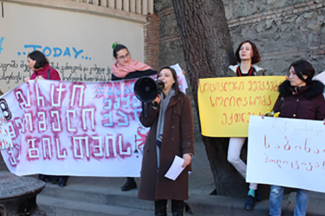
Women human rights defenders (WHRDs) worldwide defend their lands, livelihoods and communities from extractive industries and corporate power. They stand against powerful economic and political interests driving land theft, displacement of communities, loss of livelihoods, and environmental degradation.


Why resist extractive industries?

Extractivism is an economic and political model of development that commodifies nature and prioritizes profit over human rights and the environment. Rooted in colonial history, it reinforces social and economic inequalities locally and globally. Often, Black, rural and Indigenous women are the most affected by extractivism, and are largely excluded from decision-making. Defying these patriarchal and neo-colonial forces, women rise in defense of rights, lands, people and nature.

Critical risks and gender-specific violence

WHRDs confronting extractive industries experience a range of risks, threats and violations, including criminalization, stigmatization, violence and intimidation.  Their stories reveal a strong aspect of gendered and sexualized violence. Perpetrators include state and local authorities, corporations, police, military, paramilitary and private security forces, and at times their own communities.

Acting together

AWID and the Women Human Rights Defenders International Coalition (WHRD-IC) are pleased to announce “Women Human Rights Defenders Confronting Extractivism and Corporate Power”; a cross-regional research project documenting the lived experiences of WHRDs from Asia, Africa and Latin America.

We encourage activists, members of social movements, organized civil society, donors and policy makers to read and use these products for advocacy, education and inspiration.

Share your experience and questions!

Tell us how you are using the resources on WHRDs Confronting extractivism and corporate power.

◾️ How can these resources support your activism and advocacy?

◾️ What additional information or knowledge do you need to make the best use of these resources?

Share your feedback


Thank you!

AWID acknowledges with gratitude the invaluable input of every Woman Human Rights Defender who participated in this project. This project was made possible thanks to your willingness to generously and openly share your experiences and learnings. Your courage, creativity and resilience is an inspiration for us all. Thank you!

Related Content

Mena Mangal

Mena Mangal était une éminente journaliste de télévision, défenseure des droits des femmes et conseillère culturelle du Wolesi Jirga, la chambre basse du parlement national afghan.

Pendant plus d’une décennie, Mena a travaillé pour Ariana TC, la chaîne en pashto Lamar de Tolo TV et la chaîne de télévision nationale privée Shamshad TV. Mena était principalement présentatrice d’émissions sur les droits des femmes et la culture.

« La défenseure des droits des femmes Wazhma Frogh a dit que Mangal « se faisait entendre » et s’exprimait ouvertement en faveur de la défense de son peuple. »

Loin des écrans, elle dirigeait également des plateformes sur les réseaux sociaux, promouvant les droits à l’éducation et au travail des filles et femmes afghanes. Sur le plan de sa vie privée, Mena a longuement écrit sur le mariage arrangé qu’elle a été forcée d’accepter en 2017, et le long processus qui s’en est suivi pour finalement obtenir le divorce.

Dans un post sur Facebook, Mena avait écrit qu’elle recevait des menaces de mort de sources inconnues, mais qu’elle continuerait néanmoins son travail.

Elle a été attaquée le 11 mai 2019 par des hommes armés inconnus et tuée en plein jour et dans un espace public, dans le sud-est de Kaboul.

« La situation nous inquiète, car elle a un impact direct sur les femmes qui travaillent en dehors de la maison... Les femmes journalistes changent de profession du fait de l’augmentation des risques auxquels elles sont confrontées. » - Robina Hamdard, défenseure des droits des femmes à Kaboul

Snippet - CSW69 - OURs & friends - EN

OURs & friends at the Feminist Solidarity Space

✉️ By invitation only

📅 Tuesday, March 11, 2025
🕒 2.00-4.00pm EST

🏢 Chef's Kitchen Loft with Terrace, 216 East 45th St 13th Floor New York

Organizer: Observatory on the Universality of Rights (OURs) Consortium

Pourquoi l’AWID a-t-elle décidé de changer le lieu du Forum de Bali à Taipei ?

Fin 2019, les événements en Indonésie - notamment les signes d’intensification de la militarisation et de reculs des droits LGBTQ – nous ont amené·e·s à questionner la capacité de l’AWID à maintenir un environnement sécurisé et accueillant pour les divers·es participant·e·s que nous voulons rassembler au Forum.

Après un examen attentif, la Direction de l’AWID a décidé en novembre 2019 de faire évoluer le lieu de tenue du 14ème Forum international de l’AWID, de Bali à Taipei.

Taipei dispose de fortes capacités logistiques et est accessible pour beaucoup de voyageurs·ses (avec une facilitation de procédure de visa électronique pour les conférences internationales).

Pour plus d’informations :


Snippet - GII Intro (EN)

Gender Impact Investing & The Rise of False Solutions:

An Analysis for Feminist Movements

Gender Impact Investing (GII) is now trending as a solution to gender inequality. Yet, as our report indicates, it is actually part of the problem. Public and private institutions marketing GII equate it with promotion of gender equality and with increased resources for women and girls.

Neither claim is evidence-based.

Rather, GII is another expression of subjecting our lives and societies to the same financial logic that has shaped, and continues shaping, the profound inequalities in our world.

With this report, AWID offers the readers - feminists, gender justice advocates and stakeholders in gender impact investing - a critical analysis and substantiated evidence to understand GII, its narratives, and economic and political implications for feminist movements.

FRMag - Armenians

Arménien·ne·s, le féminisme est notre passé et notre avenir

par Sophia Armen 

Que cela vous plaise ou non, les ungerhouis font partie intégrante de nos histoires de résistance et elles ne disparaîtront pas de sitôt.  (...)

Lire

Sitios web asociados a AWID

Conexión Joven Feminista 

Una comunidad en línea desarrollada para y por las jóvenes feministas que trabajan por los derechos humanos de las mujeres, la igualdad de género y la justicia social en todo el mundo.

Visita la página

Fondo de Jóvenes Feministas 

FRIDA: proporciona financiamiento a iniciativas lideradas por jóvenes feministas. Busca fortalecer la capacidad de las organizaciones de jóvenes feministas para obtener recursos para su trabajo e incrementar los compromisos de donantes y aliados con la dotación de fondos para el activismo joven feminista.

Visita la página

El Observatorio de la Universalidad de los Derechos (OURs)

En esta plataforma podrás encontrar información y recursos sobre cómo proteger la universalidad de los derechos en espacios internacionales y regionales de derechos humanos.

Visita la página (en inglés)

Directorio Virtual de Respuestas Urgentes para las Mujeres Defensoras de los Derechos Humanos 

Sitio obligado para conocer las respuestas urgentes emprendidas para proteger a las defensoras de los derechos humanos y encontrar herramientas y recursos en apoyo del trabajo y el bienestar de las defensoras.

Visita la página

IM-Defensoras 

La Iniciativa Mesoamericana de Mujeres Defensoras de Derechos Humanos es una iniciativa regional creada para prevenir, responder, documentar y dar a conocer todos los casos de violencia ejercida contra las defensoras de los derechos humanos en la región mesoamericana.

Visita la página

Coalición Internacional de Mujeres Defensoras de los Derechos Humanos  

La Coalición es una red de recursos y promoción para la protección y el apoyo a las mujeres defensoras de los derechos humanos en todo el mundo.

Visita la página (en inglés)

La Coalición de Mujeres Post-2015 

Una coalición de organizaciones feministas, por los derechos de las mujeres, por las mujeres y el desarrollo, y de organizaciones de base y por la justicia social que trabajan para interpelar y dar nuevo marco la agenda global para el desarrollo.

Visita la página (en inglés)

Grupo Mayor de Mujeres sobre el Desarrollo 

El rol del Grupo consiste en garantizar una participación pública efectiva de los grupos no gubernamentales de mujeres en los procesos normativos de la ONU sobre el desarrollo sostenible, la agenda posterior a 2015 y los asuntos ambientales. 

Visita la página (en inglés)

Grupo de Mujeres sobre Financiamiento para el Desarrollo 

Una alianza de organizaciones y redes de mujeres que promueve el avance de la igualdad de género, el empoderamiento de las mujeres y sus derechos humanos en los procesos de la ONU referidos al financiamiento para el desarrollo.

Visita la página (en inglés)

Jaitun

Jaitun, commonly referred to as ‘Amma’, was committed to ensuring the reproductive rights of women and girls in India. She was particularly dedicated to advocating for those living in poverty and who are most marginalized, including Dalit and Muslim women and girls.

Jaitun was the vital force behind the case Jaitun v Janpura Maternity Home & Ors. Her perseverance for justice led to a ground-breaking judgment issued by the High Court of Delhi, holding the Indian government accountable for failing to deliver a number of its legally-binding obligations such as reproductive health care and the right to food.

Her daughter Fatema who was living under the poverty line was denied reproductive services and had to deliver her child in public, under a tree. At the time, both Jaitun and Fatema were homeless as a result of their home being demolished by the government as part of redevelopment and gentrification in New Delhi.

“The judgment has since been used by countless lawyers and activists globally, including the Former United Nations Special Rapporteur on the Right to Health, not only as a source of inspiration but as a solid springboard to further justice.” - Jameen Kaur

Jaitun has inspired many other women living in poverty to claim their rights. She passed away in 2017.

“In Jaitun’s death, we have now lost an inimitable warrior for justice, but her spirit of defiance lives on.” - Jameen Kaur

“In my 18 years as a human rights advocate, I have not met a woman that has inspired and moved my spirit in the same way Amma did. Her roaring courage; her imitable humour - we used to compare her to the Bollywood actress Hema Melini - as she would be upset we had spent so much time away from her - she would say, with a twinkle in her eye, ‘You have forgotten Amma, Amma is not speaking to you’ and then with great dramatics turn her back, only to turn around laughing and stretching her arms out for a hug. Her kindness and ultimately her love and joy for love and the right for all of us to live with dignity. I miss her terribly.” - Jameen Kaur
 

Snippet - CSW69 On anti-rights resistance - ES

Sobre la resistencia contra las fuerzas antiderechos

Snippet Stories of Change Full - Download (FR)

FRMag - Ghosts Of Girlhood

Ghosts Of Girlhood

by Akua Antiwiwaa

There is an old, hazy picture laying in front of me. In it I am dressed in all white, from the pearl beads fastened into my hair and tucked against my ears, to the ones that trail loosely around my tiny wrists. (...)

Read

artwork: “Cultura Negra” [Black Culture] by Astrid Milena González Quintero

Courageous WHRDs in the Media

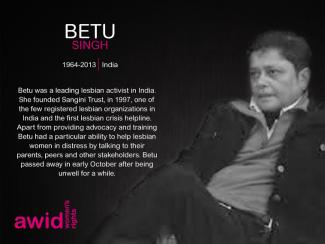
These 21 Women Human Rights Defenders (WHRDs) worked as journalists and more widely in the media sector in Mexico, Colombia, Fiji, Libya, Nepal, United States, Nicaragua, Philippines, Russia, Germany, France, Afghanistan, and the United Kingdom. 17 of them were murdered and in one case the cause of death is still unclear. On this World Press Freedom Day, please join us in commemorating the life and work of these women by sharing the images below with your colleagues, friends and networks using the hashtags #WPFD2016 and #WHRDs.

The contributions of these women were celebrated and honoured in our Tribute to Women Human Rights Defenders (WHRDs) Who Are No Longer With Us.


Please click on each image below to see a larger version and download as a file


Isabel Cabanillas de la Torre

Isabel Cabanillas de la Torre fue una activista joven y una artista feminista muy querida de Ciudad Juárez, México, conocida por sus hermosos diseños evocadores de indumentaria pintada a manoen los que los ojos eran una característica emblemática de su trabajo. Sus murales transformaron los edificios abandonados y vacíos del centro de Ciudad Juárez, al sumarles vida y crítica política a sus paredes.

A través de su arte y de su activismo político, Isabel buscó llamar la atención sobre la violencia de género que se extendía por su ciudad natal. Colaboró como voluntaria con la red Mesa de Mujeres en el proyecto «Observatorio Ciudadano de Género», que monitoreaba la actuación de jueces, fiscales y defensorxs públicxs en casos de femicidios y otras violaciones a los derechos basadas en el género. Integró también «Hijas De Su Maquilera Madre», una colectiva feminista cuyo nombre alude a las hijas de madres que son trabajadoras de la maquila. Algunas de estas madres fueron las primeras víctimas de femicidio en Ciudad Juárez.

El último proyecto de Isabel (todavía en curso) fue una instalación artística para protestar contra una compañía canadiense que quería extraer cobre de los Médanos de Samalayuca.

El 18 de enero de 2020 Isabel fue atacada a balazos mientras volvía a su casa del centro de Ciudad Juárez en bicicleta, víctima, aparentemente, de un asesinato selectivo. Su cuerpo fue encontrado junto a su bicicleta.

El asesinato de Isabel desató una nueva ola de indignación contra los femicidios de la región: cientos de personas marcharon hacia el puente de la frontera entre EEUU y México, y lo bloquearon durante horas mientras cantaban «Ni una más», que es la protesta continua de las colectivas feministas contra los asesinatos de las mujeres en todo México. Solamente en 2019, 3.142 mujeres y niñas fueron asesinadas en el país; muchas de ellas fueron atacadas específicamente por su género.

Amaba andar en bicicleta.

«La bicicleta era un símbolo de libertad para ella. Simbolizaba ser libre en las calles.» - Marisol, amiga de Isabel

Snippet - CSW69 - Where will the money be - EN

Where will the money be for feminist organizing?

Activists reflection & solidarity circle

✉️ By registration only. Register here

📅 Friday, March 14, 2025
🕒 12.00-2.00pm EST

🏢 Blue Gallery, The Blue Building, 222 East 46th Street

🎙️Facilitated by: Gopika Bashi, AWID Director of Programs

Organizer: Count Me In! Consortium

Snippet Forum Quoate Jac s m Kee, Malaysia (EN)

There is nothing like being in a shared space, exchanging body energies,... seeing the world and doing something together. Events like the Forum are among the strongest of the global feminist movement.
- Jac s m Kee, Malaysia

Film club - outrun

Out Run (2016) Inglés | Tagalo con subtítulos en inglés

Mediante la movilización de peluquerxs y reinas de belleza transgénero de clase trabajadora, lxs dinámicxs líderes del único partido político LGBT del mundo libran una cruzada histórica para elegir a una mujer trans al Congreso filipino.


Conversación en vivo con S. Leo Chiang y Johnny Symons, directores de “Out Run”