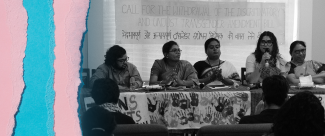
‘By changing the very definition of “transgender persons,” this Bill is in violation of the Supreme Court Judgement, ignores International legal standards, and goes against the demands of the transgender movements in this country.’ - Collective Statement on Transgender Persons (Protection of Rights) Amendment Bill 2026
Over the last two weeks, India’s trans, queer and allied movements came together in a swell of solidarity to oppose the proposed Transgender Persons (Protection of Rights) Amendment Bill 2026, which was passed by both houses of Parliament on 25 March without any public or community consultation. On 31 March, the President of India gave her assent to the Bill.
“This Bill has been widely rejected by trans*, queer, intersex and allied movements across the country, with over 100,000 emails sent to Members of Parliament and more than 88 public statements demanding its repeal within just 10 days. This is not only about identity. It is about who is recognised, and therefore who can access rights. In a country where documentation determines access to education, healthcare, housing and survival itself, making identity conditional is not a procedural change, it is exclusion in practice. And in a society shaped by caste, descent, religion and class, this will unfold in deeply unequal ways. This creates conditions where a diverse range of trans* and gender-diverse communities face both erasure and the risk of criminalisation at the same time.”- Don Hasar, Indian queer-trans* activist
Sign up here
This is a trans-affirming and inclusive space. All registrations will be vetted. Learn more about AWID membership here.
What should you know about the Amendment and its impacts on trans people?
In practice, the Amendment undermines the right of transgender people for bodily autonomy, to self-identify and make decisions over their own body and lives. In short, it:
- narrows the definition of transgender persons to exclude many identities, while grouping intersex persons under the Act, and restricts legal gender recognition;
- grants state-appointed medical experts the power to determine whether a trans person’s identity is legally valid, leading to increased medical scrutiny and bureaucratic hurdles for legal protection of trans persons;
- expands the 2019 Act’s existing list of punishable offences, including penalising “coercion into sex change”, likely to be weaponised against trans persons’ right to self-determination.
Beyond self-determination: colonialism, anti-rights agendas, violence and criminalization
“We see this denial of the principle of self-determination in conjunction with the historic denial of separate electorates for Dalits, the violent suppression of Adivasi resistance to developmentalist violence in India’s heartland, penalizing religious conversion, the arbitrary revocation of Article 370, the racial marginalization of India’s north-east, the weakening of federalism and the linguistic imposition of Hindi. In doing so, we call for a broader struggle for self-determination that takes the trans experience at its centre but also engages at multiple fronts.” - Excerpt from statement from DBA Trans Queer Panthers National Network
In addition to giving power to the state to “adjudicate” transness through increasing medical bureaucracy, Indian activists and global human rights organizations have highlighted the narrowing of the Bill (now Act) to protect certain historically recognized socio-cultural identities.
Given the marginalization of trans persons, the Act is expected to significantly impact the quality of life, housing, healthcare, and employment of hundreds of thousands of transgender people. It is likely to undermine the economic and social conditions to enable self-determination and the right to live a life of dignity.
“How is this a feminist issue? This attack is a part of a global anti-gender and anti-rights movement. In India, we are seeing similar patterns of laws being passed in the name of ‘protection of women’ that have led to more surveillance. There are state-level protectionist laws around live-in relationships or to address religious conversion, for example. We are also seeing increasing attacks on support systems for women or trans or queer survivors of violence. The Act uses the language of criminalization to give legitimacy to this violence. Feminist solidarity is imperative in this context.” - Vihaan Vee, Ambedkarite Queer Feminist Transman Activist
The intensification of nationalism, ethnonationalism (nationalism that privileges a specific ethnic group), religious fundamentalism and neoliberalism globally relies on reinforcing hierarchies between the ‘deserving’ and those seen as disposable - as ‘outcasts’ who do not qualify for social and legal protection, and economic access.
No room for biological essentialism in our feminisms
From Malaysia to Argentina, trans and gender diverse persons face increasing criminalization and restrictions on gender affirming care. Like the 2026 Amendment Act, the question of “biology” emerges as a qualifier for legal gender recognition in UN human rights spaces, and countries like the UK. In the case of India, the Minister of Social Justice and Empowerment highlighted that the Bill intends to “protect only those who face severe social exclusion due to biological reasons “for no fault of their own and no choice of their own.”
Feminists have worked extensively to challenge this restrictive biological and essentialist understanding of womanhood. They have also documented the racist and colonial roots of the weaponization of trans identities (and gender more broadly) for nationalist and imperialist goals. In her book, Enemy Feminisms, Sophie Lewis traces the history of anti-trans movements in the UK with two centuries’ worth of “proudly Anglo-Saxon” self-proclaimed feminist participation in eugenicist colonial efforts to clean up so called gender “transgressions” (and sex work) of communities of non-cisgender indigenous communities in former colonies, including India.
Existence is Resistance: Building transnational and inter-movement solidarities
Denial of recognition goes far beyond language; denying one’s existence is about social erasure with dangerous real-life consequences. Laws like this don’t stop trans and queer communities from existing; but they serve to legitimize and intensify violence, exclusion and discrimination against them.
“At a time when civil society globally is adopting the language of women and girls in all their diversities, that commitment must be reflected in practice, in how solidarity is built and sustained across contexts. As rights-based movements face attacks simultaneously across regions, it is short-sighted to treat these struggles as isolated, or to assume that our differences outweigh the structural conditions shaping our lives. This moment calls for urgent, grounded, and collective engagement.”- Don Hasar, Indian queer-trans* activist
These anti-rights tactics and narratives maintain that there is only one ‘proper’ type of identity, one type of way to exist and actively cause harm to communities facing multiple marginalizations. Our work as feminists to advance the right to bodily autonomy and human rights for all cannot be isolated from the fight for legal recognition of each person’s self-defined gender identity, expression, and sexuality. As feminist movements, we must recognize the intersections of our liberation, and not fall into the silos that seek to divide us.
To learn more and connect, join our transnational online learning circle on Tuesday 21st April 2026, 5pm IST/ 11.30am UTC/7.30am ET
Photo credits: Ronojoy Sircar | (he/they) @ronfoshizzle | @ronojoy.sircar