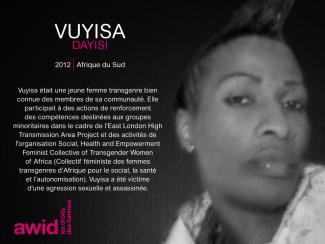
Vuyisa Dayisi

In September 2016, the 13th AWID international Forum brought together in Brazil over 1800 feminists and women’s rights advocates in a spirit of resistance and resilience.
This section highlights the gains, learnings and resources that came out of our rich conversations. We invite you to explore, share and comment!
One of the key takeaways from the 2016 Forum was the need to broaden and deepen our cross-movement work to address rising fascisms, fundamentalisms, corporate greed and climate change.
With this in mind, we have been working with multiple allies to grow these seeds of resistance:
And through our next strategic plan and Forum process, we are committed to keep developing ideas and deepen the learnings ignited at the 2016 Forum.
AWID Forums started in 1983, in Washington DC. Since then, the event has grown to become many things to many peoples: an iterative process of sharpening our analyses, vision and actions; a watershed moment that reinvigorates participants’ feminisms and energizes their organizing; and a political home for women human rights defenders to find sanctuary and solidarity.
Conoce el programa del Club de Cine Feminista de AWID «Holding up the Skies» [«Sosteniendo los cielos»], una serie de películas sobre realidades feministas de África y la Diáspora Africana, curada por Gabrielle Tesfaye.
“Je n’adhère pas au concept de ‘tiers-monde’. Je fais des films pour que les gens puissent les comprendre indépendamment de leur race ou de leur couleur. Pour moi, il n’y a que des exploiteurs et des exploités, c’est tout. Faire un film, c’est prendre position.” - Sarah Maldoror
Son film révolutionnaire Sambizanga (1972), avec son “image révolutionnaire”, retrace la lutte de libération anticoloniale des activistes angolais et retranscrit le point de vue d’une femme qui se trouve dans ce moment historique.
“Pour beaucoup de cinéastes africains, le cinéma est un outil de la révolution, une éducation politique pour transformer les consciences. Il s’inscrivait dans l’émergence d’un cinéma du Tiers-Monde cherchant à décoloniser la pensée pour favoriser des changements radicaux dans la société.” - Sarah Maldoror
Au cours de sa carrière, Sarah a fondé, aux côtés d’un certain nombre d’artistes africain·e·s et caribéen·ne·s, la première compagnie de théâtre noire en France (1956). Elle a réalisé une quarantaine de films, y compris d’importants documentaires qui mettent en valeur les vies et l’oeuvre d’artistes noir·e·s, notamment celles de son ami et poète Aimé Césaire qui lui écrivit ceci:
“À Sarah Maldoror qui, caméra au poing,
combat l’oppression, l’aliénation
et défie la connerie humaine”.
Sarah a également voulu permettre aux femmes africaines de s'approprier davantage le processus de réalisation des films. Dans une interview, elle faisait remarquer :
"La femme africaine doit être partout. Elle doit être à l'image, derrière la caméra, au montage, à toutes les étapes de la fabrication d'un film. C'est elle qui doit parler de ses problèmes…”
Sarah a laissé un héritage incroyablement puissant qui doit être transmis.
Née le 19 juillet 1929, Sarah est décédée le 13 avril 2020 des suites de complications liées au coronavirus.
Regardez Sambizanga et lisez la critique de film parue dans le New York Times en 1973 (seulement en anglais)
我們會盡快宣布。敬請關注!
Las inscripciones comenzarán a principios de 2024. Pronto anunciaremos la fecha exacta de inscripción y el valor correspondiente. La inscripción incluirá la participación en el Foro, así como almuerzo y refrigerios (el desayuno se proporcionará en los hoteles) y una cena en el lugar.
A complex and evolving network of anti-rights actors is exerting increasing influence in international spaces as well as domestic politics. Often backed by obscure funding, these actors build tactic alliances across issues, regions, and faiths to increase their impact.
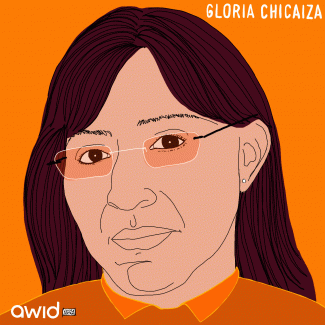
Gloria Chicaiza, an Ecuadorian social and environmental activist, was a fervent defender of land and water. She defied the status quo, fighting against a model of development based on extraction and worked tirelessly for ecological justice and the rights of communities affected by mining.
In diverse areas of Ecuador, Gloria was part of resistance actions in favour of protecting the ecosystem. With passion and dedication, Gloria supported the indigenous and environmental movement, its communities and organizations who oppose mining projects and protect their territories and collective life projects. She spoke out, in local and international foras, against the criminalization of dissent and resistance, the pressure and violence being enacted against community activists, in particular, women human rights defenders and in support of community led efforts for food sovereignty and sustainability.
She was the Mining Justice Coordinator at Acción Ecológica, member of the Latin American Network of Women Defenders of the Social and Environmental Rights and a Board member at the Observatory of Mining Conflicts of Latin America.
In October 2010, Gloria was accused by the mining company Curimining / Salazar Resources S.A. (with Headquarters in Vancouver, Canada) of sponsoring an act of terrorism, sabotage and illegal association to commit a crime. Acción Ecológica believed this to be “in retaliation for her work of denouncing the impacts of mining activities in the country.”
In 2014, Gloria supported the coordination of a delegation to the UN COP 20 Dialogue on Climate Change. The group consisted of 25 Indigenous women from Latin America.
Gloria passed away due to complications from a lung transplant on December 28, 2019. She is remembered for her resistance and tireless work.
"The fastest way to achieve sustainability is still resistance." - Gloria Chicaiza (2010 interview)
“Para GLORIA. GLORIA Agua. GLORIA Tierra. GLORIA Madre. GLORIA Revolución. GLORIA Hermana. GLORIA Cielo. GLORIAmiga. GLORIAstral. Thank you for weaving us together.” -Liliana Gutierrez
“Thank you Glorita, for sustaining hope, for keeping the fabric strong, for connecting the community, for the united hands, for solidarity, thank you Glorita for standing with us in the most difficult moments. Thank you for teaching us that throughout life, nobody gets tired.” (Chakana News)
“Gloria Chicaiza cherished and flourished in being one of many. And as humble as she was, she had an uncanny ability to lead and maintain a steady and thunderous beat, a life-affirming pulse that guided, mobilized, and inspired communities and networks in the protection of Mother Earth. She denounced all forms of violence against cuerpos-territorios. She endorsed el buen vivir.” - Gabriela Jiménez, Latin America Partnerships Coordinator, KAIROS
“Thank you Gloria Chicaiza from infinity we are sure that you will continue to support our struggle. You who continued to struggle with us despite your failing health. You will live on in the forests and the water that you defended with such courage. You will live on in our hearts.”- The community of Intag in Ecuador
您不必成為AWID會員即可參加,但是AWID會員可以獲得折扣的註冊費以及許多其他好處。
詳細瞭解如何成為AWID成員 (in English)

Filter your search by funders from different sectors i.e., philanthropic foundations, multilateral funders, women’s and feminist funds
Notre fonds d'accès offrira un nombre limité de bourses pour financer la participation d'activistes qui ne pourraient autrement pas se rendre sur place, sachant qu’ils·elles ne bénéficient pas du soutien de bailleurs de fonds leur permettant de couvrir leur participation. Si d'autres possibilités s'offrent à vous, n'hésitez pas à les explorer. Nous ferons de notre mieux pour accorder un maximum de bourses, et échangerons plus d'informations concernant cette procédure et les modalités de candidature au début de l’année 2024.
El informe más reciente del Observatorio sobre la Universalidad de los Derechos desarma discursos como los de la «ideología de género», el «genocidio prenatal» y el «imperialismo cultural». También investiga los flujos de fondos para CitizenGo, la Alliance Defending Freedom/ADF Internacional y otros grupos anti-derechos. En este informe también se puede encontrar un análisis de los sistemas regionales de derechos humanos así como de las estrategias exitosas y los logros feministas.
Lorena Borjas, una mujer trans latina y activista, vivía y trabajaba en el barrio de Jackson Heights de Queens, en la ciudad de Nueva York. En esas calles, cuidó de su comunidad durante años, defendiendo los derechos de las personas trans e inmigrantes, apoyando a lxs sobrevivientes del tráfico humano y del abuso, y haciendo campaña por los derechos de lxs trabajadorxs sexuales y de las personas que viven con VIH y SIDA.
Lorena era fuerte e incansable en su lucha por apoyar, defender y proteger a quienes son más marginalizadxs y discriminadxs por la transfobia, la misoginia y el racismo.
«Ella nos empujaba a brillar auténticamente, a convertirnos en un grito de subversión que dice “Aquí estoy, y merezco felicidad también”.» - Cecilia Gentili, activista trans amiga de Lorena
Luego de haber enfrentado ella misma numerosos traumas y dificultades como mujer trans inmigrante y víctima de tráfico humano, recabó conocimientos y memoria emocional de la fuente de sus propias experiencias para ayudar a construir y fortalecer la comunidad de la cual era parte, y que era parte de ella. Algunas de las formas en que llevó esto a cabo fue organizando y movilizando apoyo, que abarcaba desde proveer preservativos y conectar a las mujeres trans con distintos servicios sociales, hasta armar una clínica para el testeo de VIH en su propia casa.
«Era un alma tan bella que ayudaba a otrxs, aun cuando su propio camino era difícil y doloroso como inmigrante, como inmigrante trans. Creía que la comunidad trans necesitaba amor, aceptación, y compasión, y lo daba todo.» - Luchia Dragosh, supervisora de producción de QPTV de un documental sobre Lorena
En sus más de 25 años de activismo, también fundó con Chase Strangio (abogadx y activista por los derechos trans) el Lorena Borjas Community Fund. Este fondo ayuda a lxs diferentes integrantes de su comunidad (y en especial a las personas trans) que lidian con problemas de inmigración, para evitar el ciclo de arresto-cárcel-deportación.
Lorena falleció en marzo de 2020 por complicaciones derivadas del COVID-19.
Su enorme y hermoso legado será llevado adelante a través de las calles de Queens por la red y la comunidad que ella ayudó a crear.
« Continuaremos su trabajo desde donde ella lo dejó, un trabajo que es esencial para el bienestar de “mis pájaras”, como llamaba Lorena a las chicas trans de Queens que protegía bajo su ala.» - Cecilia Gentili
«Lorena nos trajo luz, cuando atravesábamos tiempos muy oscuros aquí en Nueva York. Nos trajo luz cuando tuvimos que enfrentar la epidemia del crack, cuando tuvimos que enfrentar la crisis del SIDA, cuando tuvimos que enfrentar los cambios en las políticas de inmigración.» - Cristina Herrera, fundadora y CEO de Translatina Network y amiga de Lorena
«Lorena ha hecho más que nadie que yo conozca para arrojar luz sobre la epidemia del tráfico en las comunidades transgénero y para ayudar a otras mujeres trans a escapar de la explotación.» - Lynly Egyes, representante de Borjas en nombre del Transgender Law Center
Mira un documental sobre Lorena Borjas (solo en inglés)
Lee un artículo publicado en The New Yorker sobre Lorena Borjas (solo en inglés)
Lee una nota de opinión de Cecilia Gentili publicada en The New York Times (solo en inglés)

如有其他疑問,請使用我們的聯繫表,然後從下拉選單中選擇「第14屆AWID論壇」。

Be it core funding, programmes & projects or rapid response/ emergency grants.
We will reconnect with past partners, to ensure past efforts are honored. If your contact information has changed since the last Forum process, please update us so that we may reach you.
Suivez notre super-héroïne alors qu'elle se lance dans une quête pour récupérer le récit des acteurs anti-droits à travers le monde.