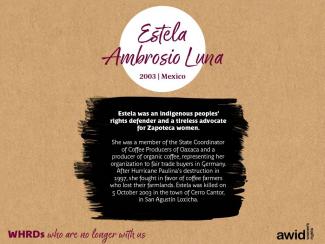
Estela Ambrosio Luna

Young feminist activists play a critical role in women’s rights organizations and movements worldwide by bringing up new issues that feminists face today. Their strength, creativity and adaptability are vital to the sustainability of feminist organizing.
At the same time, they face specific impediments to their activism such as limited access to funding and support, lack of capacity-building opportunities, and a significant increase of attacks on young women human rights defenders. This creates a lack of visibility that makes more difficult their inclusion and effective participation within women’s rights movements.
AWID’s young feminist activism program was created to make sure the voices of young women are heard and reflected in feminist discourse. We want to ensure that young feminists have better access to funding, capacity-building opportunities and international processes. In addition to supporting young feminists directly, we are also working with women’s rights activists of all ages on practical models and strategies for effective multigenerational organizing.
We want young feminist activists to play a role in decision-making affecting their rights by:
Fostering community and sharing information through the Young Feminist Wire. Recognizing the importance of online media for the work of young feminists, our team launched the Young Feminist Wire in May 2010 to share information, build capacity through online webinars and e-discussions, and encourage community building.
Researching and building knowledge on young feminist activism, to increase the visibility and impact of young feminist activism within and across women’s rights movements and other key actors such as donors.
Promoting more effective multigenerational organizing, exploring better ways to work together.
Supporting young feminists to engage in global development processes such as those within the United Nations
Collaboration across all of AWID’s priority areas, including the Forum, to ensure young feminists’ key contributions, perspectives, needs and activism are reflected in debates, policies and programs affecting them.
L’AWID remercie chaleureusement les nombreuses personnes dont les idées, analyses et contributions ont permis de rédiger la recherche "Où est l’argent pour l’organisation des mouvements féministes?" et les actions de plaidoyer au fil des années.
En premier lieu, et avant tout, nos profonds remerciements aux membres et activistes de l’AWID ayant pris part aux consultations WITM et piloté cette enquête à nos côtés, partageant si généreusement leur temps, leurs analyses et ouvrant leur cœur.
Notre gratitude va également aux mouvements féministes, aux allié·es et aux fonds féministes, et notamment, sans s’y limiter, au Black Feminist Fund, au Pacific Feminist Fund, à ASTRAEA Lesbian Foundation for Justice, à FRIDA Young Feminist Fund, à Purposeful, au Kosovo Women’s Network, au Human Rights Funders Network, au Dalan Fund et à PROSPERA International Network of Women's Funds pour vos études et recherches rigoureuses sur l’état du financement de l’organisation des mouvements, vos analyses pointues et vos incessantes actions de plaidoyer en faveur de davantage de financement de meilleure qualité et de plus de pouvoir pour l’organisation des mouvements féministes et de genre dans tous les contextes.
This is an English article
- translated from the French article
Vivimos en un mundo donde la destrucción de la naturaleza alimenta nuestra economía global actual. |
Incluso en tiempos de crisis climática, los gobiernos continúan alentando el crecimiento de las industrias agrícolas a gran escala. Estas actividades envenenan la tierra, amenazan la biodiversidad y destruyen la producción de alimentos y los medios de vida locales. Mientras tanto, aunque las mujeres producen la mayoría de nuestros alimentos en el mundo, casi no poseen tierra. |
|
¿Qué pasaría si percibiéramos la tierra y la Naturaleza no como una propiedad privada para ser explotada, sino como una totalidad con la cual aprender y coexistir en armonía? ¿Y si repararíamos nuestras relaciones con la tierra y adoptaríamos alternativas más sostenibles que nutran tanto al planeta como a sus comunidades? Nous Sommes la Solution (Somos la Solución, NSS) es uno de los muchos movimientos liderados por mujeres que se esfuerzan por lograr este objetivo. Esta es su historia. |
|

Tout à fait, nous souhaitons connaître votre opinion et votre expérience du financement.
En nuestro Tributo Virtual 2015 honramos a cinco defensoras de derechos humanos asesinadas en la región de Medio Oriente y África del Norte. Estas defensoras trabajaron por los derechos de las mujeres y los derechos civiles, en su rol de abogadas y activistas. Sus muertes ponen en evidencia las condiciones de trabajo peligrosas y difíciles que, a menudo, imperan en sus países. Únete a AWID para honrar a estas mujeres, su activismo y su legado, compartiendo los memes aquí incluidos con tus colegas, amistades y redes; y tuiteando las etiquetas #WHRDTribute y #16Días.
Por favor, haz click en cada imagen de abajo para ver una versión más grande y para descargar como un archivo.


AGROECOLOGÍA Y SOBERANÍA ALIMENTARIA COMO RESISTENCIA |
Hoy en día, la producción industrial de alimentos a gran escala utiliza plantaciones de monocultivo, organismos genéticamente modificados y otros pesticidas que destruyen la tierra y el conocimiento de las comunidades locales. |
La agroecología es una resistencia a la agricultura hiper-industrializada utilizada por las multinacionales. La agroecología prioriza la agricultura a pequeña escala, los cultivos múltiples y la producción de alimentos diversificados, al tiempo que se centra en el conocimiento y las prácticas tradicionales locales. La agroecología va de la mano con los reclamos de soberanía alimentaria, o el "derecho de los pueblos a alimentos sanos y culturalmente apropiados producidos por métodos ecológicamente racionales y sostenibles, y su derecho a definir sus propios sistemas alimentarios y agrícolas" (Vía Campesina, Declaración de Nyéléni).
El papel de las mujeres, las comunidades indígenas y rurales y las personas racializadas en los países del Sur Global es fundamental para mantener los sistemas alimentarios. Lxs agroecologistxs feministas trabajan para desmantelar los roles de género opresivos y los sistemas patriarcales arraigados en la producción de alimentos. Como lo muestran las heroínas de Nous Sommes la Solution, generan una agroecología liberadora al fortalecer la resiliencia de las comunidades, empoderar a las mujeres campesinas y agricultoras mientras preservan las tradiciones locales, los territorios y los conocimientos de las comunidades productoras de alimentos.
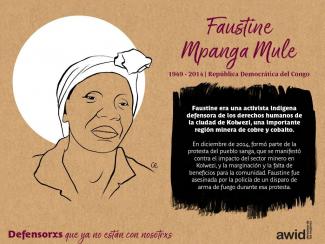
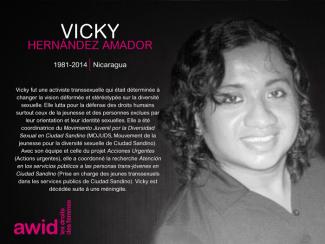
En Europe de l’Ouest et du Sud-Est ces défenseuses des droits humains ont voué leur vie à mener des campagnes ou des recherches. Elles ont été membres de différents mouvements pour la paix ou pour les droits des femmes et ont contribué à les faire évoluer par le biais de l'action politique, de l’activisme social ou à travers la danse. Nous les remercions infiniment pour l'héritage qu'elles nous ont laissé. Nous vous invitons à vous joindre à l’AWID pour rendre hommage à ces femmes, à leur activisme et à l’héritage qu’elles nous ont laissé. Faites ces mèmes auprès de vos collègues et amis ainsi que dans vos réseaux et en twittez en utilisant les hashtags #WHRDTribute et #16Jours.
S'il vous plaît cliquez sur chaque image ci-dessous pour voir une version plus grande et pour télécharger comme un fichier



Sí, es accesible para personas con diverso grado de discapacidades auditivas, visuales, cognitivas y de movilidad.
Le cadre de référence de votre recherche vous guidera tout au long du processus de recherche. Le document de référence que vous élaborez peut aussi servir de note de synthèse destinée aux personnes qui vous conseillent et à vos partenaires, ainsi qu’à une demande de financement aux éventuels donateurs.
Dans cette section
Avant de mener toute recherche :
- Fixez les objectifs de votre recherche.
- Dressez la liste des questions principales auxquelles vous souhaitez que votre recherche réponde.
- Écrivez les types de données que vous devrez recueillir et examinez-les pour répondre à vos questions principales.
- Définissez les produits finaux que vous élaborerez à l’aide de votre recherche.
Le cadre de votre recherche pourra évoluer avec le temps, alors que vous peaufinez vos questions et recueillez de nouvelles informations. Cependant, le fait de créer un cadre de recherche dès le départ vous permettra de travailler à partir d’une base solide.
Afin que votre recherche WITM ait une base solide, il est important de définir clairement ce que vous souhaitez accomplir.
Par exemple, l’un des objectifs de la recherche mondiale WITM de l’AWID consistait à fournir des données rigoureuses afin de prouver ce que nous savions déjà par ouï-dire : que les organisations de droits des femmes sont sous-financées, et de surcroît de façon marquée. Ces données nous permettraient selon nous d’être en meilleure position pour influencer les prises de décisions des bailleurs de fonds.
Vos objectifs pourraient être les suivants :
Structurez votre processus de recherche à l’aide de questions clés auxquelles seule votre recherche puisse répondre et limitez ces questions à un laps de temps spécifique (p. ex. la dernière année, les derniers cinq ans, etc.).
Tenez compte des aspects suivants :
Le fait de choisir une période spécifique pour votre recherche peut mener à des résultats plus précis qu’ils ne le seraient si vous travailliez avec un calendrier ouvert. De plus, la décision de répéter ou non votre recherche à intervalles réguliers vous permettra de fixer des repères de collecte de données, facilitant la reproduction et la comparaison au fil du temps.
Principales questions qui ont guidé le processus de recherche WITM de l’AWID :
- Quelle est la situation actuelle quant à la durabilité financière des organisations de droits des femmes à travers le monde ?
- Quelles sont les tendances externes et internes qui influent sur les décisions de financement des donateurs à l’appui des organisations et des mouvements de femmes ?
Maintenant que vous avez défini vos questions principales, vous pouvez déterminer les types de données qui vous aideront à répondre à ces questions. Ainsi, vous serez en mesure de planifier le reste du calendrier de votre recherche WITM.
Par exemple, est-ce que vous mènerez une enquête qui couvre une vaste proportion de votre population prioritaire ? Est-ce que vous analyserez les demandes de financement que les bailleurs de fonds reçoivent dans une région particulière ? Est-ce que vous procéderez à des interviews (recommandé) ? En déterminant quelles sont les données dont vous avez besoin, vous pourrez entrer en contact avec des parties externes qui vous fourniront ces données dès le départ, et serez à même de planifier en conséquence l’ensemble de votre calendrier. Nous vous suggérons les sources de données suivantes :
La diversité des ensembles de données constitue un excellent moyen de créer une analyse robuste et riche.
Par exemple, les données de l’Enquête mondiale de l’AWID en 2011 sont les piliers de nos récentes analyses. Cependant, nous avons également recueilli des données d’interviews sur le terrain, avec des donateurs, des activistes ou des organisations de droits des femmes.
L’élaboration d’un plan initial sur les produits que vous créerez vous permettra non seulement de fixer votre calendrier, mais vous donnera également une idée des ressources dont vous aurez besoin.
Par exemple, produirez-vous uniquement un rapport de recherche ou créerez-vous également des infographies, des dépliants et des présentations ? Selon les produits que vous choisirez, vous aurez peut-être à recourir à des sociétés de conception graphique, à prévoir des manifestations, etc.
Ces produits seront également les outils que vous utiliserez pour atteindre vos objectifs. Ainsi, il est important de garder ces objectifs à l’esprit. Par exemple, votre recherche WITM a-t-elle pour unique objectif de servir d’outil de plaidoyer visant à influencer les bailleurs de fonds ? Si tel est le cas, vos produits devraient vous permettre de mobiliser les bailleurs de fonds de manière significative.
Exemples de produits :
Le fait d’établir un cadre de recherche portant sur les objectifs, les questions principales, les types de données et les produits finaux vous permettra de créer un calendrier bien planifié, de préparer vos ressources à l’avance et de fixer un budget réaliste.
Cette démarche facilitera les interactions avec les partenaires externes, tout en vous permettant de gérer plus aisément les contretemps inattendus.

• 1 mois
• 1 personne (ou plus) chargée de la recherche
• Exemple 1 : Cadre de référence d’une recherche
• Exemple 2 : Cadre de référence d’une recherche