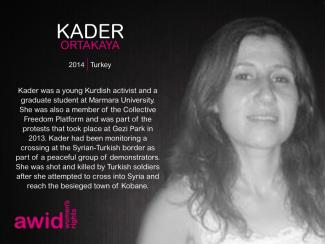
Kader Ortakaya
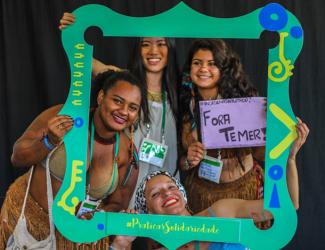
Young feminist activists play a critical role in women’s rights organizations and movements worldwide by bringing up new issues that feminists face today. Their strength, creativity and adaptability are vital to the sustainability of feminist organizing.
At the same time, they face specific impediments to their activism such as limited access to funding and support, lack of capacity-building opportunities, and a significant increase of attacks on young women human rights defenders. This creates a lack of visibility that makes more difficult their inclusion and effective participation within women’s rights movements.
AWID’s young feminist activism program was created to make sure the voices of young women are heard and reflected in feminist discourse. We want to ensure that young feminists have better access to funding, capacity-building opportunities and international processes. In addition to supporting young feminists directly, we are also working with women’s rights activists of all ages on practical models and strategies for effective multigenerational organizing.
We want young feminist activists to play a role in decision-making affecting their rights by:
Fostering community and sharing information through the Young Feminist Wire. Recognizing the importance of online media for the work of young feminists, our team launched the Young Feminist Wire in May 2010 to share information, build capacity through online webinars and e-discussions, and encourage community building.
Researching and building knowledge on young feminist activism, to increase the visibility and impact of young feminist activism within and across women’s rights movements and other key actors such as donors.
Promoting more effective multigenerational organizing, exploring better ways to work together.
Supporting young feminists to engage in global development processes such as those within the United Nations
Collaboration across all of AWID’s priority areas, including the Forum, to ensure young feminists’ key contributions, perspectives, needs and activism are reflected in debates, policies and programs affecting them.
Claro que sim! Encorajamo-lo a compartilhar a ligação do nosso inquérito com as suas redes. Quanto mais perspetivas diversas recolhermos, melhor será a nossa compreensão do cenário financeiro para a organização feminista.
por Dr. Pragati Singh
En 2019, fui invitada por la BBC para hablar en la 100 Women Conference en Delhi, India. El tema era «El futuro del amor, las relaciones, y las familias». El público presente en el gran salón consistía mayoritariamente en jóvenes indixs: estudiantes universitarixs, profesionales, activistas, etc. (...)
arte: «Angels go out at night too» [Los ángeles también salen de noche], Chloé Luu >
Stephanie Bracken is a feminist who is dedicated to building and supporting strong systems that meet the needs of the moment and the people who interact with them, and serve principles of justice. She holds a Master of Human Rights from the University of Sydney and a BA in Gender Studies, History, and Philosophy from McGill University, and has experience working with feminist and social justice organizations on monitoring, evaluation & learning, strategic work planning, governance, project management, and building operational systems and processes. Stephanie is based in Tiohtià:ke/Montreal, where she enjoys singing with others, camping, fiber arts, and spending time with her kids and community.
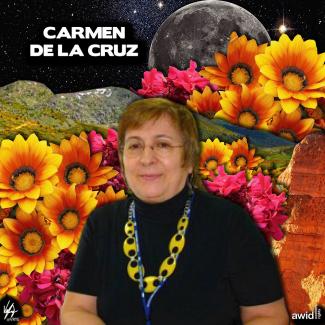
Carmen tuvo una larga carrera en la defensa de los derechos de las mujeres tanto en organizaciones no gubernamentales como en el sistema de las Naciones Unidas.
Dio clases en varias universidades españolas y latinoamericanas y publicó numerosos artículos e informes sobre mujeres, género y paz en países en desarrollo. Sus escritos y reflexiones críticas repercutieron en toda una generación de mujeres jóvenes.
En sus últimos años, fue responsable del Área Práctica de Género en el Centro Regional para América Latina del Programa de las Naciones Unidas para el Desarrollo (PNUD), desde donde apoyó iniciativas muy valiosas en favor de la igualdad de género y los derechos humanos de las mujeres.
Al unirte a AWID, te sumas a un proceso organizativo feminista mundial, un poder colectivo surgido del trabajo entre movimientos y basado en la solidaridad.
Tengo la convicción de que las mujeres empoderadas dotan de empoderamiento a otras mujeres, y es por ello que la he pasado tan bien como afiliada de AWID. Todo lo que sé y lo que entiendo de feminismo e interseccionalidad se ha ampliado gracias a los contactos que tuve como parte del Equipo de la Calle de la Comunidad AWID. Espero que más mujeres se sumen y compartan temas e ideas que ayuden a otras mujeres.- Loyiso Lindani, Sudáfrica.
par Haddy Jatou Gassama
Il est de coutume pour la tribu mandingue, en Gambie, de mesurer la première écharpe utilisée par les mères pour porter leur nourrisson sur leur dos. (...)
illustration : « Puta sacrée », par Pia Love >
Margarita es una feminista y activista por los derechos de las personas LGBTIQA de América Latina. Sus pasiones son la transformación social y el bienestar colectivo. Posee títulos en Psicología, Comunicaciones y Administración Pública, y varias certificaciones en Política Pública, Liderazgo, Gestión y Toma de Decisiones. Como profesional, ha tenido una dilatada experiencia con organizaciones de base, ONG nacionales y regionales, universidades y el sector público, en los que se ha abocado a la facilitación, la capacitación, la incidencia política, las comunicaciones y la evaluación de políticas.

Affectueusement connue sous le nom de « Mama Efua », Efua a lutté contre les mutilations génitales féminines (MGF) pendant trois décennies et a contribué à attirer l'attention et l'action de la communauté internationale pour mettre fin à cette pratique néfaste.
En 1983, Efua a cofondé FORWARD (fondation pour la santé, la recherche et le développement des femmes), qui est devenue une organisation de premier plan dans la lutte contre les MGF. Son livre intitulé « Cutting the Rose: Female Genital Mutilation » (couper la rose), publié en 1994, est considéré comme le premier ouvrage sur les mutilations génitales féminines. Il figure parmi « Les 100 meilleurs livres africains du XXe siècle » de l’Université de Columbia.
Originaire du Ghana et infirmière de formation, Efua a rejoint l'OMS en 1995 et a réussi à faire en sorte que les mutilations génitales féminines fassent partie des agendas politiques des États membres de l'OMS. Elle a également travaillé en étroite collaboration avec le gouvernement nigérian pour élaborer une politique nationale globale qui servirait de base légale aux lois nigérianes contre les mutilations et qui est toujours en vigueur à ce jour.
Son travail de pionnière a abouti à une campagne menée par l'Afrique intitulée « The Girl Generation », qui s'est engagée à mettre fin aux MGF en une génération. Efua a montré comment une seule personne peut devenir la voix unificatrice d'un mouvement : « Une identité partagée peut aider à rassembler des activistes d'horizons différents dans un but commun ». Ces mots, emplis de sagesse, sont plus pertinents que jamais.

Le Forum de l’AWID est le plus grand événement mondial axé sur les mouvements féministes et de justice de genre dans toute leur diversité. Il s'agit d'un espace de transformation créé par et pour les mouvements féministes, où les féministes du Sud Global et autres communautés historiquement marginalisées occupent le devant de la scène, élaborent des stratégies pour changer le pouvoir et se connectent avec les mouvements alliés, la philanthropie et les politiques. C'est donc avec le cœur plein que nous vous annonçons que...
Le 15e Forum international de l'AWID se tiendra du 2 au 5 décembre 2024 à Bangkok, en Thaïlande !
Nous espérons réunir 2 500 participant.e.s en personne et 3 000 participant.e.s en ligne/hybride.
Lorsque des milliers de féministes se réunissent, nous créons une force de solidarité écrasante qui a le pouvoir de changer le monde. Nous sommes enthousiastes, et nous savons que vous l'êtes aussi, alors restez à l'écoute pour plus de détails, y compris l'inscription et nos plans pour un programme plein de magie féministe.
"We believe that this is the time for us to continue to organize from a place of solidarity, hope and radical imaginations."
- Beijing+30 & CSW: Feminist meaning-making at a time of polycrisis
Our final Feminist Film Club program is now available to view: “Films from Nuestramérica” is a film series on Latin/Central American Feminist Realities curated by Alejandra Laprea (Venezuela).
Sara AbuGhazal est une féministe palestinienne vivant à Beyrouth. Elle est Co-fondatrice de Sawt al-Niswa, un collectif qui produit des connaissances à Beyrouth. Elle est co-directrice de The Knowledge Workshop, une organisation féministe basée à Beyrouth qui travaille sur l'histoire orale et l'archivage féministes. Sara est actuellement coordonnatrice régionale de la Regional Coalition for Women Human Rights Defenders in the Middle East and North Africa.
Sara s'efforce de contribuer à la création d'espaces de transformation et de solidarité féministes. Son travail est principalement axé sur la création de mouvements durables dans la région Moyen-Orient et de l'Afrique du Nord Elle est investie dans la production de connaissances, la transformation féministe et la Palestine. Elle publie régulièrement dans sawtalniswa.org et ses œuvres de fiction apparaissent également dans le magazine électronique Romman

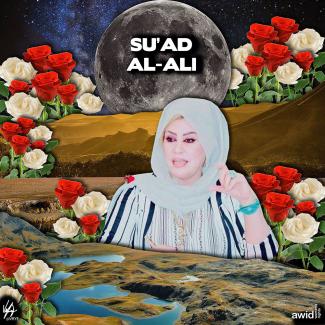
Su’ad was a strong advocate of women’s and children’s rights, and was the head of Al-Weed Al-Alaiami - an Iraqi human rights organisation.
She participated in the July 2018 demonstrations that took place in Basra and several other Iraqi cities protesting unemployment and demanding jobs and proper public services for citizens, as well as calling for the elimination of rampant corruption.
On 25 September 2018, Su’ad was assassinated in the Al-Abbasiyah district in downtown Basra. A video of the incident showed a person approaching her as she was getting into her car, firing a bullet at the back of her head and pointing another bullet at her driver Hussain Hassan, who was injured in the shoulder. Al-Ali was 46 and the mother of four children.
Every three to four years, AWID hosts its flagship international event. It is the world’s largest event that wholeheartedly centers feminist and gender justice movements in all their diversity. It is a global gathering of feminist activists, allied movements, scholars, funders and policymakers. The Forums rotate between different regions and countries in the global South.
✉️ By invitation only
📅 Tuesday, March 11, 2025
🕒 2.00-4.00pm EST
🏢 Chef's Kitchen Loft with Terrace, 216 East 45th St 13th Floor New York
Organizer: Observatory on the Universality of Rights (OURs) Consortium
Crear | Résister | Transform es para ti y para todxs lxs increíbles activistas feministas y por la justicia social que conozcas. Reunámonos para compartir nuestras estrategias de resistencia, para crear conjuntamente algo de magia feminista, y para transformar juntxs este mundo.