None On Record

Special Focus

AWID is an international, feminist, membership organisation committed to achieving gender equality, sustainable development and women’s human rights

Young Feminist Activism

Organizing creatively, facing an increasing threat

Young feminist activists play a critical role in women’s rights organizations and movements worldwide by bringing up new issues that feminists face today. Their strength, creativity and adaptability are vital to the sustainability of feminist organizing.

At the same time, they face specific impediments to their activism such as limited access to funding and support, lack of capacity-building opportunities, and a significant increase of attacks on young women human rights defenders. This creates a lack of visibility that makes more difficult their inclusion and effective participation within women’s rights movements.

A multigenerational approach

AWID’s young feminist activism program was created to make sure the voices of young women are heard and reflected in feminist discourse. We want to ensure that young feminists have better access to funding, capacity-building opportunities and international processes. In addition to supporting young feminists directly, we are also working with women’s rights activists of all ages on practical models and strategies for effective multigenerational organizing.

Our Actions

We want young feminist activists to play a role in decision-making affecting their rights by:

  • Fostering community and sharing information through the Young Feminist Wire. Recognizing the importance of online media for the work of young feminists, our team launched the Young Feminist Wire in May 2010 to share information, build capacity through online webinars and e-discussions, and encourage community building.

  • Researching and building knowledge on young feminist activism, to increase the visibility and impact of young feminist activism within and across women’s rights movements and other key actors such as donors.

  • Promoting more effective multigenerational organizing, exploring better ways to work together.

  • Supporting young feminists to engage in global development processes such as those within the United Nations

  • Collaboration across all of AWID’s priority areas, including the Forum, to ensure young feminists’ key contributions, perspectives, needs and activism are reflected in debates, policies and programs affecting them.

Related Content

Snippet Kohl - Panel | El placer más allá de las fronteras

Plenaria | Ella está en camino: alternativas, feminismos y otro mundo

con Vandana Shiva, Dilar Dirik y Nana Akosua Hanson

YOUTUBESOUNDCLOUD (inglés)

Snippet - COP30 - International Eco-Socialist Encounter - ES

Encuentro Ecosocialista Internacional

Paneles, talleres, plenarias y espacios de intercambio entre colectivos, activistas y organizaciones que luchamos para recorrer de forma colectiva el camino hacia una agenda y un programa de lucha por el ecosocialismo.

📅 8 - 11 de noviembre de 2025
📍 Buenos Aires, Argentina

Regístrate aquí

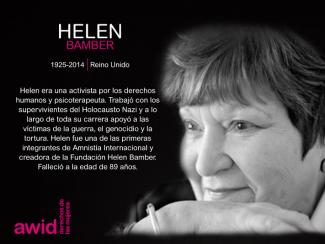
Cynthia Cockburn

Cynthia Cockburn was a feminist sociologist, writer, academic, photographer and peace activist.

She explored the gendered aspects of violence and conflict and made significant contributions to the peace movement through her exploration of the themes of masculinity and violence as well as her local and international activism.

Cynthia brought a feminist power analysis to militarisation and war, and was among the academics whose writings and analysis clearly demonstrated how gender-based violence played a key part in perpetuating war. Working closely with peace activists in countries experiencing conflict, her findings covered diverse contexts including Northern Ireland, Bosnia-Herzegovina, Israel/Palestine, South Korea, Japan, Spain and the UK. She helped bring in her research and academic writings, an understanding that violence was experienced as a continuum of time and scale and perceived very differently when seen from a gendered lens.

In her words, “Gender helps us to see the continuity, the connection between instances of violence.” 

Cynthia bridged her research with the activism she did locally and internationally with movements for demilitarisation, disarmament and peace. She helped start the Greenham Common women’s peace camp, which advocated for universal nuclear disarmament in Britain and was part of establishing the London chapter of Women in Black.

Over the decades, Cynthia organized and participated in local weekly vigils and the political choir Raised Voices, singing in the choir, and writing several of the lyrics to the songs that have made up its repertoire. She was also active in the Women’s International League for Peace and Freedom (WILPF), the European Forum of Socialist Feminists as well as in Women Against Fundamentalism.

“Cynthia shed feminist light, wove together feminist communities, sang songs of peace, listened, listened, listened, watched the birds – and stopped traffic. I’ll be forever and gratefully in her debt, the other ‘Cynthia’” – Cynthia Enloe

Cynthia was born in July 1934 and passed away in September 2019 at the age of 85.

Body

Voulez-vous vous inspirer des stratégies de résistance créatives des féministes du monde entier ? Souhaitez-vous découvrir des initiatives féministes qui nous montrent comment nous pouvons tou.te.s vivre dans un monde plus juste ? Voulez-vous en savoir plus sur les modèles de soins et de guérison féministes à apporter à votre propre communauté ? Est-ce un oui retentissant que nous entendons ? OUI!

Alors consultez Crear | Résister | Transform : un festival pour les mouvements féministes. Ce festival s'est déroulé virtuellement tout au long du mois de septembre 2021 sur toutes les plateformes de l'AWID, et vous pouvez désormais en faire l'expérience à votre rythme.

Les sessions ci-dessous sont pour vous et tou.te.s les incroyables militant.e.s féministes et de justice sociale que vous connaissez. Rassemblons-nous pour partager nos stratégies de résistance, co-créer de la magie féministe et transformer ce monde ensemble.

Key impacts on the international human rights system

Anti-rights actors have had a substantive impact on our human rights framework and the progressive interpretation of human rights standards, especially rights related to gender and sexuality.

When it comes to the impact of conservative actors in international policy spaces, the overall picture today is of stasis and regressions.


We have witnessed the watering down of existing agreements and commitment; deadlock in negotiations; sustained undermining of UN agencies, treaty review bodies and Special Procedures; and success in pushing through regressive language in international human rights documents.

Commission on the Status of Women (CSW)

The CSW, held annually in March, has long been one of the most contested sites in the UN system. In March 2015, conservative efforts set the tone before events or negotiations even began; the outcome document of the Commission was a weak Declaration negotiated before any women’s rights activists even arrived on the ground.

At 2016’s CSW, the new Youth Caucus was infiltrated by large numbers of vocal anti-abortion and anti-SRHR actors, who shouted down progressive youth organizations. Again, intensive negotiations resulted in a lacklustre text, which included regressive language on ‘the family.’

Precisely when addressing women’s human rights is of urgent importance, the CSW has been rendered a depoliticized and weakened space. Using it to advance rights has become harder and harder since progressives’ energy is taken up trying to hold the ground against conservative backlash.

Human Rights Council (HRC)

As the intergovernmental body responsible for the promotion and protection of human rights around the globe, the HRC is a key entry point for conservative actors. In recent years, this mechanism has been the scene for a number of damaging anti-human rights moves.

In conversation with other anti-rights actors, one strategy of conservative states, and blocs of states, is to aggressively negotiate out positive language and to introduce hostile amendments to resolutions, most often resolutions focusing on rights related to gender and sexuality.

To take one example, during the June 2016 session of the HRC, opposition was mounted towards a resolution on discrimination against women by the member states of the Organization of Islamic Cooperation (OIC) and allies. During contentious negotiations, multiple provisions were removed, including women’s and girls’ right to have control over their sexuality, sexual and reproductive health, and reproductive rights; and the need to repeal laws which perpetuate the patriarchal oppression of women and girls in families, and those criminalizing adultery or pardoning marital rape.

The HRC has also been the site of pernicious conservative initiatives to co-opt human rights norms and enact conservative “human rights” language, such as that of the Russia-led “traditional values” resolutions, and more recently the “Protection of the Family” agenda.

Human Rights Committee

In 2015, moving their sights to another front, a number of religious right organizations began to target the Human Rights Committee, the treaty monitoring body for the International Covenant on Civil and Political Rights (ICCPR), a pivotal human rights instrument.

Anti-human rights groups mobilized in hopes of cementing their anti-abortion rhetoric into the treaty.

When the Committee announced it was drafting a new authoritative interpretation of the right to life, over 30 conservative non-state actors sent in written submissions, advocating their misleading discourse on ‘right to life’ - that life begins at conception and that abortion is a violation of the right - be incorporated in the Committee’s interpretation of article 6.

Conservative groups targeting the Human Rights Committee was a shift considering that historically anti-human rights actors have repeatedly attempted to undermine and invalidate the essential work of the treaty monitoring bodies, including the Human Rights Committee.

SDG negotiations and Agenda 2030

Anti-human rights actors were involved in lobbying towards the development of the new Sustainable Development Goals (SDGs) in 2015, focusing again on rights relating to gender and sexuality. These efforts had limited traction in their attempts to embed regressive language in Agenda 2030.

However, after successfully pushing back against progressive language in the final text, conservative actors then pivoted to another strategy. In an attempt to evade state accountability and undermine the universality of rights, several states have repeatedly made reservations to the Goals.

On behalf of the African Group, Senegal claimed that African states would only “implement the goals in line with the cultural and religious values of its countries.”

The Holy See also made a number of reservations, stating it was “confident that the related pledge ‘no one will be left behind’ would be read” as meaning “the right to life of the person, from conception until natural death.”

Saudi Arabia went one step further, declaring that the country would not follow any international rules relating to the SDGs that reference sexual orientation or gender identity, describing them as running “counter to Islamic law.”

General Assembly (GA)

Anti-rights actors have made increasing headway at the UN General Assembly (GA).  Most recently, during the 71st session in 2016, the GA was the scene of feverish anti-rights organizing in opposition to the new mandate created by the Human Rights Council resolution on sexual orientation and gender identity in June 2016: the Independent Expert on SOGI. Four separate attempts were made to undercut the mandate in GA spaces.

One approach was to introduce a hostile resolution at the Third Committee[1], led by the African Group, which in essence aimed to indefinitely defer the new mandate. While this approach was not successful, such an attempt in the GA to retroactively block the creation of a mandate brought forward by the Human Rights Council represented a new and troubling tactic - anti-right actors are now working to directly undermine the HRC’s authority respective to the General Assembly.

Another approach targeted the Fifth Committee (responsible for administration and budgetary matters) as an entry point to attack the mandate. In an unprecedented move a number of States attempted (again, unsuccessfully) to block the funding of UN human rights experts, including the new IE on SOGI[2],.

While these multiple efforts were unsuccessful in blocking the creation and continuation of the new mandate, the significant support they received, the novel strategizing employed, and the strong alliances built along regional lines through negotiations point to difficulties ahead.


[1] The Third Committee of the GA deals with agenda items relating to a range of social, humanitarian affairs, and human rights issues.  Each year it discusses and issues resolutions on issues including the advancement of women, the protection of children, family, and youth.

[2] While UN Special Procedures experts (i.e. Special Rapporteurs, Working Group members and Independent Experts) work pro bono, some funds are generally allocated to facilitate country visits on the invitation of the national government, and support staff.


Other Chapters

Read the full report

CFA 2023 - Online and Hybrid - FR

Nouveau

En ligne et hybride

En tant que participant.e en ligne, vous pouvez animer des sessions, vous connecter et converser avec d'autres, et faire l'expérience directe de la créativité, de l'art et de la célébration du Forum de l'AWID. Les participant.e.s connecté.e.s en ligne bénéficieront d'un programme riche et varié, allant des ateliers et des discussions aux séances de guérison et aux spectacles musicaux. Certaines activités seront axées sur la connexion entre les participant.e.s en ligne, tandis que d'autres seront véritablement hybrides, se concentrant sur la connexion et l'interaction entre les participant.e.s en ligne et celles.ceux qui se trouvent à Bangkok.

Snippet Kohl - Intro

Incarnations transnationales

Les féministes affirment depuis longtemps que le privé et le personnel sont politiques. Le festival Crear, Résister, Transform a créé des espaces de discussion permettant aux féministes d'aborder les questions relatives au corps, au genre et aux sexualités, et a exploré les interconnexions entre ces questions qui sont à la fois des expériences profondément incarnées et un terrain où les droits sont constamment contestés et menacés dans la société.

Le pouvoir des mouvements féministes repose sur la façon dont nous organisons et menons des actions coordonnées, non seulement au sein de nos propres communautés et mouvements, mais aussi pour des causes et aux côtés de groupes alliés œuvrant en défense de la justice sociale. Cet espace a permis aux mouvements de partager et de renforcer mutuellement leurs stratégies d'organisation et leurs tactiques.

La pandémie sanitaire mondiale liée au COVID-19 a mis en évidence les échecs du capitalisme néolibéral comme jamais auparavant, révélé les fissures de nos systèmes ainsi que souligné la nécessité et les possibilités de forger de nouvelles réalités. La reprise économique et sociale féministe doit être le fruit de notre travail commun à toustes. Cette édition du journal, en partenariat avec Kohl : a Journal for Body and Gender Research (Kohl : une revue pour la recherche sur le corps et le genre) explorera les solutions, propositions et réalités féministes afin de transformer notre monde actuel, nos corps et nos sexualités.

Vous pouvez explorer les articles en ligne ou
Télécharger le PDF

Snippet - COP30 - Resistance Hubs Section Column 2 - FR

Les partenaires suivantes organisent les pôles de la COP30 :

  1. Caribbean Feminist Climate Justice Movement, Barbade
  2. Gender Interactive Alliance (GIA)*, Pakistan
  3. Women’s Initiative for Sustainable Environment (WISE)*, Nigéria
  4. Réseau des Acteurs du Développement Durable (RADD), Cameroun
  5. MASIPAG*, Philippines

*Sites web en anglais

Hevrin Khalaf

Hevrin Khalaf fue una destacada líder política siria-kurda de la región autónoma de Rojava, donde las mujeres kurdas están arriesgando sus vidas para resistir la ofensiva turca y construir un sistema feminista.

Hevrin fue Secretaria General del Future Syria Party [Partido de la Futura Siria] (FSP, por sus siglas en inglés), un grupo que tenía como objetivo la construcción de puentes, la reconciliación entre diferentes grupos étnicos y el trabajo hacia una "Siria democrática, pluralista y descentralizada".

Hevrin fue un símbolo de este esfuerzo de reconciliación. También trabajó para promover la igualdad entre mujeres y hombres y fue una representante para periodistas, trabajadorxs de ayuda humanitaria y diplomáticxs que visitaban la región.

Hevrin era también una ingeniera civil de Derik, y fue una de las fundadoras de Foundation for Science and Free Though [(Fundación para la Ciencia y el Libre Pensamiento] en 2012.

El 12 de octubre de 2019 fue torturada y asesinada por la milicia Ahrar al-Sharqiya, sustentada por Turquía, durante una operación militar contra las Fuerzas Democráticas Sirias en Rojava.

"El asesinato de Khalaf es un punto de inflexión en la historia moderna de Siria. Demuestra una vez más el viejo proverbio kurdo "no hay amigxs sino montañas". Siempre seré amigo[NC1]  de Khalaf y su visión de un mundo mejor." - Ahed Al Hendi

Body

Sala de prensa

AWID en los medios

Compilación de noticias sobre la organización y/o el trabajo de AWID


Notas de prensa

Notas de prensa, dosieres y kits


Kits de social media

Contacto para medios

Email de contacto

+1 416 594 3773

CFA 2023 - Themes - FR

Les thèmes

Nous acceptons les candidatures dans toute la gamme des domaines thématiques et des intersections importantes pour les mouvements féministes et de justice de genre. Dans le formulaire de candidature, vous pourrez cocher plus d'un thème correspondant à votre activité/atelier.

  • Corps libres, esprits libres : tout ce qui concerne l'autonomie corporelle, le genre et la sexualité, la santé et les droits reproductifs, la liberté face à la violence basée sur le genre, la liberté de vivre en sécurité, le plaisir et la joie dans nos divers corps, identités et communautés, et bien d'autres choses encore.
  • Résister aux antidroits : localement et globalement, les féministes montrent la voie en résistant à toutes les formes d'oppressions intersectionnelles, y compris les fascismes, les fondamentalismes et les régimes autoritaires; nous avons beaucoup à partager et à élaborer des stratégies les un.e.s avec les autres.
  • Mouvements et organisation : apprenons à connaître nos mouvements respectifs. De la navigation du pouvoir (interne et externe) aux stratégies de protection face à la répression des femmes et des défenseuses.eurs des droits humains et de genre, de la construction d'alliances aux formes créatives et réussies d'organisation, apprenons et inspirons-nous les un.e.s des autres.
  • Justice économique et économies féministes : ce thème englobe tous les efforts féministes visant à transformer nos économies, depuis la remise en question des modèles extractifs dominants et la défense des droits des travailleuses.eurs jusqu'à l'incarnation et la mise en œuvre de pratiques et d'alternatives économiques féministes dans la vie de tous les jours.
  • Financement/ressourcement de l'activisme : l'obtention des financements nécessaires est un défi commun pour les mouvements du monde entier. Décortiquons ensemble l'écosystème du financement féministe, de l'analyse critique aux expériences de première main et aux moyens pratiques de financer le travail féministe.
  • Climat, justice environnementale, terre et eau : la justice écologique et climatique a des racines profondes dans beaucoup de nos mouvements et communautés; des traditions anciennes aux visions futuristes, des villages écologiques aux campagnes pour mettre fin à l'extractivisme et à la justice en matière de santé, nous invitons à un éventail complet d'activités sur tous les aspects de la justice climatique et environnementale.
  • Militarisation, guerre et conflit : nous souhaitons mettre en lumière l'organisation, l'analyse et les expériences féministes souvent en première ligne de la réponse aux crises et de l'aide au maintien de la viabilité, de la communauté et de la justice dans les moments les plus durs de la guerre et des conflits prolongés.
  • Décolonisation : la décolonisation est au cœur de chacun de nos thèmes, mais elle constitue également un programme féministe clé de résistance et de construction du monde dans de nombreuses réalités coloniales et postcoloniales.
  • Réalités numériques et technologies féministes : nous nous réjouissons de pouvoir célébrer les incroyables initiatives féministes qui transforment les mondes numériques, remettent en question les structures de pouvoir des grandes entreprises technologiques et démocratisent la technologie comme étant véritablement par et pour les individus.
  • Justice curative : il existe une incroyable diversité d'approches en matière de soins collectifs et de justice curative. Dans le monde entier, les professionnels.elles du soin et les mouvements se réapproprient la justice curative comme un principe politique, un ensemble de pratiques, un parcours d'apprentissage, un mode de vie, et bien d'autres choses encore.
  • Ajoutez votre thème ici!

Sexting Like a Feminist: Humor in the Digital Feminist Revolution Snippet Small

Sextoter comme une féministe : humour et révolution féministe numérique

by Chinelo Onwualu

Le 2 septembre 2021, les géniales féministes et activistes pour la justice sociale du festival de l’AWID Crear | Résister | Transform se sont retrouvées, non seulement pour mettre en commun leurs stratégies de résistance, cocréer et transformer le monde, mais également pour parler crûment sur Twitter.


Lire plus


Snippet - COP30 - Deckgame card - FR

🎯 Jeu de cartes : S’organiser. Créer des stratégies. Se mobiliser.

Un jeu de cartes pratique destiné aux collectives, qui permet d’explorer les alternatives économiques féministes et les systèmes de soins comme réponse aux crises. Pensé pour tous les mouvements qui évoluent au sein des crises climatiques mondiales, ce jeu de cartes propose de jouer et d’élaborer des stratégies en s’appuyant sur des scénarios de la vie réelle. Un moyen créatif de réfléchir aux stratégies lors de réunions, d’ateliers et de rassemblements de la communauté !

Bientôt disponible

Diana Isabel Hernández Juárez

Diana Isabel Hernández Juárez était une enseignante, défenseure des droits humains et activiste pour l’environnement et les communautés guatémaltèque. Elle coordonnait le programme environnemental de la paroisse de Nuestra Señora de Guadalupe, sur la côte sud du Guatemala. 

Diana a dévoué sa vie à co-créer des actions de sensibilisation à l’environnement, en étroite collaboration avec les communautés locales, dans le but de résoudre les problèmes environnementaux et protéger les ressources naturelles. Elle a été à l’initiative de projets de pépinières forestières, de fermes municipales, de jardins familiaux et de campagnes de nettoyage. Active dans les programmes de reboisement, elle s’est efforçée de récupérer des espèces locales et de remédier aux pénuries d’eau dans plus de 32 communautés rurales.

Le 7 septembre 2019, Diana a été assassinée par balle par deux hommes armés inconnus alors qu’elle participait à une procession dans sa localité. Diana n’avait que 35 ans au moment de son décès.

Body

Here are your report and infographics: Toward a feminist funding ecosystem