Organizing creatively, facing an increasing threat
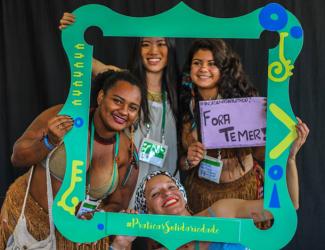
Young feminist activists play a critical role in women’s rights organizations and movements worldwide by bringing up new issues that feminists face today. Their strength, creativity and adaptability are vital to the sustainability of feminist organizing.
At the same time, they face specific impediments to their activism such as limited access to funding and support, lack of capacity-building opportunities, and a significant increase of attacks on young women human rights defenders. This creates a lack of visibility that makes more difficult their inclusion and effective participation within women’s rights movements.
A multigenerational approach
AWID’s young feminist activism program was created to make sure the voices of young women are heard and reflected in feminist discourse. We want to ensure that young feminists have better access to funding, capacity-building opportunities and international processes. In addition to supporting young feminists directly, we are also working with women’s rights activists of all ages on practical models and strategies for effective multigenerational organizing.
Our Actions
We want young feminist activists to play a role in decision-making affecting their rights by:
Fostering community and sharing information through the Young Feminist Wire. Recognizing the importance of online media for the work of young feminists, our team launched the Young Feminist Wire in May 2010 to share information, build capacity through online webinars and e-discussions, and encourage community building.
Researching and building knowledge on young feminist activism, to increase the visibility and impact of young feminist activism within and across women’s rights movements and other key actors such as donors.
Promoting more effective multigenerational organizing, exploring better ways to work together.
Supporting young feminists to engage in global development processes such as those within the United Nations
Collaboration across all of AWID’s priority areas, including the Forum, to ensure young feminists’ key contributions, perspectives, needs and activism are reflected in debates, policies and programs affecting them.
Cynthia Cockburn fue una socióloga feminista, escritora, académica, fotógrafa y activista por la paz.
Estudió los aspectos relacionados con el género en la violencia y el conflicto e hizo importantes contribuciones al movimiento por la paz gracias a sus investigaciones sobre masculinidad y violencia, así como gracias a su activismo local e internacional.
Cynthia aportó un análisis feminista potente sobre la militarización y la guerra, y fue una de las académicas cuyos escritos y estudios demostraron claramente cómo la violencia de género desempeñaba un papel clave en la perpetuación de la guerra. Al trabajar en estrecha colaboración con activistas por la paz en distintos países en conflicto, sus conclusiones abarcaron diversos contextos, entre ellos: Irlanda del Norte, Bosnia y Herzegovina, Israel/Palestina, Corea del Sur, Japón, España y el Reino Unido. También logró incluir en sus investigaciones y escritos académicos una interpretación sobre cómo la violencia se experimenta como un continuo de tiempo y escala y cómo se percibe de forma muy diferente cuando se analiza desde la perspectiva de género.
En sus propias palabras: "El género nos ayuda a ver la continuidad, la conexión entre los casos de violencia".
Cynthia conectó su trabajo de investigación con el activismo que sostuvo a nivel local e internacional con los movimientos por la desmilitarización, el desarme y la paz. Ayudó a iniciar el campamento de paz de las mujeres de Greenham Common, que defendía el desarme nuclear universal en Gran Bretaña, y formó parte también de la creación del capítulo londinense de Women in Black [Mujeres de Negro]. A lo largo de las décadas, Cynthia organizó y participó en vigilias semanales locales y en el coro político Raised Voices [Elevar las Voces], para el que, además de cantar, escribió varias letras de canciones que forman parte de su repertorio.
Su activismo la llevó a apoyar también el trabajo de la Women’s International League for Peace and Freedom [Liga Internacional de Mujeres por la Paz y la Libertad] (WILPF, por su siglas en inglés), el European Forum of Socialist Feminists [Foro Europeo de Feministas Socialistas] y Women Against Fundamentalism [Mujeres contra el Fundamentalismo].
"Cynthia arrojó claridad feminista, tejió comunidades feministas, cantó canciones de paz, escuchó, escuchó, escuchó, observó los pájaros - y detuvo el tráfico. Siempre estaré agradecida y en deuda con ella, la otra 'Cynthia'" - Cynthia Enloe.
Cynthia nació en julio de 1934 y falleció en septiembre de 2019, a la edad de 85 años.
Hevrin Khalaf était une grande dirigeante politique kurde de Syrie dans la région autonome du Rojava, où les femmes kurdes risquent leur vie pour résister aux offensives turques et pour bâtir un système féministe.
Elle a travaillé en tant que secrétaire-générale du Parti du Futur de la Syrie, un groupe qui souhaitait construire des ponts, réconcilier les différents groupes ethniques et mettre sur pied une « Syrie démocratique, pluraliste et décentralisée ».
Véritable symbole de cet effort de réconciliation, elle a également oeuvré à la promotion de l’égalité entre les femmes et les hommes et fut représentante auprès des journalistes en visite, des humanitaires et des diplomates.
Hevrin a de plus été diplômée en tant qu’ingénieure civile, à la ville de Derik, ainsi que l’une des fondatrices de la Fondation pour la Science et la Libre pensée en 2012.
Elle a été torturée et assassinée le 12 octobre 2019 par la milice Ahrar al-Sharqiya, soutenue par la Turquie, lors d’une opération militaire contre les Forces démocratiques syriennes dans le Rojava.
« L’assassinat de Khalaf est un tournant majeur dans l’histoire moderne de la Syrie, celui-ci ayant une fois de plus confirmé la validité du vieux proverbe kurde qui dit : « Il n’y a de véritable ami·e que la montagne ». Je serai toujours ami avec Khalaf et sa vision d’un monde meilleur. » – Ahed Al Hendi
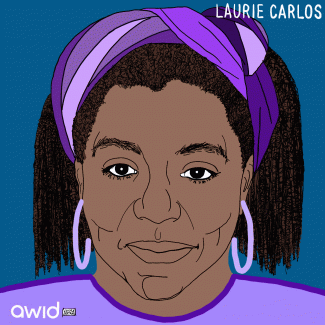
Laurie Carlos was an actor, director, dancer, playwright, and poet in the United States. An extraordinary artist and visionary with powerful ways of bringing the art out in others.
“Laurie walked in the room (any room/every room) with swirling clairvoyance, artistic genius, embodied rigor, fierce realness—and a determination to be free...and to free others. A Magic Maker. A Seer. A Shape Shifter. Laurie told me once that she went inside people’s bodies to find what they needed.” - Sharon Bridgforth
She combined performance styles such as rhythmic gestures and text. Laurie mentored new actors, performers, writers and helped amplify their work through Naked Stages, a fellowship for emerging artists. She was an artistic fellow at Penumbra Theater and supported with identifying scripts to produce, with a goal of “bringing more feminine voices into the theater”. Laurie was also a member of Urban Bush Women, a renowned contemporary dance company telling stories of women of the African diaspora.
In 1976, as Lady in Blue, she made her Broadway debut in Ntozake Shange’s original and award-winning production of the poetic drama For colored girls who have considered suicide / when the rainbow is enuf. Laurie’s own works include White Chocolate, The Cooking Show, and Organdy Falsetto.
“I tell the stories in the movement—the inside dances that occur spontaneously, as in life—the music and the text. If I write a line, it doesn’t necessarily have to be a line that is spoken; it can be a line that’s moved. A line from which music is created. The gesture becomes the sentence. So much of who we are as women, as people, has to do with how we gesture to one another all the time, and particularly through emotional moments. Gesture becomes a sentence or a state of fact. If I put on a script ‘four gestures,’ that doesn’t mean I’m not saying anything; that means I have opened it up for something to be said physically.” Laurie Carlos
Laurie was born and grew up in New York City, worked and lived in Twin Cities. She passed away on 29 December 2016, at the age of 67, after a battle with colon cancer.
Tributes:
“I believe that that was exactly Laurie’s intention. To save us. From mediocrity. From ego. From laziness. From half-realized art making. From being paralyzed by fear.
Laurie wanted to help us Shine fully.
In our artistry.
In our Lives.” - Sharon Bridgforth for Pillsbury House Theatre
“There’s no one that knew Laurie that wouldn’t call her a singular individual. She was her own person. She was her own person, her own artist; she put the world as she knew it on stage with real style and understanding, and she lived her art.” - Lou Bellamy, Founder of Penumbra Theater Company, for Star Tribune
Host: We tend to think about communicating desire as something that is limited to the private intimacy of the bedroom and our personal relationships. But can we also think of this kind of communication as a structure, a praxis that informs our work, and how we are, how we do in the world?
Lindiwe
I believe that unfortunately in the past, expressing your sexuality has been limited. You were allowed to express it within the confines of your marriage, which was permitted, there have always been taboo and stigmas attached to expressing it any other way. When it comes to communicating, obviously the fact that certain stigmas are attached to expressing your sexuality or expressing your desire makes it a lot harder to communicate that in the bedroom or intimately with your partner. From my personal experience, I do believe that obviously if I feel more comfortable expressing myself outside of the bedroom on other matters or other topics, it’s easier for me to build that trust, because you understand conflict resolution with that particular person, you understand exactly how to make your communication special towards that particular person. It’s not easy. It’s something that is consistently done throughout whatever your engagement is, whether it’s your relationship or whether it’s casual and just in the moment. But I believe that confidence outside can definitely translate to how you communicate your desire.
Manal
Since childhood, a woman is raised with that, “you’re not allowed to talk about your body, you’re not allowed to talk about your desire,” which puts a heavy responsibility on women, especially girls in their teens when they need to express themselves and talk about these issues. So for me I think this is a big problem. You know, I have been married for more than 25 years, but still, until now, I cannot talk about my desires. I cannot say what I want or what I prefer, because it’s like I’m not allowed to go beyond this line. It’s like haram, despite it being my right. This is the case for all my friends, they just can’t express themselves in the right way.
Louise
Personally, I find that expressing our desires, my desires, however that expression comes in hand, has to do with the other, and the gaze that the other would have on me. So this is also something that we can link to cinema. And the gaze I would have on myself as well: what I think I am as an individual, but also what society expects of me and my sexuality. In the past, I somehow did the analogy between what happens in the bedroom and what happens in the workplace, because there is sometimes this dynamic of power, whether I want it or not. And oftentimes, verbal communication is harder than we think. But when it comes to representation in film, that’s a totally different game. We are very far away from what I guess all of us here would like to see on screen when it comes to just communicating sexual desires inside or outside the bedroom.
Online and Embodied
Host: We can think about the digital world as embodied: while it might be virtual, it is not less real. And this was made clear in the context of AWID’s feminist realities festival, which took place entirely online. What does it mean then to talk about sexuality, collectively, politically, in online spaces? Do we navigate virtual spaces with our bodies and affects, and in this case, what are the different considerations? What does it do to communication and representation?
Lindiwe
Social media makes you feel community-based. When you express what it is that you want or like, there is someone who’s either going to agree or disagree, but those who do agree make you feel that you belong to a community. So it’s easier to throw it out into the universe, or for others to see, and potentially not get as much judgment. And I say this very loosely because sometimes, depending on what it is that you’re expressing, it either will get you vilified or celebrated. But when it comes to the bedroom, there is an intimacy and almost a vulnerability that is exposing you and different parts of you that is not as easy to give your opinion on. When it comes to expressing your desire, speaking it and saying it and maybe putting a Tweet or a social media post, or even liking and reading other communities that are same-minded is a lot easier than telling your partner, “this is how I want to be pleasured” or “this is how what I want you to do next,” because of the fear of rejection. But not only that, just the vulnerability aspect – allowing yourself to be bare enough to let the other person see into what you are thinking, feeling, and wanting – I think this is where the difference would come in for me personally. I feel it is a lot more community-based on social media, and it’s easier to engage in discourse. Whereas in the bedroom, you don’t want to necessarily kill the moment. But I think that also kind of helps you understand going forward, depending on the relationship with the person, how you would engage thereafter. So I always know that if I try to communicate something and I fail to do so in the moment, I can always try to bring it up outside of that moment and see what the reaction would be so I know how to approach it going forward.
Louise
You know the question in films is, I don’t know if the male gaze is done intentionally or not. Like we don’t really know that. What we know is that the reason why sexuality in general has been so heternormative and focused on penetration and not giving any space for women to actually ask for anything in films, is because most of the people who have been working in this industry and making decisions in terms of, you know, storytelling and editing have been white men. So rape revenge is this very weird film genre that was birthed in the 70s, and half of the story would be that a woman is being raped by one or multiple people, and in the other half, she would get her revenge. So usually she would murder and kill the people who have raped her, and sometimes other people next to them. At the beginning of the birth of this genre and for 30 years at least, those films were written, produced, and directed by men. This is why we also want so much representation. A lot of feminists and pioneers in queer filmmaking also used the act of filming in order to do that and to reclaim their own sexuality. I’m thinking about Barbara Hammer, who’s a feminist and queer pioneer in experimental cinema in the U.S. where she decided to shoot women having sex on 16mm, and by doing so reclaimed a space within the narrative that was exposed in film at that time. And there is also then the question of invisibilization: we know now, because of the internet and sharing knowledge, that women and queer filmmakers have been trying and making films since the beginning of cinema. We only realize it now that we have access to databases and the work of activists and curators and filmmakers.
Resisting Colonization
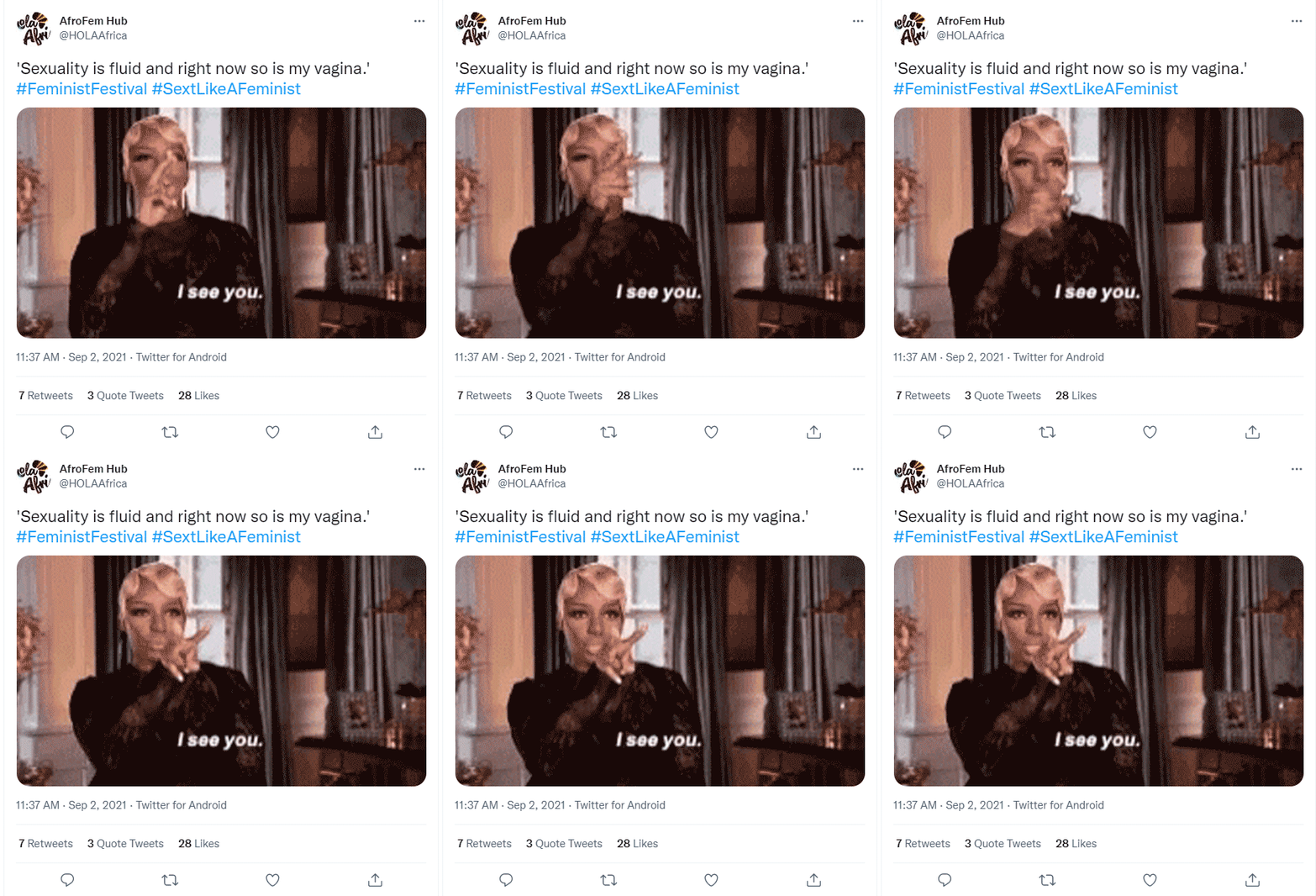
Host: And this opens up the conversation on the importance of keeping our feminist histories alive. The online worlds have also played a crucial role in documenting protests and resistance. From Sudan to Palestine to Colombia, feminists have taken our screens by storm, challenging the realities of occupation, capitalism, and oppression. So could we speak of communicating desire – the desire for something else – as decolonization?
Manal
Maybe because my village is just 600 residents and the whole village is one family – Tamimi – there are no barriers between men and women. We do everything together. So when we began our non-violent resistance or when we joined the non-violent resistance in Palestine, there was no discussion whether women should participate or not. We took a very important role within the movement here in the village. But when other villages and other places began to join our weekly protests, some men thought that if these women participate or join the protests, they will fight with soldiers so it will be like they’re easy women. There were some men who were not from the village who tried to sexually harass the women. But a strong woman who is able to stand in front of a soldier can also stand against sexual harassment. Sometimes, when other women from other places join our protest, they are shy at first; they don’t want to come closer because there are many men. If you want to join the protest, if you want to be part of the non-violent movement, you have to remove all these restrictions and all these thoughts from your mind. You have to focus on just fighting for your rights. Unfortunately, the Israeli occupation realizes this issue. For example, the first time I was arrested, I wear the hijab so they tried to take it off; they tried to take off my clothes, in front of everybody. There were like 300-400 people and they tried to do it. When they took me to the interrogation, the interrogator said: “we did this because we want to punish other women through you. We know your culture.” So I told him: “I don’t care, I did something that I believe in. Even if you take all my clothes off, everybody knows that Manal is resisting.”
Lindiwe
I think even from a cultural perspective, which is very ironic, if you look at culture in Africa, prior to getting colonized, showing skin wasn’t a problem. Wearing animal skin and/or hides to protect you, that wasn’t an issue and people weren’t as sexualized unless it was within context. But we conditioned ourselves to say, “you should be covered up” and the moment you are not covered up you are exposed, and therefore it will be sexualized. Nudity gets sexualized as opposed to you just being naked; they don’t want a little girl to be seen naked. What kind of society have we conditioned ourselves to be if you’re going to be sexualizing someone who is naked outside of the context of a sexual engagement? But environment definitely plays a big role because your parents and your grannies and your aunts say “no, don’t dress inappropriately,” or “no, that’s too short.” So you hear that at home first, and then the moment you get exposed outside, depending on the environment, whether it’s a Eurocentric or more westernized environment to what you are used to, then you are kind of free to do so. And even then, as much as you are free, there’s still a lot that comes with it in terms of catcalling and people still sexualizing your body. You could be wearing a short skirt, and someone feels they have the right to touch you without your permission. There is so much that is associated with regulating and controlling women’s bodies, and that narrative starts at home. And then you go out into your community and society and the narrative gets perpetuated, and you realize that you get sexualized by society at large too, especially as a person of color.
Resistance as Pleasure
Host: And finally, in what ways can our resistance be more than what we are allowed? Is there a place for pleasure and joy, for us and our communities?
Louise
Finding pleasure as resistance and resistance in pleasure, first for me there is this idea of the guerrilla filmmaking or the action of filming when you’re not supposed to or when someone told you not to, which is the case for a lot of women and queer filmmakers in the world right now. For example, in Lebanon, which is a cinema scene that I know very well, most of the lesbian stories that I’ve seen were shot by students in very short formats with “no production value” as the west would say – meaning with no money, because of the censorship that happens on an institutional level, but also within the family and within the private sphere. I would think that filming whatever, but also filming pleasure and pleasure within lesbian storytelling is an act of resistance in itself. A lot of times, just taking a camera and getting someone to edit and someone to act is extremely hard and requires a lot of political stance.
Lindiwe
I have a rape support group. I’m trying to assist women to reintegrate themselves from a sexual perspective: wanting to be intimate again, wanting to not let their past traumas influence so much how they move forward. It’s not an easy thing, but it’s individual. So I always start with understanding your body. I feel the more you understand and love and are proud of it, the more you are able to allow someone else into that space. I call it sensuality training, where I get them to start seeing themselves as not sexual objects, but as objects of pleasure and desire that can be interchangeable. So you’re worthy of receiving as well as giving. But that’s not only from a psychological point of view; it is physical. When you get out of the shower, you get out of the bath, and you’re putting lotion on your body, look at every part of your body, feel every part of your body, know when there are changes, know your body so well that should you get a new pimple on your knee, you are so aware of it because just a few hours ago it wasn’t there. So things like that where I kind of get people to love themselves from within, so they feel they are worthy of being loved in a safe space, is how I gear them towards claiming their sexuality and their desire.
Manal
You know we began to see women coming from Nablus, from Jerusalem, from Ramallah, even from occupied 48, who have to drive for 3-4 hours just to come to join the protests. After that we tried to go to other places, talk with women, tell them that they don’t have to be shy, that they should just believe in themselves and that there is nothing wrong in what we are doing. You can protect yourself, so where is the wrong in participating or in joining? Once I asked some women, “why are you joining?” And they said, “if the Tamimi women can do it, we can do it also.” To be honest I was very happy to hear this because we were like a model for other women. If I have to stand for my rights, it should be all my rights, not just one or two. We can’t divide rights.
Fadila M. fue una activista tribal soulaliyate de Azrú, en la región Ifrane de Marruecos. Luchó contra una forma específica de discriminación territorial dirigida a las mujeres tribales.
Como parte del Movimiento de Mujeres Soulaliyate por el Derecho a la Tierra, trabajó para reformar el marco legislativo relacionado con la administración de la propiedad comunitaria, a través de la adopción, en 2019, de tres proyectos de ley que garantizan la igualdad de mujeres y varones.
Según las leyes consuetudinarias vigentes, las mujeres no tenían derecho a beneficiarse de la tierra, en especial aquellas que eran solteras, viudas o divorciadas. En Marruecos, los derechos a las tierras colectivas eran transmitidos tradicionalmente entre los varones de la familia mayores de 16 años. Desde 2007, Fadila M. ha sido parte del movimiento de mujeres, la primera movilización nacional de base por los derechos a la tierra. Una de sus conquistas ha sido que, en 2012, las mujeres soulaliyate pudieron registrarse por primera vez en las listas de beneficiarixs, y recibir compensaciones relacionadas con la cesión de tierras. El movimiento también logró la enmienda del dahir (decreto del Rey de Marruecos) de 1919, para garantizar el derecho a la igualdad de las mujeres.
Fadila M. falleció el 27 de septiembre de 2018. Las circunstancias de su muerte no son claras. Participó en una marcha de protesta relacionada con el tema de las tierras colectivas y, si bien las autoridades informaron que su muerte fue accidental y que tuvo un paro cardíaco camino al hospital, la sección local de la Asociación de Derechos Humanos de Marruecos (AMDH) señaló que Fadila fue sofocada por un miembro de la fuerza policial utilizando una bandera marroquí. Su familia solicitó una investigación, pero los resultados de la autopsia no fueron dados a conocer.
Nota: Como no ninguna fotografía/imagen de Fadila M. disponible, la obra de arte (en lugar de un retrato) pretende representar por lo que luchó y trabajó: la tierra y los derechos a vivir y tener acceso a esa tierra y lo que crece en ella.