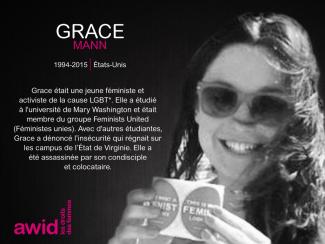
Grace Mann
WHRDs are self-identified women and lesbian, bisexual, transgender, queer and intersex (LBTQI) people and others who defend rights and are subject to gender-specific risks and threats due to their human rights work and/or as a direct consequence of their gender identity or sexual orientation.
WHRDs are subject to systematic violence and discrimination due to their identities and unyielding struggles for rights, equality and justice.
The WHRD Program collaborates with international and regional partners as well as the AWID membership to raise awareness about these risks and threats, advocate for feminist and holistic measures of protection and safety, and actively promote a culture of self-care and collective well being in our movements.
WHRDs are exposed to the same types of risks that all other defenders who defend human rights, communities, and the environment face. However, they are also exposed to gender-based violence and gender-specific risks because they challenge existing gender norms within their communities and societies.
We work collaboratively with international and regional networks and our membership
We aim to contribute to a safer world for WHRDs, their families and communities. We believe that action for rights and justice should not put WHRDs at risk; it should be appreciated and celebrated.
Promoting collaboration and coordination among human rights and women’s rights organizations at the international level to strengthen responses concerning safety and wellbeing of WHRDs.
Supporting regional networks of WHRDs and their organizations, such as the Mesoamerican Initiative for WHRDs and the WHRD Middle East and North Africa Coalition, in promoting and strengthening collective action for protection - emphasizing the establishment of solidarity and protection networks, the promotion of self-care, and advocacy and mobilization for the safety of WHRDs;
Increasing the visibility and recognition of WHRDs and their struggles, as well as the risks that they encounter by documenting the attacks that they face, and researching, producing, and disseminating information on their struggles, strategies, and challenges:
Mobilizing urgent responses of international solidarity for WHRDs at risk through our international and regional networks, and our active membership.
AWID presenta este Manual WITM para apoyar a personas y organizaciones que quieran investigar por su cuenta las tendencias en el financiamiento para una región, temática o población en particular, adaptando las metodologías de investigación de AWID.
El Manual WITM de AWID es producto de diez años de experiencia. Las investigaciones de WITM y este Manual son una demostración política y práctica de los recursos y pasos necesarios para realizar investigaciones en acción de buena calidad.
Más información sobre el contexto de la metodología de la investigación WITM
El equipo WITM también ofrece apoyo técnico y político antes y durante el proceso de investigación. Te invitamos a leer el Manual y a ponerte en contacto con nosotras en fundher@awid.org si necesitas más información.
Pronto brindaremos esta información. ¡Mantente sintonizadx!
Par le biais de l'organisation syndicale, Sopo, Sabrina et Linda se battent non seulement pour les droits des femmes, des travailleur·euses essentiel·les, des travailleur·euses migrant·e·s et des travailleur·euses du sexe, mais pour les droits de tous·tes les travailleur·euses .
La lutte pour mettre fin à l'exploitation des travailleur·euses est une lutte féministe. C’est pourquoi il n’y a pas d’économies féministes sans syndicats féministes.
Ella misma fue una de las 32.000 personas desplazadas por el Tucuruí, una mega central hidroeléctrica, construida en Brasil durante la dictadura militar de 1964-1985.
En 2005 Dilma fue invitada a unirse al Movimiento de los Pueblos Afectados por las Represas en Brasil (MAB), y en 2006 formó el colectivo de mujeres, y eventualmente se convirtió en coordinadora regional del movimiento.
Al hablar de su activismo, sus colegas comentaban:
"Se destacó muy rápido porque siempre fue muy intrépida en la lucha".
Dilma vivió en el asentamiento rural de Salvador Allende, a 50 kilómetros de Tucuruí, y dedicó toda su vida a proteger a las comunidades y las tierras afectadas por la construcción de mega proyectos. Dilma se preocupaba especialmente por el impacto de género que esos proyectos podrían causar, y defendía los derechos de las mujeres.
En una reunión nacional del MAB en 2011, Dilma, dirigiéndose a las mujeres afectadas por las represas, dijo:
"Somos las verdaderas Marías, guerreras, luchadoras que están allí, enfrentando el desafío de la lucha diaria".
En los años siguientes, Dilma organizó grupos de base del MAB y trabajó con la comunidad para formar cooperativas agrícolas que condujeron a una mejor redistribución de los alimentos entre la comunidad. Conjuntamente, mejoraron la comercialización de la pesca y desarrollaron un proyecto de cisternas para el agua potable. También fue defensora de la comunidad de agricultores cuyas tierras eran codiciadas por los "grileiros" (acaparadores de tierras).
El 22 de marzo de 2019, a la edad de 48 años, Dilma, su marido y su amigo fueron brutalmente asesinados. Los tres asesinatos fueron parte de una ola de violencia en la Amazonia contra el Movimento dos Trabalhadores Sem Terra (traducido como 'Movimiento de los Trabajadores Sin Tierra') y lxs activistas medioambientales e indígenas.
par Nandini Tanya Lallmon
Olajumoke « Jay » Abdullahi et Kym Oliver sont des féministes révolutionnaires à plus d'un titre. (...)
illustration : « Éclose » de Titash Sen >
No, no es necesario que seas afiliadx de AWID para participar en el Foro, pero lxs afiliadxs de AWID tienen un descuento en el costo de inscripción, y varios otros beneficios.
Even in times of climate crisis, governments continue to encourage large-scale agriculture industries to expand. These activities poison the land, threaten biodiversity, and destroy local food production and livelihoods. Meanwhile, while women produce the majority of our food in the world, they own almost none of the land.
What if we perceived land and Nature not as private property to exploit, but as a whole to live in, learn from, and harmoniously coexist with? What if we repaired our relationships with the land and embraced more sustainable alternatives that nurture both the planet and its communities?
Nous Sommes la Solution (We Are the Solution, NSS) is one of many women-led movements striving to do this. This is their story.
If the positions advertised have closed, or just don’t match your area of interest and expertise, we suggest the following resources for your job search.
« Mais quand le maître
s’est-il laissé éloigner du pouvoir?
Quand un système a-t-il jamais été brisé
par l’acceptation?
Quand le CHEF te remettra-t-il le pouvoir avec amour?
À Jobourg, à Cancun, à l’ONU? », Molara Ogundipe.
À travers les continents et les pays, la professeure Ogundipe a enseigné la littérature comparée, l’écriture, le genre et les études anglaises, se servant de la littérature comme outil de transformation sociale, de même que pour revisiter les relations de genre.
Penseuse, écrivaine, rédactrice, critique sociale, poète et activiste féministe, Molara Ogundipe est parvenue à allier le travail théorique et l’action créative et la créativité. Elle est considérée comme l’une des principales voix critiques du(des) féminisme(s) africain(s), des études de genre et de la théorie littéraire.
Molara est connue pour avoir créé le concept de « stiwanisme », à partir de l’acronyme STIWA, pour Social Transformations in Africa Including Women (transformations sociales en Afrique incluant les femmes), reconnaissant la nécessité de « s’éloigner de la définition du ou des féminismes en lien avec l’Euro-Amérique ou avec toute autre région, et de la déclamation de loyautés ou déloyautés ».
Avec son ouvrage fondateur « Re-creating Ourselves » de 1994 (publié sous le nom de Molara Ogundipe-Leslie), Molara Ogundipe a laissé derrière elle un immense éventail de connaissances qui ont décolonisé le discours féministe et « recentré les femmes africaines sur leurs récits entiers et complexes... menées par une exploration de la libération économique, politique et sociale des femmes africaines et la restauration de la capacité d’agir féminine dans plusieurs cultures en Afrique ».
À propos des difficultés rencontrées en tant que jeune universitaire :
« Lorsque j’ai commencé à parler et à écrire sur le féminisme à la fin des années soixante et soixante-dix, on me considérait comme une bonne et admirable fille qui s’était égarée, une femme dont l’esprit avait été gâté par trop d’apprentissages ».
Molara Ogundipe s’est démarquée grâce à son leadership alliant activisme et université. En 1977, elle comptait parmi les fondatrices de l’AAWORD (Association of African Women for Research and Development). En 1982, elle fonde WIN (Women in Nigeria) pour défendre des « droits économiques, sociaux et politiques » entiers pour les Nigérianes. Elle crée et dirige ensuite la Foundation for International Education and Monitoring, et passe plusieurs années à oeuvrer au comité de rédaction de The Guardian.
Ayant grandi avec les Yoruba, leurs traditions, leur culture et leur langue, elle a un jour déclaré :
« Je pense que célébrer la vie, célébrer les personnes qui décèdent après une vie bien remplie est l’un des plus beaux aspects de la culture yoruba ».
Le nom de fête « oiki » de Molara en yoruba était Ayike. Née le 27 décembre 1940, Molara est décédée à l’âge de 78 ans, le 18 juin 2019 à Ijebu Igbo, dans l’État d’Ogun au Nigeria.
by Alejandra Laprea
I live in a country of the impossible, where there are no bombs yet we are living in a war. (...)
artwork: “Entretejidas” [Interwoven women] by Surmercé >
Para preguntas adicionales, por favor escríbenos utilizando nuestro formulario de contacto. Selecciona «14o Foro de AWID» como asunto de mensaje.

Search for funders based on their requirements for groups to be registered.
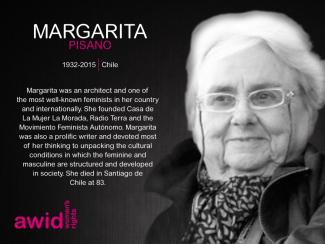
Mereani Naisua Senibici, also called ‘Sua’, was a longstanding member of the Fiji Young Women’s Christian Association (YWCA) movement.
She worked with diverse groups of women in multi-racial, rural and urban settings and was committed to supporting and promoting women’s and young women’s rights.
In the Lautoka YWCA, she worked with women of Indian descent, and was a leading figure in the sports development and participation of women and of trans athletes in Lautoka.
“Sua is greatly loved by Fiji YWCA members for her dedication and long-time support towards all that the organisation endeavoured to do.” - Tupou Vere
Mereani was part of the House of Sarah (HoS), an initiative of the Association of Anglican Women (AAW), launched in 2009 and aimed at raising awareness of the issues around gender-based violence, as well as providing support to women who face violence. She started as a dedicated volunteer and offered support to women throughout the Pacific.
“A people’s person and an all-rounder in women's empowerment and movement work at community level. Rest in Peace, Sua.” - Tupou Vere

por Sophia Armen
Guste o no, lxs férrexs ungerhouis han sido parte esencial de nuestras historias de resistencia y están aquí para quedarse. (...)
Consideramos a Taipéi como el mejor lugar de la región Asia-Pacífico para construir ese espacio seguro y rebelde destinado a nuestra comunidad feminista global.
Taipéi ofrece un cierto grado de estabilidad y seguridad para la diversidad de participantes que convocamos al Foro. Tiene también capacidad logística, y resulta accesible para muchxs viajerxs (con la facilitación de un trámite de visa electrónico para conferencias internacionales).
El Foro es bien recibido por el movimiento feminista local, que está muy interesado en interactuar con feministas de todo el mundo.