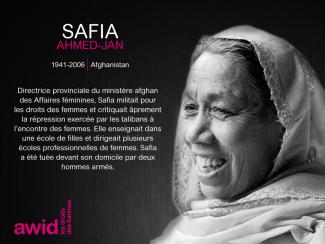
Safia Ahmed-Jan

WHRDs are self-identified women and lesbian, bisexual, transgender, queer and intersex (LBTQI) people and others who defend rights and are subject to gender-specific risks and threats due to their human rights work and/or as a direct consequence of their gender identity or sexual orientation.
WHRDs are subject to systematic violence and discrimination due to their identities and unyielding struggles for rights, equality and justice.
The WHRD Program collaborates with international and regional partners as well as the AWID membership to raise awareness about these risks and threats, advocate for feminist and holistic measures of protection and safety, and actively promote a culture of self-care and collective well being in our movements.
WHRDs are exposed to the same types of risks that all other defenders who defend human rights, communities, and the environment face. However, they are also exposed to gender-based violence and gender-specific risks because they challenge existing gender norms within their communities and societies.
We work collaboratively with international and regional networks and our membership
We aim to contribute to a safer world for WHRDs, their families and communities. We believe that action for rights and justice should not put WHRDs at risk; it should be appreciated and celebrated.
Promoting collaboration and coordination among human rights and women’s rights organizations at the international level to strengthen responses concerning safety and wellbeing of WHRDs.
Supporting regional networks of WHRDs and their organizations, such as the Mesoamerican Initiative for WHRDs and the WHRD Middle East and North Africa Coalition, in promoting and strengthening collective action for protection - emphasizing the establishment of solidarity and protection networks, the promotion of self-care, and advocacy and mobilization for the safety of WHRDs;
Increasing the visibility and recognition of WHRDs and their struggles, as well as the risks that they encounter by documenting the attacks that they face, and researching, producing, and disseminating information on their struggles, strategies, and challenges:
Mobilizing urgent responses of international solidarity for WHRDs at risk through our international and regional networks, and our active membership.
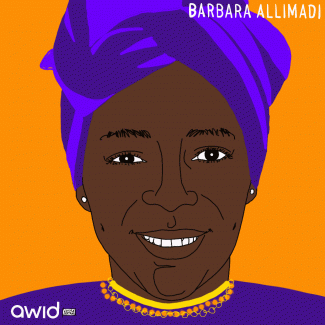
Barbara Allimadi était une militante politique et des droits humains originaire d’Ouganda. En 2012, elle a coorganisé une manifestation contre l’agression policière télévisée d’Ingrid Turinawe, opposante politique dont le sein a été pressé par un officier de police. Durant la manifestation, Barbara et d’autres activistes se sont déshabillées et n’ont gardé que leur soutien-gorge devant le poste central de police de Kampala. Cet épisode fut par la suite désigné par la tristement célèbre « manifestation en soutien-gorge » en Ouganda.
« Nous avons opté pour une manifestation en soutien-gorge. Nous avons pensé qu’elle serait la plus appropriée par rapport aux faits. Ce n’est pas comme si nous étions en train de dire que nous ne nous respections pas. Nous étions dégoûtées par les actes commis. » - Barbara Allimadi, 2013 (Daily Monitor)
Diplômée en électronique et en ingénierie des communications de l’Université métropolitaine de Londres, Barbara était ingénieure réseau au Royaume-Uni et une fervente amatrice de musique reggae. Elle retourna en Ouganda en 2007, au moment du décès de sa mère.
En 2019, elle fut désignée Coordonnatrice pour les affaires internationales et la diaspora de l’Alliance for National Transformation (alliance pour la transformation nationale, ANT), un parti politique lancé la même année par un leader d’opposition.
« Nous voulons disposer d’une vie sûre et de biens, sans souffrance, sans blessure ni même de mort aux mains des forces de sécurité, qui sont censées nous protéger. Nous voulons surtout un environnement stable et propice dans lequel nous pourrons réaliser nos rêves et nos ambitions. » - Barbara Allimadi, vidéo de l’ANT
Barbara est décédée le 27 avril 2020.
« J’étais tellement fière de ma sœur pour plein de raisons, mais surtout pour sa recherche téméraire de la paix, de la démocratie, de la justice et de l’égalité en Ouganda. Au summum de son activisme, elle conduisait de nombreuses marches dans les rues de Kampala, jusqu’aux postes de police et au Parlement. » - Doris Allimadi, sœur de Barbara
« C’est avec une tristesse profonde que nous avons appris le décès précoce de Barbara Allimadi. Elle était une force vaillante, infatigable et courageuse pour le mouvement de libération en Ouganda. Nous adressons nos sincères condoléances à sa famille. Elle nous manquera terriblement. » - Akina Mama wa Afrika (tweet du 28 avril 2020)
« Le décès de Barbara est extrêmement triste pour nous, et pour toute sa famille. Elle s’est dévouée entièrement à lutter pour la justice, la liberté et les droits des autres, tout en servant la société civile jusqu’à sa récente adhésion au parti. » Maj Gen Mugisha Muntu, coordonnateur national de l’ANT
« Une soeur magnifique, charmante, drôle, charismatique et inspirante. Mes enfants ont perdu leur tante. L’Ouganda a perdu une combattante pour les libertés, brave et courageuse. Barbara disait autrefois “tant que vous pouvez respirer, continuez à agir pour atteindre vos rêves” » - Doris Allimadi, sœur de Barbara
By joining AWID, you are becoming part of worldwide feminist organizing, a collective power that is rooted in working across movements and is based on solidarity.
Join AWID as an individual for free
Join AWID as an individual by paying a nominal amount
Los movimientos feministas necesitan financiamiento básico y de largo plazo (incluidos ahorros y reservas) para poder mantenerse focalizados en el cambio sistémico. Las reservas no son algo extra: son esenciales para la sostenibilidad.
We are in communication with regional, thematic and funder convenings planned for 2023-2024, to ensure flow of conversations and connections. If you are organizing an event and would like to make a connection to the AWID Forum, please get in touch with us!
Vous souhaitez vous rassembler pour renforcer les résistances ? Cette méthodologie de formation propose des exercices de groupes qui renforcent les connaissances et le pouvoir du collectif, avec des adaptations pour répondre à vos besoins.
Esta política rige para todas las páginas alojadas en https://www.awid.org/ y para cualquier otro sitio web bajo el control de AWID (el «Sitio web») y para las suscripciones a estos sitios. No se aplica a páginas alojadas por otras organizaciones distintas a AWID, hacia las cuales podemos dirigir un hipervínculo y cuyas políticas de privacidad pueden ser diferentes. Por favor, lee la siguiente política para que puedas comprender nuestra política de privacidad en cuanto a su naturaleza, propósito, uso y divulgación de tu información personal e identificable que es recogida a través de este sitio web.
En general, puedes navegar este sitio web sin enviarnos información personal. Sin embargo, en algunas circunstancias, te pediremos esa información personal.
Cuando te encuentras en el sitio web y se te pide información personal, estás compartiendo esa información sólo con AWID.
1.1.1 La información que nos das para recibir actualizaciones de AWID:
Cuando te registras para usar el sitio (por ejemplo, te suscribes para recibir correos electrónicos o para solicitar membresía) nos das la información necesaria acerca de ti, como tu nombre, país, idioma, para recibir actualizaciones por correo electrónico. Nos das esta información a través de formularios seguros y es almacenada en servidores seguros.
1.1.2 La información de pago que nos das para hacerte miembrx o para anotarte en algún evento:
Además, puede ser necesario que nos des información sobre el pago cuando te haces miembrx o cuando te anotas para eventos. AWID no almacena en sus servidores ninguna información relativa a tarjetas de crédito y usa portales seguros para procesar la información relativa a pagos.
1.1.3 La información opcional que decidiste darnos (con consentimiento)
Cuando te comunicas con AWID o nos das información opcional a través de formularios en el sitio web o utilizas el sitio para comunicarte con otrxs miembrxs, recogemos información sobre tu comunicación y cualquier otra información que elijas dar.
1.1.4 Información que nos das a través de los formularios de contacto o cuando te comunicas directamente con nosotrxs
Cuando te comunicas con nosotrxs, recogemos tu comunicación y toda otra información que decidas darnos.
Además, cuando interactúas con el Sitio web, nuestros servidores pueden llevar un registro de actividad que no te identifica personalmente («Información no personal»). Por lo general, recogemos las siguientes categorías de información no personal:
Para más información sobre las cookies, por favor consulta All about cookies.
Si no deseas recibir cookies puedes cambiar fácilmente tu navegador web para que rechace las cookies o notificarte cuando recibes una nueva cookie. Puedes mirar aquí cómo hacerlo.
AWID utiliza la información que recogemos acerca de ti para:
Si te has subscrito a los boletines electrónicos de AWID o a nuestras actualizaciones por correo electrónico o si te has hecho miembrx, te enviaremos comunicaciones regularmente en la forma especificada en el área correspondiente del sitio web. Puedes cancelar la suscripción de cualquiera de los boletines electrónicos o actualizaciones de correo electrónico en cualquier momento siguiendo los pasos indicados para ello en nuestros correos.
Es importante para AWID que tu información de identificación individual sea precisa. Siempre estamos buscando cómo hacer más fácil que puedas revisar y corregir la información que AWID tiene acerca de ti en nuestro sitio web. Si cambias tu dirección de correo electrónico, o si cualquier otra información que tengamos es incorrecta o desactualizada, por favor escríbenos a esta dirección.
Con excepción de lo explicado más abajo, AWID no revelará ninguna información personal acerca de ti que sea identificable, y no venderá ni alquilará a tercerxs listados conteniendo tu información. AWID podrá revelar información cuando tenga tu permiso para hacerlo o bajo circunstancias especiales, por ejemplo cuando crea de buena fe que la ley se lo exige.
De manera permanente implementamos y actualizamos las medidas administrativas, técnicas y de seguridad física para proteger tu información de accesos no autorizados, pérdida, destrucción o alteración. Algunas de las salvaguardas que usamos para proteger tu información son cortafuegos, encriptación de datos y controles de acceso a la información. Si sabes o tiene razones para creer que tus credenciales de membresía a AWID se han perdido, han sido robadas, malversadas o comprometidas de alguna forma o en caso de que sepas o sospeches de uso no autorizado de tu cuenta de membresía a AWID, por favor ponte en contacto con nosotrxs a través de nuestra página.
Esta política puede cambiar periódicamente. La política modificada será publicada en este sitio web y al final del texto se actualizará la fecha de Última actualización. Se enviará un correo electrónico con la actualización de la política revisada y si no estás de acuerdo con ella tendrás la opción de cancelar tu suscripción o suscripciones con nosotrxs. También puedes escribirnos aquí. ¡Agradecemos tus opiniones!
Última actualización: mayo de 2019
Cómo los movimientos resisten las agendas fascistas en relación con el cambio climático.
📅 Martes 11 de noviembre de 2025
📍 Hotel Beira Rio, Belém, Pará
Tan pronto como podamos, compartiremos información sobre el programa, los espacios y la forma en que todo el mundo puede participar en su construcción, en camino hacia el Foro y durante el Foro. Sigue con atención las actualizaciones.
Alors que le capitalisme hétéropatriarcal s’acharne à nous contraindre au consumérisme et à la conformité, nous constatons que nos luttes sont cloisonnées et séparées par des frontières aussi bien physiques que virtuelles.
Avec les défis supplémentaires d’une pandémie mondiale à surmonter, cette stratégie du « diviser pour mieux régner » a favorisé l’expansion de l’exploitation dans de nombreux domaines.
Malgré tout, du 1er au 30 septembre 2021, le festival Crear | Résister | Transform : un festival dédié aux mouvements féministes ! de l’AWID nous a emmené·e·s à la découverte de ce que cela signifiait d’incarner nos réalités dans des espaces virtuels. Lors du festival, des activistes féministes du monde entier se sont réuni·e·s non seulement pour partager des expériences de libertés, de résistances et de solidarités transfrontalières durement gagnées, mais aussi pour exprimer ce à quoi pourrait ressembler une forme transnationale d’unité.
C’est précisément cette unité qui a le potentiel de dépasser les frontières, permettant de tisser une vision de l’avenir qui est transformatrice parce qu’abolitionniste et anticapitaliste. À travers des infrastructures numériques que nous avons investies avec notre queerness, notre résistance et nos imaginaires, le festival a présenté un moyen de se détourner des systèmes qui nous rendent complices de l’oppression des autres et de nous-mêmes.
Si Audre Lorde nous a appris que « les outils du maître ne détruiront jamais la maison du maître », Sara Ahmed nous a montré en revanche que nous pouvons en faire mauvais usage. Le fait d’avoir à créer un espace de rassemblement, en dépit de toutes les autres contraintes pesant sur nos emplois du temps, nous a permis d’imaginer une façon de rompre avec la réalité du capitalisme hétéropatriarcal.
Maintenant, si nous comprenons le rassemblement comme une forme de plaisir, il devient alors possible de faire le lien entre le plaisir transgressif et la résistance transnationale/transdigitale; entre les types de plaisir qui bousculent les frontières d’une part, et la queerness, la théâtralité, la lutte pour la terre et les autochtones, l’anticapitalisme et l’organisation anticoloniale d’autre part.
La présente édition a tenté de donner une idée de la manière dont l’exercice de rassemblement du festival a revêtu de multiples formes et imaginations. Au-delà des collaborations directes avec certain·e·s de ses orateurices et rêveur·se·s, nous avons fait appel à une pléthore d’autres voix du Sud mondial pour aborder plusieurs de ces sujets et thématiques. Vous trouverez ci-dessous une carte de certains des panels du festival qui nous ont le plus inspiré·e·s.

En tant que mouvements féministes et mouvements pour les droits des travailleur·euses, nous articulons en solidarité les points suivants dans le cadre d’une vision collective des économies des soins qui plaçant les travailleuses domestiques au centre
Le travail domestique et des soins est sur le devant de la scène depuis la pandémie de COVID-19, car il a permis à tout le monde de continuer à fonctionner pendant les crises mondiales. La Banque Mondiale, le Fond Monétaire International et autres institutions multilatérales reconnaissent également l’importance du travail des soins et domestique dans la pérennisation de l’économie. Cette attention répond cependant généralement à une approche instrumentale - dans laquelle le travail des soins soutient l’économie « productive » - centrée sur la réalisation de profits, qui ne reconnaît pas les soins comme un droit humain et un bien public et ne prend pas en compte les travailleuses qui assurent une grande partie du labeur.
Manifestations mondiales des mouvements pour la justice climatique.
📅 Samedi 15 novembre 2025
📍 Lieux multiples
Site web en anglais

“My mission in life is not merely to survive, but to thrive; and to do so with some passion, some compassion, some humor, and some style.” - Maya Angelou
The AWID International Forum is both a global community event and a space of radical personal transformation. A one-of-a-kind convening, the Forum brings together feminist, women’s rights, gender justice, LBTQI+ and allied movements, in all our diversity and humanity, to connect, heal and thrive. The Forum is a place where Global South feminists and historically marginalized communities take center stage, strategizing with each other and allied movements, funders and policy-makers, in order to shift power, make alliances, and usher in a different, better world.
When people come together on a global scale, as individuals and movements, we generate a sweeping force. Join us in Bangkok, Thailand in 2024. Come dance, sing, dream and rise with us.
When: 2–5 December 2024
Where: Bangkok, Thailand; and online
Who: Approximately 2,500 feminists from all over the world participating in-person, and 3,000 participating virtually
Learn more about the forum:
Read our Frequently Asked Questions
with Naike Ledan and Fédorah Pierre-Louis.

La Construcción de Economías Feministas se trata de crear un mundo con aire limpio para respirar y agua limpia para beber, con trabajo significativo y cuidado para nosotrxs y nuestras comunidades, donde todxs podamos disfrutar de nuestra autonomía económica, sexual y política.
En el mundo en que vivimos hoy, la economía sigue dependiendo del trabajo de cuidado no remunerado o subvalorado que realizan las mujeres para ganancia de otrxs. La búsqueda del «crecimiento» solo expande el extractivismo, un modelo de desarrollo basado en la extracción y explotación masiva de los recursos naturales que sigue destruyendo a las personas y al planeta mientras concentra la riqueza en manos de las elites globales. Mientras tanto, el acceso a la salud, a la educación, a un salario digno y a la seguridad social se están convirtiendo en el privilegio de pocxs. Este modelo económico se asienta sobre la supremacía blanca, el colonialismo y el patriarcado.
Adoptar solamente un «enfoque de empoderamiento económico de las mujeres» es solo integrar aún más a las mujeres a este sistema. Ese ‘empoderamiento’ puede ser un medio temporal de supervivencia, pero debemos plantar las semillas que hagan que otro mundo sea posible mientras derribamos los muros del que ya existe.
Creemos en la capacidad de los movimientos feministas de trabajar para el cambio con alianzas amplias que atraviesen distintos movimientos sociales. Al amplificar las propuestas y visiones feministas, nuestro objetivo es construir nuevos paradigmas para economías justas.
Nuestro enfoque debe ser interconectado e interseccional, porque la autonomía sexual y corporal no será posible hasta que todxs y cada unx de nosotrxs disfrute de sus derechos e independencia económicos. Queremos trabajar con quienes resisten y enfrentan el auge mundial de la derecha conservadora y de los fundamentalismos religiosos, porque no es posible ninguna economía justa hasta que no hagamos crujir las bases del actual sistema.
Promovemos agendas feministas: Enfrentamos al poder corporativo y su impunidad por los abusos de derechos humanos trabajando con aliadxs. Así nos asegurarnos de llevar a los espacios de decisión política las perspectivas feministas, de derechos de las mujeres y de justicia de género. Un ejemplo sobre el que puedes leer más es nuestro trabajo sobre el futuro instrumento legalmente vinculante sobre las «corporaciones transnacionales y otras empresas comerciales con respecto a los derechos humanos», en el Consejo de Derechos Humanos de las Naciones Unidas.
Movilizamos acciones solidarias: Trabajamos para fortalecer los vínculos entre los movimientos feministas y por la justicia impositiva, incluyendo el reclamo de que los recursos públicos perdidos a través de los flujos financieros ilícitos (IFFs, por sus siglas en inglés) sean usados para asegurar la justicia social y de género.
Construimos conocimiento: Brindamos a las defensoras de derechos humanos información estratégica que es vital para enfrentar el poder corporativo y el extractivismo. Contribuiremos a construir conocimiento acerca del financiamiento local y global para el extractivismo,y los mecanismos de inversión que lo sostienen.
Creamos y difundimos alternativas: Movilizamos a nuestra membresía y a los movimientos imaginando de manera colectiva economías feministas, y compartiendo conocimientos, prácticas y agendas feministas por la justicia económica.
«La revolución corporativa va a colapsar si nos rehusamos a comprar lo que están vendiendo: sus ideas, su versión de la historia, sus guerras, sus armas, su idea de inevitabilidad. Otro mundo no solo es posible, sino que está en camino. En los días tranquilos, puedo oírlo respirar».
Arundhati Roy, War Talk.
The Forum theme––Rising Together––is an invitation to engage with our whole selves, to connect with each other in focused, caring and brave ways, so that we can feel the heartbeat of global movements and rise together to meet the challenges of these times.
Feminist, women’s rights, gender justice, LBTQI+ and allied movements around the world are at a critical juncture, facing a powerful backlash on previously-won rights and freedoms. Recent years have brought the rapid rise of authoritarianisms, the violent repression of civil society and criminalization of women and gender-diverse human rights defenders, escalating war and conflict in many parts of our world, the continued perpetuation of economic injustices, and the intersecting health, ecological and climate crises.
Our movements are reeling and, at the same time, seeking to build and maintain the strength and fortitude required for the work ahead. We can't do this work alone, in our silos. Connection and healing are essential to transforming persistent power imbalances and fault lines within our own movements. We must work and strategize in interconnected ways, so that we can thrive together. The AWID Forum fosters that vital ingredient of interconnectedness in the staying power, growth and transformative influence of feminist organizing globally.