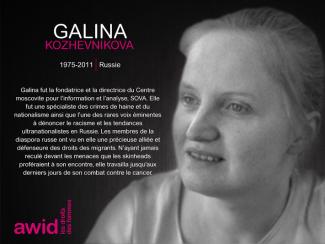
Galina Kozhevnikova

WHRDs are self-identified women and lesbian, bisexual, transgender, queer and intersex (LBTQI) people and others who defend rights and are subject to gender-specific risks and threats due to their human rights work and/or as a direct consequence of their gender identity or sexual orientation.
WHRDs are subject to systematic violence and discrimination due to their identities and unyielding struggles for rights, equality and justice.
The WHRD Program collaborates with international and regional partners as well as the AWID membership to raise awareness about these risks and threats, advocate for feminist and holistic measures of protection and safety, and actively promote a culture of self-care and collective well being in our movements.
WHRDs are exposed to the same types of risks that all other defenders who defend human rights, communities, and the environment face. However, they are also exposed to gender-based violence and gender-specific risks because they challenge existing gender norms within their communities and societies.
We work collaboratively with international and regional networks and our membership
We aim to contribute to a safer world for WHRDs, their families and communities. We believe that action for rights and justice should not put WHRDs at risk; it should be appreciated and celebrated.
Promoting collaboration and coordination among human rights and women’s rights organizations at the international level to strengthen responses concerning safety and wellbeing of WHRDs.
Supporting regional networks of WHRDs and their organizations, such as the Mesoamerican Initiative for WHRDs and the WHRD Middle East and North Africa Coalition, in promoting and strengthening collective action for protection - emphasizing the establishment of solidarity and protection networks, the promotion of self-care, and advocacy and mobilization for the safety of WHRDs;
Increasing the visibility and recognition of WHRDs and their struggles, as well as the risks that they encounter by documenting the attacks that they face, and researching, producing, and disseminating information on their struggles, strategies, and challenges:
Mobilizing urgent responses of international solidarity for WHRDs at risk through our international and regional networks, and our active membership.
with Dr. Vandana Shiva, Dr. Dilar Dirik, and Nana Akosua Hanson.
La encuesta está orientada a agrupaciones, organizaciones y movimientos que trabajan específica o primordialmente por los derechos de las mujeres, las personas LBTQI+ y la justicia de género, en todos los contextos, en todos los ámbitos y en todas las regiones. Si alguno de estos es el pilar fundamental de tu agrupación, colectivo, red o cualquier otro tipo de organización —ya sea que esté registrada, sea de reciente creación o de larga data—, te invitamos a responder la encuesta.

*En esta oportunidad, no estamos solicitando respuestas de individuos ni de fondos feministas o de mujeres.
Obtén más información sobre la encuesta:
Consultar las preguntas frecuentes
Como movimientos feministas y sindicales, juntxs en solidaridad, articulamos los siguientes puntos como una visión colectiva de las economías de los cuidados con los derechos de lxs trabajadorxs domésticxs como eje central.
El trabajo doméstico y de cuidado estuvo en la primera línea de fuego durante y después de la pandemia de COVID-19, al proporcionar los medios para sobrellevar las múltiples crisis globales que se intersectan. El Banco Mundial, el Fondo Monetario Internacional y otras instituciones multilaterales también reconocen la importancia del trabajo doméstico y de cuidados para el sostenimiento de la economía. Sin embargo, vemos que esta atención adopta un enfoque utilitarista (es decir, el trabajo de cuidados contribuye a sostener a la economía "productiva") centrado en el lucro, sin reconocer los cuidados como un derecho humano y un bien público, ni prestar atención a lxs trabajadorxs que realizan la mayor parte de este trabajo.
Nuevo
Como participante en línea, puedes facilitar actividades, conectarte y conversar con otras personas, y experimentar de primera mano la creatividad, el arte y la celebración del Foro de AWID. Lxs participantes que se conecten en línea disfrutarán de un programa rico y diverso: desde talleres y conversaciones hasta actividades de sanación y espectáculos musicales. Algunas actividades estarán centradas en la conexión entre participantes en línea, y otras serán verdaderamente híbridas, centradas en la conexión y la interacción entre lxs participantes en línea y quienes estén en Bangkok.

Desde siempre el feminismo sostiene que lo personal es político. El Festival Crear, Resister, Transform generó espacios en los que el feminismo pudo discutir las cuestiones relativas al cuerpo, el género y las sexualidades, y analizar las interconexiones de estos asuntos entendidos como experiencias profundas del cuerpo y, a la vez, un terreno en los que los derechos están en constante disputa y riesgo en la sociedad.
El poder de los movimientos feministas radica en el modo de organizarnos y emprender acciones coordinadas, no solo en nuestras propias comunidades y movimientos, sino también con otras causas y grupos aliados por la justicia social. El espacio brindó la oportunidad de que los movimientos compartieran y reforzaran los procesos de organización y las estrategias tácticas de forma mutua.
La pandemia mundial sanitaria del COVID-19 ha puesto de manifiesto como nunca antes el fracaso del capitalismo neoliberal, expuesto las fallas de nuestros sistemas y acentuado la necesidad de construir nuevas realidades y las oportunidades para ello. Una recuperación económica y social feminista exige el trabajo conjunto. Esta edición, en alianza con Kohl: una publicación para la investigación sobre cuerpo y género, analizará soluciones, propuestas y realidades feministas para transformar nuestro mundo actual, nuestros cuerpos y nuestras sexualidades.
Puedes explorar los artículos en línea o
Descargar en PDF
To claim your power as an expert on the state of resourcing for feminist movements
Building Feminist Economies is about creating a world with clean air to breath and water to drink, with meaningful labour and care for ourselves and our communities, where we can all enjoy our economic, sexual and political autonomy.
In the world we live in today, the economy continues to rely on women’s unpaid and undervalued care work for the profit of others. The pursuit of “growth” only expands extractivism - a model of development based on massive extraction and exploitation of natural resources that keeps destroying people and planet while concentrating wealth in the hands of global elites. Meanwhile, access to healthcare, education, a decent wage and social security is becoming a privilege to few. This economic model sits upon white supremacy, colonialism and patriarchy.
Adopting solely a “women’s economic empowerment approach” is merely to integrate women deeper into this system. It may be a temporary means of survival. We need to plant the seeds to make another world possible while we tear down the walls of the existing one.
We believe in the ability of feminist movements to work for change with broad alliances across social movements. By amplifying feminist proposals and visions, we aim to build new paradigms of just economies.
Our approach must be interconnected and intersectional, because sexual and bodily autonomy will not be possible until each and every one of us enjoys economic rights and independence. We aim to work with those who resist and counter the global rise of the conservative right and religious fundamentalisms as no just economy is possible until we shake the foundations of the current system.
Advance feminist agendas: We counter corporate power and impunity for human rights abuses by working with allies to ensure that we put forward feminist, women’s rights and gender justice perspectives in policy spaces. For example, learn more about our work on the future international legally binding instrument on “transnational corporations and other business enterprises with respect to human rights” at the United Nations Human Rights Council.
Mobilize solidarity actions: We work to strengthen the links between feminist and tax justice movements, including reclaiming the public resources lost through illicit financial flows (IFFs) to ensure social and gender justice.
Build knowledge: We provide women human rights defenders (WHRDs) with strategic information vital to challenge corporate power and extractivism. We will contribute to build the knowledge about local and global financing and investment mechanisms fuelling extractivism.
Create and amplify alternatives: We engage and mobilize our members and movements in visioning feminist economies and sharing feminist knowledges, practices and agendas for economic justice.
“The corporate revolution will collapse if we refuse to buy what they are selling – their ideas, their version of history, their wars, their weapons, their notion of inevitability. Another world is not only possible, she is on her way. On a quiet day, I can hear her breathing”.
Arundhati Roy, War Talk

Apreciaremos propuestas de actividades referidas a todo el rango de áreas temáticas e intersecciones que son importantes para los movimientos feministas y por la justicia de género. En el formulario de propuesta podrás marcar más de un tema que se adecúe a tu actividad.
por Chinelo Onwualu
El 2 de septiembre de 2021 lxs increíbles activistas feministas y por la justicia social del festival Crear | Résister | Transform de AWID nos juntamos no solo para compartir estrategias, crear juntxs y transformar al mundo sino también para decir cosas sucias en Twitter.
 While funders committed significantly more money to gender equality over the last decade, still only 1% of philanthropic and development funding has actually been moved to directly resource feminist-led social change.
In solidarity with movements that continue to be invisibilized, marginalized and without access to core, long-term, flexible and trust-based funding, the WITM survey highlights the actual state of resourcing, challenges false solutions, and points to how funding models must change for movements to thrive and meet the complex challenges of our times.
Por primera vez, el Foro de AWID ofrece tres modos de participación:
Lxs participantes se reunirán en Bangkok, Tailandia. ¡No podemos esperar!

Tu veux cette ch*tte? Montre-moi ton doc. (Mais vraiment, où sont tes résultats de tests? En numérique ça ira.)
Provide AWID members, movement partners and funders with an updated, powerful, evidence-based, and action-oriented analysis of the resourcing realities of feminist movements and current state of the feminist funding ecosystem.
Identify and demonstrate opportunities to shift more and better funding for feminist organizing, expose false solutions and disrupt trends that make funding miss and/or move against gender justice and intersectional feminist agendas.
Articulate feminist visions, proposals and agendas for resourcing justice.