Cecilia Coicué
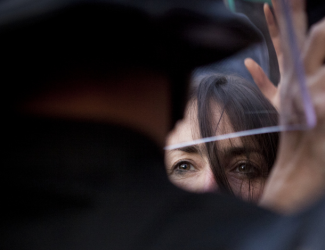
WHRDs are self-identified women and lesbian, bisexual, transgender, queer and intersex (LBTQI) people and others who defend rights and are subject to gender-specific risks and threats due to their human rights work and/or as a direct consequence of their gender identity or sexual orientation.
WHRDs are subject to systematic violence and discrimination due to their identities and unyielding struggles for rights, equality and justice.
The WHRD Program collaborates with international and regional partners as well as the AWID membership to raise awareness about these risks and threats, advocate for feminist and holistic measures of protection and safety, and actively promote a culture of self-care and collective well being in our movements.
WHRDs are exposed to the same types of risks that all other defenders who defend human rights, communities, and the environment face. However, they are also exposed to gender-based violence and gender-specific risks because they challenge existing gender norms within their communities and societies.
We work collaboratively with international and regional networks and our membership
We aim to contribute to a safer world for WHRDs, their families and communities. We believe that action for rights and justice should not put WHRDs at risk; it should be appreciated and celebrated.
Promoting collaboration and coordination among human rights and women’s rights organizations at the international level to strengthen responses concerning safety and wellbeing of WHRDs.
Supporting regional networks of WHRDs and their organizations, such as the Mesoamerican Initiative for WHRDs and the WHRD Middle East and North Africa Coalition, in promoting and strengthening collective action for protection - emphasizing the establishment of solidarity and protection networks, the promotion of self-care, and advocacy and mobilization for the safety of WHRDs;
Increasing the visibility and recognition of WHRDs and their struggles, as well as the risks that they encounter by documenting the attacks that they face, and researching, producing, and disseminating information on their struggles, strategies, and challenges:
Mobilizing urgent responses of international solidarity for WHRDs at risk through our international and regional networks, and our active membership.
En vous promenant dans le quartier du Raval à Barcelone, vous croiserez peut-être Metzineres, une coopérative féministe par et pour les femmes et personnes trans et non-binaires qui consomment de la drogue.
Imaginez un endroit sans stigmatisation, où les femmes et personnes trans et non-binaires peuvent consommer des drogues en toute sécurité. Un lieu qui offre sécurité, soutien et accompagnement aux femmes et personnes trans et non-binaires dont les droits sont systématiquement bafoués par la guerre contre la drogue et qui subissent violence, stigmatisation et répression en conséquence.
Juste à l'extérieur de l'entrée, les passant·es et les visiteur·euses sont accueilli·e·s par un immense tableau noir où figurent des conseils, des astuces, des souhaits et des dessins de personnes qui consomment de la drogue. Il existe également un calendrier qui présente une série d'activités auto-organisées par la communauté Metzineres. Qu'il s'agisse d'ateliers coiffure et cosmétique, des émissions radio, des pièces de théâtre, de repas communs offerts à la communauté ou des cours d'autodéfense, il y a toujours quelque chose à faire!
La coopérative offre des sites de consommation sûrs ainsi que des services qui couvrent les besoins de base des gens. Il y a des lits, des casiers, des douches, des toilettes, des machines à laver et une petite terrasse extérieure où les gens peuvent se détendre ou jardiner.
Metzineres opère dans un cadre de réduction des méfaits, qui tente de réduire les conséquences négatives de la consommation de drogue. Mais la réduction des méfaits est bien plus qu'un ensemble de pratiques: c'est une politique ancrée dans la justice sociale, la dignité et les droits des personnes qui consomment des drogues.

La encuesta está disponible en árabe, español, francés, inglés, portugués y ruso.
L’enquête WITM mondiale est un des piliers essentiels de la troisième édition de notre recherche orientée sur l’action, intitulée Où est l’argent pour l’organisation des mouvements féministes? (abrégé en Où est l’argent ou WITM, pour l’acronyme en anglais). Les résultats de l’enquête seront développés et approfondis à l’occasion de conversations profondes avec des activistes et des financeurs, et les références seront croisées avec d’autres analyses et études existantes sur la situation du financement des mouvements féministes et de l’égalité des genres à travers le monde.
Le rapport complet de la recherche Où est l’argent pour l’organisation des mouvements féministes sera publié en 2026.
 Pour en apprendre davantage sur la manière dont l’AWID met en lumière l’argent utilisé pour et contre les mouvements féministes, consultez notre dossier WITM et nos précédents rapports à ce sujet ici.
全球和區域的合作夥伴已就論壇會前會的一些想法與我們聯繫,我們將很快分享有關這些想法的更多信息。
由諮詢小組組織,AWID資助的2016年黑人女權主義論壇(BFF)湧現出許多美好的事物。BFF產生了一些獨立組織包括巴西的黑人女權組織。儘管今年我們不會再舉辦BFF,但我們仍致力於與有興趣繼續圍繞黑人女權主義組織開展工作的任何人分享一些重要的經驗。
Related content
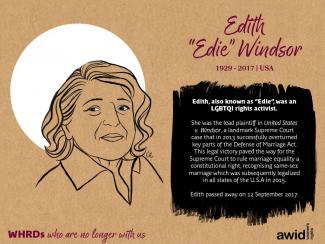
The Guardian: Edith Windsor, icon of gay rights movement, dies aged 88
Rolling Stone: Edith Windsor, Same-Sex Marriage Activist, Dead at 88
BBC: Edie Windsor: Gay rights trailblazer dies aged 88
The New Yorker: Postscript: Edith Windsor, 1929-2017
The Guardian: Goodbye, Edie Windsor. Thank you for never giving up
Love and Justice: Edith Windsor talks with Ariel Levy - The New Yorker Festival - The New Yorker (Video)
Remembering Edie Windsor (Video)

El objetivo fundamental de la encuesta ¿Dónde está el dinero? es arrojar luz sobre la situación financiera de la diversidad de movimientos feministas, por los derechos de las mujeres, la justicia social, las personas LBTQI+ y demás movimientos aliados de todo el mundo y, sobre la base de dicha información, reforzar las razones fundadas para movilizar más y mejores fondos y transferir el poder a los movimientos feministas.
An online community for and by young feminists working on women’s human rights, gender equality and social justice around the world.
The platform is the go-to place for information and resources on safeguarding the universality of rights in international and regional human rights spaces.
Provides funding for young feminist-led initiatives. It aims to strengthen the capacity of young feminist organizations to leverage resources for their work and to increase donors’ and allies’ commitments to resourcing young feminist activism.
A go-to site to learn about the urgent responses undertaken to protect women human rights defenders and to find tools and resources to support the work and wellness of WHRDs.
A regional initiative created to prevent, respond, document and make public all cases of violence against women human rights defenders in the Mesoamerican region.
The WHRD IC is a resource and advocacy network for the protection and support of women human rights defenders worldwide.
A Coalition of feminist, women´s rights, women´s development, grassroots and social justice organisations working to challenge and reframe teh global development agenda.
The role of the Women’s Major Group is to assure effective public participation of women’s non-governmental groups in the UN policy processes on Sustainable Development, Post2015 and Environmental matters.
An alliance of women’s organizations and networks to advocate for the advancement of gender equality, women’s empowerment and human rights in the Financing for Development (FfD) related UN processes.
第十四屆AWID國際論壇將於西元2021年9月20日至23日在台北举行。
Non, nous souhaitons recevoir une seule participation par groupe.
English article created from Spanish site