
Natalia Estemirova

WHRDs are self-identified women and lesbian, bisexual, transgender, queer and intersex (LBTQI) people and others who defend rights and are subject to gender-specific risks and threats due to their human rights work and/or as a direct consequence of their gender identity or sexual orientation.
WHRDs are subject to systematic violence and discrimination due to their identities and unyielding struggles for rights, equality and justice.
The WHRD Program collaborates with international and regional partners as well as the AWID membership to raise awareness about these risks and threats, advocate for feminist and holistic measures of protection and safety, and actively promote a culture of self-care and collective well being in our movements.
WHRDs are exposed to the same types of risks that all other defenders who defend human rights, communities, and the environment face. However, they are also exposed to gender-based violence and gender-specific risks because they challenge existing gender norms within their communities and societies.
We work collaboratively with international and regional networks and our membership
We aim to contribute to a safer world for WHRDs, their families and communities. We believe that action for rights and justice should not put WHRDs at risk; it should be appreciated and celebrated.
Promoting collaboration and coordination among human rights and women’s rights organizations at the international level to strengthen responses concerning safety and wellbeing of WHRDs.
Supporting regional networks of WHRDs and their organizations, such as the Mesoamerican Initiative for WHRDs and the WHRD Middle East and North Africa Coalition, in promoting and strengthening collective action for protection - emphasizing the establishment of solidarity and protection networks, the promotion of self-care, and advocacy and mobilization for the safety of WHRDs;
Increasing the visibility and recognition of WHRDs and their struggles, as well as the risks that they encounter by documenting the attacks that they face, and researching, producing, and disseminating information on their struggles, strategies, and challenges:
Mobilizing urgent responses of international solidarity for WHRDs at risk through our international and regional networks, and our active membership.
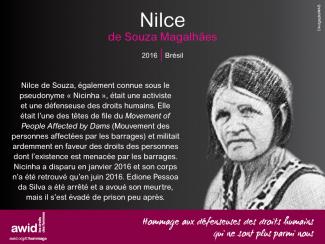
Cette année, nous rendons hommage à dix-neuf défenseuses des droits humains originaires de la région Amérique latine et Caraïbes. Parmi elles, seize ont été assassinées, dont six journalistes et quatre défenseuses des droits des personnes LGBT*QI. Nous vous invitons à vous joindre à nous pour commémorer la vie et le travail de ces femmes. Faites circuler les mèmes figurant ci-dessous auprès de vos collègues et amis ainsi que dans vos réseaux et twittez en utilisant les hashtags #WHRDTribute et #16Jours.
S'il vous plaît cliquez sur chaque image ci-dessous pour voir une version plus grande et pour télécharger comme un fichier


“Los saberes y prácticas indígenas siempre han apoyado la soberanía alimentaria, y ese saber está en manos de las mujeres […] El ecofeminismo para mí es el respeto por todo lo que tenemos a nuestro alrededor” -
AWID tiene un compromiso con la justicia lingüística y, en este punto, lamentamos no poder contar con más idiomas para la encuesta ¿Dónde está el dinero? Sin embargo, en caso de que necesites asistencia con la traducción o desees responder la encuesta en otro idioma, te pedimos que nos contactes al email witm@awid.org.

Este año, el Tributo Virtual honra a 7 defensoras de derechos humanos de la región de Asia meridional y Sudeste asiático. Son defensoras que han hecho aportes fundamentales para lograr avances en los derechos humanos y de las mujeres, los derechos de los pueblos indígenas y el derecho a la educación. Estas defensoras se desempeñaron como abogadas, activistas de derechos de las mujeres, académicas y políticas. Únete a AWID para conmemorar a estas defensoras de derechos humanos, su trabajo y su legado, compartiendo los memes aquí incluidos con tus colegas, amistades y redes; y tuiteando las etiquetas #WHRDTribute y #16Días.
Por favor, haz click en cada imagen de abajo para ver una versión más grande y para descargar como un archivo.


Un lieu de travail n'a pas à fonctionner sur la base de la concurrence et du profit. Un lieu de travail ne devrait pas exploiter les gens au profit d’autrui. C’est pourquoi les communautés marginalisées en dehors des économies formelles construisent des modèles coopératifs alternatifs basés sur l'autonomie, la coopération, la coresponsabilité, l'autogestion et la solidarité.
Les lieux de travail et coopératives autogérés par les travailleur·euses ont toujours offert d'autres moyens de générer des opportunités d'emploi, des revenus, une sécurité sociale et des épargnes, tout en distribuant les revenus de manière plus communautaire, durable et sûre.
Mais le coopérativisme c'est bien plus qu'une opportunité d'emploi: c'est la réalisation des rêves et la construction d’économies féministes basées sur la solidarité et l'entraide. C'est la création d’un monde où nos vies, notre travail et nos communautés comptent.
Voici l'histoire de la Coopérative Textile Nadia Echazú, la première coopérative créée et dirigée par et pour les personnes travesti et trans en Argentine.

Oui, nous voulons connaître votre situation, que vous ayez reçu du financement pendant une, deux ou les trois années de la période 2021–2023.
Antes de comenzar a aplicar la metodología de investigación WITM, es importante que te prepares y que sepas con qué te vas a encontrar.
Antes de implementar la metodología de investigación WITM de AWID, te recomendamos que leas el Manual completo.
Si bien el propósito de este Manual es democratizar las investigaciones sobre WITM, tu organización podrá usar esta metodología en la medida de su capacidad, es decir, sus recursos y experiencia en investigación.
Utiliza la Planilla «¿Estoy listx?» para evaluar en qué medida estás preparadx para comenzar la investigación WITM. Cuantas más preguntas de la planilla puedas responder, más preparadx estarás para embarcarte en la investigación.
Antes de comenzar cualquier investigación, te recomendamos evaluar los lazos que tiene tu organización con la comunidad y la confianza que ha generado en ella.
En muchos contextos, algunas organizaciones tal vez no quieran compartir abiertamente información financiera por distintos motivos que van desde la preocupación acerca de cómo se utilizará la información hasta el miedo frente a la «competencia» por el financiamiento o la ansiedad ante las restricciones cada vez mayores que impone el gobierno a las organizaciones de la sociedad civil.
Cuando desarrolles vínculos con otras organizaciones y te pongas en contacto con ellas de manera informal en el estadio previo a dar inicio a la investigación, ser clarx acerca de tus objetivos te ayudará a generar confianza. La transparencia permitirá que quienes participen en la investigación sepan por qué estás recogiendo información y qué beneficios podrá esperar la comunidad de tu trabajo.
Recomendamos asegurarte de que la información se recoja de manera confidencial, preservando el anonimato de quienes respondan. Esto permitirá que lxs participantes se sientan más cómodxs compartiendo información delicada contigo.
También recomendamos que consultes la Planilla «¿Estoy listx?» para evaluar tus avances.

Life expectancy of a trans and travesti person in Argentina is 37 years old - the average age for the general population is 77.

Absolutely. These questions are optional, we value your right to remain anonymous. Please fill the survey regardless of your decision to share the name and contact information of your group, organization and/or movement.
Related Content
Front Line Defenders: Ruth Alicia López Guisao killed
HRD Memorial: Ruth Alicia Lopez Guisao

Esta sección te guiará para garantizar que los resultados de la investigación sean representativos y confiables.
En esta sección:
- Recoge la información
1. Antes de difundir la encuesta
2. La presentación
3. Mientras la encuesta está abierta- Prepara la información para ser analizada
1. Limpia la información
2. Codifica las respuestas abiertas
3. Elimina la información innecesaria
4. Protege la información- Genera el informe de resultados
- Analiza la información
1. Programas estadísticos
2. Puntos sugeridos para el análisis
Si también piensas recoger información de las solicitudes que se envían a las financiadoras, este es un buen momento para ponerte en contacto con ellas.
Considera qué clase de solicitudes quieres analizar. El marco de investigación te ayudará a tomar esta decisión.
Tal vez no necesites ver todas las solicitudes enviadas a una financiadora en particular y te resulte más útil y eficiente consultar solo las que cumplen con los requisitos para ser financiadas (más allá de que finalmente las hayan apoyado o no).
También puedes pedirles a las financiadoras que compartan su información contigo.
Ver un modelo de carta para enviar a las financiadoras
Terminó el plazo para responder la encuesta y cuentas con mucha información. Lo que necesitas ahora es garantizar que sea lo más precisa posible.
Según el tamaño de la muestra y la cantidad de encuestas respondidas, este paso puede tomarte bastante tiempo. Para acelerar el proceso, lo mejor será contar con una buena cantidad de personas con capacidad de prestar atención a los detalles que se puedan encargar de esta tarea, garantizando así una mayor precisión en esta etapa.
Junto con las encuestas, probablemente también hayas recogido información de solicitudes enviadas a las financiadoras. Utiliza este mismo paso para organizar también esa información. No te desalientes si no puedes comparar estos dos conjuntos de datos entre sí. Las financiadoras recogen información que es diferente de la que tú habrás conseguido con las encuestas. En el informe y los productos finales sobre la investigación, podrás analizar y presentar por separado ambos conjuntos de información (la encuesta y la que te proporcionaron las financiadoras).
Existen dos clases de respuestas abiertas que requieren ser codificadas.
Preguntas con respuestas abiertas
Para estas preguntas, necesitarás codificar las respuestas para poder encontrar tendencias.
Algunos problemas que podrás enfrentar en este paso son los siguientes:
Si más de una persona analiza y codifica, tendrás que garantizar la consistencia de la codificación. Por eso recomendamos que incluyas solo una cantidad limitada de preguntas abiertas y que las estas pidan respuestas lo más concretas posibles.
Por ejemplo, si la pregunta abierta es «¿Qué desafíos específicos enfrentaste este año para movilizar recursos?» y algunas respuestas comunes son «falta de personal» o «la recesión económica», tendrás que codificar cada una de ellas para que puedas analizar cuántas veces fueron mencionadas.
Preguntas cerradas
Si ofreciste la posibilidad de agregar comentarios a las respuestas en preguntas cerradas, también necesitarás codificar esas respuestas.
Tal vez en varias preguntas de la encuesta hayas ofrecido la opción de «Otra», que muchas veces viene acompañada de un espacio en blanco para explicar la respuesta.
Tendrás que codificar esas respuestas y para esto dispones de dos opciones:
Analiza la frecuencia de los resultados
Para cada pregunta cuantitativa, puedes optar por eliminar el 5% o el 1% superior o inferior para impedir que los resultados se vean distorsionados por los valores atípicos*. También puedes controlar el efecto distorsionador de los valores atípicos* utilizando la mediana en lugar del promedio. Calcula la mediana ordenando las respuestas y luego eligiendo los valores que queden en el medio. Pero ten en cuenta que los valores atípicos tienen su utilidad. Pueden darte una idea del rango y la diversidad de participantes en la encuesta y tal vez te interese hacer estudios de caso en torno a algunos de esos valores atípicos.
* Los valores atípicos son puntos de referencia mucho mayores o mucho menores que la mayoría. Por ejemplo, imagina que vives en un barrio de clase media donde también vive una familia multimillonaria, y quieres averiguar cuál es el rango de ingresos para las familias de clase media en el barrio. Para eso, tendrás que eliminar el ingreso de la familia multimillonaria del conjunto de datos, porque se trata de un valor atípico. Si no lo haces, el promedio de ingresos de las familias de clase media que viven en el barrio aparecerá como mucho más elevado de lo que es en realidad.
Si encuentras respuestas de grupos que no corresponden a la población que quieres estudiar, elimina sus encuestas. En general puedes identificar a estos grupos por sus nombres o por sus respuestas a las preguntas cualitativas.
Para garantizar la confidencialidad de la información aportada por lxs participantes, en este paso puedes reemplazar los nombres de las organizaciones por un nuevo conjunto de números que identifiquen a cada organización y crear un archivo separado en el que figure la correspondencia entre cada código y la organización a la que identifica.
Junto con el equipo, decide cómo guardar y proteger el documento con los códigos y la información en general.
Una opción podría ser guardar toda la información en una computadora protegida por una clave o en un servidor al que solo pueda acceder el equipo de investigación.
En el informe con los principales resultados, detallarás los porcentajes de respuestas recibidas para cada pregunta de la encuesta. Esto te permite ver la suma total de respuestas.
Consejos:
Ahora que la información está limpia y ordenada, lo que sigue es entender su significado. Esta es la parte más entretenida, en la que comienzas a analizar tendencias.
¿Hay algún tipo de financiadora que se destaca (los gobiernos por encima de las empresas, por ejemplo)? ¿Hay regiones que están recibiendo más financiamiento? La información que recogiste te revelará algunos datos interesantes.
Las muestras más pequeñas (menos de 150 respuestas) las puede analizar la propia organización utilizando una planilla de Excel.
Las muestras más grandes (más de 150 respuestas) las puede analizar la propia organización utilizando Excel si solo van a calcular el total de respuestas, los promedios o cualquier otro análisis simple.
Si piensas hacer análisis más avanzados, como los de variables múltiples, te recomendamos utilizar programas estadísticos como SPSS, Stata o R.
NOTA: SPSS y Stata son caros, pero R es gratis.
Estos tres tipos de programas exigen conocimientos por parte del personal y no es fácil aprender rápido cómo usarlos.
Intenta conseguir pasantes o personal temporario de universidades locales. Muchxs estudiantes deben aprender análisis estadístico como parte de su carrera y tal vez tengan acceso gratuito a programas como SPSS o Stata a través de su universidad. Tal vez también conozcan el R, que se puede descargar y utilizar gratis.

• 1 persona (o más) de investigación
• Traductores de ofrecer encuesta en varios idiomas
• 1 persona (o más) para ayudar en la difusión de la encuesta a la población objetivo
• 1 persona (o más) para la análisis de los datos