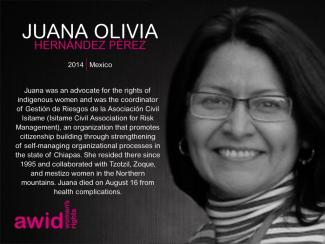
Juana Olivia Hernández Pérez
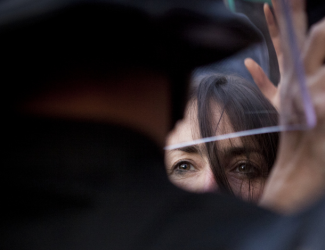
WHRDs are self-identified women and lesbian, bisexual, transgender, queer and intersex (LBTQI) people and others who defend rights and are subject to gender-specific risks and threats due to their human rights work and/or as a direct consequence of their gender identity or sexual orientation.
WHRDs are subject to systematic violence and discrimination due to their identities and unyielding struggles for rights, equality and justice.
The WHRD Program collaborates with international and regional partners as well as the AWID membership to raise awareness about these risks and threats, advocate for feminist and holistic measures of protection and safety, and actively promote a culture of self-care and collective well being in our movements.
WHRDs are exposed to the same types of risks that all other defenders who defend human rights, communities, and the environment face. However, they are also exposed to gender-based violence and gender-specific risks because they challenge existing gender norms within their communities and societies.
We work collaboratively with international and regional networks and our membership
We aim to contribute to a safer world for WHRDs, their families and communities. We believe that action for rights and justice should not put WHRDs at risk; it should be appreciated and celebrated.
Promoting collaboration and coordination among human rights and women’s rights organizations at the international level to strengthen responses concerning safety and wellbeing of WHRDs.
Supporting regional networks of WHRDs and their organizations, such as the Mesoamerican Initiative for WHRDs and the WHRD Middle East and North Africa Coalition, in promoting and strengthening collective action for protection - emphasizing the establishment of solidarity and protection networks, the promotion of self-care, and advocacy and mobilization for the safety of WHRDs;
Increasing the visibility and recognition of WHRDs and their struggles, as well as the risks that they encounter by documenting the attacks that they face, and researching, producing, and disseminating information on their struggles, strategies, and challenges:
Mobilizing urgent responses of international solidarity for WHRDs at risk through our international and regional networks, and our active membership.
Não. Tem por base a história de 20 anos da AWID de mobilizar mais financiamento de maior qualidade para mudanças sociais lideradas por feministas e é a terceira edição do nosso inquérito “Onde está o dinheiro para organização feminista?”. O nosso objetivo é repetir o inquérito WITM a cada 3 anos.

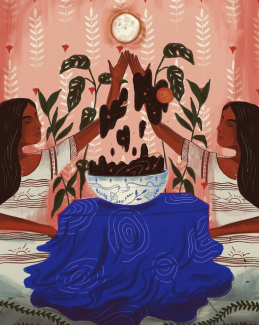
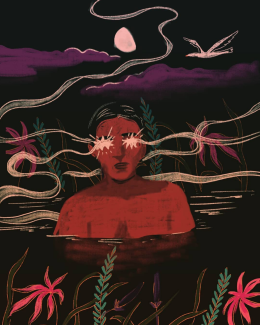
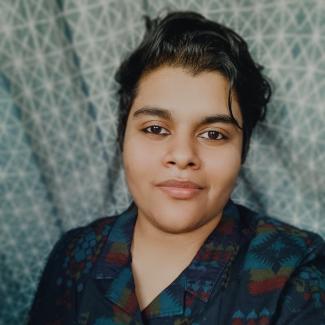
« C’[elle] était une personne qui se caractérisait par son travail acharné en faveur de la défense des droits humains et la construction de la paix à Nariño, notamment dans la municipalité de Samaniego-Nariño » - Jorge Luis Congacha Yunda pour Página10
Elle s’est concentrée sur les droits civils et politiques, les enjeux d’impunité et de justice, et a contribué à dévoiler les abus de pouvoir, dont la corruption. Elle a également participé à des projets de construction de la paix dans sa ville natale, Samaniego, comme le Conseil municipal pour la paix et le Bureau municipal de femmes.
Paula a reçu des menaces de mort après avoir exposé une gestion irrégulière des ressources, de même que porté plainte contre des actes de corruption au sein de l’Hôpital Lorencita Villegas dans la municipalité de Nariñense. Elle a été assassinée le 20 mai 2019, lorsque deux hommes se sont approchés d’elle et l’ont abattue à bout portant.
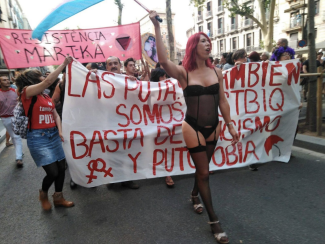
Linda Porn is yet another heroine of feminist union organizing and sex worker activism nationally (in Spain) and transnationally.
Originally from Mexico, she has been living in Spain since the 2000s. She is a sex worker, an activist, a single mother and a multidisciplinary artist. Drawing from these different identities, she uses performance, video art and theater to vizibilize struggles at the intersections of transfeminism, sex work, migration, colonialism and motherhood.
She combines art and sex work while caring for her daughter as a single mother.
Linda also belongs to sex workers collectives that fight for their rights, such as the OTRAS union and CATS Murcia. She also co-founded the group 'Madrecitas' - that visibilises and denounces racist institutional violence against migrant families. Violence to which she and her daughter were subjected as a sex worker and migrant single mother.
You can follow her art work here.
إن كانت لديكم/ن أسئلة أو أمور تثير قلقكم/ن، الرجاء التوجه الينا عن طريق هذا النموذج وكتابة "استطلاع أين المال" في العنوان أو راسلنا على witm@awid.org
El creciente poder de los actores anti-derechos no se está desarrollando en un vacío. Entender el auge del ultranacionalismo, del poder corporativo irrestricto, del incremento de la represión y de la disminución del espacio cívico resulta clave para contextualizar las amenazas anti-derechos que enfrentamos actualmente.

Hoy en día, una cantidad considerablemente mayor a la mitad de la población mundial está gobernada por líderes de extrema derecha. En este escenario, lxs defensorxs de derechos humanos y lxs feministas están trabajando arduamente para «mantenerse firmes» y proteger el multilateralismo y el sistema internacional de derechos humanos. También enfrentan el riesgo de que su compromiso acarree represalias violentas. Al mismo tiempo, estas instituciones están cada vez más sujetas a los intereses del sector privado. Las grandes empresas (en particular, las corporaciones transnacionales) están ocupando asientos en la mesa de negociación y posiciones de liderazgo en una gran cantidad de instituciones multilaterales, incluida la ONU. Este nexo de ultranacionalismo, espacio cívico restringido y captura corporativa está teniendo un tremendo impacto sobre la posibilidad de que, alguna vez, logremos obtener derechos humanos para todxs.
The AWID Forum will be organized around 6 interconnected topics. These ‘anchors’ center feminist realities.
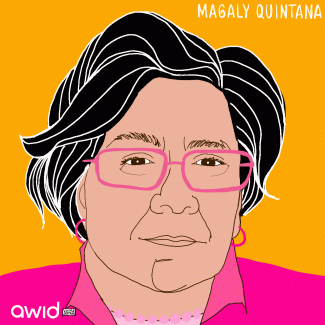
Magaly Quintana was known by many in Nicaragua as ‘La Maga’ (meaning wizard). She was a feminist historian, activist, and an unyielding defender of women’s rights demanding justice for the victims of femicide.
Magaly was committed to documenting and building statistics on women and girls who were killed as a result of sexual violence in the country.
“She rebuilt the life of each one, of their families, to show those lives that had been torn away.” - Dora María Téllez
Magaly also criticized the government for reforming Law 779 addressing violence against women. A product of the hard work of Nicaraguan women’s movements, this law included important provisions to criminalize femicide before its reform. She argued that legislative reforms weakened the law and limited the definition of femicides to homicides, as a result invisibilizing violent crimes against women.
Magaly’s feminist organizing began in the early 1980s. She was the director of Catholic Women for the Right to Choose, advocating for the right to therapeutic abortion after it was banned in 2006. In 2018, she supported the protests against Daniel Ortega’s government.
Magaly was born in May 1952 and passed away in May 2019.
“See you later, my dearest Magaly Quintana. Thanks so much, thanks for your legacy. We’ll see you again, as strong and powerful as ever.”- Erika Guevara Rosas (American Director of Amnesty International)

Are you job hunting? One of the perks of joining the AWID Community, is getting access to our community curated jobs board. You'll get to explore new opportunities, and you will also have the chance to share vacancies and call for proposals with all members.
Alors que les fondamentalismes, les fascismes et autres systèmes d’oppression se métamorphosent et trouvent de nouvelles tactiques et stratégies pour consolider leur pouvoir et influence, les mouvements féministes persévèrent et célèbrent leurs victoires nationales, régionales et internationales.
La [MB1] reconnaissance en 2019 par le Conseil des droits de l’Homme du droit à l’intégrité et à l’autonomie corporelles, par exemple, a marqué une étape cruciale. Des résolutions du Conseil sur la discrimination envers les femmes et les filles admettent cependant un recul lié à des groupes de pression rétrogrades, des conceptions idéologiques ou un détournement de la culture ou la religion pour s’opposer à l’égalité de leurs droits. Des avancées féministes sont aussi notées dans le travail des Procédures spéciales, qui soulignent notamment l’obligation des États de contrer les doctrines de l’idéologie du genre, rappellent à l’ordre les antidroits qui détournent des références à la « culture », et signalent que les convictions religieuses ne peuvent pas servir à justifier la violence ou la discrimination.
Janet Benshoof fue una abogada de derechos humanos de los Estados Unidos, y defensora de la igualdad de las mujeres y de los derechos sexuales y reproductivos.
Hizo campaña para ampliar el acceso a los anticonceptivos y al aborto en todo el mundo, y luchó contra las sentencias antiaborto y en el territorio estadounidense de Guam. Fue arrestada en 1990 por oponerse a la ley de aborto más restrictiva de su país. Sin embargo, obtuvo una medida cautelar en el tribunal local de Guam que bloqueó la ley y, finalmente, ganó en el Tribunal de Apelaciones del Noveno Circuito, que llevó a la anulación de la ley para siempre.
"Las mujeres de Guam están en una situación muy trágica. No tengo intención de callarme al respecto." - Janet Benshoof para la revista People.
Janet sentó precedentes jurídicos históricos, entre ellos, la aprobación de la anticoncepción de emergencia por parte de la Administración de Alimentos y Medicamentos de los Estados Unidos, así como la aplicación del derecho internacional para garantizar los derechos de las víctimas de violación en el Tribunal Superior de Iraq, durante el procesamiento de los crímenes de guerra de la época de Saddam.
Janet fue Presidenta y fundadora del Centro de Justicia Global, y fundadora también del Centro de Derechos Reproductivos, la primera organización internacional de derechos humanos del mundo centrada en la elección y la equidad reproductiva. Durante 15 años se desempeñó como directora del Proyecto de Derechos Reproductivos de la Unión Americana de Libertades Civiles, donde encabezó litigios que dieron forma a las leyes constitucionales de los Estados Unidos sobre igualdad de género, libertad de expresión y derechos reproductivos.
"Janet era conocida por su mente jurídica brillante, su agudo sentido del humor y su coraje ante la injusticia". - Anthony D. Romero
Nombrada una de las "100 Abogadas más influyentes de América" por el National Law Journal, Janet recibió numerosos premios y honores.
Nació en mayo de 1947 y falleció en diciembre de 2017.