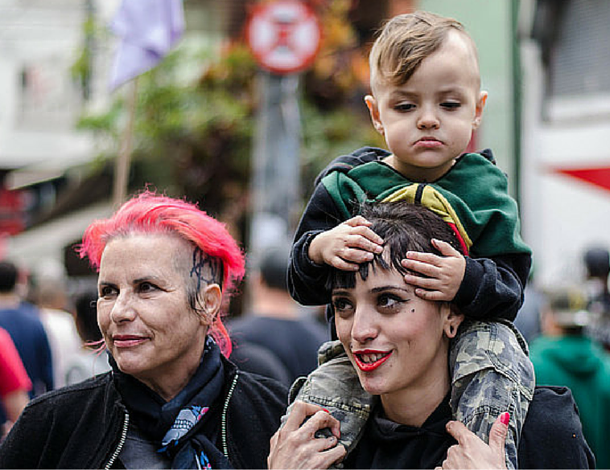
Flickr/Leonardo Veras (CC BY 2.0)

Special Focus

AWID is an international, feminist, membership organisation committed to achieving gender equality, sustainable development and women’s human rights

Protection of the Family

The Issue

Over the past few years, a troubling new trend at the international human rights level is being observed, where discourses on ‘protecting the family’ are being employed to defend violations committed against family members, to bolster and justify impunity, and to restrict equal rights within and to family life.

The campaign to "Protect the Family" is driven by ultra-conservative efforts to impose "traditional" and patriarchal interpretations of the family, and to move rights out of the hands of family members and into the institution of ‘the family’.

“Protection of the Family” efforts stem from:

  • rising traditionalism,
  • rising cultural, social and religious conservatism and
  • sentiment hostile to women’s human rights, sexual rights, child rights and the rights of persons with non-normative gender identities and sexual orientations.

Since 2014, a group of states have been operating as a bloc in human rights spaces under the name “Group of Friends of the Family”, and resolutions on “Protection of the Family” have been successfully passed every year since 2014.

This agenda has spread beyond the Human Rights Council. We have seen regressive language on “the family” being introduced at the Commission on the Status of Women, and attempts made to introduce it in negotiations on the Sustainable Development Goals.


Our Approach

AWID works with partners and allies to jointly resist “Protection of the Family” and other regressive agendas, and to uphold the universality of human rights.

In response to the increased influence of regressive actors in human rights spaces, AWID joined allies to form the Observatory on the Universality of Rights (OURs).  OURs is a collaborative project that monitors, analyzes, and shares information on anti-rights initiatives like  “Protection of the Family”.

Rights at Risk, the first OURs report, charts a map of the actors making up the global anti-rights lobby, identifies their key discourses and strategies, and the effect they are having on our human rights.   

The report outlines “Protection of the Family” as an agenda that has fostered collaboration across a broad range of regressive actors at the UN.  It describes it as: “a strategic framework that houses “multiple patriarchal and anti-rights positions, where the framework, in turn, aims to justify and institutionalize these positions.”


Related Content

Lina Ben Mhenni

« Je veux dire à tou·te·s les Tunisien·ne·s : Nous devons nous rassembler pour dire “non” à la censure et aux procès d’opinion. » - Lina Ben Mhenni (entretien de 2013)

Lina Ben Mhenni était une blogueuse, activiste et chargée de cours de linguistique tunisienne. Elle s’est exprimée haut et fort contre la censure sur Internet, a défendu la liberté d’expression ainsi que les droits des femmes et les droits humains. Lina s’est également battue pour la libération des étudiant·e·s arrêté·e·s sous l’ancien président Zine el-Abidine Ben Ali. 

« Un cyberactiviste doit aller sur le terrain, sentir ce que vivent les autres. On dit que la Révolution tunisienne est celle du Net, mais si elle n’était que ça, elle n’aurait jamais abouti ! » » Lina Ben Mhenni (article dans Ouest-France)

Elle a co-organisé en 2010 une manifestation en réaction à la suppression des médias et la censure sur Internet imposées par le gouvernement. Lina était très connue pour son blog « A Tunisian Girl » et son travail pendant la révolution tunisienne en 2011 était reconnu. Elle s’est servie de son blog pour transmettre des informations sur la révolte, partager des images documentant les manifestations, et a été parmi les rares voix qui s’élevèrent pour dénoncer les assassinats et la répression des manifestant·e·s à Sidi Bouzid. Lina était une des rares blogueuses à utiliser son vrai nom sur Internet, et non un pseudonyme pour protéger son identité. 

« Notre liberté d’expression est vraiment en danger. Je crains que nous ne soyons en train de perdre les fruits magnifiques de notre révolution : la disparition de la peur et la liberté d’expression. Nous devons continuer de nous battre pour protéger et préserver ce droit. » - Lina Ben Mhenni (entretien de 2013)

Lina n’avait que 36 ans lorsqu’elle est décédée, le 27 janvier 2020, de complications d’une maladie auto-immune. 

« La liberté, une meilleure éducation et la santé - c’est tout ce que nous voulions. Lorsque nous échouions, elle nous incitait à continuer. » Hala, l’institutrice de Lina.
 

Marzo 2015: se publica el Borrador Cero del Documento Final

Difusión del Borrador Cero del Documento Final

  • El Borrador Cero del documento (con fecha 16 de marzo), preparado por los facilitadores, fue difundido para su discusión durante la segunda sesión redactora a realizarse del 13 al 17 de abril de 2015.
  • Durante la sesión de apertura, el WWG pidió que se incorporara al Borrador Cero la asignación de recursos específicamente para la igualdad de género y el empoderamiento de las mujeres, tal como lo estipulan el Consenso de Monterrey y la Declaración de Doha.

sinppet-annual-budget-size-4-4

Key factors impacting 
budget size

→Region
→Level of organizing
→Registration status
→Priorities and Agendas


Read and download the insights here

What are the Forum languages?

AWID’s working languages are English, French and Spanish. Thai will be added as the local language, as well as sign language & other accessibility measures. Other languages may be added if funding permits, so check back regularly for updates. We care about language justice and will try to include as many languages as we can and as our resources allow. We hope to create multiple opportunities for many of us to be present in our languages and to communicate with each other.

Note des éditeurices | Des mots perdus

Note des éditeurices

Des mots perdus

Lorsque notre travail incarné devient un profit entre les mains de systèmes que nous cherchons à démanteler, il n’est pas étonnant que nos sexualités et nos plaisirs soient une fois de plus relégués à la marge – surtout lorsqu’ils ne sont pas assez rentables. À plusieurs reprises au cours de la production de ce numéro, nous nous sommes demandé ce qui se passerait si nous refusions de nous plier aux services essentiels du capitalisme. Mais pouvons-nous oser poser cette question, lorsque nous sommes épuisé·e·s par le monde? Peut-être que nos sexualités sont si facilement rejetées parce qu’elles ne sont pas considérées comme des formes de soins. Peut-être que ce dont nous avons besoin, c’est de réimaginer le plaisir comme une forme de soin radical – un soin qui est également anticapitaliste et anti-institutionnel.

En Savoir plus

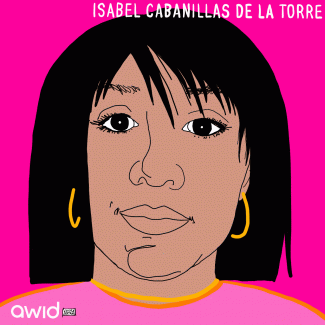
Isabel Cabanillas de la Torre

Isabel Cabanillas de la Torre was a much loved young feminist artist and activist from Ciudad Juárez, Mexico, known for her beautiful and evocative hand-painted clothing with eyes being an emblematic feature in her work. Her murals transformed the run down and vacant buildings in Ciudad Juarez’s downtown, bringing life and political commentary to their walls.

Through her art and political activism Isabel sought to draw attention to the gender based violence pervasive in her hometown. She volunteered with the women’s network Mesa de Mujeres on the Citizen Observatory on Gender to monitor the performance of judges, prosecutors and public defenders on cases of femicides and other gender based violations. She was also a member of Hijas de su Maquilera Madre, a feminist collective whose name makes reference to the daughters of mothers who are maquila workers. Some of these mothers were among the first victims of femicide in the city.

Isabel’s latest project, still in progress, was an art installation to protest a Canadian company that was looking to mine copper in the Samalayuca Desert. 

On 18 January, 2020 Isabel was shot while riding her bike back home in Downtown Juárez, in what appeared to be a targeted killing, her body found beside her bike.

Isabel’s murder, sparked a new wave of outrage against femicides in the region, hundreds marched to the US-Mexico border bridge, blocking it for hours and chanting “Ni una mas” (Not one more) as feminist collectives continue to protest the murders of women throughout Mexico. In 2019 alone, 3142 women and girls were killed in Mexico, many of whom were targeted specifically because of their gender.

She loved riding her bike.

"The bike for her was a symbol of freedom. A symbol of being free in the streets." - Marisol (a friend of Isabel’s)  

Qu’est-ce que le processus des Nations Unies sur le financement du développement ?

Le processus de l’Organisation des Nations Unies (ONU) sur le financement du développement (FdD) vise à traiter  différentes formes de financement du développement et de coopération pour le développement. Selon le Consensus de Monterrey, ce processus comporte six axes clés :

  • La mobilisation des ressources financières nationales au service du développement.
  • La mobilisation des ressources internationales au service du développement : investissements étrangers directs et autres flux financiers privés.
  • Le commerce international, comme moteur  du développement.
  • L’accroissement de la coopération financière et technique internationale pour le développement.
  • La dette extérieure.
  • L’examen des questions systémiques : amélioration de la cohérence et de la constance des systèmes monétaires, financiers et commerciaux internationaux en faveur du développement. 

WITM - Refreshed Intro Text (EN)

🚨Available in ENGLISH, FRENCH and SPANISH  🚨

Where is the Money? An Evidence-Driven Call to Resource Feminist Organizing

This new report shines a light on the resourcing realities of feminist and women’s rights organizations amid unprecedented political and financial upheaval. Drawing on over a decade of analysis since AWID last Where is the Money? report it takes stock of the gains, gaps, and growing threats in the funding landscape.

Download the report now!

ours 2021 - chapter 2 en

Chapter 2

Understanding the Context of Anti-Rights Threats

The rising power of anti-rights actors is not happening in a vacuum. Understanding the rise of ultra-nationalism, unchecked corporate power, growing repression, and diminishing civic space is key to contextualize the anti-rights threats we face today.

Read more

Snippet Kohl - Plénière | « Elle est en chemin » : Alternatives, féminismes et autre monde

Plénière | « Elle est en chemin » : Alternatives, féminismes et autre monde

Avec Dre Vandana Shiva, Dre Dilar Dirik et Nana Akosua Hanson..

YOUTUBE | SOUNDCLOUD (anglais)

Aïssata Kane

Aïssata Kane, también conocida afectuosamente como «Yaye Kadia»” [«Madre Kadia»], fue una feminista comprometida, durante toda su vida, con la defensa de los derechos de las mujeres africanas y, en especial, mauritanas.

En 1975 fue la primera mujer en ocupar el cargo de Ministra de Protección Familiar y Asuntos Sociales, puesto desde el cual Aïssata trabajó fervientemente para mejorar el estatus de las mujeres de su país.

Este trabajo incluyó el fomento de la educación de niñas y mujeres, la lucha contra la práctica de alimentación forzada de mujeres jóvenes, la incidencia para la inclusión de una legislación sobre derechos maritales, y la promoción de la creación de un cupo de representación femenino en el Parlamento.

«[Aïssata] materializaba todas sus pasiones con humildad, valentía y determinación. No quería molestar a nadie con su lucha en todos estos frentes simultáneos.» - Ball Halimata Dem, sobrina de Aïssata

Fundó la Unión Nacional de Mujeres de Mauritania (UNFM), creando y publicando con otras activistas Marienou, una revista dedicada a la emancipación de las mujeres mauritanas. Aïssata también dirigió varias organizaciones subregionales y locales, por ejemplo, como Presidenta de la Asociación Internacional de Mujeres Francófonas (AIFF) y, como firme ecologista, fue Presidenta de la Asociación para la Protección del Medio Ambiente de Mauritania (APEM).

En 2018, recibió el Premio a la Mujer Pionera, en honor a su trabajo para la promoción del estatus de las mujeres de Mauritania y como reconocimiento de su fuerte liderazgo y su sentido de la innovación.

Aïssata falleció el 10 de agosto de 2019.

Puis-je soumettre une proposition de session ?

L'appel à propositions est maintenant fermé.

Nous avons lancé un Appel à activités le 19 novembre 2019 et la date limite de réception des propositions était le14 février 2020.  

Trouvez d'autres moyens de vous engager sur le chemin du Forum

Snippet - COP30 - The People's Summit

The People's Summit

The climate summit by movements, for movements.

📅 November 12 - November 16, 2025
📍 Universidade Federal do Pará, Belém

More info here

CFA 2023 - Hubs - EN

New

Hubs: Cross-Border Space Travel

Participants will physically gather at a number of sites outside the Bangkok venue, in different parts of the world, on each day of the Forum. All of these self-organized sites will be virtually connected to the Forum venue in Bangkok. As with individuals connecting online, Hub participants will be able to facilitate activities, participate in conversations and enjoy a rich and diverse program.

Hub locations to be announced in 2024!

Snippet Kohl - Intro Arabic

التجسيدات العابرة للحدود

قضايا تتعلق بالجسد والجندر ومختلف أنواع الجنسانية، واستكشف الروابط المتشابكة بين القضايا هذه وكونها تجاربَ مجسّدة بعمق ومكانًا يُعترض فيه على الحقوق تكون فيه الأخيرة مهدّدة في المجتمع.

تكمن قوّة الحركات النسوية في طريقة تنظيمنا وتنسيق نشاطنا، ليس ضمن مجتمعاتنا وحركاتنا فحسب إنما بالتعاون مع قضايا ومجموعات حليفة في مجال العدالة الاجتماعية. وفّرت المساحة هذه فرصًا للحركات لمشاركة طرق التنظيم واستراتيجيات تكتيكية مع بعضنا البعض وتعزيزها.

لقد أوضحت جائحة كوفيد-١٩ العالمية فشل الرأسمالية النيوليبرالي فبدا أكبر من قبل وكشفت عن التفكك الموجود في أنظمتنا أكثر من أي وقت سابق، فشددت على ضرورة بناء أنواع واقع جديد وفرص بنائها. يتطلّب التعافي النسوي الاقتصادي والاجتماعي منّا جميعًا أن ننجح كلّنا معًا. نصدر النسخة هذه من المجلة بالشراكة مع «كحل: مجلة لأبحاث الجسد والجندر»، وسنستكشف عبرها الحلول والاقتراحات وأنواع الواقع النسوية لتغيير عالمنا الحالي وكذلك أجسادنا وجنسانياتنا.

يمكنك تصفح المقالات عبر الإنترنت أو
  قم بتنزيل ملف PDF

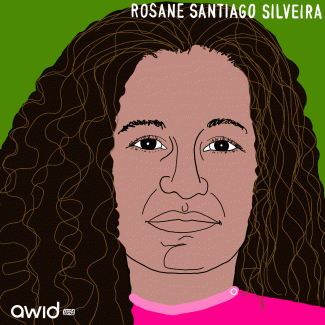
Rosane Santiago Silveira

Rosane Santiago Silveira, que l’on appelait affectueusement Rô Conceição, était une activiste brésilienne pour l’environnement et les droits humains qui se battait inlassablement pour protéger l’environnement, là où il était le plus menacé. 

Il pouvait entre autres s’agir de le défendre sur l’île de Barra Valha, mise en danger par une exploitation pétrolière, ou de le protéger avec des campagnes contre l’accaparement des terres et l’expansion de plantations d’eucalyptus dans l’État de Bahia, où Rosane était membre du conseil de la réserve d’extractivistes de Cassurubá.

« La réserve d’extractivistes est une zone protégée où les familles résidentes vivent des produits naturels extraits de la forêt. Ces activités contribuent à protéger l’intégrité de la forêt. » - Global Justice Ecology Project (source initiale : Rede Brasil Atual)

Elle participait à des activités syndicales et des mouvements culturels et de défense des droits humains. Rosane consacrait une grande partie de sa vie à des causes qui lui étaient chères, mais qui concernaient également la terre, les forêts, les rivières et les communautés dont les droits et vies sont constamment en danger. 

Elle a été torturée et assassinée le 29 janvier 2019 à Nova Viçosa, une ville du sud de Bahia. 

« Malheureusement, un sentiment d’insécurité totale règne désormais, parce que l’État ne juge pas ces crimes. Nous étions avec elle à Noël, et tout le monde s’est rendu compte qu’elle était inquiète. Nous savons maintenant qu’elle avait reçu trois menaces de mort », Tuian, le fils de Rosane dans un entretien avec Rádio Brasil Atual. (source initiale : Rede Brasil Atual)

Quand pourrai-je m’inscrire au Forum ?

Nous vous fournirons cette information sous peu. Restez à l’écoute !