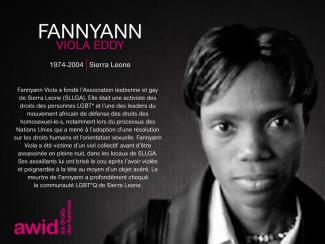
Fannyann Viola Eddy
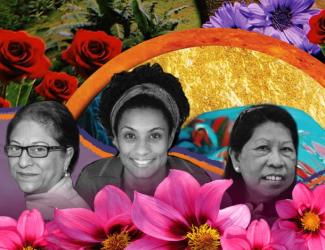
AWID’s Tribute is an art exhibition honouring feminists, women’s rights and social justice activists from around the world who are no longer with us.
This year’s tribute tells stories and shares narratives about those who co-created feminist realities, have offered visions of alternatives to systems and actors that oppress us, and have proposed new ways of organising, mobilising, fighting, working, living, and learning.
49 new portraits of feminists and Women Human Rights Defenders (WHRDs) are added to the gallery. While many of those we honour have passed away due to old age or illness, too many have been killed as a result of their work and who they are.
This increasing violence (by states, corporations, organized crime, unknown gunmen...) is not only aimed at individual activists but at our joint work and feminist realities.
The portraits of the 2020 edition are designed by award winning illustrator and animator, Louisa Bertman.
AWID would like to thank the families and organizations who shared their personal stories and contributed to this memorial. We join them in continuing the remarkable work of these activists and WHRDs and forging efforts to ensure justice is achieved in cases that remain in impunity.
“They tried to bury us. They didn’t know we were seeds.” - Mexican Proverb
It took shape with a physical exhibit of portraits and biographies of feminists and activists who passed away at AWID’s 12th International Forum, in Turkey. It now lives as an online gallery, updated every year.
To date, 467 feminists and WHRDs are featured.
Syndicat OTRAS

Boil them down to communications language preferences
Isabel Cabanillas de la Torre était une jeune artiste et activiste féministe très appréciée de Ciudad Juárez, au Mexique. Elle était connue pour ses belles peintures textiles, très expressives. Les yeux faisaient partie des représentations emblématiques de son travail. Ses peintures murales ont métamorphosé les immeubles décrépis et laissés à l’abandon du centre-ville de Ciudad Juárez, ornant leurs façades de messages de vie et de commentaires politiques.
Isabel voulait, à travers son art et son activisme politique, attirer l’attention sur les violences basées sur le genre omniprésentes dans sa ville natale. Elle était bénévole dans le réseau Mesa de Mujeres pour l’Observatoire citoyen sur le genre, qui supervise le travail des juges, procureurs et avocats de la défense dans les affaires de féminicides et autres violations basées sur le genre. Elle était également membre de Hijas de su Maquilera Madre, un collectif féministe dont le nom fait référence aux filles de mères qui travaillent dans les maquiladoras, ou zones de traitement pour l’exportation. Certaines de ces mères ont figuré parmi les premières victimes de féminicide dans la ville.
Le dernier projet d’Isabel, toujours en cours, était une installation artistique pour protester contre une entreprise canadienne qui cherchait à extraire du cuivre dans le désert de Samalayuca.
Le 18 janvier 2020, Isabel a été tuée par balle alors qu’elle rentrait chez elle à vélo dans le centre de Juárez, dansce qui semble avoir été un acte ciblé, son corps ayant été retrouvé à côté de son vélo.
Le meurtre d’Isabel a déclenché une nouvelle vague d’indignation contre les féminicides dans la région, des centaines de personnes ont manifesté jusqu’au pont frontalier entre le Mexique et les États-Unis, le bloquant pendant des heures et scandant « Ni Una Menos » (pas une de plus) alors que des collectifs féministes continuaient de manifester contre les meurtres de femmes dans tout le pays. Au cours de la seule année 2019, 3 142 femmes et filles ont été tuées au Mexique. Un grand nombre ont été spécifiquement ciblées du fait de leur genre.
Elle adorait faire du vélo.
« Le vélo était son symbole de liberté. Il symbolisait le fait d’être libre dans les rues. » - Marisol (une amie d’Isabel)
nous estimons que pour être transformateurs et forts, les mouvements féministes doivent continuer à travailler au-delà de leurs similitudes et de leurs différences. Nous devons également interroger le pouvoir et les privilèges, tant au sein qu'à l'extérieur de nos mouvements.
A war that exists only for those of us living in this territory.
I live in a country no one understands, which few can really see, where various realities co-exist, and where the truth is murdered time and again.
I live in a country where one has to pay for the audacity of thinking for oneself, for taking on the challenge of seeing life another way.
I live in a country of women who have had to invent and reinvent, time and again, how they live and how to get by.
I live in Venezuela, in a time of an unusual and extraordinary threat.
Since 2012 my country has been subjected to an unconventional war. There are no defined armies or fire power. Their objective is to dislocate and distort the economy, affecting all households, daily life, the capacity of a people to dream and build a different kind of politics, an alternative to the patriarchal, bourgeois, capitalist democracy.
Venezuelan women are the primary victims of this economic war. Women who historically and culturally are responsible for providing care, are the most affected and in demand. However, in these years of economic and financial embargo, Venezuelan women have gone from being victims to the protagonists on the front lines defending our territory.
Battles are fought from the barrios, kitchens, and small gardens. We defend the right of girls and boys to go to school, and to be given something so simple as some arepas for breakfast.
Arepas are a kind of corn cake that can be fried, roasted or baked and served sweet or savoury as a side or main dish. It is a staple in the diet of all Venezuelans.
In Venezuela, arepas mean culture, family, food sovereignty, childhood nostalgia, the expert hands of grandmothers molding little balls, the warmth that comforts you when recovering from illness.
Arepas connect us as a people with the pre-Colombian cultures of corn, a resistance that has endured for more than five centuries. They are the Caribbean expressed differently on firm ground.
They are an act of resistance.
When my mother was a girl, they would start grinding the dry corn early in the morning to make arepas. The women would get up and put the kernels of corn in wooden mortars and pound it with heavy mallets to separate the shells. Then they would boil, soak, and grind the corn to make dough, and finally they would mold it into round arepas. The process would take hours and demand a lot of physical effort.
In the mid-20th century a Venezuelan company industrialized the production of corn meal. For an entire generation that seemed like an act of liberation, since there was now a flour that you could simply add water to and have hot arepas in 45 minutes time.
But that also meant that the same generation would lose the traditional knowledge on how to make them from scratch. My grandmother was an expert arepa maker, my mother saw it as a girl, and for me the corn meal came pre-packaged.
In the war with no military, the pre-cooked corn meal came to be wielded as an instrument of war by the same company that invented it, which was not so Venezuelan anymore: today the Polar group of companies is transnational.
We women began to recuperate our knowledge by talking with the eldest among us. We searched in the back of the closets for our grandmothers’ grinders, the ones we hadn’t thrown away out of affection. Some families still prepared the corn in the traditional way for important occasions. In some towns there were still communal grinding stations which had been preserved as part of local history or because small family businesses refused to die. All of these forms of cultural resistance were activated, and we even went so far as to invent new arepas.
Today we know that in order to resist we cannot depend on one food staple. Although corn arepas continue to be everyone’s favourite, we have invented recipes for arepas made of sweet potato, cassava, squash, and celery root.
We have learned that we can use almost any root vegetable to make arepas. Cooperative businesses have developed semi-industrial processes to make pre-cooked corn meal. In other words, we have recuperated our arepas and their preparation as a cultural good that belongs to all.
My artivism aims to decolonize our senses in everyday life. I like to create spaces that communicate how we weave together our different struggles, and that render visible dissident (re)existences, other possible worlds, and living bodies here in the SOUTH.
As we continue to fight in our struggles, let us remember how essential it is that we support each other, believe each other, and love ourselves and our sisters. When this system fucks us over, we must take time to look after our (physical and mental) health, that of our sisters, and to understand that each one of us carries unique stories, making us fighters in resist

These portraits are inspired by the voices of resistance and protest movements in Latin America, especially by the key role that feminised bodies play in these struggles. It is a tribute to the grassroots feminist movements in resistance.
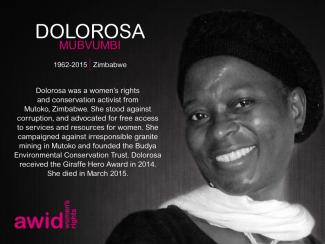
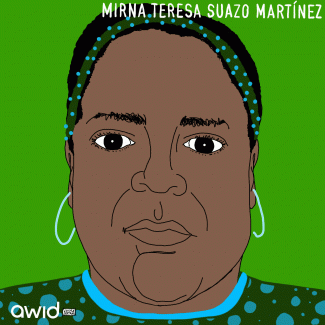
Mirna Teresa Suazo Martínez was part of the Garifuna (Afro-descendent and Indigenous) Masca community, living on the North Caribbean coast of Honduras. She was a community leader and a fervent defender of the Indigenous territory, a land that was violated when the National Agrarian Institute of Honduras gave territorial licenses to people outside of the community.
This deplorable deed resulted in repeated harassment, abuse and violence against the Masca, where economic interests of different groups met those of Honduran armed forces and authorities. According to the Black Fraternal Organization of Honduras (OFRANEH), the strategy of these groups is to evict and exterminate the Indigenous population.
“Masca, the Garifuna community located next to the Cuyamel Valley, is part of the area of influence of one of the supposed model cities, a situation that has triggered territorial pressures along the Garifuna coast.” - OFRANEH, 8 September 2019
Mirna Teresa, president of the Board of Trustees of the Masca Community in Omoa, was also firmly rejecting the construction of two hydroelectric plants on the river that carries the same name as her community, Masca.
“The Garífuna community attributes the worsening of the situation in their region to their opposition to tourist exploitation, the monoculture of African palm and drug trafficking, at the same time that it seeks to build an alternative life through the cultivation of coconut and other products for self-consumption.” - Voces Feministas, 10 September 2019
Mirna Teresa was murdered on 8 September 2019 in her Restaurant “Champa los Gemelos”.
She was one of six Garifuna women defenders murdered between September and October 2019 alone. According to OFRANEH, there was no investigation by the authorities into these crimes.
“In the case of the Garífuna communities, a large part of the homicides are related to land tenure and land management. However, squabbles between organized crime have resulted in murders, such as the recent ones in Santa Rosa de Aguán.” - OFRANEH, 8 September 2019
"I participated in a member-only activity and I was particularly moved to see how there was space for everyone to share and that there was no judgment whatsoever. The entire session was energetic and vibrant."
- Kirthi Jayakumar, Founder, The Gender Security Project, India
Estas obras son un trabajo colaborativo de fotografías e ilustraciones realizadas por Siphumeze y Katia durante el confinamiento. Muestran narrativas negras queer de sexo y placer, bondage, sexo seguro, juguetes, salud mental y sexo, y mucho más. Fueron creadas para acompañar la antología Touch.





Linda Porn es una otra heroína de la organización sindical feminista y del activismo de las trabajadoras sexuales a nivel nacional (en España) y transnacional.
Originaria de México, vive en España desde los años 2000. Es trabajadora sexual, activista, madre soltera y artista multidisciplinar.
Partiendo de estas diferentes identidades, utiliza la performance, el videoarte y el teatro para visibilizar las luchas en las intersecciones del transfeminismo, el trabajo sexual, la migración, el colonialismo y la maternidad. Combina el arte y el trabajo sexual mientras cuida a su hija como madre soltera.
Linda también pertenece a colectivos de trabajadoras sexuales que luchan por sus derechos, como el sindicato OTRAS y CATS Murcia. También cofundó el grupo 'Madrecitas' - que visibiliza y denuncia la violencia institucional racista contra las familias migrantes. Violencia de la que ella y su hija fueron objeto por ser trabajadora sexual y madre soltera migrante.
¡No te pierdas su trabajo artístico aquí!
In 2023, feminist and women's rights organizations had a median annual budget of USD 22,000. Behind that median lies disparity and inequality: while a few groups access large-scale resources, the vast majority survive on shoestring budgets.
A closer look at actual budgets reveals major income diversity and inequality.
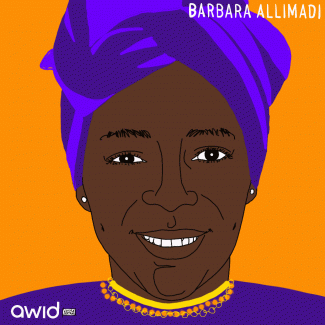
Barbara Allimadi fue una activista política y defensora de los derechos humanos de Uganda. En 2012, co-organizó una protesta contra la agresión policial a Ingrid Turinawe, una figura política de la oposición, que fue televisada y muestra cómo un policía le aprieta el pecho. Durante la protesta, Barbara, junto con otras compañeras activistas, se quitaron la ropa hasta quedarse en sujetador frente a la Estación Central de Policía de Kampala. Este hecho pasó a conocerse en Uganda como la infame "protesta de los sujetadores".
"Nos decidimos por la protesta de los sujetadores. Pensamos que sería lo más apropiado para lo que había sucedido. Con esta acción, no es que estuviésemos diciendo que no nos respetásemos a nosotras mismas. Estábamos indignadas con lo que había sucedido." - Barbara Allimadi, 2013 (Daily Monitor, en inglés)
Barbara se licenció en Ingeniería Electrónica y de Comunicaciones en la Universidad Metropolitana de Londres, y ejerció como ingeniera de redes en el Reino Unido. Era,además, una fan entusiasta de la música reggae. Regresó a Uganda en 2007, cuando su madre falleció.
En 2019, fue nombrada Coordinadora de Asuntos Internacionales y de la Diáspora de la Alianza para la Transformación Nacional (ANT, por sus siglas en inglés), un partido político lanzado ese año por un líder de la oposición.
"Queremos garantizar la seguridad de la vida y la propiedad, no el dolor, las lesiones o incluso la muerte a manos de unas fuerzas de seguridad que se supone deberían protegernos. Y lo más importante, queremos un entorno estable y propicio donde podamos realizar nuestros sueños y aspiraciones". - Barbara Allimadi, video de ANT (en inglés)
Barbara falleció el 27 de abril de 2020.
"Estaba muy orgullosa de mi hermana por muchas razones, pero, en particular, por su intrépida búsqueda de la paz, la democracia, la justicia y la igualdad en Uganda. En los momentos más álgidos de su activismo, Barbara lideró muchas marchas por las calles de Kampala, hacia las comisarías de policía y el Parlamento". - Doris Allimadi, hermana de Barbara
"Nos enteramos con profunda tristeza del prematuro fallecimiento de Barbara Allimadi. Ella ha sido una fuerza valiente, implacable y valerosa para el movimiento de liberación de Uganda. Queremos dar nuestro más sentido pésame a su familia. La echaremos mucho de menos". - Akina Mama wa Afrika (tweet, 28 April 2020)
"El fallecimiento de Barbara es una noticia muy triste para nosotrxs y para toda su familia. Barbara dedicó su vida a luchar por la justicia, la libertad y los derechos de las personas desde la sociedad civil, hasta que se unió, recientemente, al partido." Maj Gen Mugisha Muntu, coordinador nacional de la ANT (por sus siglas en inglés)
"Una hermana hermosa, encantadora, divertida, carismática e inspiradora. Mis hijxs han perdido a su tía. Uganda ha perdido a una audaz y valiente defensora de la libertad. Barbara dijo una vez: "Mientras siga habiendo aliento en ti, sigue trabajando por conseguir tus sueños". - Doris Allimadi, hermana de Barbara.
El Foro de AWID estará organizado alrededor de 6 tópicos interconectados. Estos «ejes» se centran en las realidades feministas.
