Supporting feminist, women’s rights and gender justice movements to thrive, to be a driving force in challenging systems of oppression, and to co-create feminist realities.
A Joy to the World: Six Questions with Naike Ledan
Interviewed by Chinelo Onwualu
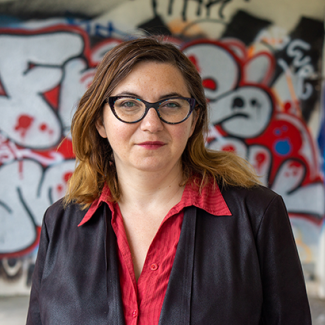
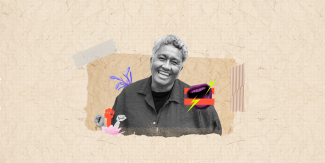
Naike Ledan is a social justice defendant, a committed feminist that brings forward 20 years of experience in human rights and health justice advocacy, women’s empowerment, the fight for universal access to basic services and social inclusion, as well as civil society capacity building. She has built extensive work in Canada, West and southern Africa, as well as in Haiti, in civil rights advocacy, capacity building for CSOs, while emphasising the social determinants of structural exclusion. She values the principles of shared leadership, anticolonial, anti-oppressive, and anti-patriarchal spaces.
Chinelo You’re billed as a trans rights activist; I’m curious about how you made that journey.
Naike So, I grew up in Haiti until I was 18, then I lived in Montreal for 19 years. Coming back to Haiti in 2016, I thought I would be coming back home, but the place had changed and I had to readjust. I did not necessarily reconnect in the way that I’d expected to with childhood family and friends. I came back as an expat with a comfortable work situation, and I felt very much like a foreigner for a very long time. And at the same time, I felt very much at home because of the language, the understood silence, the not having to explain when we start singing a commercial – you know, that thing we share, that energy, that space, that spirit.
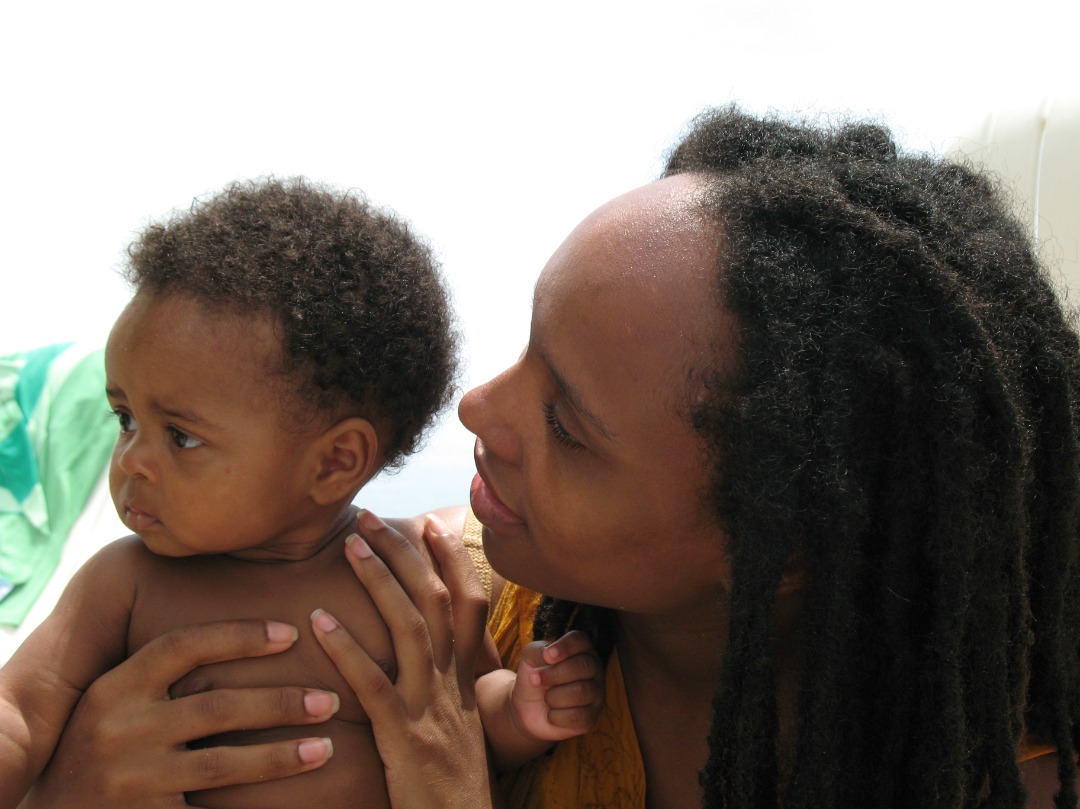
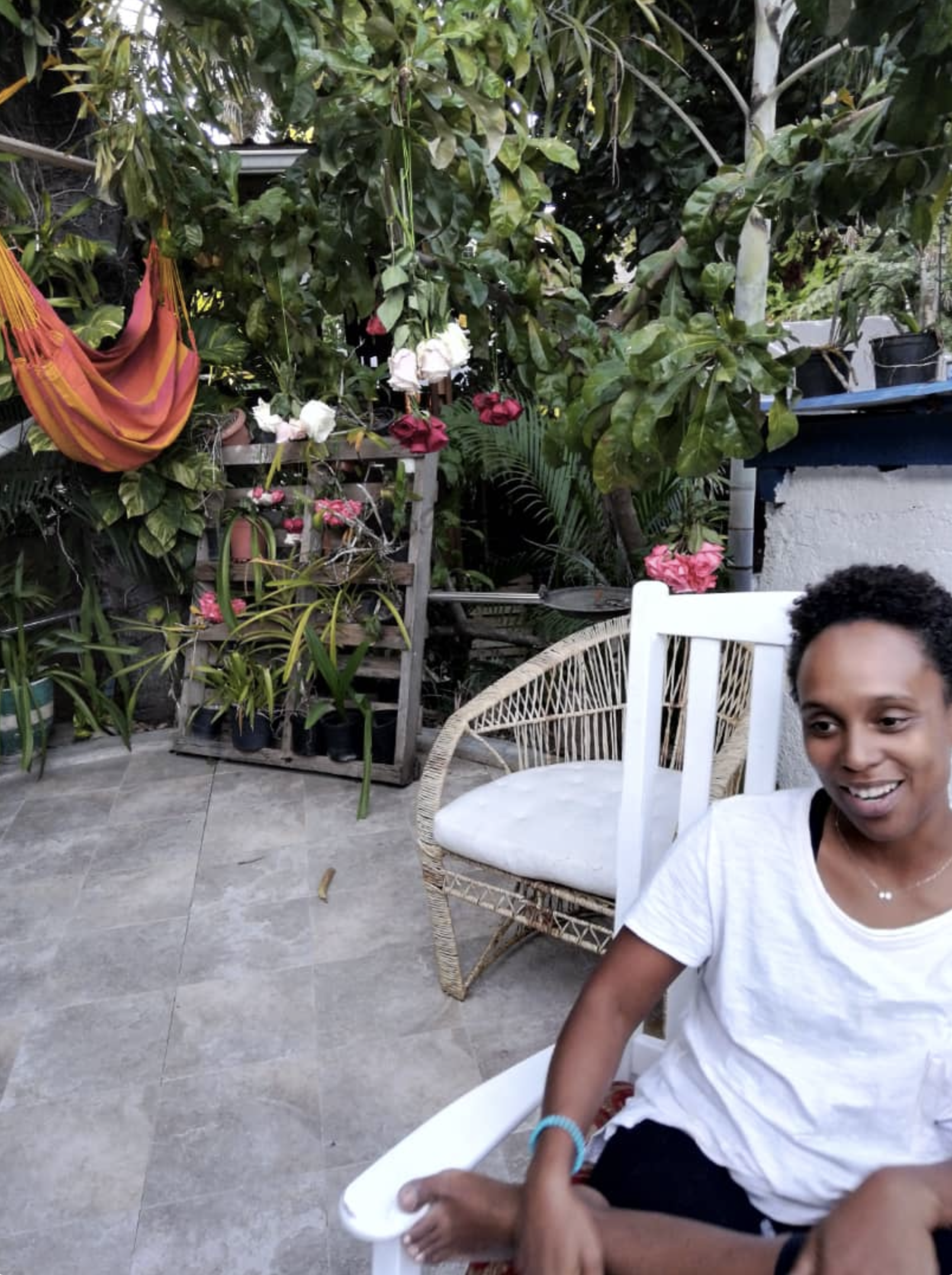
My return to self-love – I would call “rebirth” – coinciding with giving birth to my first child, giving birth to myself, and falling in love with my queerness or same-gender lovingness. (Photo credit: Naike Ledan)
What helped me was, I loved the work of going into the country and documenting people’s knowledge. So I left the comfort. I became a country director of a regional organisation that was queer as fuck! Most of my work was to find resources and build the capacity of civil society. My strategy was to go into the countryside, look for all these little organizations, help build their capacity, and fund them. I was not interested in politicians and shaking hands and taking pictures . I had a very good ally, Charlot Jeudy – the [queer] activist that got killed three years ago in his house. We got very close after an Afro-queer film festival we were planning got banned in Haiti. But it made a lot of noise and sparked conversations about queerness everywhere, so Charlot introduced me to every little CSO in every little corner of the country. And I would just be there to help organisation[s] with registering legally or building their strategic plan. So it’s been a lot of these kinds of work that made me a queer activist and by extension, a trans activist. Although I don’t call myself that – an activist. It’s such a loaded word, you know? And it’s something people call you. I think I’m just a lover and a fighter .
Chinelo Tell me about the workshop you conducted with AWID for the festival. What was it about and what was the context?
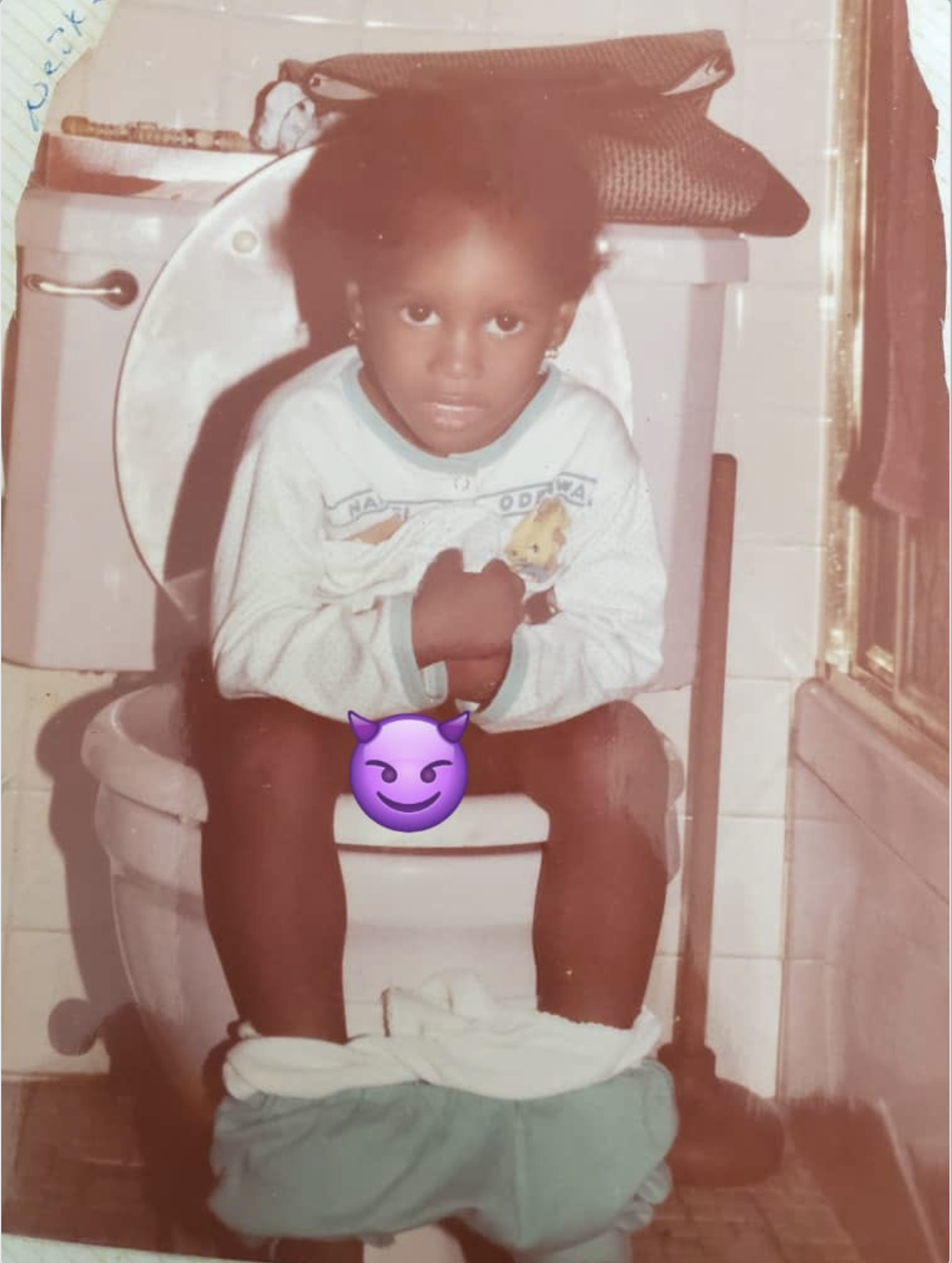
My deep self awareness during my childhood years and my engagement in questioning inequalities and injustice at a very very young age (+/- 4 years old). (Photo credit: Naike Ledan)
Naike International media doesn’t really talk about Haiti, but with a political environment that is as bad as ours, the economic environment is even more catastrophic. Being a more middle class Haitian, speaking different languages, having different passports, I was initially hesitant to take the space. But I often see myself as a bridge more than someone that would talk about themself. That is how I came to invite Semi, who is a brilliant young trans woman from outside Port-au-Prince, to take the space to talk for herself and walk us through the ecosystem of the realities for trans women in Haiti. We ended up building a session about uninclusive feminism – or, I would say, formal feminist spaces – and how trans girls in Haiti do not have spaces where they can contribute to women’s knowledge and sharing of women’s realities. So the AWID festival was the opportunity for me to give the space to the women who should have it. We had a wonderful time; we had wine online while hosting the conversation. My co-facilitator, Semi, shared what it is like to be a trans child/girl/woman at different stages of her life. She also shared the dangers of the street, of poverty, of exclusion, of “not passing,” and her victories as well.
Chinelo What is the relationship of trans women to feminist organizations in Haiti? What has been your experience with that?
Naike It’s been really hard – heartbreaking, actually – the experience of trans women in Haiti. From not existing at all to just being extremely sexualized. The other thing that’s been happening is how they’re being killed, and how those killings have gone unreported in the media. This is how non-existent, how erased trans women are. They’re everywhere but not in job settings, not in feminist settings, not in organizational settings. Not even in LGBT organizations. It’s only recently, and because of a lot of advocacy push, that some of these organization are kind of readjusting, but in feminist spaces, this is still out of the question. We are still having to deal with the old exclusionary discourse of “They’re not women. Of course, if they can pass…” The culture of passing, it’s a risk management conversation – how much you pass and how much you don’t pass and what it means for your body and the violence it inflicts. In the trans-exclusionary realities we live in, which are reproduced in a lot of feminist spaces, those that pass completely may be considered girls, but only to a certain extent. But how about falling in love, how about having a conversation, how about being in the closet, how about wanting a certain aesthetic, or a career? So really, the conversation about hormone therapy becomes about risk reduction, as Semi herself shared at the workshop. But we don’t have the option of hormone therapy, we don’t have the medical framework nor the system to support those who would like to pursue that option.
Chinelo When you talk about the way that trans people and queer people are thought of in society, it sounds like it might be similar to Nigeria, which can be a deeply homophobic environment.
Naike Haiti is a very complex country in a very beautiful way. Nothing is simple, you know, nothing is ever one way. Haitians are very tolerant – and they’re also very homophobic. You’re going to find regions in the countryside where people aren’t that homophobic at all because all the Vodou temples there, and this is a religion that respects life. One basic principle of the Vodou religion is that all children are children. So, there is no right or wrong in the religion. For the longest time, people thought of Haiti as a haven, a place where people are tolerant – we’re talking 70s, 80s, pre-HIV, 90s even. Then you had the earthquake [in 2010] where around 300,000 people died. And then all this money came from the south of the US through the Evangelicals to rebuild the country and find Jesus. So, the homophobia in Haiti is very recent. In the depth, in the heart of the soul of the culture, I cannot really say that it is homophobic. But in the everyday life, it surely lands on the skin of queer people, that violence. And that of women, of poor women, of dark women as well, because colorism runs deep in the Caribbean.
Chinelo How have you managed this? What’s been your strategy for survival?
My return to Haiti as part of my decolonizing process, and choosing to physically position my senses and my family’s senses to magic and blackness uncompromisingly. (Photo credit: Naike Ledan)
Naike I’m really in love with my work. I love working. When I first arrived, I was working with this horrible NGO but I was doing amazing work. I was always in the countryside, conversing and learning from people, from women. And that filled my heart for so long because I’m very much in love with my culture, with black people, with black women – old black women, black babies. It just fills me up in a spiritual way. When we were in Canada my kids were in these all-white schools and tokenized. They did not speak Creole nor French. And now, they’re running free in the yard and starting to fight in Creole. I also found hubs of survival with the people I met. I created bonds with the queers and others who were weirdos like me and it’s been really wonderful. But now I’m struggling because I don’t feel safe in Haiti anymore. We have about 40 kidnappings per week in Port-Au-Prince – and it’s been like that since 2018. I’ve developed anxiety and panic attacks. So It’s time to go, and I’ve been asking myself, “where is home?” I spent 19 years in Montreal but I never felt at home there. When I left, I never missed it so I don’t want to go back. I’ve been crying a lot lately because it feels like entering a second exile.
Chinelo What’s your relationship to pleasure, leisure, and rest?
Naike My relationship with pleasure, leisure, and rest are for me one and the same. It is the lived moment when I indulge in the heat of the sun on my face for example. It is pleasure, leisure, and rest at the same time.
Pleasure: My go-to space, most solely a haven of celebration of myself. I reserve myself the power and the right to be loud or quiet in the enjoyment of the pleasure I experience. All the pleasure I viciously and abundantly indulge in, including and not limited to the pleasure of solitude and silence.
Leisure: biking, music festivals, eating, wine discoveries, dancing in Haitian traditional Vodou dances are amongst many that occur at the moment.
Rest: is what I live for. As an overachiever and a person that is literally in love with work, it is a paradox how lazy I am. No one knows that because all of what the world sees is this: an accomplished overworker. They do not know how I can just, uncompromisingly and profoundly indulge in idleness.
ExploreTransnational Embodiments
This journal edition in partnership with Kohl: a Journal for Body and Gender Research, will explore feminist solutions, proposals and realities for transforming our current world, our bodies and our sexualities.
نصدر النسخة هذه من المجلة بالشراكة مع «كحل: مجلة لأبحاث الجسد والجندر»، وسنستكشف عبرها الحلول والاقتراحات وأنواع الواقع النسوية لتغيير عالمنا الحالي وكذلك أجسادنا وجنسانياتنا.
Does AWID provide scholarships to attend the Forum?
Our Access Fund will offer a limited number of scholarships to fund the participation of activists who cannot otherwise make it, and don’t have relationships with funders who could cover their participation. So if you have other possibilities, please explore them. We will do our best to offer as many scholarships as we can, and will share more information about this process and how to apply in early 2024.
Introducing AWID’s next Co-Executive Directors
Dear Feminist Movements,
On behalf of the AWID Board of Directors, I am proud to introduce AWID’s next Co-Executive Directors: Faye Macheke and Inna Michaeli!
Faye Macheke is a passionate Pan-African feminist, active in movements for women's rights, racial justice, migrant and labor rights, and environmental justice. Her activism builds on the legacy of the struggle against apartheid in South Africa and the aftermath of the apartheid era in Zimbabwe. In 2019, Faye joined AWID as the Director of Finance, Operations and Development. She brings extensive experience in feminist leadership, strategy, and all aspects of organisational development. Faye is a committed Board Member of UAF-Africa and other women's rights organizations. She is based in Cape Town, South Africa.
Inna Michaeli is a feminist lesbian queer activist and sociologist with many years of deep engagement in feminist and LGBTQI+ struggles, political education and organizing by and for migrant women, and Palestine liberation and solidarity. Inna joined AWID in 2016 and served in different roles, most recently as the Director of Programs. She brings extensive experience in research and knowledge building, policy advocacy and organizational development. Inna serves on the Board of the Jewish Voice for Peace - Germany. She is based in Berlin, Germany.
This decision is the result of a rigorous process with full participation of the Board and the staff of AWID. The Board recognised and honoured the skills and talents of AWID staff by opening an internal hiring search. As a result, we had two brilliant candidates, who embody the integrity, ethic of care, and feminist intersectional values that drive AWID’s work, apply together as a team. Faye and Inna brought forward a brave and exciting vision to meet the challenges of this moment: building a global feminist community, resisting and disrupting systems of oppression, and supporting feminist movements to thrive.
As AWID celebrates 40 years we are excited for Inna and Faye to co-lead AWID into our next strategy and a new phase of evolving, pushing boundaries, and supporting feminist movements worldwide.
Appointing and supporting AWID’s Co-Executive Directors to lead the organisation is a fiduciary responsibility we take seriously as a Board. How we engage those processes is also a reflection of AWID’s brilliant and diverse membership, which elects AWID’s Board.
As we say good-bye to Cindy and Hakima, we, the Board, unanimously and enthusiastically welcome Faye and Inna as our next Co-EDs as of September 5, 2022. Stay tuned for more updates about our leadership transition in the months ahead.
Most of all, thank you for your ongoing support!
In feminist solidarity and love, Margo Okazawa-Rey
President, AWID Board
“My mission in life is not merely to survive, but to thrive; and to do so with some passion, some compassion, some humor, and some style.” - Maya Angelou
Welcome to the 15th AWID International Forum!
The AWID International Forum is both a global community event and a space of radical personal transformation. A one-of-a-kind convening, the Forum brings together feminist, women’s rights, gender justice, LBTQI+ and allied movements, in all our diversity and humanity, to connect, heal and thrive. The Forum is a place where Global South feminists and historically marginalized communities take center stage, strategizing with each other and allied movements, funders and policy-makers, in order to shift power, make alliances, and usher in a different, better world.
When people come together on a global scale, as individuals and movements, we generate a sweeping force. Join us in Bangkok, Thailand in 2024. Come dance, sing, dream and rise with us.
When: 2–5 December 2024 Where: Bangkok, Thailand; and online Who: Approximately 2,500 feminists from all over the world participating in-person, and 3,000 participating virtually
AWID is a part of an incredible ecosystem of feminist movements working to achieve gender justice and social justice worldwide. With our 40th anniversary, we are celebrating all that we’ve built over these last 40 years. As a global feminist movement support organization we know that working with fierce feminisms is our way forward, acknowledging both the multiplicity of feminisms and the value of fierce and unapologetic drive for justice. The state of the world and of feminist movements calls for brave conversations and action. We look forward to working together with our members, partners and funders in creating the worlds we believe in, celebrating the wins and speaking truth to power in service of feminist movements globally.
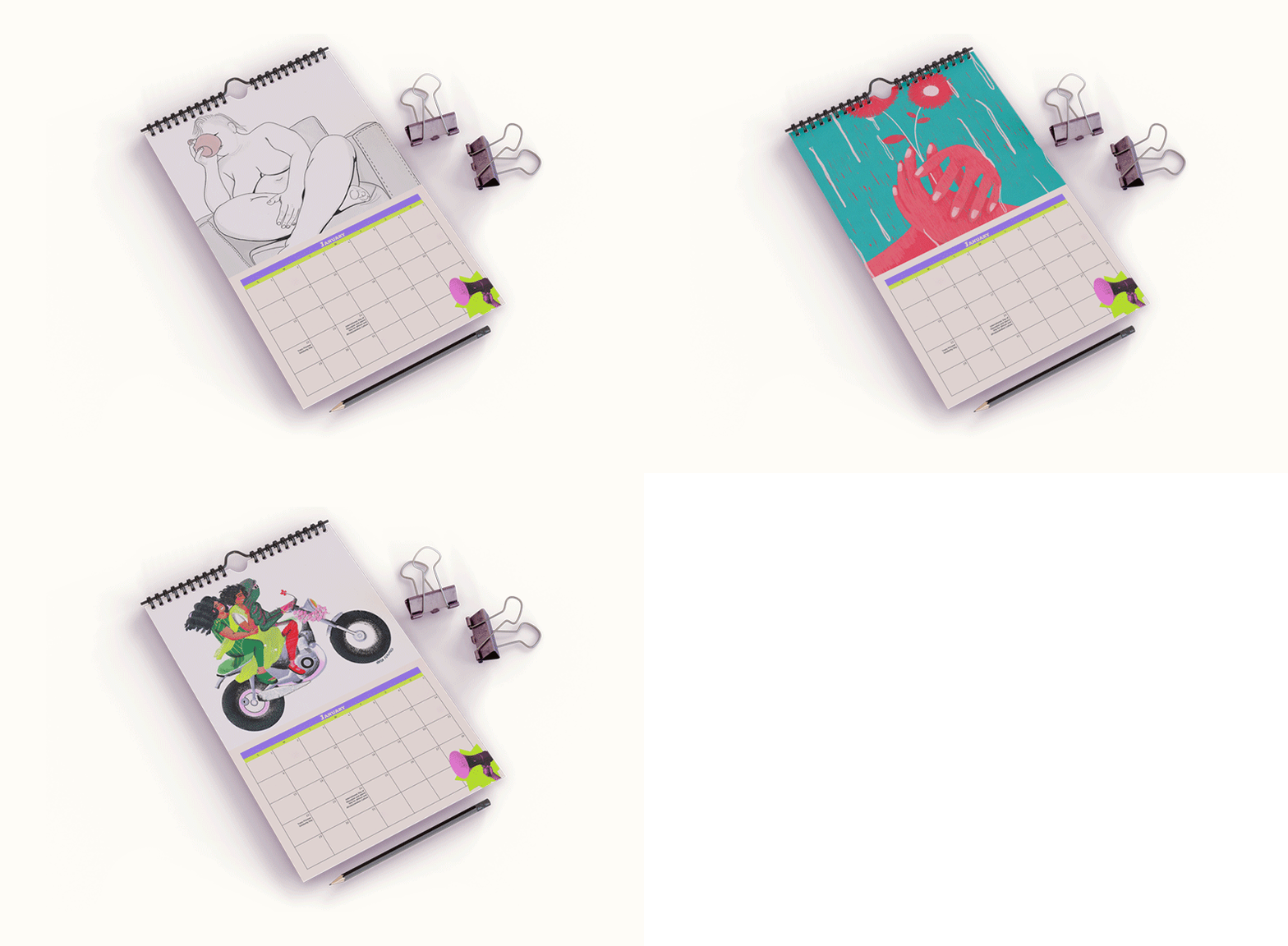
The 2023 Feminist Calendar is our gift to movements. It features the artwork of some of our amazing AWID members.
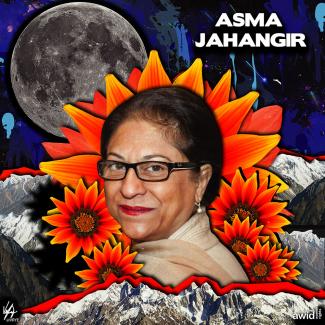
Asma was a leading Pakistani rights activist, fearless critic of the military’s interference in politics and a staunch defender of the rule of law.
She was the founding chairwoman of the Human Rights Commission of Pakistan, an independent group, and was a trustee of the International Crisis Group. She won international awards and served as the United Nations rapporteur on human rights and extrajudicial killings.
“With her life, Asma rewrote the history that many of us were told as women. Asma changed the world. She changed it in Pakistan, and she changed it in our imaginations."
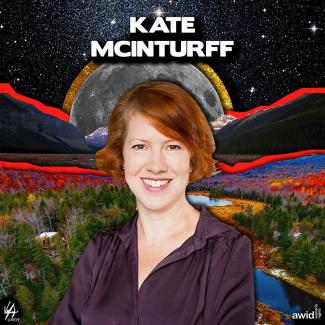
From Peacebuild to the Canadian Feminist Alliance for International Action, Amnesty International, and the Canadian Centre for Policy Alternatives (CCPA), Kate had a lifelong passion for women’s rights and gender equality and dedicated her career to fighting inequality and making the world a more compassionate place.
Kate was a member of the Coordinating Committee of Social Watch and a contributor to the Canadian National Social Watch reports. As a Senior Researcher at the CCPA, Kate received national acclaim for researching, writing, and producing the annual “The Best and Worst Places to be a Woman in Canada” report.
Kate died peacefully surrounded by her family, following a three-year battle with colon cancer. She is described by loved ones as a “Funny, Fearless, Unapologetically Feminist.”
Amal was a prominent politician and parliamentarian in Libya. She was a faculty member at Benghazi University from 1995 until her death in 2017.
Amal was a civil society activist and a member of various social and political initiatives. She assisted the families of martyrs and the disappeared, and was a founding member of a youth initiative called ‘’Youth of Benghazi Libya”. In the 2014 parliamentary elections, Amal was elected to the House of Representatives with more than 14,000 votes (the highest number of votes anyone received in the 2014 elections).
Amal will remain in the memories of many as a woman politician working to ensure a better future in one the most difficult and conflict-ridden contexts in the region.
متى يمكنني التسجيل في المنتدى؟ كم هي تكلفة التسجيل؟ ماذا يشمل التسجيل؟
سيبدأ التسجيل أوائل العام 2024. وسنعلن عن تاريخ التسجيل المحدد ورسوم التسجيل قريبًا. سيتضمن التسجيل المشاركة في المنتدى، بالإضافة إلى الغداء والوجبات الخفيفة (يتم تقديم وجبة الإفطار في الفنادق)، وعشاء واحد في الموقع.
Andaiye in Swahili means ‘a daughter comes home’. Born Sandra Williams on 11 September 1942 in Georgetown, Guyana, she changed her name to ‘Andaiye’ in 1970 as the Black Power movements swept her country and the wider Caribbean region.
Andaiye was seen as a transformative figure on the frontlines of the struggles for liberation and freedom. She was an early member and active in the leadership of the Working People’s Alliance (WPA), a socialist party in Guyana which fought against authoritarian rule and continued throughout her life to focus on justice for the working-class and rural women’s rights and on bridging ethnic barriers between Indo and Afro-Guyanese women.
Andaiye was a founding member of Red Thread Women, an organization that advocated for women’s care work to be fairly remunerated, worked at the University of the West Indies and with CARICOM. Never afraid to challenge governments, she pointed out gender imbalances in state boards, laws that discriminated against sex workers, called for abortion rights in Jamaica and spoke out against trade agreements such as the Caribbean Single Market and Economy (CSME) that allowed for the free movement of women domestic migrant workers but did not give their children the same rights.
Andaiye published several scholarly essays, wrote newspaper columns and also edited the last books of Walter Rodney, the Guyanese political activist and fellow WPA leader, who was assassinated in 1980. A cancer survivor, Andaiye was one of the founders of the Guyana Cancer Society and the Cancer Survivors’ Action Group. She also served on the executive of the Caribbean Association for Feminist Research and Action (CAFRA), as a Director of Help and Shelter and as Board Member of the Guyana National Commission on Women. She received a number of awards, including the Golden Arrow of Achievement in Guyana (the fourth highest national award).
Andaiye passed away on 31 May 2019 at the age of 77. The subsequent tributes that flowed in from activists, friends and those inspired by her life spoke eloquently to her amazing legacy and her beautiful humanity.
Here are but a few:
“Andaiye had a profound effect on me...she was so many things, an educator, fighter, she taught me to be self-critical, to think more clearly, she taught me about survival, about incredible courage, about compassion, about going beyond external appearances and treating people as people and not being distracted by status, class, race...anything.” - Peggy Antrobus, Feminist Activist, Author, Scholar, Barbados
“The kind of confident idealism Andaiye expressed, this willingness to confront the world and a stubborn belief that you could actually change it... That politics of hope...How else to honour her life, legacy and memory but to keep doing the work ethically and with ongoing self-critique? And to put women’s caring work at the center of it.” - Tonya Haynes, Barbados
“I can hear her quip at our collective keening. So through the tears I can laugh. Deep bows to you beloved Andaiye, thank you for everything. Love and light for your spirit’s journey. Tell Walter and all the ancestors howdy.” - Carol Narcisse, Jamaica