WHRDs are self-identified women and lesbian, bisexual, transgender, queer and intersex (LBTQI) people and others who defend rights and are subject to gender-specific risks and threats due to their human rights work and/or as a direct consequence of their gender identity or sexual orientation.
WHRDs are subject to systematic violence and discrimination due to their identities and unyielding struggles for rights, equality and justice.
The WHRD Program collaborates with international and regional partners as well as the AWID membership to raise awareness about these risks and threats, advocate for feminist and holistic measures of protection and safety, and actively promote a culture of self-care and collective well being in our movements.
Risks and threats targeting WHRDs
WHRDs are exposed to the same types of risks that all other defenders who defend human rights, communities, and the environment face. However, they are also exposed to gender-based violence and gender-specific risks because they challenge existing gender norms within their communities and societies.
By defending rights, WHRDs are at risk of:
Physical assault and death
Intimidation and harassment, including in online spaces
Judicial harassment and criminalization
Burnout
A collaborative, holistic approach to safety
We work collaboratively with international and regional networks and our membership
to raise awareness about human rights abuses and violations against WHRDs and the systemic violence and discrimination they experience
to strengthen protection mechanisms and ensure more effective and timely responses to WHRDs at risk
We work to promote a holistic approach to protection which includes:
emphasizing the importance of self-care and collective well being, and recognizing that what care and wellbeing mean may differ across cultures
documenting the violations targeting WHRDs using a feminist intersectional perspective;
promoting the social recognition and celebration of the work and resilience of WHRDs ; and
building civic spaces that are conducive to dismantling structural inequalities without restrictions or obstacles
Our Actions
We aim to contribute to a safer world for WHRDs, their families and communities. We believe that action for rights and justice should not put WHRDs at risk; it should be appreciated and celebrated.
Promoting collaboration and coordination among human rights and women’s rights organizations at the international level to strengthen responses concerning safety and wellbeing of WHRDs.
Supporting regional networks of WHRDs and their organizations, such as the Mesoamerican Initiative for WHRDs and the WHRD Middle East and North Africa Coalition, in promoting and strengthening collective action for protection - emphasizing the establishment of solidarity and protection networks, the promotion of self-care, and advocacy and mobilization for the safety of WHRDs;
Increasing the visibility and recognition of WHRDs and their struggles, as well as the risks that they encounter by documenting the attacks that they face, and researching, producing, and disseminating information on their struggles, strategies, and challenges:
Mobilizing urgent responses of international solidarity for WHRDs at risk through our international and regional networks, and our active membership.
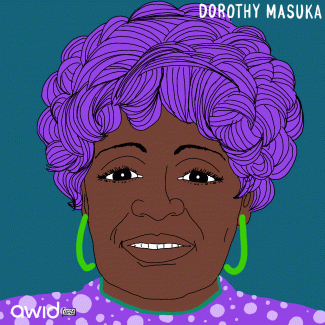
“I didn’t plan to be a singer, singing planned to be in me.” - Dorothy Masuka (interview with Mail & Guardian)
Dorothy Masuka, born 1935 in Bulawayo (then Southern Rhodesia, now Zimbabwe), grew up in South Africa to become a well-known songwriter, composer, jazz singer and activist, a fervent advocate of the struggle against apartheid. Called “an architect of the discourse of popular African liberation music”, Dorothy often sang about politics in indigenous African languages and throughout her work she confronted the racist policies of the South African government.
One such song titled “Dr. Malan” (named after the pro-apartheid politician D.F. Malan) was banned. She went on to record “Lumumba” (1961), a song about the assassination of the anti-colonial leader Patrice Lumumba. Dorothy’s work and activism attracted the attention of the Special Branch of the South African police and she was forced into a political exile that would span over three decades. Throughout this time, she worked with pro-independence groups including the African National Congress. In 1992, as apartheid started to crumble and Nelson Mandela was released from prison, she returned to South Africa.
Some of her other work includes the first song she recorded in 1953 entitled “Hamba Notsokolo”, a hit in the 1950s and a valued classic. She also wrote “El Yow Phata Phata”, a song that was adapted by Miriam Makeba, making “Pata, Pata” popular internationally.
Rooted in resistance, Dorothy’s music and activism were intertwined, leaving a magnificent and inspiring legacy. She was also widely known as “Auntie Dot”.
On 23 February 2019 at the age of 83, Dorothy passed away in Johannesburg due to ill health.
Snippet AWID Forum Location Announcement Title (EN)
Announcing the AWID Forum Date & Location
Lettres d'amour aux mouvements féministes : Une lettre d'Inna et Faye
Chers mouvements féministes,
L'amour est ce qui entretient notre feu féministe. Avec le souci de nos communautés, la colère et la rage face à l'injustice et le courage d'agir.
En septembre 2022, nous sommes entrés avec beaucoup d'enthousiasme dans nos rôles de leadership à l'AWID, en tant que co-directeurs exécutifs. Nous avons ressenti la chaleur et l'étreinte de la fraternité féministe lorsque vous nous avez accueillis.
En réfléchissant à nos souvenirs les plus précieux en tant que féministes, nous nous souvenons de puissants moments de solidarité lors de manifestations de rue, d'analyses pointues et de voix courageuses ébranlant le statu quo lors de rassemblements. Nous avons tenu ces conversations intimes la nuit, ri pendant des heures et dansé ensemble lors de fêtes.
Les feux féministes doivent être alimentés, en particulier dans les moments difficiles où les défis extérieurs ne manquent pas, de la crise climatique et de la montée des forces de droite aux économies d'exploitation et aux schémas persistants d'oppression au sein de nos propres mouvements sociaux. Ce sont ces feux, brûlant partout, qui éclairent nos voies et nous gardent au chaud, mais nous ne pouvons pas ignorer les effets épuisants de la violence politique et de la répression dirigées contre nombre de nos luttes, mouvements et communautés.
Nous comprenons le désir de changer le monde comme un ingrédient essentiel de l'organisation féministe. Nous ne pouvons jamais oublier que nous sommes ceux que nous attendions pour construire des alternatives et façonner notre avenir. Pourtant, l'énergie féministe dynamique ne peut être tenue pour acquise et doit être préservée de plusieurs façons. En cela, nous continuerons d'être vigilants. Un accès plus grand et égal aux soins et au bien-être, à la guérison et au plaisir, ne sont pas seulement des instruments pour prévenir l'épuisement professionnel et soutenir nos mouvements, même si c'est une fonction importante ; d'abord et avant tout, ils sont la façon dont nous espérons vivre nos vies.
"Fierce Feminisms: Together We Rise" reflète notre conviction que le moment est venu pour nous d'être féroces et sans vergogne dans nos agendas tout en faisant un effort pour nous connecter entre les mouvements et vraiment connaître les réalités de chacun, afin que nous puissions nous élever ensemble - car, pour nous, c'est le seul moyen.
Nos plans incluent le Forum de l’AWID tant attendu ! Nous sommes impatients de vous rencontrer tous en personne et en ligne en 2024. Nous entendons de vous le besoin de vous connecter et de vous ressourcer, de vous reposer et de guérir, d'être mis au défi et inspiré, de partager de la bonne nourriture, de rire et de danser ensemble. Peu de choses dans ce monde sont aussi puissantes et transformatrices que des féministes de toutes les régions du monde qui se réunissent, et nous retenons vraiment notre souffle pour ce moment, car nous connaissons la magie que nous pouvons créer ensemble.
L'engagement de nos membres a pris vie grâce àla communauté AWID (notre plate-forme en ligne pour les membres), et notre objectif de créer des liens et de la solidarité trouve un écho chez beaucoup d'entre vous. Rejoignez-nous et connectez-vous avec nous et d'autres dans les mouvements féministes du monde entier. Nous connaissons l'importance de la connexion dans un temps et un espace où les règles ne sont pas faites pour nous, et nous tenons à notre communauté, où chacun de nous compte.
Avec nos fantastiques collègues de l'AWID, nous promettons de faire de notre mieux pour soutenir les mouvements féministes, comme c'est la mission et le but de l'AWID. Veuillez nous demander des comptes.
Au cours des 40 dernières années, vous - les mouvements féministes - avez façonné l'histoire de l'AWID et nous avez poussés à être plus courageuses, créatives et radicales. 40 ans est un âge fabuleux, et nous attendons avec impatience 40 autres années avec vous tous. Nous attendons avec impatience les partenariats, les appels à la justice, la collaboration, l'influence sur les politiques et le pouvoir féministe dur à cuire que vous apportez tous pour naviguer dans le contrecoup toujours croissant de la justice de genre, raciale et environnementale. Nous avons tant à apprendre de vous et les uns des autres, alors que nous construisons collectivement les mondes auxquels nous croyons.
Cindy Clark et Hakima Abbas, merci de nous avoir ouvert la voie et de nous préparer à remplir leurs énormes chaussures. Nous apprécions toujours tous ceux sur les épaules desquels nous nous sommes tenus et continuons de nous tenir debout. Nous nous comprenons comme faisant partie d'un paysage de mouvement plus large, d'histoires féministes, de présents et d'avenirs audacieux.
Et pour le Conseil d'administration de l'AWID, nous vous sommes reconnaissants pour le soutien et l'amour féministe que vous nous témoignez, ainsi que pour votre engagement envers le leadership des pays du Sud et le modèle de co-leadership. Nous envoyons notre amour et notre respect à chaque collègue de l'AWID, nous nous sentons honorées de travailler avec une équipe féministe aussi exceptionnelle de professionnelles dévouées.
C'est la première fois que nous écrivons une lettre d'amour ensemble, comment pourrions-nous la conclure sans exprimer de l'amour, de l'attention et du respect l'un envers l'autre ? C'est une relation assez intense dans laquelle nous sommes entrés! Nous apportons tous deux nos perspectives et compétences différentes et diverses à notre travail, et en tant qu'individus, nous apportons également nos expériences vécues et notre moi authentique.
Avec vous tous, nous sommes une histoire en devenir, une partie d'un beau tissage - et souvent magnifiquement stimulant - une tapisserie qui se poursuit à l'avenir. Nous nous sommes amusés à commencer ce voyage les uns avec les autres et avec vous, et nous espérons vraiment que la romance restera vivante.
En solidarité avec l'amour et les soins Inna and Faye
Réserve cette date!
21 février 2023, membre Mixer 5 sur la politique féministe avec Faye et Inna.
Ya está disponible nuestro primer programa del Club de Cine Feminista: «Tenderness is the Sharpest Resistance» [«La ternura es la resistencia más intensa»], que es una serie de películas sobre realidades feministas de Asia-Pacífico curada por Jess X. Snow.
If the positions advertised have closed, or just don’t match your area of interest and expertise, we suggest the following resources for your job search.
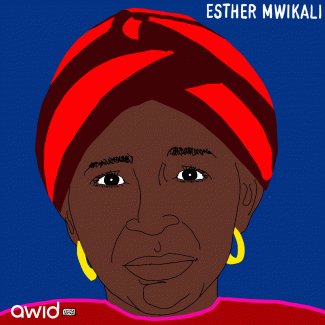
El hogar de Esther Mwikali estaba en la aldea de Mithini, en el condado de Murang'a, Kenya. Esther fue una defensora del derecho a la tierra destacada y valorada que investigó los abusos contra okupas de tierras reclamadas por magnates. La investigación de la que participó Esther incluyó también violaciones del derecho a la tierra cometidas por personas con poder en Makuyu.
Luego de que Esther faltara a una de las reuniones de la aldea, un grupo de búsqueda salió a rastrear a Esther. El 27 de agosto de 2019, dos días después de su desaparición, el cuerpo de Esther fue encontrado en una granja cerca de su casa, con signos de tortura. Esther había sido brutalmente asesinada.
"El trabajo de Esther por evitar el desalojo de lxs integrantes de las comunidades de las tierras reclamadas por magnates era conocido por todxs. Para lxs activistas locales no existía ninguna duda de que su asesinato estaba relacionado con las luchas en la zona por el acceso a la tierra; un trágico recordatorio de la alarmante frecuencia con que se llevan a cabo las ejecuciones extrajudiciales en Kenia."- Global Wittness Report, Julio 2020
"Asociamos la muerte de Mwikali con las luchas locales por el derecho a la tierra, y exigimos al Gobierno que investigue el asunto sin demora." - James Mburu, portavoz de lxs okupas.
"Es necesario tomar medidas con respecto a las personas que presuntamente han amenazado a lxs ocupantes ilegales, incluida la familia de Mwikali". - Alice Karanja, Coalición Nacional de Defensorxs de Derechos Humanos
"El impacto de su trabajo y su tenacidad permanecerán vivos en Kenia durante décadas. El CJGEA consuela a las personas afligidas y pide justicia". - Comunicado de prensa del Centro para la Justicia y la Acción Gubernamental (CJGEA, por sus siglas en inglés), 13 de septiembre de 2019
Snippet Discover Forum Stories (ES)
Los movimientos feministas han cambiado y se han adaptado enormemente desde la última vez que nos reunimos de esta manera - así que para recordar por qué son importantes los Foros de AWID, pedimos a activistas de todo el mundo que reflexionaran y compartieran sus historias, impresiones y recuerdos. Esto es lo que aprendimos.
Three Boats, a Horse and a Taxi: Pacific Feminists at the AWID Forums
Three Boats, a Horse and a Taxi: Pacific Feminists at the AWID Forums
This story is about how an increasingly diverse group of feminists from the Pacific organized through the years to attend the AWID Forums and how that process changed them personally, as organizations, and as a movement through what they learned, discovered and experienced. It illustrates the importance of the Forums as a space through which a region that tends to be marginalized or ignored at the global level can build a strong presence in the feminist movement that is then replicated at other international women’s rights spaces.
La carapace de mon père (2012) Allemand | Arabe avec sous-titres anglais
LA CARAPACE DE MON PÈRE raconte l'histoire d'un homme mystérieux dont la vie a été modelée par la fuite, l’expulsion, la vie en exil et un retour raté en Palestine. Le film comporte la quête d’une fille cherchant à obtenir des réponses de la part de son père.
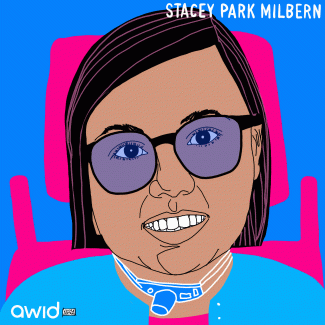
« Je n’y connais pas grand-chose sur la spiritualité ou sur ce qui se passe lorsqu’on meurt, mais ma vie de queer crip coréenne me laisse penser que notre esprit corporel terrestre n’est qu’une petite partie du tout. En ne considérant pas nos ancêtres, nous choisissons de ne voir qu’un aperçu de qui nous sommes. » - Stacey Park Milbern
Stacey Park Milbern s’identifiait comme une femme de couleur, queer, handicapée et précurseure. Leader, mobilisatrice historique et fortement respectée dans le mouvement pour les droits des personnes handicapées et la justice, elle défendait également les droits de nombreuses autres communautés, et non seulement celles auxquelles elle appartenait. L’activisme de Stacey s’appuyait fortement sur ses expériences à l’intersection du genre, du handicap, de la sexualité et de la race.
Stacey a cofondé avec quelques ami·e·s le club de culture sur la justice liée au handicap, un groupe de travail en soutien aux diverses communautés, notamment les plus vulnérables, aidant entre autres les personnes sans-abri à accéder aux ressources durant la pandémie de COVID-19.
Elle a également coproduit une campagne impactante pour le documentaire « Crip Camp » de Netflix. Elle était membre du conseil d’administration de la WITH Foundation et a dirigé plusieurs organisations aux niveaux local, régional et national. Stacey écrivait joliment et vigoureusement :
« Mes ancêtres sont des personnes déchirées de leurs amours par la guerre et les déplacements. C’est grâce à elleux que je connais le pouvoir de construire un foyer avec tout ce que l’on trouve, peu importe l’endroit et les personnes qui sont avec nous. Mes ancêtres sont des queers qui vivaient au Sud américain. Grâce à elleux, j’ai compris l’importance des relations, des lieux et d’une vie vécue en grand, même lorsque cela peut être dangereux. Tou·te·s mes ancêtres connaissent le désir. Ce désir est souvent notre espace de connexion... » - Stacey Park Milbern
Elle est née à Séoul, en Corée, a grandi en Caroline du Nord et continué son parcours dans la région de la baie de San Francisco. Stacey est décédée à la suite de complications chirurgicales le jour de son 33ème anniversaire, le 19 mai 2020.
« Beaucoup de gens le diraient : c’était une leader. Elle couvrait tous les aspects de ce rôle. Vous savez, parfois il y a des conduites de premier rang, de milieu ou de l’arrière. Et elle était d’une certaine façon capable de mener tous ces rangs. » - Andraéa LaVant, activiste pour les droits des personnes handicapées
« Perdre Stacey au moment où nos communautés ont le plus besoin de son leadership est une réelle épreuve, surtout dans un contexte où sa force, sa vision et son cran étaient de plus en plus reconnus dans des milieux autres que ceux du handicap, lui offrant des leviers plus importants pour faire progresser le travail de toute une vie… Nous n’aurons pas la chance de savoir où son leadership charismatique nous aurait mené·e·s. Mais une chose est sûre : ce que Stacey nous a donné, en un temps relativement court, continuera de bénéficier à d’autres dans les prochaines années. » - Disability Rights Education and Defense Fund (Fonds de défense et d’éducation sur les droits liés au handicap)
Quelles mesures seront mises en place pour protéger la santé publique et contenir les risques d'épidémie de la Covid19 ?
Nous surveillons attentivement ce risque parmi d'autres, et nous publierons des informations détaillées concernant la santé et la sécurité dès l'ouverture des inscriptions afin que vous puissiez prendre une décision en toute connaissance de cause. En outre, le format hybride est conçu de façon à offrir une expérience de participation significative aux personnes qui préféreront ne pas voyager ou qui ne sont pas en mesure de le faire.
Salir del clóset en el momento culminante de mi vida: El Foro de Feminismos Negros
Muchxs participantes experimentan los Foros de AWID como un singular espacio de libertad, donde son acogidxs y celebradxs tal como son. En un mundo donde incluso lxs feministas más privilegiadxs a menudo encuentran que no encajan del todo, para aquellas personas cuyas identidades son criminalizadas o de alguna manera condenadas en sus contextos cotidianos esta experiencia de libertad y celebración puede ser profundamente transformadora (y reparadora). La historia de cómo OluTimehin Kukoyi (que participaba por primera vez) vivió el Foro de Feminismos Negros y el Foro de AWID de Bahía (2016) ilustra esto con mucha potencia.
GLOBAL Y DIVERSA: Reflexiona acerca de las realidades de la dotación de recursos entre las organizaciones feministas a escala mundial y desglosada por regiones.
CONTEXTUALIZADA: Se centra en las voces, perspectivas y experiencias de los movimientos feministas en toda su riqueza, audacia y diversidad, en sus respectivos contextos.
DE CREACIÓN CONJUNTA: Desarrollada y puesta a prueba en consulta estrecha con lxs afiliadxs y movimientos aliados de AWID.
COMPLEMENTARIA: Contribuye a la evidencia disponible acerca del estado de la dotación de recursos para las organizaciones feministas, por los derechos de las mujeres y la justicia de género por parte de activistas, donantes feministas y aliadxs, y la difunde.
PLURILINGÜE: Disponible en árabe, español, francés, inglés, portugués y ruso.
CONFIDENCIAL: Damos prioridad a tu privacidad y anonimato. En ningún caso, AWID divulgará información acerca de una organización en particular ni exhibirá información que permita identificar a una organización por su ubicación o características. Los detalles de nuestra política de privacidad se encuentran disponibles aquí.
ACCESIBLE: Es accesible a personas con distinto grado de capacidades auditivas, de movilidad, visuales y cognitivas, y responderla toma aproximadamente 30 minutos.
REPLICABLE: Es susceptible de ser replicada por los movimientos en sus respectivos contextos; las herramientas y los conjuntos de datos de la encuesta estarán disponibles al público como forma de apoyar una mayor investigación y la promoción colectiva.
Do I have to be an AWID member to participate in the Forum?
No, you don't have to be an AWID member to participate but AWID members receive a discounted registration fee as well as a number of other benefits. Learn more on how to become an AWID member.
Donation Success
Thank you for taking a step further to change the world!
Your generous contribution will help us support feminist movements across the globe working to achieve gender justice and women’s human rights worldwide.
You can also support our work as an AWID Member. Find out how here.