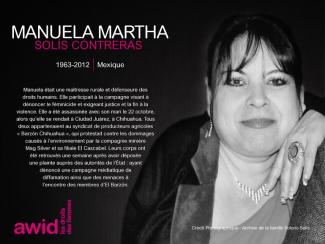
Manuela Martha Solís Contreras

In September 2016, the 13th AWID international Forum brought together in Brazil over 1800 feminists and women’s rights advocates in a spirit of resistance and resilience.
This section highlights the gains, learnings and resources that came out of our rich conversations. We invite you to explore, share and comment!
One of the key takeaways from the 2016 Forum was the need to broaden and deepen our cross-movement work to address rising fascisms, fundamentalisms, corporate greed and climate change.
With this in mind, we have been working with multiple allies to grow these seeds of resistance:
And through our next strategic plan and Forum process, we are committed to keep developing ideas and deepen the learnings ignited at the 2016 Forum.
AWID Forums started in 1983, in Washington DC. Since then, the event has grown to become many things to many peoples: an iterative process of sharpening our analyses, vision and actions; a watershed moment that reinvigorates participants’ feminisms and energizes their organizing; and a political home for women human rights defenders to find sanctuary and solidarity.
หากคำถามเพิ่มเติมอื่นๆ กรุณาติดต่อเรา เราจะอัปเดทเนื้อหานี้อยู่เสมอจากคำถามต่างๆที่เราได้รับจากคุณ
AWID began preparing this annual report just as the global pandemic began to unravel how we gather, organize and live our lives. It is impossible to review what we have done without COVID-19 tinting our assessment.
Download the full 2019 Annual review
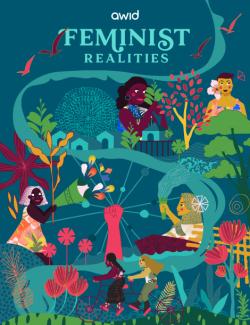
It is an urgently needed affirmation that there are other, more just ways of organizing our lives. During 2019 hundreds of groups shared their experiences and proposals for feminist realities with us, ranging from radical networks of community support in Latin America facilitating self-managed abortion, to practices of community-centered economies in Indonesia and community-centered food systems in India and the US, to a re-imagination and new practice of harm-free rites of passage in Sierra Leone. These are the experiences that will chart a path forward for a “new normal”.
Yet long histories of oppression and violence can make it difficult to imagine the possible. A key part of our work in 2019 was to spark these explorations through a toolkit AWID launched to support groups interested in unearthing the stories and aspirations that are the building blocks of feminist propositions.
Through the Observatory on the Universality of Rights, Feminists for a Binding Treaty, Count Me In! and other alliances, AWID has continued to push back against unfettered corporate power and fascist and fundamentalist agendas that undermine women’s rights and gender justice. With dim prospects for transformative change through multilateral processes and limited responsiveness from most states, we are redoubling our efforts to ensure that feminist movements, in all their diversity, are resourced in ways that match the critical roles they play - supporting their communities, demanding rights and responding to crises. In 2019 we introduced feminist principles and approaches to ground-breaking funds like the Spotlight Initiative and the Equality Fund, and succeeded in leveraging resources through feminist reality seed grant funding from feminist funders.
As we look ahead, it is clear that the context is calling for a transformation of our organizing strategies:
AWID is embarking on a new membership model that lowers barriers to access and emphasizes opportunities for engagement and cross-member connection. We will continue to experiment with different online tools and processes for building community. Cross-movement engagement will stay at the center of our work. AWID’s actions in solidarity with oppressed movements and identities, even and especially where these are marginalized in feminist movements, are important to drive change and support broad and inclusive movements for all.
We are resilient, we adapt, and we show up for each other. And we have to keep doing better. Thank you to all who are part of the journey with us.
Download the full 2019 Annual review
.
Jour 1
From the rising right in many countries and the flurry of funding cuts hitting hard civil society of the Global Majority, to the ongoing genocide in Gaza, the intensification of violent conflicts in Sudan, and climate crisis in many parts of our planet, we are facing real forces of fascism and a world order of impunity. This makes our opportunities to come together and build solidarity particularly valuable and imperative for our survival as a global feminist community. Of course, in 2024, the 15th AWID International Forum finally happened, and what a powerful space it was.
Download the full 2024 Annual Report
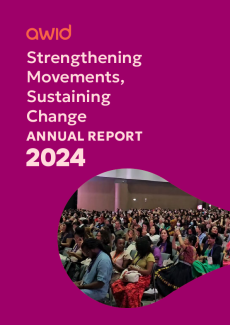
As we look ahead, we build on the powerful calls to action made by feminists at the AWID Forum; Together we can build a world where justice, liberation and care are not aspirations but realities.

Née à Bahia, dans le nord-est du Brésil, Carmen est une immigrante, militante sociale et mère de 8 enfants.
Carmen a connu l'itinérance à l'âge de 35 ans, après avoir émigré seule à São Paulo. Cela l'a amenée à devenir une ardente défenseuse des communautés vulnérables, marginalisées et invisibles les plus touchées par la crise du logement. Elle est finalement devenue l'une des fondatrices de MSTC en 2000.
En tant qu'organisatrice politique visionnaire et actuelle dirigeante du MSTC, le travail de Carmen a révélé la crise du logement de la ville de São Paulo et inspiré d'autres personnes sur différentes façons d'organiser et de gérer les occupations.
Carmen a été fermement à l'avant-garde de diverses occupations. L'une d'elles est l’Ocupação 9 de Julho, qui sert désormais de scène à la démocratie directe et d'espace où chacun·e peut être soigné·e, entendu·e, apprécié·e et travailler ensemble.
Carmen a longtemps été célébrée pour son audace à redonner vie à des bâtiments abandonnés au cœur de São Paulo.
Pour en savoir plus sur sa vie, vous pouvez la suivre sur Instagram!
(avec des invités spéciaux!)
📅Mardi 12 mars
🕒18 h - 21 h 30 HNE
🏢 Blue Gallery, 222 E 46th St, New York
Entrée par RSVP uniquement
Ritu est une technologue féministe qui apporte son expérience au secteur non lucratif, animée par une passion pour l'utilisation d'approches innovantes pour trouver des solutions technologiques féministes. Titulaire d'un master en technologie des applications informatiques de l'Institut indien de technologie, son rôle au sein de l'AWID couvre un large spectre de responsabilités. De la supervision de la sécurité numérique et gestion des serveurs à l'administration des bases de données, en passant par le renforcement des capacités, l'évaluation technologique, la mise en œuvre de logiciels et de solutions cloud, Ritu veille à ce que l'infrastructure informatique de l'AWID soit résiliente et efficace. Avant de rejoindre l'AWID, elle a joué un rôle central dans l'avancement des initiatives technologiques des secteurs de la promotion de la santé et de l'environnement, alimentée par son engagement à tirer parti de la technologie pour le bien social.
 |
Human and ethnic-territorial rights Ensuring the defense of human rights and Nature’s rights through alliance-building with local, national, regional and global actors and organizations. |
 |
Sustainable development Ensuring all economic, cultural and environmental activities contribute to sustainable development, food security and income generation, while respecting the self-determination and self-government of Afro-descendant communities. |
 |
Education and training Carrying out training for women and empowering them to carry out women’s rights advocacy in different political, social and economic spaces. For more information, see here! |
The WITM survey is focused on the feminist resourcing realities of the last 3 years (2021 to 2023), and has five key sections:
It consists of mandatory* and optional questions, most of which are multiple-choice. You will have a chance to share more on issues that are important to you by responding to the open question(s) at the end of the survey.

To respond to the questions quickly and easily, we advise that you have your key financial information at hand (e.g., your annual budgets from 2021 to 2023). However, if you wish to save your responses and come back to the survey later, you are able to do this whenever needed.
Marianne Mesfin Asfaw is a Pan-African feminist who is dedicated to social justice and building community. She has a BA in Gender Studies and International Relations from the University of British Columbia (UBC), and an MA in Gender Studies and Law from SOAS University of London. She has previously worked in academic administration and international student support, and has worked as a researcher and facilitator in feminist and non-profit spaces. She has also worked and volunteered at non-governmental organizations including Plan International in administrative roles. Prior to taking up her current role she worked in logistics and administrative support at AWID. She is from Ethiopia, was raised in Rwanda and is currently based in Tkaronto/Toronto, Canada. She enjoys reading, traveling and spending time with her family and friends. In the warmer months she can be found strolling around familiar neighborhoods in search of obscure cafés and bookstores to wander into.

Paseando por el barrio del Raval en Barcelona, puede que te encuentres con Metzineres, una cooperativa feminista por y para mujerxs que consumen drogas y que sobreviven múltiples situaciones de vulnerabilidad.
Imagínate un lugar libre de estigma, donde lxs mujerxs puedan consumir drogas de manera segura. Un lugar que brinda seguridad, apoyo y acompañamiento a mujerxs cuyos derechos son sistemáticamente vulnerados por la guerra contra las drogas y que sufren violencia, discriminacion y represión como consecuencia.
Justo afuera de la entrada, lxs transeúntes y visitantes son recibidxs con una enorme pizarra que describe consejos, trucos, deseos y dibujos de personas que usan drogas. También hay un calendario que cuenta con una serie de actividades auto-gestionadas por la comunidad de Metzineres. Ya sean talleres de peluquería y cosmética, radio, teatro, comidas comunales ofrecidas a la comunidad o clases de defensa personal, ¡siempre hay algo que hacer!
La cooperativa proporciona sitios de consumo seguros, así como servicios que cubren las necesidades básicas de las personas. Hay camas, espacios de almacenamiento, duchas, baños, lavadoras y una pequeña terraza al aire libre donde la gente puede relajarse o hacer un poco de jardinería.
Metzineres opera dentro de un marco de reducción de daños, que intenta reducir las consecuencias negativas del uso de drogas. Pero la reducción de daños es mucho más que un conjunto de prácticas: es una política anclada en la justicia social, la dignidad y los derechos de las personas que consumen drogas.