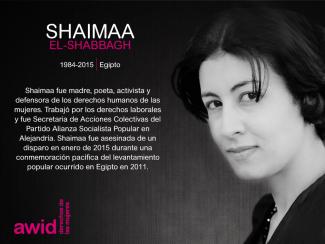
Shaimaa El-Shabbagh
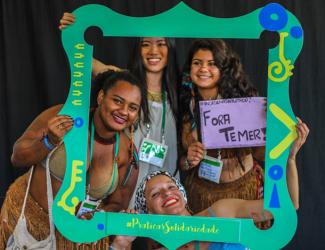
Young feminist activists play a critical role in women’s rights organizations and movements worldwide by bringing up new issues that feminists face today. Their strength, creativity and adaptability are vital to the sustainability of feminist organizing.
At the same time, they face specific impediments to their activism such as limited access to funding and support, lack of capacity-building opportunities, and a significant increase of attacks on young women human rights defenders. This creates a lack of visibility that makes more difficult their inclusion and effective participation within women’s rights movements.
AWID’s young feminist activism program was created to make sure the voices of young women are heard and reflected in feminist discourse. We want to ensure that young feminists have better access to funding, capacity-building opportunities and international processes. In addition to supporting young feminists directly, we are also working with women’s rights activists of all ages on practical models and strategies for effective multigenerational organizing.
We want young feminist activists to play a role in decision-making affecting their rights by:
Fostering community and sharing information through the Young Feminist Wire. Recognizing the importance of online media for the work of young feminists, our team launched the Young Feminist Wire in May 2010 to share information, build capacity through online webinars and e-discussions, and encourage community building.
Researching and building knowledge on young feminist activism, to increase the visibility and impact of young feminist activism within and across women’s rights movements and other key actors such as donors.
Promoting more effective multigenerational organizing, exploring better ways to work together.
Supporting young feminists to engage in global development processes such as those within the United Nations
Collaboration across all of AWID’s priority areas, including the Forum, to ensure young feminists’ key contributions, perspectives, needs and activism are reflected in debates, policies and programs affecting them.
por Maryum Saifee
Cuando se hace una búsqueda en Internet sobre «mutilación genital femenina» o «MGF», junto a la entrada de Wikipedia, aparece una imagen de cuatro dibujos lineales de la anatomía femenina, que ilustran cuatro tipos de violencia. (...)
arte: «Dreams» [Sueños], Neesa Sunar >
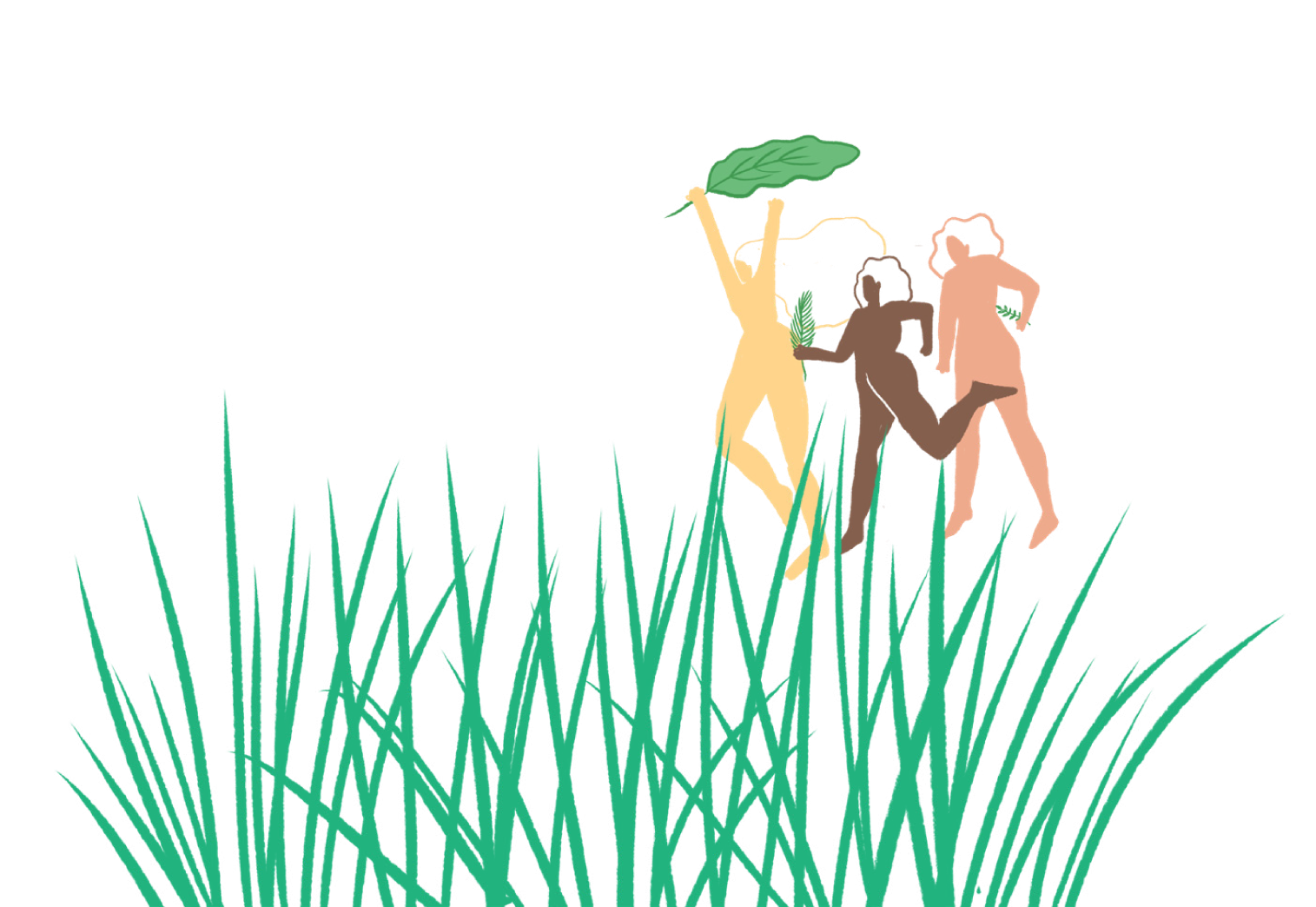
In 2022, AWID celebrates 40 years since our founding. We’re using this moment to reflect on our past and learn from the road traveled as we prepare to look forward, and to forge the journey ahead. As we move through cycles of progress and pushback, we know that struggles for women’s rights and gender justice are iterative and non-linear. In collaboration with artist Naadira Patel, we created a scrapbook that highlights a handful of snapshots from AWID’s last four decades of feminist movement support.
We have not done all this on our own. We share this with deep appreciation for the constellation of feminist activists and groups that have made this work possible. In this context of so many converging crises, we embrace the opportunity to celebrate the power and resilience of feminist movements around the world.
You can also explore in full-screen mode.
Download the Scrapbook
« La vie... c’est vivre dans la joie, se lever avec un but, sentir son énergie créative, répondre à son appel. » – Sylvia Robinson
Cet espace de performances créatrices foisonnantes rassemblait des initiatives d’éducation, d’engagement citoyen, d’arts, de services sociaux et spirituels et de pratiques de développement durable. Sylvia considérait cet endroit comme une maison où « il existe un équilibre et une synergie avec les activités dont les gens ont besoin pour entretenir la vie ».
Elle comptait également parmi les membres fondateur·trice·s du Georgia Avenue Community Development Taskforce, dans le nord-ouest de la capitale, un groupe de quartier actif dans le domaine de la justice sociale et de l’organisation qui veillait à ce que la communauté ait son mot à dire dans le redéveloppement et l’embourgeoisement du secteur.
« Nous demandons des logements abordables. Nous demandons que les petits commerces qui sont ici depuis longtemps ne soient pas balayés par de nouvelles enseignes. Nous demandons des espaces verts et des lieux où les gens peuvent se rencontrer. Nous demandons à ce que le paysage urbain soit amélioré, avec des rues en meilleur état et des éclairages publics. » – Sylvia Robinson, à propos du travail de la Taskforce
Avant de devenir organisatrice, et après avoir obtenu son diplôme en informatique, Sylvia avait travaillé dans le domaine des systèmes de contrôle du trafic aérien pendant plus d’une décennie. Elle s’est ensuite orientée vers le conseil relatif à la consommation d’alcool et de drogue, s’impliquant davantage dans le travail communautaire.
« Cette implication dans la communauté, c’était ma vocation. » – Sylvia Robinson
Née à Washington D.C. le 14 août 1961, Sylvia est décédée le 18 septembre 2017 après avoir lutté contre le cancer.
« L’esprit et l’héritage de Sylvia continueront d’inspirer cette communauté pour de nombreuses années. » – ECAC
Nous tenons à remercier le collectif Amar.ela de femmes féministes militantes et créatives qui ont rendu cette série possible, et tout particulièrement Natalia Mallo (le poulpe de l'équipe) pour son soutien et son accompagnement dans ce voyage.
Nous exprimons également notre profonde gratitude et notre admiration à tous les groupes et personnes qui ont participé à ce projet, et nous les remercions d'avoir partagé leur temps, leur sagesse, leurs rêves et leurs illusions avec nous. Nous les remercions de faire de ce monde un monde plus juste, féministe et durable.
Nous espérons que leurs histoires inspireront le reste du monde autant qu’elles nous ont inspirés.
par Émilie Herbert-Pontonnier
Vous vous souvenez d’Esmeralda? Cette héroïne « gitane » et exotique née sous la plume de Victor Hugo, géant de la littérature française, et rendue célèbre par les studios Disney et leur Bossu de Notre-Dame. (...)
< illustration : « Si les Marronas le permettent » Nayare Soledad Otorongx Montes Gavilan
Por Nkhensani Manabe
El título de la conversación «¿Pansexual, ginosexual o abrosexual? Una exploración de lo queer, el placer y la positividad sexual» da mucho para pensar. Tiffany Kagure Mugo (escritora, educadora y curadora de HOLAAfrica) comienza la sesión con una lectura de Touch [Tocar/Tacto], una compilación recientemente publicada de ensayos de ficción y no ficción sobre sexo, sexualidad y placer. En este fragmento, la autora propone la idea de que el placer es constante y continuo, que está presente en las actividades cotidianas, y que no se circunscribe a las relaciones sexuales.
Esta idea de que el placer es parte de la vida diaria (al igual que tantas otras cosas) atraviesa la conversación, que también abarca temas sobre el deseo, la atracción y la orientación sexual.

Desde el comienzo, existe una sensación de esperanza y posibilidad. Tiffany presenta opciones y explica alternativas, dándonos un nuevo lenguaje para hablar sobre quiénes somos, qué nos gusta, y cómo lo queremos. Esto se refiere al deseo y al sexo, pero se trata primordialmente de autoconocimiento y empoderamiento. Tiffany habla apasionadamente sobre tomar decisiones desde un lugar de poder: aprender sobre la propia identidad para poder elegir lo mejor para unx mismx.
En una conversación abierta y libre, que representa la actitud que Tiffany propone que todxs adoptemos, aprendemos que el conocimiento sobre sexo y sexualidad está en permanente cambio, que los límites se están desplazando. Lo que podemos haber aprendido o, más fundamentalmente, aquello que se nos ocultó durante la infancia o la adultez es exactamente el lugar desde donde deberíamos comenzar a desaprender y reprogramarnos. Tiffany señala que, actualmente, las personas jóvenes necesitan herramientas para comprender las experiencias que ya están teniendo, un recordatorio para no subestimar jamás lo que lxs niñxs y adolescentes saben sobre la clase de placer/es que quieren procurarse en la vida.
La conversación abrió mi mente a esto: conocerme a mí misma me ayudará a desarrollar mi confianza; podré encarar relaciones con cuidado no solo de mí misma sino de otras personas también. Aprender el lenguaje de orientación, atracción, deseo y placer contribuirá a profundizar mis futuras conexiones. Valoré el espacio para pensar sobre este aspecto de mi vida: las partes privadas e íntimas a las que no accedo habitualmente. El entusiasmo de Tiffany sobre el placer y la identidad desplazó mis propias barreras, permitiéndome considerar nuevas posibilidades personales.
La idea de aprender a establecer conexiones holísticas no es algo común todavía. En general, vivimos en una cultura de conexiones instantáneas y pasajeras. Casi no hay tiempo para reflexionar verdaderamente sobre cómo y por qué buscamos relaciones o parejas... al menos, no hasta que llega un momento de crisis.
Por supuesto, existen espacios privilegiados que están abiertos a preguntas y conversaciones, tales como el festival «Crear Résister Transform» de AWID y otras plataformas o publicaciones en línea que promueven la libertad de pensamiento. Pero el acceso a la información de fuentes útiles y sin prejuicios es algo que todavía debe ser descifrado. Esto puede deberse en parte al hecho de que la gente no se siente segura en el lenguaje de la sexualidad y el placer.

La idea del lenguaje y las herramientas se repite durante toda la presentación de Tiffany. Ella y sus colegas están haciendo el trabajo de hablar, enseñar y nutrir, viendo qué es lo que cada persona necesita, dónde están esas personas, qué quieren para sí mismxs, y caminando junto con ellxs mientras construyen sus mundos ideales, brindándoles nuevas palabras y definiciones para ayudarlxs a configurar sus identidades en las diferentes etapas de sus vidas.
Esta es la clase de conversaciones que se necesita, incluso en una sociedad que permanentemente difunde un sinfín de mensajes sobre el cuidado de la salud, con diferentes grados de detalle. A veces la gente debe retrotraerse de las instancias de perspectiva global, y sentirse alentada a aprender sobre sus opiniones y deseos individuales. Esto es lo que hace la ponencia de Tiffany: genera un espacio para cada persona, dentro del rompecabezas general.
Sexual: el deseo expreso de tener relaciones sexuales con una o varias personas
Sensual: el deseo de tocar a una o varias personas, de estar físicamente cerca, sin necesariamente incluir una relación sexual
Romántica: el deseo de salir con una o varias personas, o de estar en una relación con una o varias personas
Platónica: el deseo de construir amistades profundas
Estética: el deseo de mirar a una o varias personas, sintiendo placer por su apariencia
Estos cinco tipos o niveles de atracción ofrecen una forma abreviada para definir el deseo y el placer, y ayudan a contextualizar las distintas clases de placer que pueden experimentar las personas.
Pensar la atracción más allá de lo físico o sexual ofrece una nueva perspectiva sobre la conexión. Es una oportunidad para restar presión a las relaciones, abriendo oportunidades para asociaciones diferentes, más esclarecidas y satisfactorias.
Esta libertad y este conocimiento que propone Tiffany configuran una hoja de ruta hacia el futuro. La presentación ofreció una nueva perspectiva sobre aquello que es posible.
Tal como lo expresa el fragmento de apertura, el placer es continuo. A la luz de la ponencia de Tiffany, también resulta claro que el placer es dinámico y apasionante. Siempre hay más para aprender.
Esto puede parecer abrumador al comienzo, pero del otro lado del titubeo se encuentran la esperanza, el potencial y la libertad.
✉️ Les inscriptions en personne sont closes. Inscrivez-vous au livestream ici
Événement en anglais
📅 Mercredi 12 mars 2025
🕒 12.00h-13.30h EST
🏢 PNUD, 304 E 45th St. Doha Room, 11th Floor (FF Building)
Organisé par : PNUD, Femena, SRI et AWID
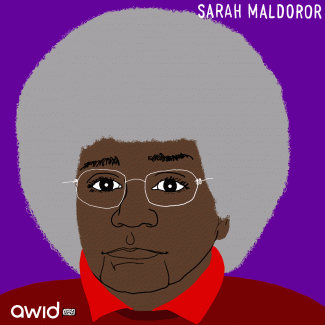
“I’m no adherent to the concept of the ‘Third World’. I make films so that people - no matter what race or color they are - can understand them. For me there are only exploiters and the exploited, that’s all. To make a film means to take a position.” - Sarah Maldoror
Her groundbreaking film and “revolutionary picture” Sambizanga (1972) follows Angolan militants’ anti-colonial liberation struggle, as well as captures a woman’s perspective in a historical moment she finds herself in.
“For many African filmmakers, cinema is a revolutionary tool, a political education to raise consciousness. It is inscribed in the evolution of a Third Cinema striving to decolonize thought and advocate radical changes in society.” - Sarah Maldoror
Throughout her career, Sarah - together with a number of African and Caribbean artists - co-founded (1956) the first Black theatre troupe in France. She made around 40 films, comprising important documentaries that amplify the lives and work of black artists, including her friend and poet Aimé Césaire who wrote to her:
“To Sarah Maldo
who, a camera in hand,
fights oppression, alienation
and flies in the face
of human bullshit.”
Sarah was also committed to giving African women more ownership of the filmmaking process. In an interview, she pointed out:
"African women must be everywhere. They must be in the images, behind the camera, in the editing room and involved in every stage of the making of a film. They must be the ones to talk about their problems."
Sarah left an incredibly powerful legacy to be carried forward.
Born 19 July 1929, Sarah passed away on 13 April 2020 from complications of the coronavirus.
Watch Sambizanga and read a film review in a 1973 New York Times article
by Judyannet Muchiri
October last year I left for Kenya to begin what I have come to think of as my most important work yet. (...)
artwork: “Healing Together” by Upasana Agarwal >
Chers êtres splendides,
Je sais que vous y êtes presque. Vous le sentez, non? La manière dont les choses doivent changer et que vous devez recentrer.
Ceci est une lettre pour vous dire de le faire. Choisissez votre guérison. Choisissez d’aller bien. Mieux que bien. Choisissez d’être entières, être heureuses. De pleurer pour vous-même et pour personne d’autre. Choisissez de laisser le monde dehors et de lui dire « Je reviens dans cinq minutes ». Ou dans cinq jours. Ou dans cinq ans.

Ou jamais.
Choisissez de ne pas tout prendre. Choisissez de ne rien en prendre. Parce que rien de tout cela n’est à vous. Et ça ne l’a jamais été. On vous dit depuis votre naissance que c’est à vous. Les problèmes de votre famille. Les problèmes de votre amoureuxse. Les problèmes du quartier. Les problèmes du monde. Cette petite voix constante qui vous dit que ces problèmes vous appartiennent. Ils sont à vous. C’est à vous de les tenir, à vous de les supporter. À vous de les régler.
C’était un mensonge.
Un bobard.
Une arnaque.
Une escroquerie.
Les problèmes de l’univers ne sont pas les vôtres.
Les seuls problèmes qui sont à vous sont les vôtres. Tout le reste peut aller se faire voir.
Permettez-vous de tout lâcher et de partir en courant dans la jungle. Faites connaissance avec une nymphe vêtue de marguerites, ouvrez une petite librairie dans les racines d’un arbre. Dansez toute nue et hurlez à la lune. Discutez avec Ochun sur les berges de la rivière.
Ou buvez simplement une tasse de thé quand vous avez besoin de prendre le temps de vous poser.
Donnez-vous la permission de disparaître dans la brume et réapparaissez trois pays plus loin en tant que mystérieuse chocolatière au passé un peu trouble avec un penchant pour les habits excentriques et les cigares.
Ou arrêtez de prendre les appels du travail cette fin de semaine.
Nagez jusqu’à une île déserte avec votre amoureuxse et habillez-vous de noix de coco avec lesquelles vous aurez fait un rhum que vous savourerez au coucher du soleil.
Ou dites non quand vous n’avez pas la capacité de faire de la place à quelqu’un.
Les options pour vous retenir sont innombrables.
Quoi que vous fassiez, sachez que le monde continuera de tourner. C’est là toute la beauté et la douleur de l’expérience. Qui ou quoi que vous choisissiez plutôt que vous-même et votre âme, le monde continuera toujours de tourner.
Donc, choisissez-vous.
Le matin, quand la première lueur apparaît, choisissez-vous. Quand arrive midi et qu’il est l’heure de pleurer pendant vos heures de travail, choisissez-vous. Le soir, quand vous réchauffez des restes parce que vous n’avez pas eu le temps de cuisiner, choisissez-vous. Quand l’anxiété vous réveille et que l’existence fait silence à 3 h 45 du matin.
Choisissez-vous.
Parce que le monde continuera toujours à tournoyer, de guingois, et que vous méritez d’avoir quelqu’un·e qui essaie toujours de le redresser pour vous.
Avec amour,
Votre nymphe de la jungle vêtue excentriquement
✉️ By registration for larger groups. Drop-ins for smaller groups. Register here
📅 Wednesday, March 12, 2025
🕒 2.00-4.00pm EST
🏢 Chef's Kitchen Loft with Terrace, 216 East 45th St 13th Floor New York
Organizer: AWID
María Digna Montero fue una garífuna (afrodescendiente e indígena) defensora de la tierra e integrante de la Organización Fraternal Negra Hondureña (OFRANEH), una organización de base que trabaja para proteger a las comunidades garífunas, sus derechos ancestrales, su cultura, sus recursos y su territorio.
María también enseñaba en la escuela local, e integraba el grupo de trabajo de Educación Bilingüe Intercultural de OFRANEH.
El 12 de octubre (Día de la Resistencia Indígena) de 2019, sujetos desconocidos le dispararon a María varias veces en el patio de su casa.
Fue una de las seis defensoras garífunas asesinadas entre septiembre y octubre de 2019 y, según OFRANEH, no hubo ninguna investigación de estos crímenes por parte de las autoridades. En un comunicado oficial, la organización también subrayó la conexión entre la violencia contra líderes garífunas y el incremento de las industrias extractivas que explotan los recursos naturales en sus comunidades, y definieron esta violencia como «parte de una estrategia de intimidación y de expulsión sistemática por parte del Estado de Honduras.»
«El recrudecimiento de la tensión y de los riesgos crecientes para la seguridad y derechos humanos de las lideresas en las comunidades y territorios ancestrales es producto del despojo, desplazamiento y criminalización hacia las comunidades, y de los mega proyectos extractivos que impulsa el Estado junto con las corporaciones nacionales e internacionales.» - Pronunciamiento de OFRANEH, 13 de octubre de 2019