Women Human Rights Defenders
WHRDs are self-identified women and lesbian, bisexual, transgender, queer and intersex (LBTQI) people and others who defend rights and are subject to gender-specific risks and threats due to their human rights work and/or as a direct consequence of their gender identity or sexual orientation.
WHRDs are subject to systematic violence and discrimination due to their identities and unyielding struggles for rights, equality and justice.
The WHRD Program collaborates with international and regional partners as well as the AWID membership to raise awareness about these risks and threats, advocate for feminist and holistic measures of protection and safety, and actively promote a culture of self-care and collective well being in our movements.
Risks and threats targeting WHRDs
WHRDs are exposed to the same types of risks that all other defenders who defend human rights, communities, and the environment face. However, they are also exposed to gender-based violence and gender-specific risks because they challenge existing gender norms within their communities and societies.
By defending rights, WHRDs are at risk of:
- Physical assault and death
- Intimidation and harassment, including in online spaces
- Judicial harassment and criminalization
- Burnout
A collaborative, holistic approach to safety
We work collaboratively with international and regional networks and our membership
- to raise awareness about human rights abuses and violations against WHRDs and the systemic violence and discrimination they experience
- to strengthen protection mechanisms and ensure more effective and timely responses to WHRDs at risk
We work to promote a holistic approach to protection which includes:
- emphasizing the importance of self-care and collective well being, and recognizing that what care and wellbeing mean may differ across cultures
- documenting the violations targeting WHRDs using a feminist intersectional perspective;
- promoting the social recognition and celebration of the work and resilience of WHRDs ; and
- building civic spaces that are conducive to dismantling structural inequalities without restrictions or obstacles
Our Actions
We aim to contribute to a safer world for WHRDs, their families and communities. We believe that action for rights and justice should not put WHRDs at risk; it should be appreciated and celebrated.
-
Promoting collaboration and coordination among human rights and women’s rights organizations at the international level to strengthen responses concerning safety and wellbeing of WHRDs.
-
Supporting regional networks of WHRDs and their organizations, such as the Mesoamerican Initiative for WHRDs and the WHRD Middle East and North Africa Coalition, in promoting and strengthening collective action for protection - emphasizing the establishment of solidarity and protection networks, the promotion of self-care, and advocacy and mobilization for the safety of WHRDs;
-
Increasing the visibility and recognition of WHRDs and their struggles, as well as the risks that they encounter by documenting the attacks that they face, and researching, producing, and disseminating information on their struggles, strategies, and challenges:
-
Mobilizing urgent responses of international solidarity for WHRDs at risk through our international and regional networks, and our active membership.
Related Content
¿Qué es AWID?
La Asociación para los Derechos de las Mujeres y el Desarrollo (AWID) es una organización internacional feminista de membresía.
Trabajamos para alcanzar la justicia de género y los derechos humanos de las mujeres mediante el fortalecimiento de la voz colectiva, el impacto y la influencia de las/os activistas, organizaciones y movimientos por los derechos de las mujeres de todo el mundo.
Is there a preferred methodology for the sessions?
The Call for Activities lists a number of suggested formats and methodologies. Be creative and make sure to read the section “What you need to know”.
Snippet She is on her way_Fest (EN)
Plenary session:
She is on her way:
Alternatives, feminisms and another world
Felogene Anumo, AWID
Dr. Vandana Shiva, India
Dr. Dilar Dirik, Kurdistan
Nana Akosua Hanson, Ghana
L’AWID est-elle une organisation féministe ?
Sushmita Banerjee
Si lxs presentadorxs utilizan una lengua de señas que no es el ISL, ¿habrá interpretación en otras lenguas de señas?
Si tu actividad es seleccionada, el equipo de AWID te contactará para evaluar y responder a tus necesidades de interpretación y accesibilidad.
Do you produce an annual report?
Yes, we do produce annual reports.
All our annual reports are accessible online.
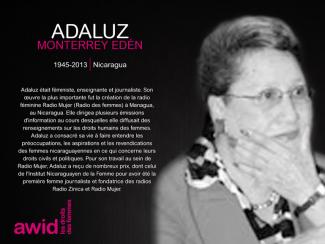
Adaluz Monterrey Eden
لماذا بانكوك؟
يعقد كل منتدى في منطقة مختلفة، وقد حان الوقت لعودة منتدى جمعية حقوق المرأة في التنمية إلى آسيا! قمنا بزيارة العديد من البلدان في المنطقة، واستشرنا الحركات النسوية، وأجرينا تقييمات مفصلة للخدمات اللوجستية، وإمكانية الوصول، والسلامة، والتأشيرات، وغيرها من التفاصيل. وفي نهاية المطاف، وافق مجلس إدارة جمعية حقوق المرأة في التنمية على إقامة المنتدى في بانكوك، تايلاند، باعتبارها الخيار الأفضل. نحن متحمسون/ات للعودة إلى بانكوك، حيث عقدنا منتدى جمعية حقوق المرأة في التنمية في عام 2005.
Hande Kader
Snippet intro text_Festival (FR)
Notre festival a réuni 130 conférencièr.e.s, animateur.ice.s et artistes de 43 pays, réparti.e.s sur plus de 40 sessions !
Escribí un artículo sobre un asunto relacionado con los derechos de las mujeres y el desarrollo. ¿Cómo puedo compartirlo con la membresía de AWID?
Margarita Murillo
CFA FAQ - Funding - AR
تمويل مشاركتك
Ruth Alicia López Guisao
Contenu lié
Front Line Defenders: Assassinat de Ruth Alicia Lopez Guisao
Snippet SM CTA_Fest (FR)
Suivez-nous sur les réseaux sociaux et partagez vos moments préférés de notre festival :
Facebook: @AWIDWomensRights
Instagram: @awidwomensrights
Twitter FR: @awid_fr
LinkedIn: Association for Women's Rights in Development (AWID)
2003: le premier Dialogue de haut niveau a lieu
Premier Dialogue de haut niveau sur le financement du développement, 29-30 octobre 2003.
Les dialogues de haut niveau de l’Assemble générale des Nations Unies sur le financement du développement, tenus tous les deux ans, sont l’un des mécanismes de suivi de la Conférence de Monterrey. À la suite de ce premier dialogue, huit tables rondes ont été organisées autour de différentes questions comprenant les subventions agricoles, le commerce, l’allègement de la dette et le financement des OMD. Toutes les discussions se concentraient sur les manières de faire face aux obstacles structurels qui pesaient sur ces questions et défavorisaient les nations « en développement ».
D'autres mécanismes de suivi de la Conférence de Monterrey :
- Les réunions spéciales de haut niveau du Conseil économique et social des Nations Unies (ECOSOC) tenues chaque année sur le thème du suivi du Consensus de Monterrey et sous la direction de la Banque mondiale, du Fonds monétaire international, de l’Organisation mondiale du commerce et de la CNUCED. En outre, au cours de chacune de ses sessions de fond, l’ECOSOC consacre jusqu’à deux jours à des délibérations portant sur les priorités du FdD.
- L’organe des Nations Unies consacré aux questions fiscales, le Comité d'experts de la coopération internationale en matière fiscale, traite des différentes questions relatives aux politiques fiscales qui ont été identifiées dans le Consensus de Monterrey. Il constitue un cadre de dialogue visant à améliorer et à encourager la coopération fiscale internationale entre les autorités fiscales nationales.