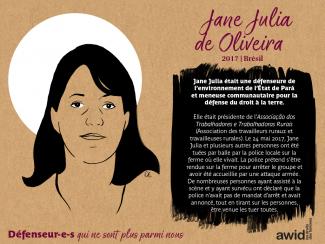
Jane Julia de Oliveira

WHRDs are self-identified women and lesbian, bisexual, transgender, queer and intersex (LBTQI) people and others who defend rights and are subject to gender-specific risks and threats due to their human rights work and/or as a direct consequence of their gender identity or sexual orientation.
WHRDs are subject to systematic violence and discrimination due to their identities and unyielding struggles for rights, equality and justice.
The WHRD Program collaborates with international and regional partners as well as the AWID membership to raise awareness about these risks and threats, advocate for feminist and holistic measures of protection and safety, and actively promote a culture of self-care and collective well being in our movements.
WHRDs are exposed to the same types of risks that all other defenders who defend human rights, communities, and the environment face. However, they are also exposed to gender-based violence and gender-specific risks because they challenge existing gender norms within their communities and societies.
We work collaboratively with international and regional networks and our membership
We aim to contribute to a safer world for WHRDs, their families and communities. We believe that action for rights and justice should not put WHRDs at risk; it should be appreciated and celebrated.
Promoting collaboration and coordination among human rights and women’s rights organizations at the international level to strengthen responses concerning safety and wellbeing of WHRDs.
Supporting regional networks of WHRDs and their organizations, such as the Mesoamerican Initiative for WHRDs and the WHRD Middle East and North Africa Coalition, in promoting and strengthening collective action for protection - emphasizing the establishment of solidarity and protection networks, the promotion of self-care, and advocacy and mobilization for the safety of WHRDs;
Increasing the visibility and recognition of WHRDs and their struggles, as well as the risks that they encounter by documenting the attacks that they face, and researching, producing, and disseminating information on their struggles, strategies, and challenges:
Mobilizing urgent responses of international solidarity for WHRDs at risk through our international and regional networks, and our active membership.
Nombre d’hommes qui partagent notre engagement vis-à-vis du féminisme et des droits humains des femmes sont membres de l’AWID.
Felogene Anumo, AWID
Dr. Vandana Shiva, India
Dr. Dilar Dirik, Kurdistan
Nana Akosua Hanson, Ghana
Чтобы заявить о себе как об эксперте по вопросам ресурсного обеспечения феминистских движений
Contenido relacionado
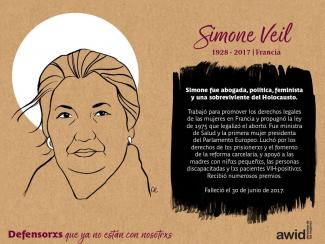
Huffington Post: Muere Simone Veil, la moral de Francia hecha mujer
El Mundo: Muere Simone Veil, superviviente del Holocauso e icono de los derechos de la mujer
Coumba Toure
Cindy Clark, AWID
DJ Miss Ray
DJ Luana Flores
Phoenix Inana

 За последнее десятилетие спонсоры выделили значительно больше средств на обеспечение гендерного равенства, однако лишь 1% средств, выделенных на благотворительность и развитие был направлен непосредственно на поддержку социальных изменений, проводимых под руководством феминисток.
В солидарности с движениями, которые по-прежнему остаются невидимыми, маргинализированными и не имеют доступа к основному, долгосрочному, гибкому и основанному на доверии финансированию, данный опрос освещает фактическое состояние ресурсного обеспечения, выявляет ошибочные решения и указывает на то, как необходимо изменить модели финансирования, чтобы движения процветали и решали сложные задачи современного мира.
Conférence internationale de suivi sur le financement du développement, Doha, Qatar
Do you want to be inspired by the creative resistance strategies of feminists from all over the world? Do you want to discover feminist initiatives that show us how we can all live in a more just world? Do you want to learn about models of feminist care and healing to bring to your own community? Is that a resounding yes that we hear? YES!
Then check out Crear | Résister | Transform: a festival for feminist movements. This festival took place virtually throughout the month of September 2021 across all of AWID’s platforms, and now you can experience it on your own time.
The panelists participated in their preferred language and at AWID we included subtitles on the videos for your accessibility.
AWID выражает признательность всем тем, чьи идеи, аналитические работы и вклад в развитие легли в основу исследования «Где деньги?» и его дальнейшей адвокации.
Прежде всего, мы выражаем глубочайшую благодарность членам AWID и активисткам(-там), которые участвовали в консультациях, и провели этот опрос вместе с нами, щедро поделившись своим временем, аналитикой и теплом.
Мы выражаем признательность феминистским движениям, союзницам(-кам) и феминистским фондам, включая (но не ограничиваясь ими) Black Feminist Fund, Pacific Feminist Fund, ASTRAEA Lesbian Foundation for Justice, FRIDA Young Feminist Fund, Purposeful, Kosovo Women’s Network, Human Rights Funders Network, Dalan Fund and PROSPERA International Network of Women's Funds , за ваше тщательное исследование состояния ресурсного обеспечения, вдумчивый анализ и постоянную адвокацию для достижения более объемного и эффективного финансирования для феминистских организаций и движений за гендерную справедливость во всех контекстах.