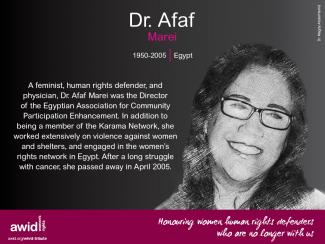
Dr. Afaf Marei

Building Feminist Economies is about creating a world with clean air to breath and water to drink, with meaningful labour and care for ourselves and our communities, where we can all enjoy our economic, sexual and political autonomy.
In the world we live in today, the economy continues to rely on women’s unpaid and undervalued care work for the profit of others. The pursuit of “growth” only expands extractivism - a model of development based on massive extraction and exploitation of natural resources that keeps destroying people and planet while concentrating wealth in the hands of global elites. Meanwhile, access to healthcare, education, a decent wage and social security is becoming a privilege to few. This economic model sits upon white supremacy, colonialism and patriarchy.
Adopting solely a “women’s economic empowerment approach” is merely to integrate women deeper into this system. It may be a temporary means of survival. We need to plant the seeds to make another world possible while we tear down the walls of the existing one.
We believe in the ability of feminist movements to work for change with broad alliances across social movements. By amplifying feminist proposals and visions, we aim to build new paradigms of just economies.
Our approach must be interconnected and intersectional, because sexual and bodily autonomy will not be possible until each and every one of us enjoys economic rights and independence. We aim to work with those who resist and counter the global rise of the conservative right and religious fundamentalisms as no just economy is possible until we shake the foundations of the current system.
Advance feminist agendas: We counter corporate power and impunity for human rights abuses by working with allies to ensure that we put forward feminist, women’s rights and gender justice perspectives in policy spaces. For example, learn more about our work on the future international legally binding instrument on “transnational corporations and other business enterprises with respect to human rights” at the United Nations Human Rights Council.
Mobilize solidarity actions: We work to strengthen the links between feminist and tax justice movements, including reclaiming the public resources lost through illicit financial flows (IFFs) to ensure social and gender justice.
Build knowledge: We provide women human rights defenders (WHRDs) with strategic information vital to challenge corporate power and extractivism. We will contribute to build the knowledge about local and global financing and investment mechanisms fuelling extractivism.
Create and amplify alternatives: We engage and mobilize our members and movements in visioning feminist economies and sharing feminist knowledges, practices and agendas for economic justice.
“The corporate revolution will collapse if we refuse to buy what they are selling – their ideas, their version of history, their wars, their weapons, their notion of inevitability. Another world is not only possible, she is on her way. On a quiet day, I can hear her breathing”.
Arundhati Roy, War Talk
"We know everything is against us and there is very little chance to change that. But we believe in intervention and I do think we have a chance and should use it. That’s why we're doing everything we're doing. We're willing to push for things that are unheard of."
Sopo Japaridze to OpenDemocracy
Photo @სოლიდარობის ქსელი / Solidarity Network

With over ten years of finance experience, Lucy has devoted her career to for profit and furthering nonprofit missions. She also worked and volunteered at non-for-profit organizations. From the fast-paced world of Finance, Lucy has passion for staying tuned with tech skills in the finance field. Lucy joined AWID in 2014. During her spare time she enjoys music, traveling, and variety sports.
Elina is a young afro-Dominican intersectional feminist and human rights lawyer, committed to use her voice and skills to build a more just, empathic and inclusive world. She started Law school at 16, convinced it would give her the tools to understand and promote social justice. After a J.D. in the Dominican Republic, she pursued an LL.M. in Public International Law and Human Rights in the UK as a Chevening Scholar. She was the only Latinx-Caribbean woman in her class, graduating with honours.
Elina has worked at the intersection of human rights, gender, migration and policy, from government, grassroots collectives and international organizations. She helped litigate cases on gender-based violence before the Inter-American Court of Human Rights. As a member of the Youth Advisory Panel of UNFPA, she contributed to strengthening sexual and reproductive rights in the Dominican Republic. She co-led Amnesty International’s first campaign on sex workers’ rights in the Americas, developing strong partnerships with sex-worker led organizations and using Amnesty’s position to amplify women human rights defenders and sex workers’ voices.
Elina is part of Foro Feminista Magaly Pineda and the Global Shapers Community. She speaks Spanish, French and English. Thanks to her diverse background, Elina brings strong governance and strategic planning skills, substantive expertise on the United Nations and regional human rights mechanisms and her bold determination to keep AWID as an inclusive organization for all women, especially young and Caribbean feminists. With these offerings, joins a global sisterhood of feminist badasses, where she can keep nurturing her feminist leadership and never again feel alone in her path.
Related content
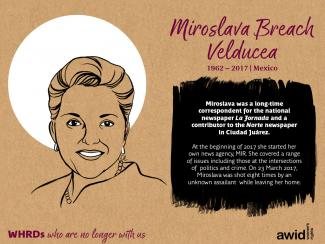
BBC: Miroslava Breach third Mexican journalist to be killed this month
Committee to Protect Journalists: Miroslava Breach Velducea
Amnesty International: Mexico: "Open season" on journalists as third reporter killed in a month
TeleSUR: New Award to Honor Murdered Journalists in Latin America
2-5 December, 2024, Bangkok, Thailand! We will gather at the Queen Sirikit National Convention Center (QSNCC) as well as virtually online.
Yes! We are currently exploring innovating technologies to allow for meaningful connection and participation.

New
Participants will physically gather at a number of sites outside the Bangkok venue, in different parts of the world, on each day of the Forum. All of these self-organized sites will be virtually connected to the Forum venue in Bangkok. As with individuals connecting online, Hub participants will be able to facilitate activities, participate in conversations and enjoy a rich and diverse program.
Hub locations to be announced in 2024!
The Monterrey Conference on Financing for Development marked the beginning of discussions on the Financing for Development agenda.

"مهمتي في الحياة ليست مجرد البقاء على قيد الحياة، بل أن أزدهر؛ وأن أفعل ذلك ببعض الشغف، وبعض التعاطف، وبعض الفكاهة، وبعض الأناقة". - مايا أنجيلو
يعتبر المنتدى الدولي الخامس عشر لجمعية حقوق المرأة في التنمية حدثًا مجتمعيًا عالميًا ومساحة للتحول الشخصي الجذري. يجمع المنتدى، وهو اجتماع فريد من نوعه، الحركات النسوية وحقوق المرأة والعدالة الجندرية ومجتمع الميم عين والحركات الحليفة، بكل تنوعنا وإنسانيتنا، للتواصل والشفاء والازدهار. المنتدى هو المكان الذي تحتل فيه نسويات ونسويو الجنوب العالمي والمجتمعات المهمشة تاريخياً مركز الصدارة، حيث يضعون الاستراتيجيات مع بعضهم/ن البعض، مع الحركات الحليفة الأخرى، ومع المموّلين وصانعي السياسات بهدف تحويل السلطة، إقامة تحالفات استراتيجية، والدخول في عالم أفضل ومختلف.
عندما يجتمع الناس على نطاق عالمي، كأفراد وحركات، فإننا نولد قوة جارفة. انضموا إلينا في بانكوك، تايلاند في عام 2024. تعالوا وارقصوا وغنوا واحلموا وانهضوا معنا.
متى: 2-5 ديسمبر 2024
أين: بانكوك، تايلاند؛ وعلى الانترنت
من: ما يقرب الـ 2500 ناشط/ة نسوية من جميع أنحاء العالم يشاركون شخصيًا، و3000 يشاركون افتراضيًا
The United Nations (UN) Financing for Development (FfD) process seeks to address different forms of development financing and cooperation. As per the Monterrey Consensus it focuses on six key areas: