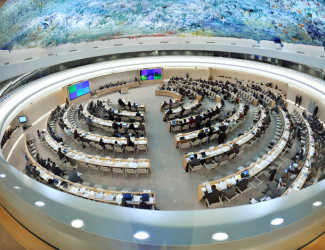
A general view of participants at the 16th session of the Human Rights Council in Geneva, Switzerland.
Analyses Spéciales
L´AWID est une organisation féministe mondiale qui consacre ses efforts à la justice de genre, au développement durable et aux droits humains des femmes
Le Conseil des droits de l'homme (CDH) est un organe intergouvernemental clé du système des Nations Unies, responsable de la promotion et la protection des droits humains autour du globe. Il se réunit trois fois par an en session ordinaire, en Mars, Juin et Septembre. Le Bureau du Haut-Commissariat des Nations Unies aux Droits de l’Homme (HCDH) constitue le secrétariat pour le CDH.
Le CDH :
Débat et adopte des résolutions sur les questions globales des droits humains ainsi que sur la situation des droits humains dans des pays particuliers
Examine les plaintes des victimes de violations des droits humains et des organisations activistes, au nom des victimes de violations des droits humains
Nomme des experts indépendants (que l'on connaît sous le nom de « Procédures Spéciales ») pour réviser les cas de violation des droits humains dans des pays spécifiques, ainsi que pour examiner et suivre des questions globales relatives aux droits humains
Prend part à des discussions avec les experts et les gouvernements sur les questions de droits humains
Évalue les bilans des États membres de l'ONU en matière de droits humains tous les quatre ans et demi, dans le cadre de l'examen périodique universel.
La prochaine session du CDH a lieu à Genève, en Suisse, du 30 juin au 17 juillet 2020.
AWID travaille avec des partenaires féministes, progressistes et du domaine des droits humains pour partager nos connaissances clé, convoquer dialogues et évènements avec la société civile, et influencer les négociations et les résultats de la session.
Avec nos partenaires, notre travail consiste à :
◾️ Suivre, surveiller et analyser les acteurs, discours et stratégies anti-droits et leur impact sur les résolutions du CDH.
◾️ Co-développer un plaidoyer collectif pour contrer les acteurs anti-droits et discuter plus en détails les résultats du Rapport de tendances 2017 du OURs
◾️ Soutenir, coordoner et développer de manière collaborative le Caucus féministe qui émerge au CDH.
Contenu lié
Introducing AWID’s next Co-Executive Directors
Dear Feminist Movements,
On behalf of the AWID Board of Directors, I am proud to introduce AWID’s next Co-Executive Directors: Faye Macheke and Inna Michaeli!
Faye Macheke is a passionate Pan-African feminist, active in movements for women's rights, racial justice, migrant and labor rights, and environmental justice. Her activism builds on the legacy of the struggle against apartheid in South Africa and the aftermath of the apartheid era in Zimbabwe. In 2019, Faye joined AWID as the Director of Finance, Operations and Development. She brings extensive experience in feminist leadership, strategy, and all aspects of organisational development. Faye is a committed Board Member of UAF-Africa and other women's rights organizations. She is based in Cape Town, South Africa.
Inna Michaeli is a feminist lesbian queer activist and sociologist with many years of deep engagement in feminist and LGBTQI+ struggles, political education and organizing by and for migrant women, and Palestine liberation and solidarity. Inna joined AWID in 2016 and served in different roles, most recently as the Director of Programs. She brings extensive experience in research and knowledge building, policy advocacy and organizational development. Inna serves on the Board of the Jewish Voice for Peace - Germany. She is based in Berlin, Germany.
This decision is the result of a rigorous process with full participation of the Board and the staff of AWID. The Board recognised and honoured the skills and talents of AWID staff by opening an internal hiring search. As a result, we had two brilliant candidates, who embody the integrity, ethic of care, and feminist intersectional values that drive AWID’s work, apply together as a team. Faye and Inna brought forward a brave and exciting vision to meet the challenges of this moment: building a global feminist community, resisting and disrupting systems of oppression, and supporting feminist movements to thrive.
As AWID celebrates 40 years we are excited for Inna and Faye to co-lead AWID into our next strategy and a new phase of evolving, pushing boundaries, and supporting feminist movements worldwide.
Appointing and supporting AWID’s Co-Executive Directors to lead the organisation is a fiduciary responsibility we take seriously as a Board. How we engage those processes is also a reflection of AWID’s brilliant and diverse membership, which elects AWID’s Board.
As we say good-bye to Cindy and Hakima, we, the Board, unanimously and enthusiastically welcome Faye and Inna as our next Co-EDs as of September 5, 2022. Stay tuned for more updates about our leadership transition in the months ahead.
Most of all, thank you for your ongoing support!
In feminist solidarity and love, Margo Okazawa-Rey
President, AWID Board
Every three to four years, AWID hosts its flagship international event. It is the world’s largest event that wholeheartedly centers feminist and gender justice movements in all their diversity. It is a global gathering of feminist activists, allied movements, scholars, funders and policymakers. The Forums rotate between different regions and countries in the global South.
Rosa Candida Mayorga Muñoz était une travailleuse sociale, leader syndicale et défenseure des droits humains du Guatemala. On la surnommait affectueusement Rosita.
Dans les années 1980, Rosa devient la première femme à siéger au comité exécutif du syndicat de l’Institut d’électrification nationale (STINDE), syndicat qu’elle avait rejoint en premier lieu pour défendre les droits des femmes au travail. Cela signifiait, à ses yeux, de lutter pour l’égalité des chances dans une entreprise où de nombreuses femmes affrontaient un système discriminatoire et violent mis en place par la direction de l’entreprise. Rosa avait également subi du harcèlement sexuel sur son lieu de travail, tant de la part de collègues que de responsables. Elle n’entendait cependant pas rester silencieuse.
Rosa a continué à se battre et fait partie des efforts pour façonner la lutte afin qu’elle prenne la forme du « Pacte collectif pour les conditions de travail du INDE-STINDE ». Ce pacte était le premier du genre et le premier au Guatemala à caractériser le concept de harcèlement (sexuel). Il fait désormais référence dans la loi guatémaltèque pour les questions de travail, et sert d’encouragement aux autres syndicats.
« Elle n’avait d’autres outils pour se battre que ses propres idéaux... Elle a été intimidée à plusieurs reprises, harcelée pour abandonner la lutte, mais son courage a fait naître l’espoir chez les syndicalistes de la base. Rosita a créé une image de respect non seulement au sein de son syndicat mais également face aux autorités de l’institution et au sein du mouvement des femmes. Elle a été reconnue comme une pionnière du mouvement des femmes du syndicat, dans un espace qui avait davantage été dominé par les hommes. » - Maritza Velasquez, ATRAHDOM
Rosa est décédée le 4 avril 2018, elle avait 77 ans.
Crear Resistar Snippet
Crear | Résister | Transform
Crear | Résister | Transform es para ti y para todxs lxs increíbles activistas feministas y por la justicia social que conozcas. Reunámonos para compartir nuestras estrategias de resistencia, para crear conjuntamente algo de magia feminista, y para transformar juntxs este mundo.
La integro desde que tengo uso de razón. De jovencita, no sabía que existía una palabra — «feminista» — para nosotrxs, quienes aspiramos a superar y desmantelar el patriarcado; quienes buscamos refugio en los brazos de la inclusión y la interseccionalidad; quienes tratamos a las personas como iguales independientemente de su género, raza, sexualidad, religión y etnia; quienes estamos continuamente aprendiendo a obrar mejor, a ser mejores y a usar nuestros privilegios para que otras personas mejoren.
Cuando tenía 14 años, mi profesor de francés de la escuela secundaria, un hombre de 1,80 metros de altura y 30 años de edad, agredió a una alumna de mi clase delante de todxs nosotrxs. La alumna, que era amiga mía desde la infancia, y varias chicas más fuimos a la dirección para denunciarlo, madres y padres se involucraron y toda la clase, treinta alumnxs, expresó su apoyo a la chica. Pero todos nuestros intentos para que el profesor rindiera cuentas por lo que había hecho fracasaron: la administración ocultóó la denunciaa y el profesor nunca fue despedido ni perseguido. Mis compañeras y yo estábamos indignadas, así que hicimos lo que toda joven feminista furiosa haría: LE TIRAMOS HUEVOS A SU AUTO. Si bien los huevos se lavaron con facilidad, costó más sacar la pintura que usamos para escribir las palabras «Cerdo» y «Khamaj» (basura). Nunca olvidaré cómo nos hizo sentir eso: liberadas, enfurecidas, felices, muy unidas y con poder. La misma emoción se repite en todos los ámbitos feministas en los que he estado desde entonces. La feminista adolescente que hay en mí creció y participó en Women Deliver, AWID, Unootha, facilitó talleres feministas en la universidad, e incluso fue perseguida por su filiación feminista a los 19 años, pero esa es otra historia para otra carta.
Los movimientos y espacios feministas me brindan seguridad y empoderamiento. Son las madres que hubiéramos deseado tener y los vínculos que necesitábamos para conectarnos y organizarnos, a pesar de nuestras diferencias, contra un enemigo común, el patriarcado, que nos ha estado perjudicando a todxs. Con ustedes aprendí a ser resiliente y a reunir mis fuerzas y habilidades para estimular a otras personas, para sacar a la luz la situación de las personas marginadas, y dar voz a quienes no la tienen.
Lo que más me gusta de ustedes, movimientos feministas, es que a veces hacen mal las cosas, desprecian y también marginan, tienen prejuicios como cualquier otro movimiento, pero lo que los diferencia es que siempre se esfuerzan por ser mejores. La rendición de cuentas no es algo a lo que le teman, y son un colectivo en constante cambio que refleja cómo el altruismo y la filantropía que se proponen lograr la equidad de género también cambian con el paso del tiempo.
Que crezcan siempre, que obren mejor, que siempre se enfurezcan, que siempre rujan, que siempre amen, que siempre hablen distintas lenguas y que siempre sientan su poder.
Nuestra presencia colectiva trastorna las prácticas institucionales de exclusión en dichos espacios y, a la vez, apoya los procesos de organización de los movimientos en torno a las alternativas feministas a los sistemas de opresión.
Súmate a las conversaciones desde el 10 al 21 de marzo de 2025, mientras transformamos de forma colectiva la CSW69 en espacios para y sobre la resistencia y la solidaridad.
Con una asistencia de hasta 2500 participantes presenciales y 3,000 conectadxs de manera virtual, este será el Foro de AWID más grande hasta ahora. Vislumbramos múltiples espacios para establecer conexiones significativas, aprender, intercambiar ideas, tener conversaciones estratégicas, sanar y celebrar. Es la primera vez que nos reunimos en este espacio desde la pandemia, y estamos muy deseosxs de hacerlo.
Esther Mwikali’s home was in Mithini village, Murang’a County, Kenya. A prominent and valued land rights activist, she looked into abuses against squatters who are living on land claimed by tycoons. The investigation Esther was part of also involved land rights’ violations in Makuyu by powerful individuals.
After failing to attend a village meeting, a search party went looking for Esther. On 27 August 2019, two days after her disappearance, her body was found on a farm near her homestead, displaying signs of torture. She was brutally murdered.
“Esther was renowned for her work to prevent community members being evicted from land claimed by tycoons. Local activists had no doubt her murder was related to the area’s ongoing land struggles, a tragic reminder of the alarming regularity with which extra-judicial killings are routinely carried out in Kenya,” - Global Witness Report, July 2020
“We associate Mwikali’s death with land struggles around here. We are asking the Government to investigate the matter without delay.” - James Mburu, spokesperson for the squatters
“Action should be taken on individuals who are alleged to have threatened the squatters including Mwikali's family.” - Alice Karanja, National Coalition of Human Rights Defenders
“The impact of her work and tenacity will remain alive in Kenya for decades. CJGEA consoles with the bereaved and it calls for justice.” - Center for Justice and Governmental Action (CJGEA) Press Release, 13 September 2019
I am pleased to share with you one of my remarkable dates as feminist with disability. It was May 30, 2014 when we (the Nationwide Organization of Visually-Impaired Empowered Ladies NOVEL) participated in the Philippine Fashion Week Holiday 2014 for our white cane advocacy campaign. Two ladies who are blind walked down the catwalk to promote the white cane as one of the symbols of gender equality, empowerment, full inclusion and equal participation of women and girls with visual impairment in society.
Their walk in front of the crowd were extremely a nerve-wracking experience for me, as the proponent of our project with the Runway Productions (I enduringly waited for a year for its approval), knowing that they were not models, they were the crowned Ms. Philippines Vision and 1st Runner Up of 2013 Ms. Philippines on Wheels, Signs and Vision by Tahanang Walang Hagdanan, Inc. (House with No Steps). Also, they fell on their orientation and practiced the evening before the event and they didn’t have practice with professional models. Before the show started, I talked to them via mobile phone to boost their confidence and to pray together for God’s guidance. When they exited the catwalk, I breathed deeply while my tears were flowing. I was feeling euphoric because we did it despite the challenges we’ve been through! Our message to the world that women and girls with visual impairment can walk with dignity, freedom and independence on an equal basis with others, with the use of our assistive device - white canes was successfully delivered! We trended in social media and we were featured by television networks.
My life as a feminist with disability started as a means to mend my broken spirit and to see a different path towards finding my life’s purpose after I became victim-survivor to a vicious acid attack in 2007 while I was waiting for a ride going home from office. My eyes were severely damaged, to the point that I became a woman with low vision.
I never knew how joyful and purposeful my life could be again until I met women leaders in the gender and disability movement who influenced me to keep going. Their words of encouragement attracted me and became the sweetest music to my ears. My broken heart leaped like a hummingbird in flight every time I think of them and feminism which stimulated me to partake in making difference for our invisible sisters with disabilities and to those who continue to experience discrimination. To date, I am consumed by the desire to be with the movement. I cannot hide my excitement whenever I submit project proposals to different stakeholders for our sisters with disabilities' empowerment, development and advancement; and to make representations in local, national and international conversations to amplify our voices even at my expense.
Unexpectedly, I was selected as our country’s female representative in the 2012 World Blind Union (WBU) General Assembly in Thailand even though I was a newcomer in the disability movement. In the same year, I was elected as the only woman officer of the Philippine Blind Union (PBU) in its assembly. I was inspired to reach out, gather and empower our sisters with visual impairment on their rights and to know their intersecting issues. In 2013, we officially launched the Nationwide Organization of Visually-Impaired Empowered Ladies (NOVEL) to support the empowerment of our sisters with disabilities, build coalitions with cross-disability and women’s movements and promote gender and disability-inclusive development.
My participation as co-focal person of women with disabilities in our 2016 CEDAW Shadow Report submission convened by Women’s Legal and Human Rights Bureau (WLB) with the marginalized groups of women, opened many doors such as working with various women’s organizations and attending the 2017 Inclusion Days International in Berlin, Germany together with 3 Filipino women leaders with disabilities to share our good practices, mainly our engagement with the women’s movement in our country.
My journey as feminist with disability has been an emotional roller coaster for me. It gave me happiness and a sense of worth when I participated in promoting for our sisters with disabilities full inclusion, equal and effective participation in society, yet I felt frustrated and upset when I gave my all but I received negative remarks. Nevertheless, I feel that way because I am in love with the movement.
I see my future working in solidarity with the movement to ensure that our sisters with and without disabilities can equally and fully enjoy and participate in society.
Love lots,
Gina Rose P. Balanlay
Feminist with disability
Philippines
Reclaim Power to #FreezeFascisms: Resources for Feminists to Survive & Thrive
Feminist and gender justice movements continue to be chronically underfunded in the face of global funding cuts and freezes. Particularly in Global South regions with shrinking civic spaces, resource scarcity has impacted the most vulnerable communities.
In the face of these setbacks, AWID has updated the Who Can Fund Me? Database - an easy-to-use, practical tool for movements looking for funders from philanthropic foundations, multilateral funders to women’s and feminist funds to support vital lifesaving efforts.
Faut-il être membre de l'AWID pour participer au Forum ?
Non, il n'est pas nécessaire d'être membre de l'AWID pour y participer, mais les membres de l'AWID bénéficient d'une réduction sur les frais d'inscription ainsi que d'un certain nombre d'autres avantages.
Barbara Allimadi fue una activista política y defensora de los derechos humanos de Uganda. En 2012, co-organizó una protesta contra la agresión policial a Ingrid Turinawe, una figura política de la oposición, que fue televisada y muestra cómo un policía le aprieta el pecho. Durante la protesta, Barbara, junto con otras compañeras activistas, se quitaron la ropa hasta quedarse en sujetador frente a la Estación Central de Policía de Kampala. Este hecho pasó a conocerse en Uganda como la infame "protesta de los sujetadores".
"Nos decidimos por la protesta de los sujetadores. Pensamos que sería lo más apropiado para lo que había sucedido. Con esta acción, no es que estuviésemos diciendo que no nos respetásemos a nosotras mismas. Estábamos indignadas con lo que había sucedido." - Barbara Allimadi, 2013 (Daily Monitor, en inglés)
Barbara se licenció en Ingeniería Electrónica y de Comunicaciones en la Universidad Metropolitana de Londres, y ejerció como ingeniera de redes en el Reino Unido. Era,además, una fan entusiasta de la música reggae. Regresó a Uganda en 2007, cuando su madre falleció.
En 2019, fue nombrada Coordinadora de Asuntos Internacionales y de la Diáspora de la Alianza para la Transformación Nacional (ANT, por sus siglas en inglés), un partido político lanzado ese año por un líder de la oposición.
"Queremos garantizar la seguridad de la vida y la propiedad, no el dolor, las lesiones o incluso la muerte a manos de unas fuerzas de seguridad que se supone deberían protegernos. Y lo más importante, queremos un entorno estable y propicio donde podamos realizar nuestros sueños y aspiraciones". - Barbara Allimadi, video de ANT (en inglés)
Barbara falleció el 27 de abril de 2020.
Tributos:
"Estaba muy orgullosa de mi hermana por muchas razones, pero, en particular, por su intrépida búsqueda de la paz, la democracia, la justicia y la igualdad en Uganda. En los momentos más álgidos de su activismo, Barbara lideró muchas marchas por las calles de Kampala, hacia las comisarías de policía y el Parlamento". - Doris Allimadi, hermana de Barbara
"Nos enteramos con profunda tristeza del prematuro fallecimiento de Barbara Allimadi. Ella ha sido una fuerza valiente, implacable y valerosa para el movimiento de liberación de Uganda. Queremos dar nuestro más sentido pésame a su familia. La echaremos mucho de menos". - Akina Mama wa Afrika (tweet, 28 April 2020)
"El fallecimiento de Barbara es una noticia muy triste para nosotrxs y para toda su familia. Barbara dedicó su vida a luchar por la justicia, la libertad y los derechos de las personas desde la sociedad civil, hasta que se unió, recientemente, al partido." Maj Gen Mugisha Muntu, coordinador nacional de la ANT (por sus siglas en inglés)
"Una hermana hermosa, encantadora, divertida, carismática e inspiradora. Mis hijxs han perdido a su tía. Uganda ha perdido a una audaz y valiente defensora de la libertad. Barbara dijo una vez: "Mientras siga habiendo aliento en ti, sigue trabajando por conseguir tus sueños". - Doris Allimadi, hermana de Barbara.
Biblioteca de recursos Derechos en Riesgo
Una colección viva de recursos para apoyar a los movimientos feministas, a personas que diseñan políticas y a aliadxs que resisten a las tendencias fascistas, fundamentalistas y anti-derechos.
AWID es parte de un impresionante ecosistema de movimientos feministas que trabajan para alcanzar la justicia de género y la justicia social en todo el mundo. Al acercarse nuestro 40° aniversario estamos celebrando todo lo que hemos construido a lo largo de estos últimos cuarenta años. Como organización global de apoyo a los movimientos feministas, sabemos que nuestro camino hacia adelante es trabajar con feminismos apasionados, reconociendo tanto la multiplicidad de los feminismos como el valor de un impulso por la justicia apasionado y sin reservas. El estado del planeta y de los movimientos feministas requiere conversaciones y acciones valientes. Esperamos con ansia trabajar junto con nuestrxs afiliadxs, asociadxs y donantes para crear los mundos en los que creemos,celebrar los logros y expresar la verdad ante el poder, al servicio de los movimientos feministas a nivel global.
El Calendario Feminista 2023 es un regalo para los movimientos. Presenta las obras de arte de algunxs de nuestrxs maravillosxs afiliadxs de AWID.
Getting the Money We Need | A 101 Guide on Fundraising for Small Grassroots Organizations
From building prospect funders lists with *templates*, to understand how to write a solid grant proposal, with ‘Getting the Money we Need’ Guide really we don't have to figure this out alone anymore
How does the AWID Forum connect to regional and other spaces?
We are in communication with regional, thematic and funder convenings planned for 2023-2024, to ensure flow of conversations and connections. If you are organizing an event and would like to make a connection to the AWID Forum, please get in touch with us!