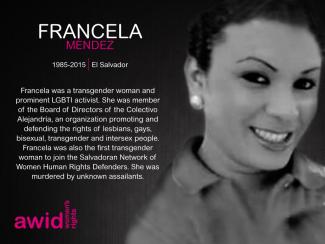
Francela Mendez

En septiembre de 2016, 1800 feministas y activistas por los derechos de las mujeres de todos los rincones de nuestros movimientos se congregaron en las costas de Bahia, en el 13º Foro Internacional de AWID.
En esta sección se destacan los logros, los aprendizajes y los recursos que surgieron de las ricas conversaciones mantenidas. Te invitamos a analizar, compartir y comentar.
Uno de los aportes más importantes del Foro fue la necesidad de ampliar y profundizar nuestro trabajo entre movimientos, frente a la confluencia de los fascismos en auge, fundamentalismos, codicia corporativa y cambio climático.
Nuestras Iniciativas Semilla han ayudado a 20 ideas que surgieron en el Foro para crecer en forma de acciones concretas
El vídeo «Defendiendo a las Personas y al Planeta» y la guía «Tejiendo la resistencia a través de la acción» estan protagonizados por defensoras de derechos humanos y presentan estrategias concretas para confrontar al poder corporativo
Con nuestras animaciones El estado de nuestros movimientos feministas y Justicia climática y ambiental, los movimientos ahora tienen herramientas creativas para apoyar su trabajo.
La compilación de las expresiones artísticas «Los Movimientos Importan», sigue inspirando una organización más fuerte y creativa en todo el mundo.
Los movimientos también pueden beneficiarse de nuevas metodologías para imaginar nuestros futuros feministas (¡pronto!)
AWID se ha comprometido, mediante su próximo plan estratégico y su proceso del Foro, a continuar y profundizar las relaciones, las lecciones y los procesos iniciados en el Foro 2016 y basándonos en el momento actual.
Los Foros de AWID comenzaron en 1983 en Washington DC. Desde entonces, el evento ha crecido hasta convertirse en muchas cosas para muchas personas: un proceso iterativo para darle forma a nuestros análisis, objetivos y acciones; un hito crucial que fortalece los feminismos de lxs participantes e infunde energías a sus procesos de organización; un hogar político donde lxs defensoras de derechos humanos encuentran un santuario y solidaridad.
Par María Bonita - Venezuela
Nos ancêtres femmes forment un cercle
Sacré, vivant, puissant
Nous sommes au milieu
Et sentons leur force.
Le tambour bat le son de la terre
Notre peau s’habille de couleurs
Nous sommes vertes, rouges, oranges, bleues, violettes, noires
Le tambour bat le son de la terre
La voix vibre, le cri envahit, le chant retentit, berce le sommeil, éveille la conscience.
Le tambour bat le son de la terre
Et le regard se fait complice, ami, profond.
Le tambour bat le son de la terre
Nous ne sommes qu’un seul cœur battant au rythme de l’âme, il nous invite à bouger, nous inspire le désir, nous montre un chemin
Celle du rassemblement communautaire, celle du pouvoir populaire, celle de l’auto-gouvernement, celle de la révolution des femmes, celle du soin subversif.
Le tambour bat le son de la terre
Et je vous invite à entrer, à être voix, peau, regard, graine, feu, chanson, communion.
Le tambour bat le son de la terre
Et je vous invite à la découvrir, à l’aimer, la connaître et la défendre depuis le coeur de la communauté.
Cela fait 25 ans qu’elles habitent ces mêmes rues poussiéreuses, au sommet d’une colline qui porte le nom d’un lion; elles viennent d’endroits différents, beaucoup ont une tradition paysanne, elles ont la peau couleur rébellion, couleur cactus cardon, parce que l’esprit semi-aride de Lara vit en elles. C’est de là que leur vient leur amour de la vie, leur appréciation, le soin et la protection apportés à l’eau et au territoire, car elles sont les héritières des lignées de Gayón, Ayaman, des communautés autochtones qui ont vécu et vivent dans le nord de l'État de Lara.
Elles ont appris dès leur plus jeune âge que la maternité est un rôle auquel il n’est pas facile d’échapper. S’occuper des enfants, de la maison, du mari, laver, repasser, cuisiner, nettoyer - elles insistent: tout devait être impeccable.
Et c’était ça la vie, ça et la violence, les insultes, la maltraitance, les coups, les réclamations et les reproches auxquels il fallait s’attendre, cela semblait presque naturel, c’est ainsi que se déroulaient leurs journées, leur quotidien. Elles vivaient dans des petites maisons en tôle dans ces rues de terre battue, sans électricité ni eau courante, c’était la pauvreté, la précarité, quand un homme est arrivé, oui, un homme, un projet, une révolution inhabituelle parce qu’elle s’est faite sans guerre.
Alors on les invita à sortir, on les invita à descendre dans les rues et à occuper l’espace public. Au cours de ce processus, elles ont arraché des portes et des fenêtres, elles ont brisé des chaînes, ont lâché leurs cheveux, elles se sont senties libres, libres comme des esclaves en fuite, des rebelles des Caraïbes, des défenseuses de la liberté.
Et ces concepts d'indépendance et de souveraineté sont des notions que celleux qui ont eu la chance d'étudier connaissent, mais le sentir, se sentir comme les protagonistes d'un processus de transformation sociale - c'est une victoire importante que nous nous devons de mentionner et que nous ne pouvons pas oublier.
Au sommet de cette colline, on peut sentir la complicité des femmes, le feu partagé, les années de lutte. On raconte que l'une d'entre elles se promenait avec son ombrelle l'après-midi et s’arrêtait de maison en maison pour prendre un café et parler aux gens, les inviter à se joindre à la cause et les convaincre…
Nous allons créer un conseil communautaire !
Allons de l'avant ensemble en tant que communauté !
Élaborons des plans pour l'éducation, le sport, la santé, la nutrition, un comité pour les femmes et l'égalité des genres, l'économie !
Nous pouvons former notre propre gouvernement populaire pour que notre quartier soit beau !
Et c'est ainsi que les maisons sont arrivées, le cabinet médical, la garderie, l'électricité, l'eau potable. Ce sont là quelques-unes des réalisations de la communauté, quelques-uns de nos rêves communs devenus réalité.
Et vous pourriez vous demander comment une cuentera, une conteuse, est arrivée sur une colline portant le nom d'un lion...
Et je vous répondrai: je suis née turbulente, me battant sans cesse, «tu es née vagabonde» dirait ma grand-mère, «tu es née prête» ajouterait le Comandante Chávez, à force de marcher, de râler, de me battre et douter de cet homme militaire. Son projet communautaire, son concept d’autonomie gouvernementale et le fait que le peuple gère ses propres ressources, que tout le pouvoir aille aux communautés, ont fini par me convaincre.
Mais je savais qu'il manquait quelque chose, parce que les femmes, les femmes de la communauté continuent à construire le pouvoir du peuple et à se battre cœur et âme contre l’impérialisme et le capitalisme, mais il y a quelque chose qui fait mal et qui continue de nous affecter. Les blessures du patriarcat sont toujours présentes.
Alors un jour, je me suis retrouvée à pleurer, le tambour battit le son de la terre et nos ancêtres parlèrent.
Je me suis retrouvée entourée d’un groupe de femmes qui m’ont soutenue, qui m’ont contenue lorsque je débordais devant elles, lorsque j’avais mal et me libérais en même temps. C’est ainsi que j’ai découvert que l’amour entre femmes vous guérit, vous sauve, que notre amitié est profondément politique et que la sororité est une manière d’être, de vivre la vie. À partir de ce moment-là, je ne me suis plus jamais sentie seule, je ne me suis plus jamais sentie comme une île parce que je sais qu’il y a un groupe de femmes qui me portent, m’emmènent, m’aiment, prennent soin de moi et moi d’elles. Je sais que mon féminisme né de l’expérience mystique de femmes pour la vie me permet de me sentir connectée, aimée par des femmes que je ne reverrai peut-être pas. Alors comment ne pas souhaiter que cela arrive aux autres? Cet éveil, cette naissance d’un nouveau cœur est un don des déesses qui doit être partagé.
C'est pourquoi j'ai décidé de me joindre à ces femmes et parcourir les communes, je me suis mise à marcher, à faire d'autres expériences, nous avons commencé à débattre de la santé, de l'éducation, de l'alimentation, nous avons commencé à prêcher le verbe anti-patriarcal et à réclamer des communautés libres de machisme. Nous avons insisté pour récupérer la sagesse ancestrale, l’intuition, nous avons décidé de défendre la vie en parlant de l'avortement et nous nous retrouvons à rire, à pleurer, à débattre, à réfléchir, je retrouve macu, la china, yenni, carolina, maria, ramona, irma et même notre sœur yenifer qui nous a quittées il y a peu.
Ceci est mon hommage à ces femmes, les femmes de la colline, les femmes lionnes, elles qui ont semé leur graine tout au fond de moi avec une telle puissance qu’elles se mêlent dorénavant aux battements de mon cœur.
C’est certain, elles tracent un chemin, et sans elles il n’y aurait ni soins familiaux, ni soins collectifs. Elles sont aussi une force sur ce territoire qui se bat contre l’embargo, la violence patriarcale, la trahison politique, la bureaucratie et la corruption.
C’est certain, elles tracent un chemin
C’est certain, elles sont des boussoles
C’est certain, elles sont le coeur de la communauté
Merci.
par Gabriela Estefanía Riera Robles
Juliana. Comme j’aimerais m’appeler Juliana! C’est un prénom plein de pouvoir et de présence, plein de force et de véhémence. (...)
< illustration : «Born Fighters», par Borislava Madeit et Stalker Since
Feminist and gender justice movements continue to be chronically underfunded in the face of global funding cuts and freezes. Particularly in Global South regions with shrinking civic spaces, resource scarcity has impacted the most vulnerable communities.
In the face of these setbacks, AWID has updated the Who Can Fund Me? Database - an easy-to-use, practical tool for movements looking for funders from philanthropic foundations, multilateral funders to women’s and feminist funds to support vital lifesaving efforts.
Nadine fue un ejemplo para muchxs por su trabajo en apoyo de las mujeres y lxs más vulnerables de su comunidad. Estaba comprometida con ayudar a l pobres, especialmente a las personas sin techo.
Aunque su muerte se informó como accidente, la familia Ramaroson, encabezada por su padre, André Ramaroson, llevó adelante una investigación que arrojó evidencias de que había sido asesinada. Se informó que había muerto en un accidente fatal ocurrido entre Soanierano - Ivongo y Ste Marie, una historia que fue desmentida por su familia. Ella había recibido numerosas amenazas de muerte por sus audaces posiciones políticas. Su caso todavía está en la corte de Antananarivo (la capital de Madagascar).


We’ve been together for over 20 years and how deeply I’ve treasured your love and support. It is interesting to think that you too are a similar age to AWID - both trying to figure out how to engage and support the community on a similar timeline. To the mothers in the movement, your leadership and guidance has been unmatched. I think of Prudence Mabele, Kate Thompson, Darien Taylor, Patricia Perez, Martha Tholanah, Deloris Dockery, Iris De La Cruise, Doris Peltier, Cecilia Chung and so many more. While not perfect (as none of us are), you always put your community first and champion the inclusion of ALL women living with HIV in feminist spaces.
I love the way you have held me when no one else has been able to, but more importantly how we hold each other. While you understand stigma, discrimination, violence and pain, you also understand joy, love and forgiveness. As feminists living with HIV, we are glorious and powerful in our intersectionality. We understand that feminism includes and is led by communities - our Black, Brown and Indigenous sisters, communities who are trans and gender diverse, sex workers, queer/lesbian, those who have been incarcerated, and those who use drugs - as set out in the GIPA (Greater Involvement of People Living with HIV) principles. Your feminism is all encompassing. We talk about the hard issues and about criminalized communities, because as people living with HIV, we ourselves are criminalized.
I would be remiss if I didn’t send special love to the young women living with HIV, the heartbeat of the movement. I see you Kia Lebejia, Keren Dunaway, Liz Onyango, Faith Ona, Sara Thapa Maga, Doreen Moraa, Yana Panfilova and millions of others incredible activists living with HIV. You are the power that will continue to propel us forward and allow us to be seen as important in mainstream feminst movements. Thank you for taking our movement further to ALWAYS include trans and gender diverse folks, to talk about the links between climate change and sexual and reproductive health and rights.
I love, love, love, love you so much. For better or for worse, let’s move forward together because this is our community - this is my community.
With love,
Jessica Whitbread
You can now watch the AWID Feminist Film Club program “Feminist Embodiments of Hope and Power” - a film series on Feminist Realities from the SWANA region curated by Esra Ozban
Join as an AWID member now and participate in our next member event:
“Forum Dreaming” on June 20th.
From building prospect funders lists with *templates*, to understand how to write a solid grant proposal, with ‘Getting the Money we Need’ Guide really we don't have to figure this out alone anymore
Read and download the guide hereText-only version
"He dado testimonio de la discriminación que vi en las calles, he sufrido burlas y abusos verbales ahí. También he hecho numerosas amistades y he conocido a mucha gente. Puede que haya peligros ahí fuera, pero soy una sobreviviente y aquí es donde estaré por ahora." - Sainimili Naivalu
Exigió a las autoridades políticas y a otras partes interesadas que proporcionaran políticas y servicios favorables a la movilidad de las personas con discapacidad, como la construcción de rampas en pueblos y ciudades para aumentar su accesibilidad. Sin embargo, las barreras físicas no fueron las únicas que Sainimili se esforzó por cambiar. Por experiencia propia, sabía que era necesario que se produjeran cambios más complejos en las esferas sociales y económicas. Muchos de los retos a los que se enfrentan las personas con discapacidad tienen su origen en actitudes que llevan a la discriminación y al estigma.
Como sobreviviente y luchadora, Sainimili contribuyó a la creación conjunta de realidades feministas que fomentasen la inclusión y cambiasen las actitudes hacia las personas con discapacidad. Como afiliada a la Asociación de Lesiones de la Espina Dorsal de Fiji (SIA, por sus siglas en inglés) y a través del proyecto del Foro para Personas con Discapacidades del Pacífico “Pacífico Habilita”, Sainimili asistió a la formación de la Organización Internacional del Trabajo "Inicie su Negocio" en Suva, lo que le permitió transformar sus ideas en su propio negocio. Fue emprendedora en el puesto 7 del mercado de Suva, donde ofrecía servicios de manicura, y también se encargaba del puesto del mercado de las mujeres de SIA, donde vendía artesanías, sulus y otros objetos. El plan de Sainimili era expandir su negocio y convertirse en una importante empleadora de personas con discapacidad.
Además de su activismo, también fue medallista y campeona juvenil de tenis de mesa.
Sainimili era única, con una personalidad vivaz. Siempre podías saber si Sainimili estaba en una habitación porque su risa y sus historias eran los primero que notabas. - Michelle Reddy
Sainimili falleció en 2019.

¿Cómo comienza un movimiento?
los fantasmas nos expulsan de una casa, una familia, y una nación
llegamos fatigadas a un espacio (a veces un domicilio real) pero fundamentalmente a un estado de ser
precedidas por una estrella fugaz
quizás nuestra llegada no está acompañada por la fatiga,
quizás está acompañada por el miedo
quizás nuestra llegada no está acompañada por el miedo
quizás está acompañada por la rabia
ante cuestiones que siguen repitiéndose:
una puñalada en el corazón (léase pena)
una bala en la espalda (léase traición)
desapariciones forzadas
cuerpos sentenciados por el matrimonio, la desfiguración y la fatiga crónica,
sin embargo, llegamos, nos reunimos, susurramos, hablamos y lloramos.
Así es como nuestros movimientos comienzan cuando llegamos unas a otras
Nos convertimos en semillas,
Así es como nuestros movimientos comienzan cuando nos plantamos unas a otras
Convirtiéndonos en flores, a veces solo espinas, a veces frutas,
somos el oasis de las otras
para cantar por las batallas
para preparar remedios
para ubicar los rostros de nuestras amantes, la forma de sus sonrisas, el sonido de su risa
el secreto de convertir los silencios en lenguaje
las detalladas instrucciones de las brujas
nuestro movimiento es para todas nosotras,
cuando llegamos como semillas con el propósito de florecer.
Sara AbuGhazal
www.badiya.blog
Como parte del Viaje por las Realidades Feministas de AWID, te invitamos a explorar nuestro nuevo Club de Cine Feminista: una colección de cortometrajes y largometrajes seleccionados por nuestrxs curadorxs y narradorxs feministas de todo el mundo, que incluyen a Jess X. Snow (Asia-Pacífico), Gabrielle Tesfaye (África/Diáspora Africana) y Esra Ozban (Sudoeste Asiático y África del Norte). Alejandra Laprea es la curadora del programa de América Latina y Centroamérica, que inauguraremos en septiembre, durante el evento de AWID Crear, Résister, Transform: un festival para movimientos feministas. Mientras tanto, ¡mantente atentx a los anuncios sobre proyecciones especiales y conversaciones con cineastas!
¡Sí! Por favor lee la Convocatoria de Actividades y presenta tu propuesta aquí. La fecha límite es el 1ero de febrero de 2024.
A closer look at actual budgets reveals major income diversity and inequality.
Connue comme la drag queen de couleur de New York, Sylvia était une infatigable et féroce défenseure des marginalisé·e·s et exclu·e·s au début des années 1970, alors que le mouvement pour les « droits des gays » prenait de l’ampleur aux États-Unis.
Dans un discours bien connu prononcé pour Chistopher Street Day en 1973, Sylvia s’est exclamée, parmi une foule de membres de la communauté LGBT :
« Vous me dites tous d’aller me cacher, la queue entre les jambes.
Je ne supporterai plus ces conneries.
On m’a battue.
On m’a cassé le nez.
On m’a jetée en prison.
J’ai perdu mon travail.
J’ai perdu mon appartement.
Tout ça pour la libération gay, et vous me traitez de la sorte?
C’est quoi votre putain de problème à tous?
Réfléchissez à ça! »
En 1969, à l’âge de 17 ans, Sylvia a participé aux célèbres émeutes de Stonewall en jetant, paraît-il, le deuxième cocktail molotov en signe de protestation contre la descente de la police dans le bar gay de Manhattan. Elle a continué à être une figure centrale des soulèvements qui ont suivi, organisant des rassemblements et ripostant aux brutalités policières.
En 1970, Sylvia a collaboré avec Marsha P. Johnson à la création de Street Transvestite Action Revolutionaries (S.T.A.R.), collectif et organisation politique qui mettait sur pied des projets de soutien mutuel pour les personnes trans vivant dans la rue, celles et ceux aux prises avec la toxicomanie ou en détention, et spécialement pour les personnes trans de couleur et celles et ceux vivant dans la pauvreté.
Refusant les étiquettes, Sylvia a incité les personnes du mouvement de libération gay à penser différemment, et ce, tout au long de sa vie. Elle a déclaré :
« J’ai quitté ma maison en 1961, à l’âge de 10 ans. Je me suis démenée sur la 42e rue. Le début des années 1960 n’était pas génial pour les drag queens, les garçons efféminés ou les garçons qui se maquillaient comme on le faisait. À l’époque, on se faisait battre par la police, par tout le monde. Je n’ai pas vraiment fait mon coming out en tant que drag queen avant la fin des années 1960. C’était vraiment la débandade lorsque des drag queens se faisaient arrêter. Je me rappelle la première fois où je me suis fait arrêter, je n’étais même pas habillée entièrement en drag. Je marchais dans la rue et les flics m’ont tout simplement attrapée. Les gens maintenant prétendent que je suis une lesbienne, parce que je suis avec Julia, ce à quoi je leur je réponds : « Non, je suis juste moi. Je ne suis pas une lesbienne. » J’en ai marre d’être étiquetée. Je ne suis même pas en faveur de l’étiquette de transgenre. J’en ai marre de vivre avec des étiquettes. Je veux juste être qui je suis. Je suis Sylvia Rivera »
Par son activisme et son courage, Sylvia Rivera a présenté un miroir où se reflétait tout ce qui n’allait pas dans la société, mais aussi la possibilité d’une transformation. Sylvia est née en 1951 et décédée en 2002.
We’re beginning a new year--2023. COVID-19 continues to infect and re-infect many, many people around the world. We are witnessing the resurgence of right-wing and fascist governments, even in places we may not have expected like Sweden. War, armed conflict, and dramatic increase in militarization, militarism, and military spending are enabling the unbridled capital accumulation by the few, with participation of seemingly “strange” alliances locking arms, both visibly and invisibly, where economic and political elites of the Global North and Global South are benefitting beyond our wildest imagination. In the meanwhile, our people and the natural environment pay enormous costs and suffer all the expected and unexpected consequences.
As all of you and all of us at AWID know, feminists in multiple movements around the world are resisting and organizing against multiple faces of tyranny, creating alternative structures, implementing grassroots strategies, and building transnational alliances. We are generating joy, inspiring one another, singing, and dancing within and against the prevailing culture of killing and cynicism that seems to have engulfed so much of the world.
We--Staff and Board--of AWID are prepared and inspired more than ever before to face challenges by strengthening our relationships with our members and organizational partners, meeting and getting to know those who we are yet to meet and do what we do best: support the global feminist movements. Although we were sad facing the departures of our beloved former Co-Eds Cindy and Hakima, our wonderful new Co-EDS Faye and Inna along with committed and creative staff have embraced the moment that encapsulates both opportunities and threats.
For sure, all of us at AWID and all our movement folks know: As the Caribbean US poet and activist June Jordan wrote to the South African women activists during the height of the apartheid regime, “We are the ones we have been waiting for”!
While fundamentalisms, fascisms and other systems of oppression shapeshift and find new tactics and strategies to consolidate power and influence, feminist movements continue to persevere and celebrate gains nationally and in regional and international spaces.