Consejo de Derechos Humanos (CDH)
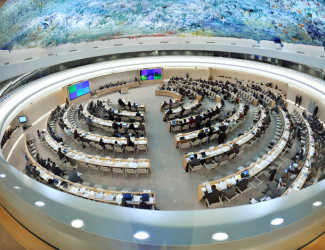
El Consejo de Derechos Humanos (CDH) es el cuerpo intergubernamental del sistema de las Naciones Unidas responsable de la promoción y protección de todos los derechos humanos en todo el mundo. El HRC se reúne en sesión ordinaria tres veces al año, en marzo, junio y septiembre. La La Oficina del Alto Comisionado para los Derechos Humanos (ACNUDH) es la secretaría del Consejo de Derechos Humanos.
El CDH trabaja de la siguiente forma:
-
Debate y aprueba resoluciones sobre cuestiones mundiales de derechos humanos y el estado de los derechos humanos en determinados países
-
Examina las denuncias de víctimas de violaciones a los derechos humanos o las de organizaciones activistas, quienes interponen estas denuncias representando a lxs víctimas.
-
Nombra a expertos independientes que ejecutarán los «Procedimientos Especiales» revisando y presentado informes sobre las violaciones a los derechos humanos desde una perspectiva temática o en relación a un país específico
-
Participa en discusiones con expertos y gobiernos respecto a cuestiones de derechos humanos.
-
A través del Examen Periódico Universal, cada cuatro años y medio, se evalúan los expedientes de derechos humanos de todos los Estados Miembro de las Naciones Unidas
La Sesión actual - CDH44
Se está llevarando a cabo en Ginebra, Suiza del 30 de junio al 17 de julio de 2020.
AWID trabaja con socios feministas, progresistas y de derechos humanos para compartir conocimientos clave, convocar diálogos y eventos de la sociedad civil, e influir en las negociaciones y los resultados de la sesión.
Con nuestrxs socixs, nuestro trabajo será:
◾️ Monitorear, rastrear y analizar actores, discursos y estrategias anti-derechos y su impacto en las resoluciones
◾️ Desarrollar conjuntamente una labor de promoción conjunta para contrarrestar a los actores anti-derechos y debatir más a fondo las conclusiones del Informe de Tendencias de OUR de 2017
◾️ Apoyar, coordinar y desarrollar de manera colaborativa el Caucus feminista emergente en el CDH
Contenido relacionado
Snippet FEA trans and travesti people in Argentina (EN)

Only 18% of trans and travesti people in Argentina have access to formal work.
Quelles sont les langues officielles de l’enquête WITM?
À l’heure actuelle, l’enquête est disponible sur KOBO en français, anglais, arabe, espagnol, portugais et russe. Vous pouvez choisir votre langue au début du questionnaire.
Quelle est l’origine de ce projet?
Nous croyons que l'économie, le marché, le système financier et les prémisses sur lesquelles ils reposent sont des domaines critiques pour la lutte féministe.
Ainsi, notre vision pour une économie juste dépasse la promotion des droits et de l'autonomisation des femmes sur le marché. Elle propose d'évaluer le rôle des oppressions liées au genre lors de l'élaboration de mesures économiques, afin de les modifier pour favoriser l'égalité de genre et la justice économique.
Processus
Nous ne partons pas de zéro et nous ne sommes pas seules à tenter de mettre en avant des propositions féministes pour une économie juste. Beaucoup des propositions formulées dans ce document existaient déjà en théorie et aussi dans la pratique, au sein de diverses communautés qui défient et résistent face aux systèmes économiques fondés sur la croissance et le marché.
Il est également très important de noter qu'il y a une prise de conscience croissante du fait que les micros solutions n’apportent pas toujours de réponses aux problèmes macros, même si elles représentent des espaces importants pour la construction de la résistance et des mouvements. Certaines alternatives spécifiques peuvent ne pas être en mesure de remédier aux injustices du système capitaliste actuel à l'échelle mondiale.
Objectifs
Cela dit, les alternatives féministes pour une économie juste sont essentielles pour ouvrir des brèches dans le système et pouvoir en tirer des leçons, en faveur d’un changement systémique transformateur. Nous n’avons pas la prétention de proposer un compte-rendu complet et exhaustif sur la manière de créer un modèle économique qui soit juste d’un point de vue féministe, ou même des modèles.
À partir d’un dialogue inter-mouvements avec des syndicats, des mouvements ruraux et paysans et des mouvements environnementaux, nous pouvons néanmoins formuler une série de propositions pour cheminer vers cette vision.
Que voulons-nous changer?
Le modèle néolibéral qui domine l'économie mondiale a démontré à maintes reprises son incapacité à traiter les causes profondes de la pauvreté, des inégalités et de l'exclusion. En réalité, le néolibéralisme a même contribué à provoquer et à exacerber ces injustices.
Caractérisées par la mondialisation, la libéralisation, la privatisation, la financiarisation et l'aide conditionnelle, les politiques générales de développement de ces trois dernières décennies ont fait des ravages dans la vie et les moyens de subsistance de tous et toutes. Ces politiques ont également contribué sans faillir à creuser le fossé des inégalités, aux injustices de genre et à une destruction de l'environnement que le monde ne peut plus se permettre de supporter.
Il y a encore des personnes qui affirment qu’en donnant carte blanche aux sociétés et aux entreprises pour favoriser la croissance économique, le vent finira par atteindre les voiles de tous les navires.
Cependant, la notion du développement dominante au cours des dernières décennies, qui repose en grande partie sur le principe d’une croissance économique illimitée, traverse actuellement une crise idéologique.
Le mythe de la croissance économique en tant que panacée capable de résoudre tous nos problèmes prend l’eau.
Voir également
Winnie Madikizela- Mandela
A Winnie la han descripto como una «militante agitadora» que luchó contra el régimen del apartheid en Sudáfrica.
Fue encarcelada numerosas veces y en varias ocasiones fue encerrada en celdas de aislamiento. Ma’Winnie, como la recuerdan afectuosamente, era conocida por hablar abiertamente sobre los desafíos que las mujeres negras enfrentaron durante y después del apartheid, habiendo sido ella misma sometida a esas brutalidades como madre, esposa y activista durante la lucha. Fue más allá del concepto erróneo que sostiene que el liderazgo está basado en el género, la clase o la raza. A pesar de haber sido una figura controvertida, es recordada por muchxs por su nombre en xhosa, «Nomzamo», que significa «la que soporta las pruebas».
Ma’Winnie sigue siendo una inspiración para muchxs, especialmente las jóvenes sudafricanas.
Su muerte incentivó un creciente movimiento bajo el lema: «Ella no murió, se multiplicó».
Snippet FEA What Challenges Story 3 (ES)
¿Qué desafíos enfrentan las personas Trans y Travesti en Argentina?
Our group did not receive external funding between 2021 and 2023, should we still fill out the survey?
Yes, we still want to hear from you regardless of whether you received funding in all three, two or only one of the years between 2021 and 2023.
Reclaiming the Commons
Definition
There are varied conceptualizations about the commons notes activist and scholar Soma Kishore Parthasarathy.
Conventionally, they are understood as natural resources intended for use by those who depend on their use. However, the concept of the commons has expanded to include the resources of knowledge, heritage, culture, virtual spaces, and even climate. It pre-dates the individual property regime and provided the basis for organization of society. Definitions given by government entities limit its scope to land and material resources.
The concept of the commons rests on the cultural practice of sharing livelihood spaces and resources as nature’s gift, for the common good, and for the sustainability of the common.
Context
Under increasing threat, nations and market forces continue to colonize, exploit and occupy humanity’s commons.
In some favourable contexts, the ‘commons’ have the potential to enable women, especially economically oppressed women, to have autonomy in how they are able to negotiate their multiple needs and aspirations.
Feminist perspective
Patriarchy is reinforced when women and other oppressed genders are denied access and control of the commons.
Therefore, a feminist economy seeks to restore the legitimate rights of communities to these common resources. This autonomy is enabling them to sustain themselves; while evolving more egalitarian systems of governance and use of such resources. A feminist economy acknowledges women’s roles and provides equal opportunities for decision-making, i.e. women as equal claimants to these resources.

Learn more about this proposition
- Reclaiming the Commons for Gender and Economic Justice: Struggles and Movements in India is an interview to scholar Soma Kishore Parthasarathy on how women in rural India are contesting this reality by proposing a shared management of common resources.
- Feminism And The Politics Of The Commons by Silvia Federici looks at the politics of the commons from a feminist standpoint shaped by the struggle against sexual discrimination and reproductive work, to clarify the conditions under which the principle of the common/s can become the foundation of an anti-capitalist program.
Part of our series of
Feminist Propositions for a Just Economy
Clotilde Marquez Cruz
Barin Kobane
Barin était membre de l’unité de combat exclusivement féminine des Unités de protection du peuple kurde (YPG).
Elle a été tuée alors qu’elle était en service actif.
La journaliste libanaise Hifaa Zuaiter a écrit : « Barin représente tout ce que nous avons entendu à propos du courage des femmes kurdes et sa mort représente bien plus que le meurtre d’un-e rival-e ou une perte résultant d’une lutte politique ou ethnique. L’exhibition monstrueuse de sa dépouille par un groupe de rebelles syriens provient du fait qu’en tant que femme combattant sur un champ de bataille réservé aux hommes, elle a osé menacer l’hégémonie masculine ».
Snippet FEA Nadia Echazu (FR)
La Coopérative Textile Nadia Echazú porte le nom d'une pionnière dans la lutte pour les droits des personnes trans en Argentine. À bien des égards, le travail de la coopérative célèbre la vie et l'héritage de Nadia Echazú, qui a eu une carrière militante remarquable.
Peu de temps après sa mort, ses collègues militantes ont fondé la coopérative en son nom, pour honorer la marque profonde qu'elle a laissée sur l'activisme trans et travesti en Argentine.
Nos solicitan el nombre de la agrupación, organización o movimiento que está respondiendo la encuesta, así como nuestra información de contacto, ¿por qué?
Solicitamos estos datos para facilitar el análisis de las respuestas, para evitar duplicaciones y para contactar a su organización en caso de que no hayan podido completar el cuestionario o de que tengan dudas u otras preguntas. Puedes consultar más detalles acerca de cómo utilizamos la información personal que recolectamos a través de nuestro trabajo aquí.
Key opposition strategies and tactics
Despite their rigidity in matters of doctrine and worldview, anti-rights actors have demonstrated an openness to building new kinds of strategic alliances, to new organizing techniques, and to new forms of rhetoric. As a result, their power in international spaces has increased.
There has been a notable evolution in the strategies of ultra conservative actors operating at this level. They do not only attempt to tinker at the edges of agreements and block certain language, but to transform the framework conceptually and develop alternative standards and norms, and avenues for influence.
Strategy 1: Training of UN delegates
Ultra conservative actors work to create and sustain their relationships with State delegates through regular training opportunities - such as the yearly Global Family Policy Forum - and targeted training materials.
These regular trainings and resources systematically brief delegates on talking points and negotiating techniques to further collaboration towards anti-rights objectives in the human rights system. Delegates also receive curated compilations of ‘consensus language’ and references to pseudo-scientific or statistical information to bolster their arguments.
The consolidated transmission of these messages explains in part why State delegates who take ultra-conservative positions in international human rights debates frequently do so in contradiction with their own domestic legislation and policies.
Strategy 2: Holding international convenings
Anti-rights actors’ regional and international web of meetings help create closer links between ultra conservative Civil Society Organizations (CSOs), States and State blocs, and powerful intergovernmental bodies. The yearly international World Congress of Families is one key example.

These convenings reinforce personal connections and strategic alliances, a key element for building and sustaining movements. They facilitate transnational, trans-religious and dynamic relationship-building around shared issues and interests, which leads to a more proactive approach and more holistic sets of asks at the international policy level on the part of anti-rights actors.
Strategy 3: Placing reservations on human rights agreements
States and State blocs have historically sought to undermine international consensus or national accountability under international human rights norms through reservations to human rights agreements, threatening the universal applicability of human rights.
The Convention on the Elimination of Discrimination Against Women (CEDAW) has received by far the most reservations, most of which are based on alleged conflict with religious law. It is well-established international human rights law that evocations of tradition, culture or religion cannot justify violations of human rights, and many reservations to CEDAW are invalid as they are “incompatible with the object and purpose” of CEDAW. Nevertheless, reference to these reservations is continually used by States to dodge their human rights responsibilities.
‘Reservations’ to UN documents and agreements that are not formal treaties - such as Human Rights Council and General Assembly resolutions - are also on the rise.
Strategy 4: Creating a parallel human rights framework
In an alarming development, regressive actors at the UN have begun to co-opt existing rights standards and campaign to develop agreed language that is deeply anti-rights.
The aim is to create and then propagate language in international human rights spaces that validates patriarchal, hierarchical, discriminatory, and culturally relativist norms.
One step towards this end is the drafting of declarative texts, such as the World Family Declaration and the San Jose Articles, that pose as soft human rights law. Sign-ons are gathered from multiple civil society, state, and institutional actors; and they are then used a basis for advocacy and lobbying.
Strategy 5: Developing alternative ‘scientific’ sources
As part of a strategic shift towards the use of non-religious discourses, anti-rights actors have significantly invested in their own ‘social science’ think tanks. Given oxygen by the growing conservative media, materials from these think tanks are then widely disseminated by conservative civil society groups. The same materials are used as the basis for advocacy at the international human rights level.
While the goals and motivation of conservative actors derive from their extreme interpretations of religion, culture, and tradition, such regressive arguments are often reinforced through studies that claim intellectual authority. A counter-discourse is thus produced through a heady mix of traditionalist doctrine and social science.
Strategy 6: Mobilizing Youth
This is one of the most effective strategies employed by the religious right and represents a major investment in the future of anti-rights organizing.
Youth recruitment and leadership development, starting at the local level with churches and campuses, are a priority for many conservative actors engaged at the international policy level.
This strategy has allowed for infiltration of youth-specific spaces at the United Nations, including at the Commission on the Status of Women, and creates a strong counterpoint to progressive youth networks and organizations.

Strategy 7: Defunding and delegitimizing human rights mechanisms
When it comes to authoritative expert mechanisms like the UN Special Procedures and Treaty Monitoring Bodies and operative bodies like the UN agencies, regressive groups realize their potential for influence is much lower than with political mechanisms[1].
In response, anti-rights groups spread the idea that UN agencies are ‘overstepping their mandate,’ that the CEDAW Committee and other Treaty Bodies have no authority to interpret their treaties, or that Special Procedures are partisan experts working outside of their mandate. Anti-rights groups have also successfully lobbied for the defunding of agencies such as the United Nations Population Fund (UNFPA).
This invalidation of UN mechanisms gives fuel to state impunity. Governments, when under international scrutiny, can defend their action on the basis that the reviewing mechanism is itself faulty or overreaching.
Strategy 8: Organizing online
Conservative non-state actors increasingly invest in social media and other online platforms to promote their activities, campaign, and widely share information from international human rights spaces.
The Spanish organization CitizenGo, for example, markets itself as the conservative version of Change.org, spearheading petitions and letter-writing campaigns. One recent petition, opposing the establishment of a UN international day on safe abortion, gathered over 172,000 signatures.
Overarching Trends:
- Learning from the organizing strategies of feminists and other progressives.
- Replicating and adapting successful national-level tactics for the international sphere.
- Moving from an emphasis on ‘symbolic protest’ to becoming subversive system ‘insiders.’
By understanding the strategies employed by anti-rights actors, we can be more effective in countering them.
[1] The fora that are state-led, like the General Assembly, the Human Rights Council, and UN conferences like the Commission on the Status of Women and the Commission on Population and Development
Other Chapters
Digna Ochoa
Anna Campbell (şehid Hêlîn Qerecox)
Anna grew up in Lewes, Sussex (UK) and, after deciding not to pursue her English degree at Sheffield University, she moved to Bristol and became a plumber.
She spent much of her time defending the marginalised and under-privileged, attending anti-fascist rallies, and offering support to the women of Dale Farm when they were threatened with eviction. A vegan and animal lover, she attended hunt sabotages and her name is honoured on PETA's 'Tree of Life' Memorial. Anna went to Rojava in May 2017 with a strong commitment to women's empowerment, full representation of all ethnicities and protection of the environment.
Anna died on March 15, 2018 when she was hit by a Turkish airstrike in the town of Afrin, northern Syria. Anna was fighting with the Women's Protection Forces (YPJ), when she was killed.
Snippet FEA Map of Georgia (EN)

Pendant combien de temps l’enquête reste-t-elle ouverte?
Elle est ouverte jusqu’à la fin août 2024. Merci d’y répondre avant cette date butoir, afin que vos réponses soient incluses dans l’analyse.