
Philippe Leroyer | Flickr (CC BY-NC-ND 2.0)

Women Human Rights Defenders

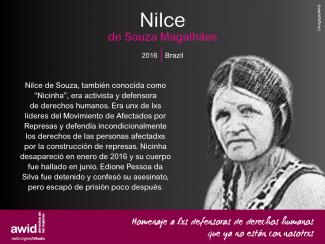
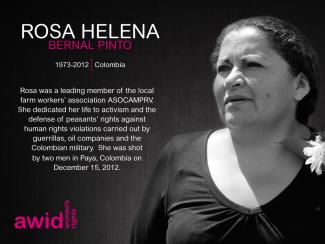
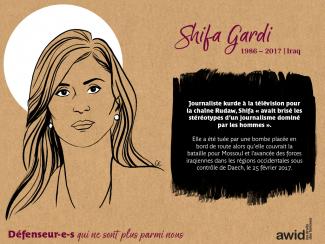
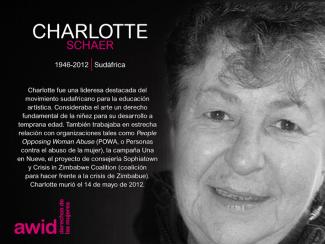
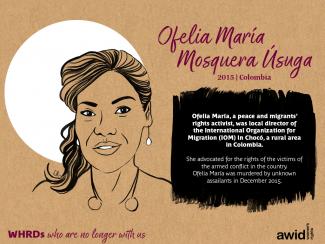
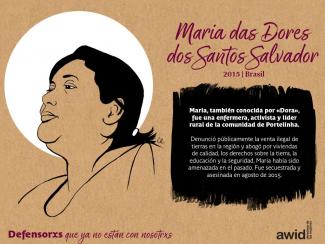
WHRDs are self-identified women and lesbian, bisexual, transgender, queer and intersex (LBTQI) people and others who defend rights and are subject to gender-specific risks and threats due to their human rights work and/or as a direct consequence of their gender identity or sexual orientation.

WHRDs are subject to systematic violence and discrimination due to their identities and unyielding struggles for rights, equality and justice.

The WHRD Program collaborates with international and regional partners as well as the AWID membership to raise awareness about these risks and threats, advocate for feminist and holistic measures of protection and safety, and actively promote a culture of self-care and collective well being in our movements.


Risks and threats targeting WHRDs  

WHRDs are exposed to the same types of risks that all other defenders who defend human rights, communities, and the environment face. However, they are also exposed to gender-based violence and gender-specific risks because they challenge existing gender norms within their communities and societies.

By defending rights, WHRDs are at risk of:

  • Physical assault and death
  • Intimidation and harassment, including in online spaces
  • Judicial harassment and criminalization
  • Burnout

A collaborative, holistic approach to safety

We work collaboratively with international and regional networks and our membership

  • to raise awareness about human rights abuses and violations against WHRDs and the systemic violence and discrimination they experience
  • to strengthen protection mechanisms and ensure more effective and timely responses to WHRDs at risk

We work to promote a holistic approach to protection which includes:

  • emphasizing the importance of self-care and collective well being, and recognizing that what care and wellbeing mean may differ across cultures
  • documenting the violations targeting WHRDs using a feminist intersectional perspective;
  • promoting the social recognition and celebration of the work and resilience of WHRDs ; and
  • building civic spaces that are conducive to dismantling structural inequalities without restrictions or obstacles

Our Actions

We aim to contribute to a safer world for WHRDs, their families and communities. We believe that action for rights and justice should not put WHRDs at risk; it should be appreciated and celebrated.

  • Promoting collaboration and coordination among human rights and women’s rights organizations at the international level to  strengthen  responses concerning safety and wellbeing of WHRDs.

  • Supporting regional networks of WHRDs and their organizations, such as the Mesoamerican Initiative for WHRDs and the WHRD Middle East and North Africa  Coalition, in promoting and strengthening collective action for protection - emphasizing the establishment of solidarity and protection networks, the promotion of self-care, and advocacy and mobilization for the safety of WHRDs;

  • Increasing the visibility and recognition of  WHRDs and their struggles, as well as the risks that they encounter by documenting the attacks that they face, and researching, producing, and disseminating information on their struggles, strategies, and challenges:

  • Mobilizing urgent responses of international solidarity for WHRDs at risk through our international and regional networks, and our active membership.

Related Content

Reason to join 5

Expand your boundaries. AWID members increasingly represent a diverse and vibrant cross-section of feminists working on land rights, workers’ rights, sexual rights and bodily autonomy, among other issues. By joining us as a member, you can connect your struggles across movements.

2008: la Conferencia Internacional de Doha se lleva a cabo con resultados limitados

Conferencia Internacional de Seguimiento sobre la Financiación para el Desarrollo, Doha, Qatar

  • La Conferencia de Doha se propuso examinar la aplicación del Consenso de Monterrey. Retomó las seis áreas de la financiación para el desarrollo, pero los progresos sustantivos alcanzados fueron mínimos.
  • Si bien el Documento Final de Doha fue más allá que el de Monterrey en cuanto a la igualdad de género, tampoco avanzó lo suficiente. En su declaración, el WWG subrayó que los compromisos de la Declaración de Doha en materia de igualdad de género solo tendrán sentido si se abordan decididamente las cuestiones sistemáticas que subyacen a la pobreza y la distribución desigual de poder y recursos en la economía política global.
  • Además de la conferencia central, en Doha se desarrolló un foro paralelo de la sociedad civil organizado por el Doha NGO Group for Financing for Development [Grupo de ONG en Doha por la Financiación para el Desarrollo, DNG en inglés] que exigió cambios estructurales en la economía global, así como políticas que dieran prioridad a los derechos de los pueblos, respetaran y promovieran los derechos humanos.

My Queer Ramadan 

by Amal Amer, California, US

I pray with my family for the first time in six years while wrapped in a keffiyah I scavenged from a dumpster.

Since coming into myself, I have refused to pray in jamaat with my family. Joining in the ranks of hierarchy, “women” behind “men” irks me. It grates my skin and teeth to the degree where I can’t focus, and the standing, bowing, and kneeling feels like a battle against my true being. Each second listening, a betrayal of my nature. Instead, I pray by myself in my own way. 

Yet this Ramadan, I feel different. Back in my childhood home after many years, I am choosing to fast. I choose suhoor with my family, and praying together feels like a natural extension of eating together. After eating, my mother, father, brother and I line up for fajr. 

I pray behind Baba, but my prayer is my own. I close my eyes, staying with my breath and my body. 

My eyes closed, I open my inner sight to a wide open window on a vista of mountains, bright sun spreading over a light mist of clouds. This was the view I had while praying in jamaat at a queer Muslim wedding I attended in the mountains of the South of France last September. 

I lined up with the wedding guests, queer and trans folks of North and West African, Arab, and European descent. Folks of all faiths joined while some chose to stand in respect at the sides or behind. The groups did not fall along fault lines of “Muslim” or “non-Muslim,”  “religious” or “non religious.” The two lovers marrying each led us in prayer, and so did the Muslim woman officiating the nikkah. Each of the three led us in two rounds of prayers, two raqat.

I showed up as I was, my body uncovered. I had not washed. I only passed my camera to a friend who chose to stand at the side. 

In the first sujood, I broke down crying. I wore a jean dress that loves my body, one found at a thrift store my ex-girlfriend pointed me to.

The sobs come through my whole body during the prayer, and I put my head to the earth with my community like a homecoming. A return to the embrace of love both intensely personal and communal, and I am held.

It feels like swimming in the sea with multiple people:  joyful togetherness. But when you go beneath the water, it’s just you and the current. 

Like a dozen people buried in the same graveyard. Separate, but sharing the same soil. Becoming one with the growing earth. 

That was how it felt to pray in communion at a queer Muslim wedding.

I welcomed the light of acceptance while showing up as myself that day, with a group of people who had also chosen to claim all the parts of themselves in love. That light made a home in me, and it illuminates my heart in the dark living room at fajr this Ramadan morning. Though I pray with my birth family who do not accept all of me, I see myself praying in jamaat at that glorious wedding with all of my queer Muslim ancestors, my queer angels, my lineage, my soul family, my queer Muslim family, all standing in prayer. Bowing as one. 

My family’s home does not always feel like my own, though I am here now. I take the bukhoor from room to room, barefoot. Smolder from the censer, an incense that says, “Here I am.” Baraka, blessings from the source of all, Allah and the Goddess to each room in the house, bidding good and dispersing the unbidden. 

As I write this the sky turns the same royal blue I am familiar with from exiting the club and pulling all-nighters. It is the gradient of morning I step into as I go to sleep. 

Word meanings:

  • Ramadan: the Muslim holy month, traditionally observed with 29 days of fasting without food or water during daylight hours

  • Keffiyah: a patterned scarf common in the SWANA region. The black and white version referred to here is associated with the Palestinian liberation movement 

  • Pray in jamaat: Islamic ritual prayer in a group. Participants follow one person, traditionally male, who calls the prayer aloud.

  • Suhoor: the meal before the fast starts at dawn

  • Fajr: the dawn prayer

  • Baba: father

  • Raqat: one round of prayer consisting of standing, bowing, kneeling, and pressing the head to the ground

  • Sujood:the prayer position when one presses one’s head to the earth

  • Nikkah: the religious marriage ceremony 

  • Bukhoor: an Arabic incense, woodchips soaked in resin

  • Baraka: blessing


“Angels go out at night too”

by Chloé Luu (@Electrichildren), France

Pictures of angels in my life, just some women and non-binary people of color hanging out, taking care of themselves and expressing love to each other. It's these simplest moments that are the most empowering.

Chloé Luu (@Electrichildren)


< Freeing the Church, Decolonizing the Bible for West Papuan Women

Kunyit Asam: The Roots of Love and Resilience >

Carol Thomas

Carol Thomas était une pionnière de la défense des droits sexuels et reproductifs des femmes en Afrique du Sud. Gynécologue aguerrie et fondatrice du WomenSpace, elle pratiquait et promouvait des modes de prestation de soins aux femmes non traditionnels, en proposant des soins à la fois de haute qualité, empathiques et accessibles.

« Elle inscrivait cela non seulement dans la joie de la grossesse et des nouveaux bébés, mais également dans les angoisses de la stérilité, des accouchements prématurés et des cancers féminins et dans le déchirement des fausses couches et des mortinaissances. » -Helen Moffett

Carol fonctionnait selon de nouveaux paradigmes, mettant au centre de sa pratique les besoins des femmes ayant le moins d’accès aux services et aux droits dans la société :

« L’environnement socioéconomique dans lequel nous nous trouvons majoritairement implique que les femmes supportent un fardeau disproportionné de maladies et du chômage... En tant que femme noire précédemment désavantagée, je comprends très bien ce qui se passe dans nos communautés. » - Carol Thomas

Son entreprise sociale innovante «iMobiMaMa», s’étant mérité de nombreux prix, prend appui sur les kiosques de téléphonie mobile et la technologie interactive pour connecter directement les femmes avec les services, l’information et le soutien en soins prénataux et de santé sexuelle dans les communautés de toute l’Afrique du Sud.

Carol soutenait les femmes à la fois lors des grossesses désirées et non désirées, et a encadré de nombreux·ses infirmier·ère·s et médecins au cours de sa vie.

On la décrivait également comme la gynécologue chez qui se rendre « pour les trans qui souhaitaient des soins trans affirmatifs. Elle savait y faire lorsque tant d’autres butaient sur les pronoms ou les mots à employer. Ses couvertures chaudes, son écoute attentive et ses mots qui tombaient toujours justes étaient vraiment réconfortants. » - Marion Lynn Stevens

On disait de Carol Thomas qu’elle était au point culminant de sa carrière lorsqu’elle est décédée, le 12 avril 2019, des complications d’une double transplantation pulmonaire.

Les très nombreux hommages qui lui ont été rendus suite à son décès inattendu faisaient mention qu’elle était, entre autres :

« un modèle à suivre, une guerrière, une innovatrice, une leader dynamique, une rebelle, une boule d’énergie, une brillante scientifique, une doctoresse bienveillante ».

Nul doute que Carol Thomas restera dans nos mémoires et que nous lui rendrons hommage pour avoir été tout cela, et bien plus.

Terei a oportunidade de partilhar os meus pensamentos sobre questões que não são abordadas pelas perguntas do inquérito?

Sim, encorajamo-lo a partilhar mais sobre questões importantes para si ao responder à(s) pergunta(s) aberta(s) no final do inquérito.

Snippet FEA Union Otras (ES)

SINDICATO OTRAS

La Organización Sindical de Trabajadoras del Sexo (OTRAS) es el primer sindicato de trabajadoras del sexo de la historia de España. Nació de la necesidad de garantizar los derechos sociales, legales y políticos de las trabajadoras sexuales en un país donde los movimientos de extrema derecha están cada vez más fuertes.

Después de años de luchas contra el sistema legal español y los grupos abolicionistas del trabajo sexual que solicitaron su cierre, OTRAS finalmente obtuvo su estatus legal como sindicato en 2021.

¿Su objetivo? Despenalizar el trabajo sexual y garantizar condiciones y entornos de trabajo dignos para todxs lxs trabajadorxs sexuales.

El sindicato representa a más de 600 trabajadorxs sexualxs, muchxs de lxs cuales son inmigrantes, racializadxs y sexo/genero disidentes.

Our values - bodily autonomy

Autonomía corporal, integridad y libertades

Celebramos el derecho de todas las personas a elegir sus identidades, relaciones, metas, trabajos, sueños y placeres, y lo que hacen con su mente, cuerpo y espíritu. Trabajamos por el acceso a los recursos, a la información, y a ambientes seguros y habilitantes que permitan que esto suceda.

2014: lacement du processus préparatoire de la 3ème Conférence sur le FdD

Lancement du processus préparatoire intergouvernemental de la troisième Conférence sur le financement du développement, octobre 2014

  • Un processus préparatoire, co-facilité par l’ambassadeur guyanais George Wilfred Talbot et l’ambassadeur norvégien Geir O. Pedersen, a été instauré pour mener des discussions préliminaires relatives à la troisième Conférence sur le FdD prévue en juillet 2015 à Addis Abeba, en Éthiopie.
  • Dans le cadre de ces préparations, deux séries de séances de fond informelles ont été organisées au siège  de l’ONU à New York  afin d’apporter des éléments d’information pouvant servir aux sessions de rédaction du futur document final.
  •  À cette occasion, le WWG sur le FdD a été réactivé dans le but d’intégrer les perspectives féministes et de défense des droits des femmes aux discussions et délibérations, avant et pendant la troisième Conférence sur le FdD. À l’heure actuelle, le groupe est co-animé par l’AWID, Development Alternatives with Women for a New Era (DAWN) et la Feminist Task Force (FTF).
  • Le WWG sur le FdD a prononcé deux déclarations  lors de la première série de sessions et présenté un document écrit lors de la seconde. Il a, dans les deux cas, souligné l’invisibilité des inégalités entre les genres dans ce processus préparatoire, tout comme celle de l’inclusion d’autres formes de discrimination et d’inégalité. Le travail du WWG met en lumière les rapports de pouvoir entre les genres et leurs points d’intersection avec d’autres catégories, telles que la race, le handicap, l’appartenance ethnique, l’âge, la richesse et l’identité sexuelle, ce qui accentue la répartition inégale des chances et des ressources dans toutes les sociétés de la planète.
  •  Les organisations de la société civile se sont dites inquiètes de l’étroitesse de l’espace qui leur a été accordé pour prendre part aux deux sessions de fond informelles. Elles ont notamment évoqué le risque que l’espace de participation de la société civile aux négociations portant sur le document final de janvier 2015 ne soit lui aussi limité.

Principes d'engagement

Bienvenue à Crear | Résister | Transform : un festival dédié aux mouvements féministes !

Principes d'engagement

L'AWID s'engage à créer un espace en ligne qui nous invite et nous pousse tou·te·s à faire preuve de courage, de curiosité, de générosité et de responsabilité partagée. 

Nous vous invitons à créer à nos côtés des espaces sans harcèlement ni violence, où chacun·e est respecté·e dans son identité et son expression de genre, sa race, ses capacités, sa classe, sa religion, sa langue, son ethnicité, son âge, sa profession, son type d'éducation, sa sexualité, sa taille et son apparence physique. Des espaces où nous reconnaissons les inégalités de notre monde et où nous nous efforçons de les transformer au gré de nos propres interactions avec les autres.


Nous voulons créer un espace qui permette à tout·te·s :

  • d’être présent·e·s:

Soyez là les un·e·s pour les autres en étant activement à l’écoute. Essayons de nous sentir proches, même si tout est virtuel. Pour cela, vous aurez accès à l’interprétation de la discussion et à des moyens de communications ouverts (comme la boîte de dialogue et autres outils) pour réagir et échanger. Nous vous recommandons de porter des écouteurs ou un casque pendant la séance pour mieux entendre les autres et vous faire entendre. Dans la mesure du possible, essayez de fermer votre messagerie électronique ou toute autre distraction pendant que vous prenez part à la discussion.

  • de valoriser toutes les formes de savoirs:

Célébrons les multiples façons dont le savoir se manifeste dans nos vies. Nous vous invitons à aborder la conversation avec curiosité et ouverture d’esprit pour apprendre des autres, en se permettant de désapprendre et de réapprendre à travers ces  échanges, comme une manièrede commencer à construire collectivement des connaissances.

  • de se sentir accueillie·s: 

Nous nous engageons à adopter une approche holistique de l'accessibilité en tenant compte des différents besoins physiques, linguistiques, mentaux et de sécurité. Nous voulons un espace qui accueille des personnes d'origines, de croyances, de capacités et d'expériences différentes. Nous anticiperons au mieux mais vous demanderons également de nous communiquer vos besoins, et nous ferons de notre mieux pour y répondre.

  • de se sentir en sécurité et respecté·e·s :

Nous nous engageons tou·te·s individuellement et collectivement à respecter la vie privée de chacun·e· et à demander le consentement des autres avant de partager des images ou du contenu qui les concerne,  générés au cours de la conversation.


Créer un environnement sécurisé, respectueux et agréable durant ces conversations est la responsabilité de  tou·te·s .


Signalement

Si vous remarquez qu'une personne a un comportement discriminatoire ou offensant, veuillez contacter la personne de référence qui vous sera indiquée en début de session. 

Tout·e participant·e qui utilisera un langage ou des images abusives sera exclu·e de la conversation et ne sera pas réadmis·e. Nous n’aurons plus de relations avec cette personne de quelque manière que ce soit. 

Janet Benshoof

Janet Benshoof was a human rights lawyer from the United States and an advocate for women’s equality, sexual and reproductive rights.

She campaigned to broaden access to contraceptives and abortions across the world, and battled anti-abortion rulings and in the American territory of Guam. She was arrested in 1990 for opposing her country’s most restrictive abortion law, but won an injunction at the local court in Guam that blocked the law and eventually won at the Ninth Circuit Court of Appeals, striking down the law for good.

“The women in Guam are in a very tragic situation. I never intend to be quiet about that.” - Janet Benshoof for People Magazine

Janet established landmark legal precedents including the US Food and Drug Administrations’ approval of emergency contraception, as well as the application of international law to ensure the rights of rape victims in the Iraqi High Tribunal’s prosecution of Saddam-era war crimes. 

Janet was President and founder of the Global Justice Center, as well as founder of the Center for Reproductive Rights, the world’s first international human rights organization focused on reproductive choice and equality. She served 15 years as Director of the American Civil Liberties Union’s Reproductive Rights Project, where she spearheaded litigation shaping US constitutional law on gender equality, free speech, and reproductive rights.

“Janet was known for her brilliant legal mind, her sharp sense of humor, and for her courage in the face of injustice.” - Anthony D. Romero

Named one of the “100 Most Influential Lawyers in America” by the National Law Journal, Janet was the recipient of numerous awards and honors. 

She was born in May 1947 and passed away in December 2017. 

كيف ستعرضون وتعالجون المعطيات التي ستجمعونها في الاستطلاع؟

سيتم جمع المعطيات لأهداف إحصائية لتسليط الضوء على وضع التمويل للحركات النسوية العالمية وسيتم عرضها فقط بشكل إجمالي. لن تنشر AWID المعلومات عن اي منظمة محددة ولن تعرض أي من المعلومات التي ستمكّن من التعرّف على منظمة عن طريق موقعها أو صفاتها دون موافقة المنظمة.

Snippet FEA Union Otras Photo 4 (FR)

Photo d'un groupe de personnes manifestant la nuit

Membership why page - Angelina Mootoo quote

En rejoignant l’AWID, j’espère pouvoir contribuer à la mobilisation du mouvement féministe. Pas seulement pour les femmes privilégiées, mais pour TOUTES les femmes et activistes féministes..- Angelina Mootoo, féministe intersectionnelle et caribéenne, Guyane/USA

July 2015

Women's Forum on Financing for Gender Equality

  • The Forum took place on 10 July 2015 in Addis Ababa and convened feminists, grassroots women, gender advocates, academics and representatives of women’s rights organizations/networks with specific inputs by UN representatives and other policy makers.
  • The objectives of the Women's Forum were to: share information on the state of play in the latest FfD negotiations; jointly analyze the FfD panorama and follow-up; build a common women’s rights positioning; and strategize on how to meaningfully and substantively engage from a feminist perspective at the Addis FfD Conference.
  • The Women's Forum was organized by the Women's Working Group on FfD, in collaboration with FEMNET, African Women's Development Fund (AWDF) and the Post 2015 Women's Coalition with support from UN Women.
  • Read the Women's Working Group reaction to the Addis Ababa Action Agenda

CSO FfD Forum

  • The CSO FfD Forum took place in Addis Ababa on 11-12 July 2015 and aimed to: inform participating CSOs on the state of play of the official process and coordinate civil society participation in the 3rd FfD Conference; develop a collective CSO Forum Declaration as well as the CSO messages for the FfD Conference Roundtables, the CSO FfD Group-led side events and any other opportunities that might emerge; and plan and organize future areas of CSO engagement on Financing for Development, beyond the 3rd FfD Conference.
  • Read the Declaration from the Addis Ababa Civil Society Forum on Financing for Development
  • For more information, please visit the CSO FfD Group's website or contact the Addis Ababa CSO Coordinating Group (addiscoordinatinggroup@gmail.com).

The Third UN International Conference on Financing for Development

  • The third Conference on Financing For Development took place in Addis Ababa, Ethiopia, from 13-16 July 2015 and focused on: assessing the progress made in the implementation of the 2002 Monterrey Consensus and the 2008 Doha Declaration; addressing new and emerging issues, including in the context of the recent multilateral efforts to promote international development cooperation. Taking into account: the current evolving development cooperation landscape; the interrelationship of all sources of development finance; the synergies between financing objectives across the three dimensions of sustainable development (economic, social and environmental); and the need to support the United Nations development agenda beyond 2015; and reinvigorating and strengthening the financing for development follow-up process.
  • The Addis Ababa Action Agenda was adopted on 15 July 2015 by Heads of State, Governments and High Representatives at the UN.
  • The feeling however from developing countries, CSOs and more specifically women's organisations was that the Addis Ababa Action Agenda failed to meet the target. The Women's Working Group expressed its strong disappointment and demanded structural changes in the global economic governance and development architecture. Read their reaction to the outcome document. Hundreds of civil society organizations and networks from around the world also expressed deep concerns and reservations. Read their response to the outcome document.

Colectivo Morivivi

Colectivo Moriviví is an all women artistic collective. Our artistic production consists of muralism, community-led muralism, and protest performance/actions. Our work is about democratizing art and bringing the narratives of Puerto Rican communities to the public sphere to create spaces in which they are validated. We believe that through artivism we can promote consciousness on social issues and strengthen our collective memory.  

“Cacibajagua” 2017, Mural Project. Jiangxi, China
“Paz para la Mujer” 2015, collaboration with Coordinadora Paz para la Mujer Organization. Santurce,
“Paz para la Mujer” 2015, collaboration with Coordinadora Paz para la Mujer Organization. Santurce, Puerto Rico


“Paz para la Mujer” 2015, collaboration with Coordinadora Paz para la Mujer Organization. Santurce, Puerto Rico
“Paz para la Mujer” 2015, collaboration with Coordinadora Paz para la Mujer Organization. Santurce, Puerto Rico
Collectivo Moriri Artwork


As part of their participation in AWID’s Artist Working Group, Colectivo Morivivi gathered a diverse group of members, partners and staff to facilitate a collaborative process of dreaming into, informing, and deciding on the content for a community mural through a multi-stage co-creation process. The project began with a remote conceptualization with feminists from different parts of the planet brought together by AWID, and then it evolved to its re-contextualization and realization in Puerto Rico. We were honored to have the input of local artists Las Nietas de Nonó(@lasnietasdenono), the participation of local women in the Community Painting Session, the logistics support from the Municipality of Caguas, and FRIDA Young Feminist Fund’s additional support to the collective.
 
The mural explores the transcendence of borders by presenting bodies like a map, in an embrace that highlights the intersection of the different feminist manifestations, practices and realities. 
 
We also thank Kelvin Rodríguez, who documented and captured the different stages of this project in Puerto Rico:

Collectivo Moriri Artwork

About Colectivo Morivivi 

Colectivo Morivivi portrait

Moriviví is a collective of young female artists, working on public art since April 2013. Based in Puerto Rico, we’ve gained recognition for the creation of murals and community led arts.

The group started out in local Urban Art Festivals. As our work became more popular, organizations and community leadership started to reach out to us. We began as eight high schoolers who wanted to paint a mural together. However, in eight years of hard work, we’ve faced many challenges.  Now we are in a period of transition. During this following year, we aim to restructure the collective internally. Our goal is to open new opportunities for collaborators and back-up our decision making process with a new evaluation system.  In the long run, we aspire to become an alternative school of art practice for those interested in immersing themselves in community art production.

Juli Dugdale

Juli Dugdale fue una feminista australiana que practicaba un liderazgo intergeneracional arraigado en los principios del feminismo, la inclusión y la igualdad. Fue líder, colega y mentora para muchas mujeres, especialmente, para las mujeres jóvenes de todo el mundo.

Juli fue una integrante comprometida del equipo del movimiento Young Women's Christian Association [Asociación Cristiana de Mujeres Jóvenes] (YWCA, por su siglas en inglés), una voluntaria y una ferviente defensora del liderazgo de las mujeres jóvenes por más de 30 años.

Se convirtió en un vínculo fuerte entre el movimiento australiano y la Oficina de la YWCA Mundial. Su confianza en la capacidad de liderazgo de las mujeres jóvenes llevó a establecer una asociación de varios años con el Departamento de Asuntos Exteriores y Comercio de Australia y a la creación del manual Rise Up (Rebélate), una guía global para el liderazgo transformador de las mujeres jóvenes, lanzada en 2018.

Juli falleció en Ginebra el 12 de agosto de 2019.


Tributos:

"Para quienes llegaron a trabajar con Juli, fue un privilegio.  Quienes no lo hicieron,  pueden tener la certeza de que su legado continúa en el trabajo que hacemos cada día y en la misión del movimiento de la YWCA". - YWCA Australia

"Juli Dugdale siempre ocupará un lugar profundo en el corazón de muchas personas en el movimiento de la YWCA, especialmente aquí, en Aotearoa, y a través del Pacífico. Juli tenía una relación especial con el Pacífico y fue un apoyo increíble para las mujeres jóvenes de allí. Ella era humilde, amable, cariñosa, dedicada, apasionada y tenía un corazón generoso. Ella encarnó la visión de la YWCA de "liderazgo transformador" con una extraordinaria visión y previsión de futuro, y ayudó a empoderar a generaciones de mujeres jóvenes líderes de todo el mundo". - YWCA Nueva Zelanda

Сколько ответов на опрос вы хотели бы получить?

Мы стремимся в общей сложности получить 2000 ответов, что почти вдвое больше, чем в последнем опросе, проведенном в 2011 году.