Human Rights Council (HRC)
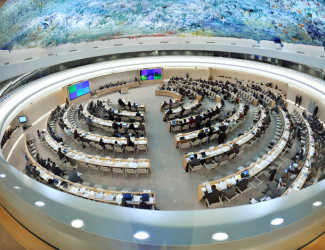
The Human Rights Council (HRC) is the key intergovernmental body within the United Nations system responsible for the promotion and protection of all human rights around the globe. It holds three regular sessions a year: in March, June and September. The Office of the UN High Commissioner for Human Rights (OHCHR) is the secretariat for the HRC.
The HRC works by:
-
Debating and passing resolutions on global human rights issues and human rights situations in particular countries
-
Examining complaints from victims of human rights violations or activist organizations on behalf of victims of human rights violations
-
Appointing independent experts (known as “Special Procedures”) to review human rights violations in specific countries and examine and further global human rights issues
-
Engaging in discussions with experts and governments on human rights issues
-
Assessing the human rights records of all UN Member States every four and a half years through the Universal Periodic Review
AWID works with feminist, progressive and human rights partners to share key knowledge, convene civil society dialogues and events, and influence negotiations and outcomes of the session.
With our partners, our work will:
◾️ Raise awareness of the findings of the 2017 and 2021 OURs Trends Reports.
◾️Support the work of feminist UN experts in the face of backlash and pressure
◾️Advocate for state accountability
◾️ Work with feminist movements and civil society organizations to advance rights related to gender and sexuality.
Related Content
Snippet FEA Principles of Work S4 (EN)

HORIZONTALITY
Moushmi Narain
“Where is the Money for Women’s Rights?" AWID’s WITM Toolkit (landing page intro)
A new edition of the Where is the Money? research is underway.
Learn more.A Do-it-Yourself Research Methodology
AWID offers the WITM Toolkit to support individuals and organizations who want to conduct their own research on funding trends for a particular region, issue or population by adapting AWID’s research methodology.
AWID’s WITM Toolkit builds on 10 years research experience. AWID’s WITM research and WITM Toolkit is a political and practical demonstration of the resources and steps it takes to conduct solid action-research.
Learn more about the context around the WITM research methodology
The Resourcing Feminist Movements team also offers technical and political support before and during the research process. Review the toolkit and contact us at fundher@awid.org if you need more information.
Snippet - WITM Start the survey 1 - EN
![]()
The survey is available in: Arabic, English, French, Portuguese, Russian and Spanish!
Leyla Yıldızhan (Deniz Fırat)
Snippet FEA No feminist economies without feminist unions (ES)
¡No hay economías feministas sin sindicatos feministas!
A través de la organización laboral y sindical, Sopo, Sabrina y Linda no solo luchan por los derechos de lxs mujeres, lxs trabajadorxs esenciales, lxs trabajadorxs migrantes y lxs trabajadores sexuales, sino por los derechos de todxs lxs trabajadorxs.
La lucha para acabar con la explotación de lxs trabajadores es una lucha feminista, y nos muestra que no hay economías feministas sin sindicatos feministas.
Matilde Lindo Crisanto
FRMag - Las Triple (ES)
Las Triple Cripples: ¡hablemos de sexo, nena!
por Nandini Tanya Lallmon
Olajumoke «Jay» Abdullahi y Kym Oliver son feministas revolucionarias en más de un sentido. (...)
arte: «Bloomed» [En flor], de Titash Sen >
Snippet - WITM about research - ES
Acerca de la investigación ¿Dónde está el dinero?
La encuesta mundial ¿Dónde está el dinero? es un pilar fundamental de la tercera edición de nuestra investigación orientada a la acción: ¿Dónde está el dinero para las organizaciones feministas? (abreviadamente, ¿Dónde está el dinero? y WITM). Los resultados de la encuesta se desarrollarán y analizarán en mayor profundidad mediante conversaciones exhaustivas con activistas y donantes, y se contrastarán con otros análisis e investigaciones disponibles acerca del estado del financiamiento para las organizaciones feministas y por la igualdad de género en todo el mundo.
El informe completo ¿Dónde está el dinero para las organizaciones feministas? se publicará en 2026.
Para conocer más información acerca de cómo AWID ha arrojado luz sobre el dinero destinado en favor y en contra de los movimientos feministas, consulta nuestra historia ¿Dónde está el dinero? y nuestros informes anteriores aquí.
Rapport Annuel 2011

Chaque programme comporte plusieurs volets, y compris le développement et la diffusion de connaissances, la recherche-action, les plaidoyers, l’établissement d’alliances et l’organisation de dialogues stratégiques.
Notre Rapport Annuel 2011 vous proposent un sommaire des principales réalisations pendant l'année, dans le cadre de chacune des programmes de l’AWID.
Jennifer López
Snippet FEA We are living in a world left (FR)
Nous vivons dans un monde où la destruction de la Nature alimente notre économie mondiale actuelle.
Natalia Estemirova
FRMag - Roots of Love and Resilience
Kunyit Asam : Les racines de l’amour et de la résilience
par Prinka Saraswati
Les cycles menstruels sont généralement d’une durée de 27 à 30 jours. Pendant cette période, les règles elles-mêmes ne durent que 5 à 7 jours. L’épuisement, les sautes d’humeur et les crampes sont le résultat de l’inflammation qui se produit alors. (...)
< illustration : « Mouvement féministe », Karina Tungari
What is the purpose of the WITM survey?
The key objective of the WITM survey is to shine light on the financial status of diverse feminist, women’s rights, gender justice, LBTQI+ and allied movements globally. Based on this, we hope to further strengthen the case for moving more and better money, as well as shift power, to feminist movements.
AWID in 2016: Co-Creating Feminist Futures
AWID is pleased to share our 2016 Annual Report.

2016 was an incredible year for AWID, we convened the 13th International AWID Forum in Bahia, Brazil, a space for strategizing and alliance building with feminists and other justice movements, which was attended by over 1800 participants from 120 countries and territories across the globe.
We know that women’s rights and feminist movements are key actors in creating sustainable transformative change. Within our movements, organizing, resisting and responding to the challenging context is sharpening, and in our increasingly connected world, the potential for collective action across diverse movements has dramatically grown.
This is the crucial work that AWID seeks to amplify and support every day.
What we achieved in 2016
We expanded solidarity and joint action across diverse movements
A highlight of 2016 was our ground-breaking 13th International Forum with the theme: “Feminist Futures: Building Collective Power for Rights and Justice”, where we harnessed the thinking and energy of nearly 500 partners, presenters, panelists, moderators, artivists, writers, facilitators, IT innovators, and performers, many of them leaders in their movements. We also supported the convening of the first and historical Black Feminisms Forum (BFF) organised by a working group of Black Feminists from across the world.
We strengthened knowledge of issues and strategies
- On challenging corporate power - we produced ‘Challenging corporate power: Struggles for women’s rights, economic and gender justice’ with the Solidarity Center, revealing the scale and scope of corporate power and outlining how corporations in collusion with elites and other powerful actors, are impacting the lives of women and oppressed peoples.
- On feminist economies - we released ‘Feminist Propositions for a Just Economy’ with the Center for Women’s Global Leadership (CWGL) and the African Women’s Development and Communication Network FEMNET.
- On Young Feminist Activism - we published ‘Brave, Creative, Resilient: The Global State of Young Feminist Organizing’, a young feminist mapping project.
We contributed to collective advocacy
AWID, in partnership with other feminist and women’s rights organisations, engaged in advocacy and dialogue to explore better solutions for women’s rights agendas including our work with the Count Me In! consortium .
We increased the visibility of movements
The experiences of women with disabilities, Black and Afro-descendant women, sex workers, Indigenous women, trans and intersex people, domestic workers and how their lives are impacted by multiple oppressions and violence were placed front and center of the Forum process.
We also launched the 2016 WHRD Tribute to commemorate defenders who are no longer with us, during the 16 Days of activism, and thanks to the contributions from our members,
We drove attention to groups and issues that do not usually receive adequate mainstream media coverage through our partnership with The Guardian and Mama Cash.
Our members