



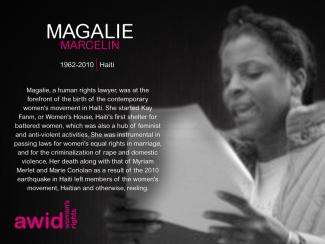
Magalie Marcelin
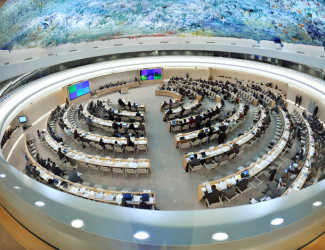
The Human Rights Council (HRC) is the key intergovernmental body within the United Nations system responsible for the promotion and protection of all human rights around the globe. It holds three regular sessions a year: in March, June and September. The Office of the UN High Commissioner for Human Rights (OHCHR) is the secretariat for the HRC.
Debating and passing resolutions on global human rights issues and human rights situations in particular countries
Examining complaints from victims of human rights violations or activist organizations on behalf of victims of human rights violations
Appointing independent experts (known as “Special Procedures”) to review human rights violations in specific countries and examine and further global human rights issues
Engaging in discussions with experts and governments on human rights issues
Assessing the human rights records of all UN Member States every four and a half years through the Universal Periodic Review
AWID works with feminist, progressive and human rights partners to share key knowledge, convene civil society dialogues and events, and influence negotiations and outcomes of the session.
Nous sommes ravis de partager notre nouveau Plan stratégique (2023-2027) avec tout le monde. Bien tôt, AWID fera une annonce pour informer notre communauté et nos membres.
L’Association pour les droits des femmes dans le développement (AWID) est une organisation féministe, associative et internationale de soutien aux mouvements.
Depuis plus de 35 ans, l’AWID fait partie d’un incroyable écosystème des mouvements féministes qui oeuvrent en faveur de la justice de genre et des droits humains des femmes à travers le monde.
L’AWID imagine un monde où les réalités féministes prospèrent, où les ressources et le pouvoir sont partagés de façon à permettre à chacun-e, y compris aux générations futures, de s’épanouir et de réaliser leur plein potentiel dans la dignité, l’amour et le respect et où la Terre nourrit la vie dans toute sa diversité.
Notre mission est d’aider les mouvements féministes, en faveur des droits des femmes et de la justice de genre à s’épanouir, à être un élément moteur de l’opposition aux systèmes d’oppression et à co-créer des réalités féministes.
Nous promouvons notre travail au travers des stratégies suivantes:
Nous tirons collectivement parti de notre portée, de notre pouvoir, de nos ressources et de nos relations afin d’influencer stratégiquement les politiques et les pratiques. Nous visons à promouvoir les programmes féministes à travers les collaborations que nous menons avec les décideurs politiques, les fonda-trices-teurs et les activistes au sein des espaces régionaux et internationaux. Dans le cadre des efforts que nous déployons pour renforcer notre pouvoir et influence collectifs, nous incitons également les mouvements féministes et de lutte pour les droits des femmes à accorder une place centrale aux mouvements historiquement opprimés.
Nous nous servons de notre pouvoir mobilisateur pour faciliter le dialogue et élaborer des stratégies sur des questions clés. Nous connectons nos membres et nos allié-e-s les une-s- aux autres, et partageons et échangeons nos ressources, nos idées et nos actions sur des questions pertinentes. Nous organisons des rassemblements et mettons à disposition des espaces nous permettant de consolider nos mouvements et de nouer des rapports les un-e-s avec les autres, d’imaginer et d’envisager de nouveaux horizons, de développer des stratégies d’influence efficaces et de créer ensemble des programmes et des processus importants.
Nous mobilisons nos membres et les mouvements que nous soutenons pour consolider l’action collective en solidarité avec les causes et les défenseur-e-s féministes en danger. Nous créons des partenariats, pratiquons l’écoute active et tissons des liens de solidarité continus et sur le long terme. Aux côtés de défenseur-e-s, nous oeuvrons à établir une base de connaissances et à soutenir des réseaux de solidarité autour de la protection et du bien-être.
Nous reconnaissons la valeur unique des stratégies culturelles et créatives dans la lutte contre les oppressions et l’injustice. Nous travaillons avec des artistes qui accordent une place prépondérante aux voix féministes et aux récits des communautés historiquement opprimées. Nous voyons en cette tactique émergente l’art et l’expression créative comme autant de moyens nous permettant d’imaginer un monde où l’on continue de célébrer des réalités féministes, et où ces dernières continuent de prospérer.
Nos initiatives oeuvrent à l’intersection des zones de changement que nous abordons, des mouvements que nous priorisons et des stratégies que nous déployons:
Nous surveillons, documentons et visibilisons la façon dont les acteurs anti-droits opèrent et conspirent au sein des espaces multilatéraux, et soutenons les mouvements et allié-e-s féministes, oeuvrant en faveur des droits des femmes et de la justice de genre pour contrer leur influence et leur impact.
En travaillant sur l’extractivisme, la justice fiscale et la responsabilisation des entreprises, nous acquérons des connaissances sur le pouvoir des entreprises et leur influence; nous plaidons pour la responsabilisation des entreprises et la distribution équitable des richesses; et amplifions les propositions féministes en faveur d’économies plus justes.
Nous développons des analyses accessibles et orientées vers l’action concernant l’état des ressources attribuées aux mouvements féministes. Nous nous efforçons d’influencer les pratiques et politiques des donateurs, d’approfondir et maintenir les subventions en faveur de changements sociaux féministes et de soutenir les besoins et les stratégies des mouvements.
L’AWID s’engage expressément à avoir de l’impact dans le monde et à renforcer nos propres résiliences et apprentissages organisationnels afin de consolider davantage les mouvements féministes internationaux.
Sans le généreux soutien et le financement de nos donateur-e-s, notre travail ne serait pas possible.
Articulate feminist visions, proposals and agendas for resourcing justice.
Nous vivons dans un monde où la destruction de la Nature alimente notre économie mondiale actuelle. |
Même en période de crise climatique, les gouvernements continuent d'encourager les industries agricoles à grande échelle à se développer. Ces activités empoisonnent la terre, menacent la biodiversité et détruisent la production alimentaire et les moyens de subsistance locaux. Pendant ce temps, alors que les femmes produisent la majorité de la nourriture dans le monde, elles ne possèdent presque aucune terre. |
|
Et si nous percevions la terre et la Nature non pas comme une propriété privée à exploiter, mais comme une totalité avec laquelle vivre, apprendre et coexister harmonieusement ? Et si nous réparions nos relations avec la terre et adoptions des alternatives plus durables qui nourrissent à la fois la planète et ses communautés? Nous Sommes la Solution (NSS) est l'un des nombreux mouvements dirigés par des femmes qui s'efforcent d'atteindre cet objectif. Voici leur histoire. |
|

In 2002 AWID celebrated its 20th anniversary. Given the challenging political, economic and funding environment in which women's organizations must survive, a milestone such as this is worthy of recognition.
In the past two decades the geo-political landscape has been transformed and development theories have come and gone, but approaches to ensure women benefit from development processes have endured.
In its twenty-year history, AWID grew from a volunteer organization for U.S. "Women in Development" (WID) specialists to an international network striving to support proactive and strategic gender equality research, activism and policy dialogue.
On the occasion of its 20th anniversary, this paper charts not only the changes in AWID's organizational structure and goals but also the shifts in policy approaches to gender equality in a changing global environment, through the lens of a membership organization committed to improving the lives of women and girls everywhere.
Les groupes, organisations et mouvements qui travaillent spécifiquement, ou principalement, à la défense des droits des femmes et des filles, pour la justice de genre, pour la défense des droits des personnes LBTQI+ et des allié·es dans toutes les régions et à tous les niveaux, que ces structures soient récentes ou non.
AGROÉCOLOGIE ET SOUVERAINETÉ ALIMENTAIRE EN TANT QUE RÉSISTANCE |
Aujourd'hui, la production alimentaire industrielle à grande échelle utilise des plantations à culture unique, des organismes génétiquement modifiés et d'autres pesticides qui détruisent la terre et les connaissances des communautés locales. |
L'agroécologie est une résistance à l'agriculture hyper-industrialisée qu’utilisent les multinationales. L'agroécologie donne la priorité à l'agriculture à plus petite échelle, aux cultures multiples et à la production alimentaire diversifiée, tout en centrant les connaissances et pratiques traditionnelles locales. L'agroécologie va de pair avec les revendications de souveraineté alimentaire, ou le "droit des peuples à une alimentation saine et culturellement appropriée produite par des méthodes écologiquement rationnelles et durables, et leur droit de définir leurs propres systèmes alimentaires et agricoles" (Via Campesina, Déclaration de Nyéléni).
Le rôle des femmes, des communautés indigènes et rurales et des personnes racialisées des pays du Sud Global est essentiel dans la préservation des systèmes alimentaires.
Les agroécologistes féministes s'efforcent aussi de démanteler les rôles de genre oppressifs et les systèmes patriarcaux intégrés à la production alimentaire. Comme le montrent les héroïnes de Nous Sommes la Solution, elles génèrent une agroécologie libératrice en renforçant la résilience des communautés, en autonomisant les femmes paysannes et agricultrices tout en en préservant les traditions locales, les territoires et les connaissances des communautés productrices de nourriture.
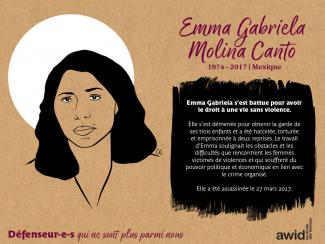
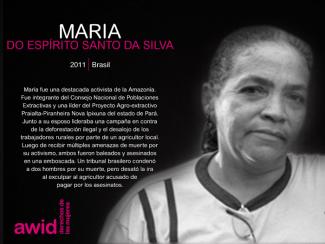
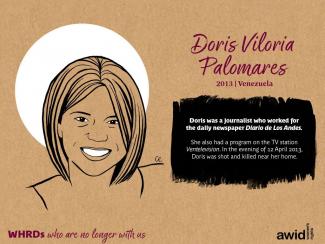
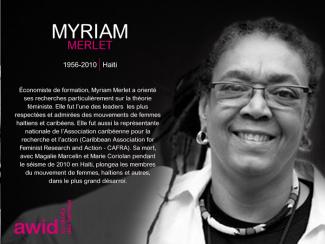
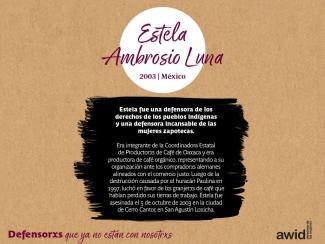
Estas defensoras lucharon por los derechos sobre la tierra, de las mujeres y de los pueblos indígenas; haciendo frente a las industrias extractivas, escribiendo poesía y promoviendo el amor. Una de ellas desapareció hace ya 19 años. Únete a nosotras para recordar y honrar a estas defensoras de derechos humanos, su trabajo y su legado, compartiendo los memes aquí incluidos; y tuiteando las etiquetas #WHRDTribute y #16Días.
Por favor, haz click en cada imagen de abajo para ver una versión más grande y para descargar como un archivo.


External funding includes grants and other forms of funding from philanthropic foundations, governments, bilateral, multilateral or corporate funders and individual donors – from both within your country or abroad. It excludes resources that groups, organizations and/or movements generate autonomously such as, for example, membership fees, the voluntary contributions of staff, members and/or supporters, community fundraisers, venue hires or sale of services. For ease and clarity, definitions of the different types of funding as well as short descriptions of different donors are included in the survey.
Nous Sommes la Solution uplifts and grows the leadership of rural women working towards African solutions for food sovereignty.
These transgender women were murdered because of their activism and their gender identity. There are insufficient laws recognizing trans* rights, and even where these laws exist, very little is being done to safeguard the rights of trans* people. Please join AWID in honoring these defenders, their activism and legacy by sharing the memes below with your colleagues, networks and friends and by using the hashtags #WHRDTribute and #16Days.
Please click on each image below to see a larger version and download as a file


