Confronting Extractivism & Corporate Power

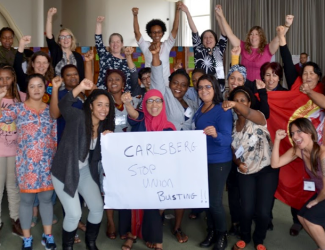
Women human rights defenders (WHRDs) worldwide defend their lands, livelihoods and communities from extractive industries and corporate power. They stand against powerful economic and political interests driving land theft, displacement of communities, loss of livelihoods, and environmental degradation.


Why resist extractive industries?

Extractivism is an economic and political model of development that commodifies nature and prioritizes profit over human rights and the environment. Rooted in colonial history, it reinforces social and economic inequalities locally and globally. Often, Black, rural and Indigenous women are the most affected by extractivism, and are largely excluded from decision-making. Defying these patriarchal and neo-colonial forces, women rise in defense of rights, lands, people and nature.

Critical risks and gender-specific violence

WHRDs confronting extractive industries experience a range of risks, threats and violations, including criminalization, stigmatization, violence and intimidation.  Their stories reveal a strong aspect of gendered and sexualized violence. Perpetrators include state and local authorities, corporations, police, military, paramilitary and private security forces, and at times their own communities.

Acting together

AWID and the Women Human Rights Defenders International Coalition (WHRD-IC) are pleased to announce “Women Human Rights Defenders Confronting Extractivism and Corporate Power”; a cross-regional research project documenting the lived experiences of WHRDs from Asia, Africa and Latin America.

We encourage activists, members of social movements, organized civil society, donors and policy makers to read and use these products for advocacy, education and inspiration.

Share your experience and questions!

Tell us how you are using the resources on WHRDs Confronting extractivism and corporate power.

◾️ How can these resources support your activism and advocacy?

◾️ What additional information or knowledge do you need to make the best use of these resources?

Share your feedback


Thank you!

AWID acknowledges with gratitude the invaluable input of every Woman Human Rights Defender who participated in this project. This project was made possible thanks to your willingness to generously and openly share your experiences and learnings. Your courage, creativity and resilience is an inspiration for us all. Thank you!

Related Content

Promouvoir la santé pour tous et toutes

Promouvoir la santé pour tous et toutes

Actif dans le secteur sans but lucratif, Isaac Oriafo Ejakhegbe, membre de l'AWID depuis juin 2015, concentre son travail sur l’égalité de genre, le changement climatique, la promotion de la santé et la santé des femmes et des enfants. Il est un jeune leader de l’initiative Women Deliver et travaille actuellement pour le Women’s Health and Action Research Centre (Centre de recherche et d’action pour la santé des femmes), une organisation non gouvernementale établie au Nigeria qui œuvre au service de la santé reproductive des femmes et de leur bien-être social.


Fondateur de l’initiative Youth Spotlight (Coup de projecteur sur la jeunesse), Isaac s’engage également à promouvoir la santé et les droits reproductifs et sexuels des jeunes. En outre, il aborde les enjeux relatifs à l’infection par le VIH.

Isaac a étudié en sciences sociales appliquées en santé à la School of Public Health de l’University of Ghana, où il a obtenu les meilleures notes de sa promotion. Sa thèse portait sur l'égalité de genre, l'autonomisation des femmes et l'usage de la contraception dans la région occidentale du Ghana.

Après avoir obtenu son diplôme, Isaac s’est porté volontaire comme éducateur pour les pairs auprès du Fonds des Nations Unies pour l’enfance (UNICEF), dans le cadre du projet national Reproductive Health HIV and AIDS Prevention and Care (La santé reproductive, la prévention et les soins liés au VIH et au SIDA) dans le Nord du Nigeria. Il est ensuite devenu chargé de programme de l'Initiative for the Rehabilitation and Care for HIV and AIDS (Initiative pour la réadaptation et les soins aux personnes porteuses du VIH et atteintes du SIDA). Il a également participé à plusieurs projets auprès des travailleurs et travailleuses du sexe.

Le renforcement des capacités et du leadership des femmes et des jeunes est un facteur clé pour libérer le potentiel des Objectifs de développement durable (ODD).

Un volet de son travail en promotion de la santé implique une participation communautaire directe. En tant qu’agent de santé communautaire à la Joy Maternity Clinic dans l’État d’Edo au Nigéria, Isaac s’est concentré sur l’offre active d’éducation en matière de santé et de soutien social à l’intention des membres de la communauté. Au même moment, il s’est inscrit à un programme en ligne, obtenant un Clinical Research and Public Health Certificate (Certificat en santé publique et recherche clinique) de la Harvard School of Public Health et un Certificat en  Challenges of Global Poverty (Les défis de la pauvreté mondiale) du Massachusetts Institute of Technology.

Pour atteindre leur objectif, les politiques liées à l’environnement et au climat doivent être holistiques : il faut réduire les émissions de dioxyde de carbone, de méthane et d’autres gaz à effet de serre, tout en promouvant des environnements plus sains, ces deux stratégies favorisant une santé durable pour tous et toutes. 

Isaac aime rédiger des articles et des blogues sur les questions entourant la santé et le changement climatique. À l’approche de la Conférence des Nations Unies sur les changements climatiques COP 21, il a écrit un article (en anglais) pour The Lancet Global Health dans lequel il souligne les incidences d’un environnement malsain sur la santé.


Apprenez à mieux connaître Isaac !

Vous pouvez entrer en contact avec lui en consultant le répertoire en ligne des membres de l’AWID (uniquement accessible aux membres) ou en envoyant un courriel à membership@awid.org. Vous pouvez également suivre ses tweets sur @wisenobleman.

Feminine Life and Disability: Fighting against the discrimination in Senegal

Feminine Life and Disability: Fighting against the discrimination in Senegal

The organization Vie Féminine et Handicap (Feminine Life and Disability) became an AWID member in 2008 “to better defend our ideas, to better promote awareness of the discrimination faced by women living with disability in Africa, and to increase visibility of our work,” says President of the organization, Ndoya Kane. 


Considering the specific needs of women living with disability

Launched in 2008, the mission of Vie Féminine et Handicap is to fight against poverty among women living with disability in Senegal and globally, but especially across the African continent. With a vision where disability is no longer a barrier to a woman’s dignity or well-being, the main objectives of the organization are to combat poverty, sexually transmitted infections, and AIDS among women living with disability, while strengthening their access to new information technologies.    

Vie Féminine et Handicap was created to address the issues of disabled women from a perspective that considers their specific needs, related to both their status as a woman and as a person living with a disability – and to ensure that their economic situation evolves in a positive way and to better sensitize society to disability issues without the negative prejudice. 

Comprised of some fifteen members and working mainly across the Pikine and Guédiawaye departments in the Dakar region, the work of Vie Féminine et Handicap includes awareness raising and training for women living with disability, as well as advocacy with decision-makers around the human rights of women living with disability, their economic empowerment, and their sexual and reproductive health. “We do awareness raising on the issue of disability in neighbourhoods by inviting community authorities, youth and ‘able-bodied’ people, because disability is surrounded by a lot of negative prejudice in the Senegalese and African context in general. We also participate in conferences at the African and International level to discuss the situation of disabled women in Africa and around the world to better align our strategies,” highlights Kane. 

 “Without solidarity, without an understanding that the fight that we lead is not done in the interest of a sole disabled people’s organization, but in the interest of all, we will never achieve any results. Each disabled people’s organization to understand that the fight that we lead outweighs the competition and that we have to go forward together to succeed in getting long lasting results,” explained Ndoya Kane in 2010, in a repport produced by AWID

Pooling resources and the self-financing of members

Since February 2010, the organization has established a self-financing fund, which consists of pooling member contributions to allow each one to finance small personal projects and to initiate income-generating activities for its members, mainly focused on small business. The idea to create the fund originated from our members themselves, a vulnerable group with limited economic resources and for which access to credit is nearly impossible.

The Fund for example allowed Marétou Diop, a resident of Guédiawaye, to open a shop in her neighbourhood market and sell foodstuffs. “Now the other women are joining our self-financing fund to receive credit and finance their activities,” highlights Ndoya Kane.  

“Group discussions are even more important as they give us the opportunity to meet among women living with disability and build confidence in some to comfortably talk about the issues they face as women. Together we decide which challenges exist and try to engage specialists in addressing the issue,” says Kane.    

Source
AWID